

The Silent Witnesses: How Human Conflict Is Destroying Life Beyond Borders
A powerful, perspective-shifting exploration of global conflict through the eyes of migratory species. This article reveals how war, pollution, sonar disruption, and environmental destruction are not confined to human borders but are reshaping ecosystems across the planet. From oil-contaminated seas to landmine-scarred landscapes, discover how human self-destruction is quietly becoming all-life destruction, affecting migration routes, biodiversity, and the future of Earth’s interconnected systems.
ENVIRONMENTHARSH REALITYAWARE/VIGILANT
Shiv Singh Rajput | Kim Shin
3/28/20266 min read
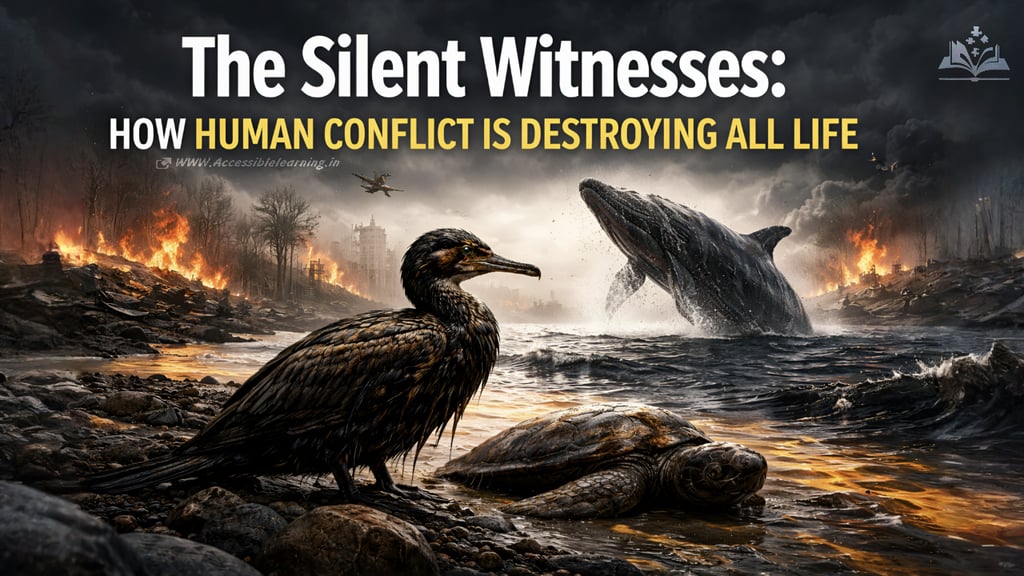
There are no borders in the sky. No fences in the sea. No passports stamped in the wind.
For migratory beings, the Earth is not divided into nations but stitched together by seasons, currents, and instinct. Routes older than language guide them. Paths memorized not by maps, but by survival. Yet something has changed. The routes remain, but the world beneath them is no longer whole.
This is not a human story. It only becomes one when we realize we are not the only ones living it.
The World in 2026: What the Witnesses Are Experiencing
From above and below, the present moment is not abstract. It is physical, measurable, and increasingly hostile.
1. The Red Sea and Expanding Oil Scars
A whale passing through the Red Sea today does not encounter just currents and prey. It encounters residue.
Ongoing instability in the region has increased risks to shipping lanes. Tanker incidents, illegal discharges, and conflict-related disruptions have contributed to localized oil contamination. Even when spills are not catastrophic enough to dominate headlines, smaller leaks accumulate.
For marine life, this means:
Toxic hydrocarbons entering food chains
Damage to plankton populations, the base of ocean ecosystems
Long-term contamination of breeding zones
Oil does not respect timeframes. It lingers in sediments, quietly reshaping entire marine systems.
2. Sonar, Naval Build-Up, and Ocean Noise Pollution
Global military activity has intensified in key maritime corridors. Naval exercises, submarine tracking, and surveillance systems rely heavily on sonar.
For whales and dolphins, this is not background noise. It is disorientation.
High-intensity sonar can cause internal injuries and mass strandings
Chronic noise disrupts communication over hundreds of kilometers
Migration routes are being rerouted to avoid “acoustic danger zones."
In recent years, unusual whale strandings across parts of Asia, Europe, and North America have been linked, in part, to these disturbances. The ocean is no longer just polluted chemically. It is polluted acoustically.
3. War-Torn Landscapes and Landmine Ecosystems
A migratory bird crossing parts of Eastern Europe, the Middle East, or regions of Africa encounters landscapes altered in ways that are not immediately visible from the sky.
Landmines remain active long after conflicts slow down or shift.
Millions of unexploded mines persist globally
Grasslands and forests become inaccessible to grazing animals
Soil degradation increases due to lack of natural movement and biodiversity
For birds, these areas may still appear usable. But the ecosystems beneath are broken. Food chains collapse quietly. Conflict zones do not just kill in the moment. They sterilize land over decades.
4. Burning Forests and Collapsing Stopover Points
Migratory species depend on precise stopover points to rest and refuel. These locations are disappearing.
Recent years have seen:
Increased wildfires across regions of North America, Southern Europe, and parts of Asia
Forest clearing linked to both conflict and economic instability
Agricultural expansion into critical wetland habitats
For a bird traveling thousands of kilometers, the loss of even one stopover site can mean exhaustion, failed migration, or death. Migration is not flexible. It is calibrated. And that calibration is being disrupted.
5. Climate Stress Amplifying Conflict Damage
Climate change is not separate from conflict. It amplifies it.
Droughts increase resource scarcity, fueling tensions
Floods displace both humans and wildlife simultaneously
Changing temperatures alter migration timing, causing mismatches with food availability
For migratory species, this creates a layered crisis:
A route that is already dangerous due to human conflict becomes even more unstable due to environmental shifts.
The margin for survival shrinks from both sides.

Dead Zones, Not Frontlines
Humans speak of conflict in terms of territories and power. But for non-human life, the language is simpler: safe or unsafe, alive or dying. A war zone is not defined by ideology. It is defined by absence.
Coral reefs stressed by warming are further damaged by oil contamination
Rivers diverted or polluted during conflict no longer support aquatic life
Agricultural chemicals, often overused during instability, create toxic runoff
These are not temporary disruptions. They are system failures.
The Data Behind the Silence
The patterns observed by these “silent witnesses” are increasingly supported by global research:
Migratory bird populations have declined significantly over the past few decades due to habitat loss and environmental stress
Marine biodiversity is under pressure from combined factors of overfishing, pollution, and noise disruption
Over 60% of ecosystems globally are degraded or used unsustainably
These are not projections. They are ongoing realities.
The Illusion of Contained Damage
Human conflict is often framed as localized. But the effects travel.
Oil spills drift across national boundaries
Air pollution from conflict zones circulates globally
Ocean noise spreads far beyond its source
From a migratory perspective, there is no such thing as a contained crisis. Every disruption connects.
The Passenger List We Ignore
If a bird could speak, it would not ask who controls a border. It would ask why the wetlands are gone. If a whale could question us, it would not ask about strategy. It would ask why the ocean has become harder to navigate.
The truth is direct:
Human self-destruction is not isolated. It is shared.
We are not removing ourselves from stability. We are removing stability itself.
Witness Without Judgment
Non-human life does not assign blame. It responds.
It reroutes
It adapts
It disappears
But adaptation is reaching its limits.
Routes cannot shift endlessly. Ecosystems cannot regenerate under constant stress. There comes a threshold where life simply does not return.
The Quiet Signals of a Changing Planet
The warnings are not dramatic. They are subtle, but consistent:
Birds arriving earlier or later than expected
Declining fish populations in once-abundant waters
Increased frequency of mass strandings
Silent habitats where activity once defined the landscape
These are not anomalies. They are indicators of systemic strain.

A Different Way to Understand Conflict
From a non-human perspective, conflict is not about nations. It is about continuity. And continuity is breaking.
One System, One Outcome
There is no separate fate waiting for humanity. The systems we disrupt are the systems we depend on. The damage we create does not stay where it begins. It moves, accumulates, and returns.
We are not passengers on a ship we can abandon. We are part of the structure itself. And as the silent witnesses change their routes, avoid their former homes, or vanish entirely, they are not just reacting to the world. They are revealing what the world is becoming.
FAQ's
Q: What does “non-human view of human conflict” mean?
It refers to understanding wars and global instability from the perspective of wildlife, especially migratory species. Instead of borders or politics, animals experience conflict through habitat destruction, pollution, noise, and disrupted migration routes.
Q: How does human conflict affect migratory species?
Human conflict alters ecosystems in multiple ways:
Destruction of habitats (forests, wetlands, oceans)
Pollution from oil spills, chemicals, and military waste
Noise disruption from sonar and heavy machinery
Physical dangers like landmines and unexploded ordnance
For migratory species, even small disruptions can break entire survival cycles.
Q: Why are migratory routes important for global ecosystems?
Migratory routes connect ecosystems across continents and oceans. Birds, whales, and other species:
Maintain food chain balance
Support biodiversity
Aid in seed dispersal and nutrient cycling
When these routes are disrupted, the impact spreads across multiple ecosystems, not just one region.
Q: What are “dead zones” in the context of conflict?
Dead zones are areas where ecosystems can no longer sustain life due to:
Chemical pollution
Oil contamination
Acoustic disturbance (like sonar)
Long-term soil or water degradation
Unlike battlefields, dead zones often remain harmful for decades after conflict ends.
Q: How does ocean noise pollution impact marine life?
Marine species rely on sound for navigation, communication, and hunting. Increased noise from naval sonar and shipping:
Disrupts migration patterns
Causes stress and disorientation
Leads to strandings and population decline
In simple terms, the ocean becomes harder to “read” and survive in.
Q: Are environmental impacts of war temporary or long-term?
Most impacts are long-term:
Oil spills can affect marine ecosystems for decades
Landmines can make land unusable for generations
Soil and water contamination can permanently alter habitats
Nature does recover, but not at the pace of repeated human conflict.
Q: How is climate change connected to human conflict?
Climate change and conflict amplify each other:
Resource scarcity (water, food) increases tensions
War damages ecosystems, worsening climate effects
Changing temperatures disrupt migration timing
Together, they create compounded stress on both humans and wildlife.
Q: Why is human conflict considered “all-life destruction”?
Because ecosystems are interconnected. When humans damage land, air, or water:
Wildlife loses habitat and survival pathways
Food chains collapse
Biodiversity declines
The effects extend beyond humans, impacting the entire living system.
Q: Can migratory species adapt to these changes?
Adaptation is happening, but it has limits:
Some species reroute migration paths
Others shift timing
Many fail to adapt and decline in population
Rapid and repeated disruptions reduce the ability to adjust over time.
Q: What are current real-world examples of this issue?
Some ongoing examples include:
Oil contamination risks in the Red Sea affecting marine life
Increased naval sonar disrupting whales and dolphins
Landmine-contaminated regions limiting ecosystem recovery
Wildfires and deforestation removing key migration stopovers
These are not isolated events but part of a growing global pattern.
Q: How does this affect humans directly?
The impact returns to humans through:
Reduced food security (fish, crops)
Climate instability
Loss of ecosystem services like clean water and air
Human survival is directly tied to ecosystem health.
Q: What can be done to reduce these impacts?
Key approaches include:
Stronger environmental protections during and after conflict
Regulation of sonar and ocean noise
Restoration of damaged ecosystems
International cooperation on pollution control
Long-term thinking is essential, as ecosystems do not follow political timelines.
Q: Why should we care about non-human perspectives?
Because they reveal the full scale of impact.
Humans often measure conflict in political or economic terms, but wildlife reflects the deeper reality:
Whether life can continue at all.
Q: What is the main message of “The Silent Witnesses”?
The central idea is simple:
Human conflict is not contained to humanity.
It reshapes the conditions for all life on Earth.We are not just affecting ourselves.
We are affecting the entire system we depend on.
Subscribe to Frontier Intelligence
All © Copyright reserved by Accessible-Learning Hub
| Terms & Conditions
Accessible Learning Hub — Actionable clarity for high-agency minds.
Weekly breakdowns on AI breakthroughs, capital flow, and human performance systems. Zero fluff.