

The Shift from Memorization to Orchestration: Why Being Smart Means Coordinating AI in 2026
The age of memorization is fading. Discover why orchestration, prompting, and systems thinking are becoming the most valuable skills in 2026, and how AI is redefining intelligence, education, and career success.
PSYCHOLOGY & COGNITIVE SCIENCEACCESSIBLE LEARNING
Sachin K Chaurasiya
6/4/20268 min read
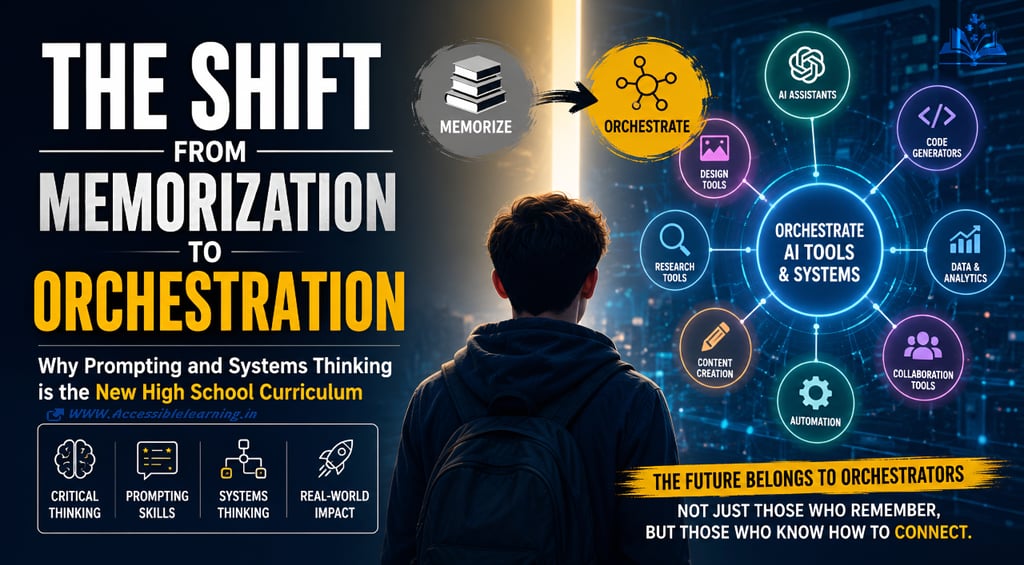
Why Prompting and Systems Thinking Is the New High School Curriculum
For generations, intelligence was measured by how much information a person could retain.
Students memorized historical dates, mathematical formulas, scientific definitions, and vocabulary lists. Success in school often depended on how accurately a person could recall information during an exam.
That model shaped education for over a century. In 2026, however, a fundamental shift is taking place.
The rise of advanced artificial intelligence has transformed information from something scarce into something instantly accessible. Facts, formulas, code snippets, research summaries, and explanations can now be generated within seconds. As a result, the most valuable human skill is no longer memorization.
It is orchestration.
The people succeeding in today's world are not necessarily those who know the most facts. They are the people who know how to coordinate knowledge, tools, AI systems, workflows, and human expertise to solve problems efficiently.
This shift is redefining education, careers, creativity, and even the meaning of intelligence itself.
What Is Orchestration?
Orchestration is the ability to direct multiple resources toward a specific outcome. Think of a conductor leading an orchestra.
The conductor may not play every instrument. Yet they understand how each piece contributes to the final performance. Similarly, modern professionals increasingly act as orchestrators.
Instead of manually performing every task, they coordinate:
AI chatbots
Research tools
Coding assistants
Design platforms
Automation systems
Human collaborators
Databases and knowledge systems
The goal is not to know everything. The goal is to know how to assemble everything effectively.
Why Memorization Is Becoming Less Valuable
Memorization itself is not disappearing. Basic knowledge remains important because it provides context and judgment. However, the economic value of pure memorization is rapidly declining. Consider several examples.
Mathematics
In the past, students memorized formulas and performed calculations manually.
Today, AI systems can solve equations, generate graphs, explain reasoning, and identify mistakes instantly.
The challenge is no longer finding the answer.
The challenge is determining the following:
Which method should be used?
Is the AI solution correct?
How should results be interpreted?
What assumptions are being made?
Programming
Developers once spent years memorizing syntax.
Modern AI coding assistants can generate entire applications from natural-language instructions.
The new skill becomes the following:
Designing architecture
Defining requirements
Testing outputs
Managing integrations
Evaluating security risks
Research
Researchers previously spent countless hours locating information.
Now AI can summarize hundreds of documents in minutes.
The critical skill shifts toward:
Asking better questions
Validating sources
Detecting bias
Synthesizing insights
Knowledge still matters. But knowing how to deploy knowledge matters more.
The Rise of Prompting as a Core Skill
Prompting is often misunderstood as simply typing instructions into an AI chatbot.
In reality, prompting is becoming a new form of communication and problem-solving.
A strong prompt demonstrates the following:
Critical thinking
Goal definition
Context management
Logical sequencing
Systems awareness
For example, a weak prompt might be
Build me a website.
A strong prompt might be
Create a responsive portfolio website with a dark theme, optimized for mobile devices, featuring project galleries, lead generation forms, and SEO-focused page structure.
The second prompt provides clarity, constraints, and objectives. This produces significantly better results.
Prompting is essentially the process of translating human intent into machine-executable instructions. As AI becomes more capable, this skill becomes increasingly valuable.
Systems Thinking: The Hidden Superpower
If prompting is the language of the AI era, systems thinking is the mindset behind it. Systems thinking involves understanding how different parts interact within a larger whole. Instead of focusing on isolated tasks, systems thinkers examine the following:
Inputs
Outputs
Dependencies
Feedback loops
Constraints
Optimization opportunities
For example, building a business website today involves multiple interconnected systems:
Content creation
Search engine optimization
User experience design
Analytics tracking
Marketing automation
AI-powered customer support
Success depends on understanding how these elements work together. This ability to connect moving pieces is becoming more valuable than isolated expertise.


What "Being Smart" Means in 2026
Traditional intelligence often emphasized the following:
Memory
Recall speed
Standardized test performance
Subject-specific expertise
Modern intelligence increasingly emphasizes the following:
Curiosity
People who ask better questions obtain better answers.
Adaptability
Technology changes rapidly.
The ability to learn continuously matters more than mastering a fixed body of knowledge.
Judgment
AI can generate thousands of answers.
Humans must determine which answers are useful, ethical, and accurate.
Creativity
AI excels at patterns.
Humans excel at defining goals, imagining possibilities, and creating meaning.
Coordination
The ability to combine multiple tools and resources is becoming one of the most valuable professional skills.
Being smart is no longer about carrying the largest library in your head.
It is about knowing how to access, evaluate, organize, and apply knowledge effectively.
The New Educational Model
Many educational institutions are beginning to recognize this transformation. The emerging curriculum is gradually shifting toward the following:
AI Literacy
Understanding how AI systems function and where they fail.
Prompt Engineering
Learning how to communicate effectively with intelligent systems.
Workflow Design
Building processes that combine humans and AI efficiently.
Digital Collaboration
Working alongside both people and machines.
Critical Thinking
Evaluating information quality and reasoning.
Project-Based Learning
Applying knowledge to real-world challenges instead of memorizing isolated facts.
Future classrooms may resemble innovation labs more than lecture halls.
Students will increasingly learn through creation rather than repetition.
Real-World Example: Building an App Without Writing Every Line of Code
Imagine a student with an idea for a fitness application. In previous decades, creating the app would require years of technical training.
Today the student can orchestrate multiple systems:
Use AI to research market demand.
Generate application wireframes with design tools.
Create user flows using AI-assisted planning.
Generate code through coding assistants.
Test features with automated tools.
Produce marketing content using generative AI.
Launch and analyze user behavior with analytics platforms.
The student's value comes from coordinating the process. They become the architect rather than the bricklayer. This represents orchestration in action.
Industries Already Rewarding Orchestrators
The trend is visible across industries.
Marketing
Professionals coordinate content tools, analytics platforms, automation software, and AI assistants.
Software Development
Engineers increasingly supervise AI-generated code while focusing on architecture and product strategy.
Healthcare
Medical professionals combine AI diagnostics, patient data, and clinical judgment.
Education
Teachers use AI to personalize learning experiences while guiding critical thinking.
Entrepreneurship
Founders increasingly build businesses by coordinating digital tools instead of hiring large teams.
Across sectors, orchestration is becoming a competitive advantage.
The Risks of Over-Reliance on AI
While orchestration is powerful, it also introduces challenges. These include:
AI hallucinations
Misinformation
Bias in outputs
Security vulnerabilities
Reduced deep understanding
Overdependence on automation
This is why foundational knowledge still matters. People who understand underlying concepts are better equipped to identify errors and make informed decisions. The future is not humans versus AI. The future is humans directing AI effectively.
How Students Can Prepare for the Orchestration Era
Students who want to thrive in the coming decade should focus on developing:
Question Formulation Skills
Learn to ask clear, precise, and meaningful questions.
Project Building
Create real-world projects instead of only studying theory.
AI Tool Fluency
Become comfortable using multiple AI systems together.
Communication Skills
Strong communication improves both human and machine collaboration.
Systems Thinking
Practice understanding relationships between components rather than memorizing isolated facts.
Lifelong Learning
Technology will continue evolving.
Continuous adaptation will become a permanent requirement.

The Future Belongs to Orchestrators
The world is entering an era where information is abundant, accessible, and increasingly automated. The competitive advantage is no longer who remembers the most.
It is who can combine resources most effectively. Memorization helped people survive the information age. Orchestration will help people thrive in the intelligence age.
The students, professionals, entrepreneurs, and creators who learn to coordinate AI systems, human expertise, workflows, and ideas will define the next generation of innovation.
The question is no longer
"What do you know?"
The more important question in 2026 is:
"What can you orchestrate?"
FAQ's
Q: What is the difference between memorization and orchestration?
Memorization focuses on storing and recalling information, while orchestration focuses on coordinating knowledge, AI tools, workflows, and resources to achieve a specific outcome. In 2026, employers increasingly value the ability to solve problems by leveraging multiple systems rather than simply recalling facts.
Q: Why is orchestration becoming more important than memorization?
AI can instantly provide information, summarize research, generate code, and solve many routine tasks. As a result, the competitive advantage has shifted toward people who can effectively direct AI, evaluate outputs, and combine tools into productive workflows.
Q: What does orchestration mean in the context of artificial intelligence?
AI orchestration refers to managing multiple AI tools, software platforms, and human inputs to complete complex projects. This may include coordinating AI for research, content creation, coding, design, automation, and decision-making.
Q: Is memorization still important in the age of AI?
Yes. Foundational knowledge remains essential for critical thinking, problem-solving, and evaluating AI-generated responses. However, pure memorization is becoming less valuable than understanding concepts and applying them effectively.
Q: What is systems thinking, and why does it matter?
Systems thinking is the ability to understand how different parts of a process interact and influence one another. It helps individuals identify dependencies, optimize workflows, and solve complex problems more efficiently in AI-powered environments.
Q: What skills define intelligence in 2026?
Modern intelligence increasingly includes:
Critical thinking
Adaptability
Creativity
Prompting skills
Systems thinking
Digital collaboration
Decision-making
AI literacy
These skills help people work effectively alongside advanced technologies.
Q: What is prompt engineering, and why is it important?
Prompt engineering is the practice of creating clear, structured instructions for AI systems. Effective prompts improve the quality, accuracy, and relevance of AI-generated outputs, making prompting a valuable professional skill.
Q: How can students prepare for an AI-driven future?
Students can prepare by:
Learning AI tools
Building real-world projects
Developing communication skills
Practicing systems thinking
Improving problem-solving abilities
Understanding how to evaluate AI-generated information
Q: Will AI replace traditional education?
AI is unlikely to replace education entirely. Instead, it is transforming education by shifting focus from memorization-based learning toward critical thinking, creativity, project-based learning, and AI-assisted problem-solving.
Q: What jobs benefit most from orchestration skills?
Many modern careers benefit from orchestration, including:
Software development
Digital marketing
Product management
Entrepreneurship
Education
Healthcare
Research
Data analysis
Business operations
Professionals who can coordinate people, tools, and AI systems often gain a significant advantage.
Q: How does AI orchestration improve productivity?
AI orchestration reduces repetitive work by automating tasks such as research, content generation, coding, scheduling, and analysis. This allows individuals and organizations to focus on strategy, creativity, and decision-making.
Q: Can someone succeed without learning AI tools?
While it is possible, learning AI tools increasingly provides a competitive advantage. Similar to how internet literacy became essential in previous decades, AI literacy is becoming a core skill across industries.
Q: What are the risks of relying too heavily on AI?
Potential risks include:
Inaccurate outputs
Hallucinated information
Bias in AI-generated content
Data privacy concerns
Reduced critical thinking
Overdependence on automation
Human oversight remains crucial for ensuring accuracy and responsible use.
Q: What is AI literacy?
AI literacy is the ability to understand how AI systems work, their capabilities, limitations, ethical considerations, and best practices for using them effectively in education, work, and daily life.
Q: Why are prompting and systems thinking considered the new foundational skills?
Prompting helps humans communicate effectively with AI systems, while systems thinking helps them understand how different technologies, people, and processes work together. Together, these skills enable individuals to solve complex problems and create value in an AI-powered world.
Q: How is the definition of being smart changing in 2026?
Being smart is no longer defined solely by how much information a person can remember. It increasingly means knowing how to find reliable information, ask better questions, coordinate resources, evaluate outcomes, and use AI effectively to solve real-world problems.
Q: What are examples of orchestration in everyday life?
Examples include:
Using AI to plan a business launch
Combining research tools to write a report
Managing multiple automation platforms
Coordinating AI-assisted content creation
Building apps with AI coding assistants
Using AI and analytics tools to improve marketing campaigns
Q: Will schools eventually teach AI orchestration?
Many schools and universities are already introducing AI literacy, prompt engineering, project-based learning, and systems thinking. These subjects are expected to become increasingly important as AI continues reshaping education and work.
Q: What is the future of learning in an AI-powered world?
The future of learning will likely focus less on information recall and more on creativity, collaboration, critical thinking, problem-solving, and the ability to work effectively with intelligent systems.
Q: What is the biggest advantage of becoming an orchestrator?
The biggest advantage is adaptability. People who can coordinate AI, technology, and human expertise can quickly learn new skills, solve complex challenges, and remain valuable even as industries continue to evolve.
Subscribe to Frontier Intelligence
All © Copyright reserved by Accessible-Learning Hub
| Terms & Conditions
Accessible Learning Hub — Actionable clarity for high-agency minds.
Weekly breakdowns on AI breakthroughs, capital flow, and human performance systems. Zero fluff.