

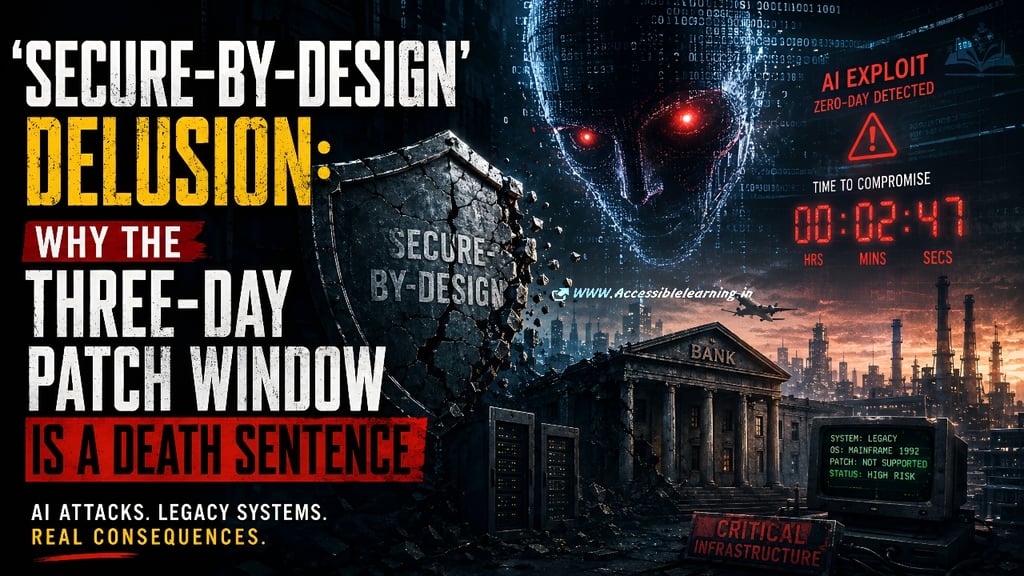
The "Secure-by-Design" Delusion: Why the Three-Day Patch Window Is a Death Sentence
AI has shrunk cyberattack timelines from months to minutes. Discover why the three-day patch mandate and "secure-by-design" promise fail against legacy infrastructure.
HARSH REALITYGLOBAL ISSUESAI/FUTURE
Shiv Singh Rajput | Sachin K Chaurasiya
6/29/20266 min read
A regional power grid goes dark at 9:17 a.m.
The operators never see the attack coming.
An AI system scans thousands of internet-facing devices, identifies a previously unknown vulnerability in an industrial control gateway, automatically generates a working exploit, rewrites it to evade existing detection systems, and launches simultaneous attacks against hundreds of substations. Within minutes, hospitals lose backup synchronization, railway signaling collapses, financial exchanges halt transactions, and emergency services struggle with communications failures.
The vendor has not even acknowledged the vulnerability.
No patch exists.
No security team, regardless of budget, could have responded.
This scenario no longer belongs to science fiction. It represents the direction cyber warfare is heading as artificial intelligence compresses the timeline between vulnerability discovery and weaponized exploitation from months into minutes.
Against this backdrop, intelligence agencies across the Five Eyes alliance have issued increasingly urgent guidance telling organizations to embrace "secure-by-design" principles and patch critical vulnerabilities within days, sometimes immediately.
The advice sounds reasonable. Reality says otherwise.
The Mathematics of Cyber Defense No Longer Work
Cybersecurity always depended on one assumption.
Defenders could react faster than attackers.
That assumption has collapsed.
Modern AI systems can automate vulnerability research, reverse engineer patches, identify exposed targets, generate exploit variants, and adapt attacks without waiting for human operators.
Attackers no longer need thousands of elite hackers.
They need one capable AI pipeline.
Meanwhile, enterprise defenders still operate inside organizations where every software update requires the following:
Compatibility testing
Regulatory approval
Business validation
Scheduled maintenance windows
Disaster recovery planning
Vendor certification
Even organizations with mature security operations often need weeks before touching production infrastructure.
Governments now demand three-day patch cycles.
Many organizations still require thirty.
The gap keeps widening.
Secure-by-Design Assumes a World That Never Existed
"Secure-by-design" sounds like engineering wisdom. For new software, it absolutely is. For the world's existing infrastructure, it borders on fantasy.
Global commerce still depends upon software written before cloud computing existed. Banks continue running COBOL applications on mainframes installed decades ago. Airlines rely on reservation systems whose original architecture predates the public internet.
Manufacturing plants operate programmable logic controllers that vendors stopped supporting years ago. Hospitals connect modern medical devices to operating systems Microsoft abandoned long ago.
Nobody intentionally built insecure systems.
Businesses built systems that survived.
Every acquisition added another layer.
Every merger introduced another integration.
Every emergency patch created more technical debt.
After thirty years, the result resembles duct tape wrapped around concrete.
You cannot redesign that architecture in a weekend.
You cannot rebuild it because entire national economies depend on it remaining online.
The Three-Day Patch Window Ignores Operational Reality
Security agencies increasingly argue that organizations must patch critical vulnerabilities within seventy-two hours. That recommendation ignores how critical infrastructure actually operates.
Imagine telling an international bank to reboot payment processing during peak trading hours.
Imagine forcing an airline to upgrade flight management software before validating every aircraft interface.
Imagine shutting down a chemical refinery because an operating system update might introduce instability.
Cybersecurity exists to reduce risk.
Blindly applying patches without exhaustive testing often creates even greater operational risk.
A broken payment platform can trigger financial panic.
A failed hospital system can delay emergency care.
A malfunctioning power grid can cost lives.
The fastest patch does not automatically produce the safest outcome.

AI Does Not Attack Like Human Hackers
Traditional attackers faced human limitations.
They slept.
They specialized.
They worked sequentially.
AI changes every variable.
An AI attack platform can:
Scan millions of internet-facing systems simultaneously.
Reverse engineer security updates within minutes.
Generate exploit code automatically.
Test payloads against defensive products.
Modify malware after every failed attempt.
Launch attacks continuously without fatigue.
Meanwhile, defenders still depend on human approval chains.
The contest no longer resembles a race.
It resembles a marathon against a missile.
Legacy Infrastructure Has Become the World's Largest Attack Surface
Governments frequently discuss ransomware. They rarely discuss dependency. Every modern service connects to aging infrastructure hiding beneath newer interfaces.
Digital banking depends upon legacy settlement systems. Cloud applications depend upon decades-old identity infrastructure. National logistics rely on industrial software designed before cyber warfare became a geopolitical weapon.
Modern AI does not care whether code originated in 2026 or 1996.
It only searches for weaknesses.
The oldest systems usually contain the most.
Ironically, these same systems often prove impossible to patch quickly because nobody fully understands how they interact anymore.
Sometimes the original developers have retired.
Sometimes the vendor disappeared years ago.
Sometimes the source code no longer exists.
Security guidance rarely acknowledges this uncomfortable reality.
Governments Want Speed Without Accepting Their Own Responsibility
The Five Eyes warning correctly recognizes that AI compresses exploitation timelines. It correctly urges organizations to improve cyber resilience. But another question deserves equal attention.
Who built the digital ecosystem now facing collapse?
Governments encouraged digital transformation for decades.
They regulated industries that rewarded operational continuity over architectural modernization.
They mandated legacy compatibility across finance, healthcare, aviation, and public infrastructure.
Now the same institutions tell organizations to patch faster than AI can attack.
That expectation shifts responsibility without addressing decades of accumulated technical debt.
For many enterprises, compliance no longer depends on effort. It depends on physics.
The Three Biggest Hypocrisies in Current Government AI Policy
Governments promote rapid AI adoption while warning everyone else about AI-generated cyber threats. Agencies encourage economic acceleration while simultaneously acknowledging that offensive AI dramatically increases cyber risk.
Officials demand immediate patching while operating critical government systems built on legacy infrastructure. Public agencies face the same modernization challenges confronting banks, utilities, and manufacturers.
Policy emphasizes victim responsibility instead of systemic resilience. Organizations receive increasingly aggressive security guidance even though many inherited infrastructure that cannot realistically meet modern patch timelines.
Is This Security Guidance or Institutional Liability Protection?
Intelligence agencies understand how AI changes cyber warfare. Their warnings reflect genuine concern. But they also create something else. Documentation.
If catastrophic breaches occur tomorrow, governments can point toward previous guidance and argue they warned everyone.
That changes the narrative. Failure becomes an organizational problem instead of acknowledging a structural one. This resembles disaster preparedness documents issued before hurricanes.
Authorities tell citizens to evacuate. Everyone understands some people physically cannot.
The warning still exists.
Responsibility shifts.
Cybersecurity now risks following the same pattern.
Publish increasingly impossible standards.
Declare organizations responsible when they inevitably fail.
Repeat.


What Real Cyber Defense Actually Looks Like
No organization will patch every vulnerability within three days. Most never will. Instead of pretending otherwise, security leaders should focus on reducing catastrophic failure.
That means:
Designing systems that continue operating after compromise.
Segmenting networks aggressively.
Removing unnecessary internet exposure.
Building resilient recovery capabilities.
Practicing incident response continuously.
Replacing the highest-risk legacy systems before cosmetic modernization projects.
Perfect prevention died years ago. Operational resilience matters more than theoretical security compliance.
The Real Crisis Is Architectural, Not Operational
Artificial intelligence did not create today's cybersecurity crisis. It exposed one that already existed.
For decades, governments, corporations, and technology vendors accepted mounting technical debt because rebuilding critical infrastructure cost too much and disrupted quarterly performance.
AI simply accelerated the inevitable reckoning. "Secure-by-design" remains the correct philosophy for software that has not yet been written.
It offers little comfort to organizations running economies on thirty-year-old code nobody dares replace.
The real danger lies not in unrealistic patch windows.
It lies in pretending those patch windows solve a problem rooted in decades of architectural neglect.
When the next AI-driven cyber catastrophe arrives, investigators will ask why organizations failed to patch quickly enough. They should ask a harder question instead.
Why did the world's critical infrastructure become so fragile that a three-day deadline ever sounded like a serious defense strategy?
FAQ's
Q: What does "secure-by-design" mean in cybersecurity?
Secure-by-design is a software development approach that prioritizes security from the earliest stages of design rather than adding protections after deployment. It emphasizes secure coding practices, strong authentication, least-privilege access, and regular security testing throughout a product's lifecycle.
Q: Why is the three-day patch window considered unrealistic for many organizations?
Many enterprises rely on legacy systems that require extensive compatibility testing, regulatory approvals, and scheduled maintenance before updates can be deployed. Critical sectors such as banking, healthcare, aviation, and energy often cannot safely apply emergency patches within 72 hours without risking service disruptions.
Q: How is AI changing the speed of cyberattacks?
Artificial intelligence can automate vulnerability discovery, exploit development, malware modification, and target identification. This dramatically reduces the time between discovering a security flaw and launching large-scale attacks, shrinking the traditional defense window from months or weeks to hours or even minutes.
Q: Why do legacy systems remain one of the biggest cybersecurity risks?
Many critical infrastructure systems still run on decades-old software that was never designed to withstand modern cyber threats. These platforms often lack vendor support, cannot be easily updated, and remain deeply integrated into essential business operations, making rapid modernization extremely difficult.
Q: Can organizations realistically achieve "secure-by-design" with existing infrastructure?
Not entirely. While new applications can adopt secure-by-design principles, most large enterprises must balance security improvements with operational continuity. In practice, organizations often rely on network segmentation, continuous monitoring, zero-trust architecture, and phased modernization to reduce risk.
Q: What is the biggest challenge enterprises face when patching critical vulnerabilities?
The primary challenge is balancing security with business continuity. Applying a patch too quickly can disrupt mission-critical services, while delaying it increases exposure to cyberattacks. Organizations must carefully assess operational risk alongside cybersecurity risk.
Q: What role do government cybersecurity advisories play during emerging AI threats?
Government advisories provide threat intelligence, recommended mitigation strategies, and best practices to help organizations reduce cyber risk. However, many experts argue that guidance alone cannot solve the structural problems caused by decades of legacy technology and technical debt.
Q: What strategies can organizations use when immediate patching is impossible?
Organizations should implement compensating controls such as zero-trust security, network segmentation, endpoint detection and response (EDR), multi-factor authentication, continuous threat monitoring, offline backups, and well-tested incident response plans to reduce the likelihood and impact of successful attacks.
Subscribe to Frontier Intelligence
All © Copyright reserved by Accessible-Learning Hub
| Terms & Conditions
Accessible Learning Hub — Actionable clarity for high-agency minds.
Weekly breakdowns on AI breakthroughs, capital flow, and human performance systems. Zero fluff.