

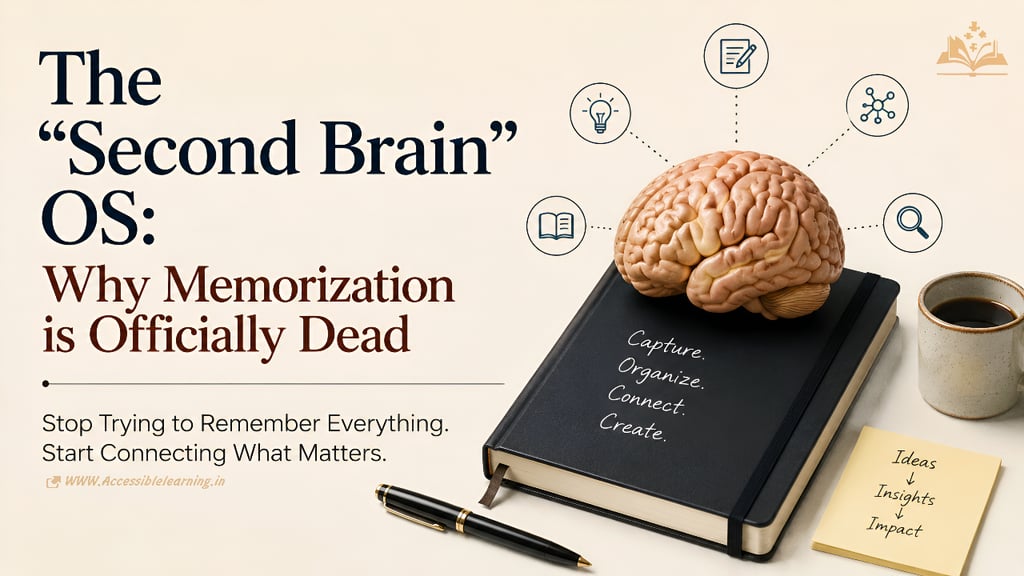
The "Second Brain" OS: Why Memorization Is Officially Dead
What if the smartest people in 2026 aren't the ones who remember the most, but the ones who connect ideas the fastest? As AI-powered Second Brain systems become the new standard for managing knowledge, memorization is losing its place as the ultimate measure of intelligence. Discover how personal AI knowledge databases are transforming learning, productivity, creativity, and decision-making by turning scattered information into actionable insight.
ACCESSIBLE LEARNINGBIOTECH & HEALTH SCIENCES
Shiv Singh Rajput | Kim Shin
6/13/20266 min read
Your Brain Is for Having Ideas, Not Holding Them
For centuries, intelligence was measured by memory.
Students were rewarded for remembering facts. Professionals were respected for recalling information on command. Experts built reputations on how much knowledge they could store in their heads.
That model is collapsing.
In 2026, the world's highest performers are no longer competing on memory. They are competing on connection.
The reality is simple: human memory was never designed for the volume of information modern life demands. Every day, people consume articles, videos, podcasts, meetings, messages, reports, research papers, books, and endless streams of digital content.
The amount of information available today exceeds what previous generations encountered in years. Trying to memorize everything is no longer a productivity strategy.
It's a bottleneck.
The most effective thinkers now operate with a "Second Brain" Operating System: an AI-powered knowledge network that stores, organizes, connects, and retrieves information automatically.
The result isn't that people become less intelligent.
They become more intelligent because their mental energy is no longer wasted on remembering.
Instead, it is invested in creating, solving, and innovating.
What Is a Second Brain?
A Second Brain is a personal knowledge management system designed to extend human memory. It acts as an external repository where information is captured, organized, linked, and made instantly searchable.
Modern Second Brain systems combine the following:
AI assistants
Knowledge databases
Note-taking platforms
Search engines
Automation workflows
Context-aware retrieval systems
Popular foundations include the following:
Notion
Obsidian
Capacities
Reflect
Tana
Mem AI
Logseq
However, the software is only the surface. The real power comes from creating an interconnected knowledge ecosystem where ideas become linked instead of isolated.
Think of it this way:
Traditional note-taking stores information.
A Second Brain understands relationships between information.
That difference changes everything.
The Death of Memorization
Many people still operate under an outdated assumption:
"If I don't memorize it, I don't know it."
That belief made sense when information was scarce. Today, information is abundant. Attention is scarce.
The challenge is no longer finding knowledge.
The challenge is finding the right knowledge at the right moment.
Consider a marketing strategist.
They might consume:
Consumer psychology research
Advertising campaigns
Social media trends
Sales frameworks
Customer feedback
Industry reports
Memorizing every detail is impossible. A Second Brain allows them to instantly retrieve and connect relevant insights whenever needed.
The value shifts from memory capacity to knowledge accessibility.
The smartest people are not those who remember the most.
They are those who can find, connect, and apply information fastest.

Human Memory Is Breaking Under Modern Information Load
The average knowledge worker encounters thousands of information inputs weekly. This includes:
Emails
Notifications
Meetings
Articles
Videos
Conversations
Documents
AI-generated content
The brain evolved to recognize patterns, not archive databases. When forced into constant storage mode, cognitive performance suffers. Common symptoms include:
Information Overload
People consume more than they can process.
Knowledge Fragmentation
Useful insights become buried across apps, notebooks, bookmarks, screenshots, and browser tabs.
Decision Fatigue
Mental resources become exhausted from managing information instead of using it.
Forgotten Learning
Most information disappears within days if not actively reinforced.
This creates a frustrating cycle:
Consume → Forget → Relearn → Forget Again
A Second Brain interrupts that cycle.
The New Definition of Intelligence
The education systems of the past rewarded recall. The AI economy rewards synthesis. These are not the same thing. Recall asks:
"What facts do you remember?"
Synthesis asks:
"What connections can you create?"
Modern breakthroughs rarely emerge from memorizing isolated facts. They emerge from combining ideas across disciplines. For example:
Psychology + Marketing
Biology + Engineering
Design + Artificial Intelligence
Economics + Behavioral Science
The ability to connect unrelated concepts is becoming one of the most valuable skills in the world. A Second Brain amplifies this capability by exposing relationships that human memory alone might miss.
How AI Turns Notes Into Knowledge
Traditional note-taking often fails because notes become digital graveyards.
People capture information.
Then never see it again.
AI changes that equation.
Modern Second Brain systems can
Automatically Categorize Information
Notes are organized without manual filing.
Generate Summaries
Long documents become concise insights.
Extract Key Ideas
Important concepts are highlighted instantly.
Create Connections
AI identifies relationships between notes that were created months or years apart.
Surface-Relevant Context
Information appears exactly when it becomes useful. Imagine researching entrepreneurship today.
Six months later, while studying consumer psychology, your system identifies overlapping principles and presents them automatically.
This creates compound learning. Every new piece of information strengthens the value of previous knowledge.
Why High Performers Are Building Personal Knowledge Databases
Elite professionals increasingly treat knowledge as an asset. Not just something they consume. Something they own. Their Second Brain becomes:
A research archive
A strategic thinking tool
A content creation engine
A decision support system
A personal intelligence network
Over time, this database becomes uniquely valuable because it reflects their experiences, observations, and accumulated learning. No public AI model can replicate that. Your personal knowledge network becomes a competitive advantage.
The Rise of Contextual Intelligence
The future belongs to contextual intelligence. Not raw intelligence. Not memorized intelligence.
Contextual intelligence means understanding:
When information matters
Why it matters
How it connects to other knowledge
Where it should be applied
AI excels at retrieval. Humans excel at judgment. Together, they create a powerful partnership.
The AI retrieves relevant knowledge.
The human decides what to do with it.
This division of labor is becoming the dominant productivity model of the AI era.

Building Your Own Second Brain OS
You do not need a complicated setup. Start with four simple components.
1. Capture Everything Valuable
Save:
Insights
Research
Quotes
Meeting notes
Ideas
Observations
If it sparks thought, capture it.
2. Organize Around Topics
Avoid organizing information by source. Instead organize around outcomes:
Business
Writing
Marketing
Health
Finance
Learning
This makes retrieval easier later.
3. Connect Ideas
Whenever possible, link related notes together.
Knowledge becomes more valuable when connected.
4. Use AI for Retrieval
Allow AI tools to search, summarize, and surface information automatically.
The goal is not storing more.
The goal is finding meaning faster.
The Hidden Advantage Nobody Talks About
Most discussions about Second Brains focus on productivity. That misses the bigger transformation. Mental freedom. When your brain stops acting as a storage device, it gains capacity for:
Creativity
Problem-solving
Innovation
Reflection
Strategic thinking
Many people experience a subtle mental burden from trying to remember everything.
Deadlines.
Ideas.
Research.
Tasks.
References.
A Second Brain removes that burden. It creates confidence that important information will not disappear. That psychological relief alone can dramatically improve performance.
The Future of Education Is Already Changing
Educational systems are beginning to face an uncomfortable reality. Memorization is becoming less valuable. AI can recall facts instantly.
Future education will increasingly focus on:
Critical thinking
Systems thinking
Pattern recognition
Decision-making
Creativity
Communication
Interdisciplinary problem-solving
The question will no longer be
"What do you remember?"
It will become:
"What can you create with what you know?"
This shift represents one of the largest transformations in learning since the invention of the internet.
The Real Competitive Advantage in 2026
Many people assume AI is replacing human intelligence. The opposite is happening. AI is replacing information storage. Human intelligence is moving higher up the value chain. The winners of the next decade will not be those with the biggest memories. They will be those with the strongest knowledge networks.
People who can:
Connect ideas quickly
Learn continuously
Retrieve information instantly
Identify patterns across domains
Generate original insights
A well-designed Second Brain transforms scattered information into a living intelligence system. And that changes how people work, learn, and create.

Memorization is not disappearing entirely. Certain foundational knowledge will always matter. But as a primary measure of intelligence, memorization is losing relevance.
The modern world produces more information than any human can reasonably retain. Fighting that reality is futile. The smarter approach is to build systems that work alongside the brain rather than against it.
Your brain was never meant to function as a hard drive. It was designed to imagine, analyze, question, invent, and connect. The future belongs to those who stop treating memory as the goal and start treating understanding as the goal.
Because in the age of AI, the most valuable skill is no longer remembering information. It is knowing how to transform information into insight.
FAQ's
Q: What is a Second Brain system?
A Second Brain system is a personal knowledge management framework that stores, organizes, and connects information outside your biological memory. Modern versions use AI to automatically categorize notes, retrieve relevant knowledge, and surface insights when needed.
Q: Why is memorization becoming less important in 2026?
Memorization is becoming less valuable because AI can instantly retrieve and organize vast amounts of information. Success increasingly depends on critical thinking, creativity, synthesis, and the ability to connect ideas rather than recall isolated facts.
Q: What tools are commonly used to build a Second Brain?
Popular Second Brain tools include Notion, Obsidian, Logseq, Capacities, and Mem.
Q: How does AI improve a Second Brain?
AI can summarize documents, organize notes, discover hidden connections between ideas, answer questions from your knowledge base, and recommend relevant information based on context.
Q: Is a Second Brain only for students?
No. Entrepreneurs, writers, researchers, marketers, executives, developers, and creators all use Second Brain systems to manage information overload and improve decision-making.
Q: What is the biggest benefit of a Second Brain?
The biggest benefit is cognitive freedom. Instead of spending mental energy remembering information, you can focus on problem-solving, creativity, strategic thinking, and generating new ideas.
Q: Can a Second Brain replace human memory completely?
No. Foundational knowledge and understanding remain important. A Second Brain complements human memory by handling storage and retrieval, allowing the brain to focus on interpretation and innovation.
Q: What skills become more valuable than memorization?
Skills such as critical thinking, pattern recognition, creativity, communication, systems thinking, decision-making, and interdisciplinary problem-solving are becoming increasingly valuable in the AI era.
Subscribe to Frontier Intelligence
All © Copyright reserved by Accessible-Learning Hub
Accessible Learning Hub — Actionable clarity for high-agency minds.
Weekly breakdowns on AI breakthroughs, capital flow, and human performance systems. Zero fluff.