

The Screenless Learning Revolution: How AI Is Transforming Education Through Audio
Discover how AI-powered voice technology, conversational tutors, and dynamic audio content are driving the screenless learning revolution. Explore the future of audio-first education and personalized learning experiences.
PSYCHOLOGY & COGNITIVE SCIENCEACCESSIBLE LEARNING
Kim Shin | Sachin K Chaurasiya
6/4/20268 min read
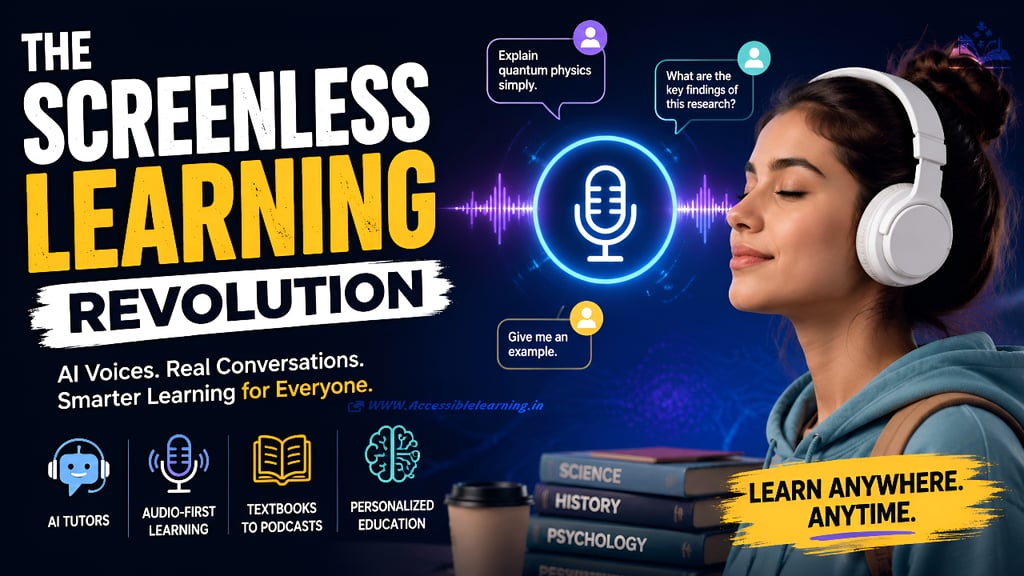
For decades, education has been tied to screens, books, and visual interfaces. Whether reading textbooks, watching online lectures, scrolling through PDFs, or completing digital assignments, modern learning has largely depended on looking at something.
But a major shift is underway.
Advances in artificial intelligence, hyper-realistic voice synthesis, natural language processing, and conversational AI are creating an entirely new learning paradigm: screenless education. Instead of reading information, learners can listen, interact, question, and explore knowledge through natural conversations.
Imagine turning a 500-page textbook into an engaging podcast hosted by AI experts. Picture a research paper transformed into a multi-speaker discussion where complex concepts are explained, debated, and simplified in real time. Consider having a personal AI tutor available through earbuds, capable of answering questions instantly and adapting explanations to your level of understanding.
This is not science fiction. It is the beginning of the screenless learning revolution.
What Is Screenless Learning?
Screenless learning refers to educational experiences that minimize or eliminate dependence on visual displays. Rather than consuming information through text or video, learners engage primarily through audio and conversation.
This approach is powered by several emerging technologies:
Advanced AI voice synthesis
Conversational AI assistants
Natural language understanding
Real-time content generation
Personalized learning systems
Dynamic audio production
The result is a learning environment where information can be heard, discussed, explored, and customized without requiring constant visual attention. Instead of opening an app and reading a chapter, learners might simply ask:
"Explain quantum mechanics like I'm 12 years old."
The AI responds naturally, adapts based on follow-up questions, and continues teaching through dialogue. Learning becomes a conversation rather than a reading task.
Why Education Became Screen-Dependent
The digital revolution dramatically expanded access to information. Online courses, eBooks, educational videos, and learning platforms made knowledge more available than ever before. However, screen-based learning introduced several challenges:
Cognitive Fatigue
People spend significant portions of their day looking at screens for work, communication, entertainment, and education. This continuous visual engagement contributes to:
Mental exhaustion
Reduced attention spans
Information overload
Eye strain
Digital burnout
Adding more educational content often means adding more screen time.
Passive Consumption
Many online learning experiences encourage passive behavior. Students often:
Watch videos without interaction
Read materials without discussion
Memorize information without application
The result can be lower engagement and weaker retention.
Accessibility Barriers
Not everyone learns effectively through reading-heavy formats. Learners with:
Dyslexia
Visual impairments
Reading difficulties
Attention challenges
may benefit significantly from alternative learning methods. Screenless learning offers a potential solution.
The Rise of AI-Generated Audio Learning
Recent breakthroughs in AI voice technology have dramatically changed what audio education can achieve. Earlier text-to-speech systems often sounded robotic and unnatural. Today's AI voices can communicate with:
Natural pacing
Emotional nuance
Human-like intonation
Multiple speaking styles
Distinct personalities
This creates educational experiences that feel closer to listening to expert instructors than interacting with software.
From Textbooks to Podcasts Instantly
One of the most transformative developments is automated content conversion. AI systems can now transform:
Textbooks
Academic journals
Research papers
Business reports
Technical documentation
Study guides
into structured audio experiences.
Rather than hearing a direct reading of text, learners receive:
Summaries
Explanations
Contextual examples
Real-world applications
Simplified breakdowns
This allows dense material to become more approachable and engaging.

Interactive Multi-Voice Learning Experiences
Perhaps the most exciting innovation is the emergence of multi-voice AI learning. Instead of a single narrator, AI can generate conversations between multiple virtual experts. For example:
A medical research paper could become a discussion between:
A physician
A researcher
A patient advocate
Each voice contributes different perspectives and explanations.
Similarly, a history lesson could become a dialogue between:
Historians
Economists
Political analysts
Complex ideas become easier to understand because they are presented as conversations rather than monologues. Humans naturally learn through dialogue, making this format particularly powerful.
Personalized AI Tutors in Your Ear
Traditional education often follows a one-size-fits-all model. AI changes this fundamentally.
Modern conversational systems can adapt to:
Knowledge level
Learning speed
Preferred explanations
Interests
Goals
Previous performance
A student struggling with calculus might receive simpler explanations and additional examples. An advanced learner might receive deeper theoretical insights and more challenging problems.
The same lesson can become completely different depending on the learner. This level of personalization has historically been impossible at scale.
Learning During Everyday Activities
One of the biggest advantages of audio-first education is flexibility. Screen-based learning requires dedicated visual attention.
Audio learning can happen while:
Walking
Exercising
Commuting
Cooking
Traveling
Performing routine tasks
This dramatically increases available learning time. Knowledge no longer competes directly with other screen-based activities. Instead, learning becomes integrated into daily life. For busy professionals, entrepreneurs, and lifelong learners, this shift could significantly expand educational opportunities.
How Screenless Learning Improves Knowledge Retention
Research in cognitive science suggests that active engagement improves learning outcomes. Conversational AI encourages active participation through:
Question-Driven Learning
Learners can interrupt at any moment. They can ask:
"What does that mean?"
"Can you simplify that?"
"Give me another example."
"Why is that important?"
This creates a dynamic feedback loop absent in most traditional content.
Contextual Reinforcement
AI can continuously connect new information to previously learned concepts. This strengthens memory formation and understanding.
Spaced Repetition Through Conversation
Instead of formal flashcards, AI can naturally revisit important concepts over time, reinforcing retention without feeling repetitive.
The Impact on Academic Research
Researchers often face a major challenge:
There is simply too much information.
Thousands of papers are published every day across scientific disciplines.
AI-powered audio systems may fundamentally change how researchers consume knowledge.
Future workflows could include:
Daily personalized research briefings
Audio summaries of newly published papers
Interactive discussions with AI-generated experts
Instant clarification of technical terminology
Cross-disciplinary knowledge synthesis
Instead of reading hundreds of pages, researchers may first explore content conversationally before diving deeper into source material. This could significantly accelerate knowledge discovery.
Accessibility and Inclusive Education
Screenless learning has enormous implications for accessibility. Potential beneficiaries include:
Learners with Visual Impairments
Audio-first systems remove many barriers associated with traditional educational materials.
Learners with Dyslexia
Listening can often be more effective than reading for certain individuals.
Elderly Learners
Voice interfaces may feel more natural and intuitive than complex digital interfaces.
Developing Regions
Audio-based systems may reduce infrastructure requirements compared to video-heavy educational platforms.
This could expand educational access globally.


Challenges Facing the Audio-First Education Movement
Despite its promise, screenless learning is not without limitations.
Visual Subjects Still Matter
Some topics require visual representation. Examples include:
Geometry
Architecture
Engineering diagrams
Medical imaging
Data visualization
Audio can supplement these fields but may not completely replace visual learning.
Information Verification
AI-generated educational content must maintain accuracy and reliability.
Educational institutions will need strong verification systems to ensure factual integrity.
Attention Management
Audio learning can be highly engaging, but distractions remain a concern.
Learners may listen passively without fully processing information.
Future systems will likely incorporate interactive checkpoints to maintain engagement.
Content Ownership and Copyright
Transforming books and research papers into dynamic audio experiences raises important questions regarding intellectual property rights and content licensing. These issues will require careful regulation and industry standards.
The Future: Learning Through Conversation
The long-term vision extends far beyond audiobooks. Future educational experiences may resemble conversations with living knowledge systems. Imagine asking:
"Teach me everything important about climate science in six hours."
The AI creates:
A personalized curriculum
Interactive discussions
Knowledge checks
Real-world examples
Adaptive explanations
The experience evolves continuously based on your responses. Education becomes fluid, responsive, and deeply personalized. Rather than navigating menus, searching databases, or reading endless documents, learners simply engage in meaningful dialogue. Knowledge becomes something you converse with rather than something you search for.
The screenless learning revolution represents one of the most significant educational shifts since the arrival of the internet.
Powered by AI voice synthesis, conversational intelligence, and personalized content generation, education is moving beyond static screens and into a world of dynamic, interactive audio experiences.
Textbooks can become podcasts. Research papers can become expert discussions. Courses can become conversations. Personal tutors can exist in every pocket. While screens will not disappear entirely, they may no longer be the primary gateway to knowledge.
As AI continues to evolve, the future of education may be less about what we see and more about what we hear, ask, discuss, and understand. The next generation of learning may not happen on a screen at all. It may happen through a simple conversation.

FAQ's
Q: What is screenless learning?
Screenless learning is an educational approach that delivers knowledge primarily through audio, voice interaction, and conversational AI rather than visual screens. It allows learners to study, ask questions, and receive personalized explanations through voice-first experiences.
Q: How does AI-powered audio learning work?
AI-powered audio learning uses advanced voice synthesis and conversational AI to transform written content such as textbooks, research papers, and study materials into interactive audio lessons, podcasts, or real-time tutoring sessions.
Q: Can AI convert textbooks into audiobooks automatically?
Yes. Modern AI systems can convert textbooks, articles, and educational documents into customized audiobooks. Unlike traditional text-to-speech tools, AI can summarize, explain, and reorganize information to create more engaging learning experiences.
Q: What are AI-generated educational podcasts?
AI-generated educational podcasts are automatically created audio programs that explain topics, discuss concepts, and present information through one or multiple AI-generated voices. They can be tailored to a learner's knowledge level and interests.
Q: Is audio learning as effective as reading?
Audio learning can be highly effective, especially when combined with active engagement and conversation. While some subjects still benefit from visual materials, audio learning improves accessibility, flexibility, and retention for many learners.
Q: What are the benefits of screenless learning?
Key benefits include:
Reduced screen fatigue
Greater accessibility
Personalized learning experiences
Learning while multitasking
Improved engagement through conversation
Better support for lifelong learning
Q: How can conversational AI improve education?
Conversational AI allows learners to ask questions, request simpler explanations, explore topics in depth, and receive instant feedback. This creates a more interactive and personalized learning experience compared to traditional educational content.
Q: Can AI explain complex research papers?
Yes. Advanced AI models can summarize research papers, explain technical terminology, highlight key findings, and even present information as a dialogue between virtual experts, making academic content easier to understand.
Q: Will AI tutors replace human teachers?
AI tutors are more likely to complement human teachers rather than replace them. They can provide personalized support, answer questions on demand, and help with practice, while human educators continue to offer mentorship, critical thinking guidance, and emotional support.
Q: What technologies are driving the screenless learning revolution?
The main technologies include:
AI voice synthesis
Large language models (LLMs)
Natural language processing (NLP)
Speech recognition
Adaptive learning systems
Real-time content generation
Q: Who benefits most from audio-first education?
Audio-first education can benefit:
Students
Professionals
Researchers
People with dyslexia
Visually impaired learners
Lifelong learners
Busy individuals with limited study time
Q: Can screenless learning improve accessibility?
Yes. Audio-based learning removes many barriers associated with reading-heavy educational systems and can make knowledge more accessible for learners with visual impairments, reading difficulties, or learning differences.
Q: What is a personalized AI tutor?
A personalized AI tutor is an intelligent learning assistant that adapts lessons, explanations, examples, and learning paths based on a user's goals, knowledge level, learning pace, and interests.
Q: How will AI change the future of education?
AI is expected to make education more personalized, interactive, accessible, and available on demand. Future learning experiences may rely heavily on conversational interfaces that adapt in real time to each learner's needs.
Q: What is the future of audio-first learning?
The future of audio-first learning includes interactive AI tutors, dynamic educational podcasts, personalized learning companions, voice-based assessments, and real-time knowledge conversations that reduce reliance on traditional screens.
Q: Can students learn without screens in the future?
While screens will remain useful for visual subjects, many educational activities such as reading, reviewing, discussing concepts, and exploring new topics may increasingly shift toward voice-driven and screenless experiences powered by AI.
Q: Are AI-generated audiobooks better than traditional audiobooks?
AI-generated audiobooks can offer advantages such as personalization, interactive questioning, adjustable complexity levels, and real-time updates. Traditional audiobooks remain valuable, but AI can make learning more adaptive and engaging.
Q: How does screenless learning reduce digital fatigue?
By reducing the need to constantly read, watch, and interact with visual interfaces, screenless learning helps minimize eye strain, cognitive overload, and the mental exhaustion often associated with prolonged screen use.
Q: Can professionals use AI audio learning for continuous education?
Yes. Professionals can use AI-powered audio learning to consume industry updates, research summaries, training materials, and educational content while commuting, exercising, or performing routine tasks.
Q: Why is screenless learning becoming popular?
Screenless learning is gaining popularity because it combines convenience, personalization, accessibility, and advances in AI technology. As voice interfaces become more natural, many learners are discovering that education can happen anytime and anywhere without needing to stare at a screen.
Subscribe to Frontier Intelligence
All © Copyright reserved by Accessible-Learning Hub
| Terms & Conditions
Accessible Learning Hub — Actionable clarity for high-agency minds.
Weekly breakdowns on AI breakthroughs, capital flow, and human performance systems. Zero fluff.