

The Science of Learning: How Our Brain Learns New Skills
Discover how the human brain learns new skills through neuroplasticity, memory formation, practice, and emotion. This in-depth guide explains the science of learning, how neural pathways grow, and the best techniques to learn faster, remember longer, and improve performance using proven brain-based methods.
A LEARNINGEDUCATION/KNOWLEDGECOMPANY/INDUSTRY
Sachin K Chaurasiya
12/12/20256 min read
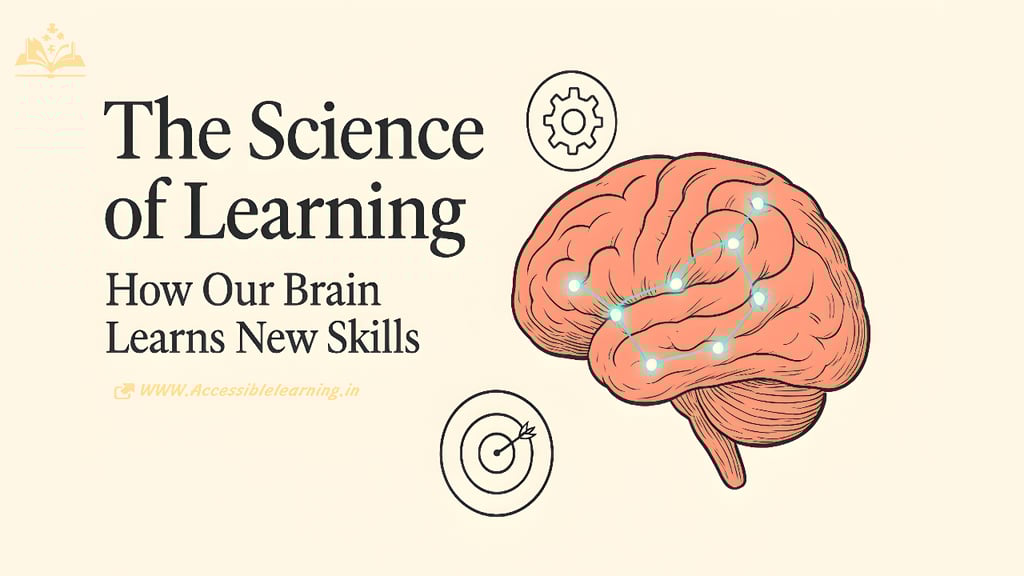
Learning is one of the most powerful things the human brain can do. Whether you’re learning a new language, improving your communication skills, or mastering a creative tool, the brain follows a predictable scientific process. Understanding this process helps you learn faster, remember longer, and stay motivated during difficult stages.
Below is an expanded, research-backed, human-centered article on how learning works and how you can use brain science to improve your skill development.
Neuroplasticity: The Foundation of All Learning
Neuroplasticity allows the brain to reorganize itself by forming new neural pathways.
Additional key insights
The brain strengthens pathways through repetition, like a muscle getting stronger through exercise.
Unused pathways weaken, which is why skills fade if you don’t practice.
Adults have slower but more efficient plasticity, meaning you may learn slightly slower than kids but understand deeper.
Emotionally charged experiences create stronger plasticity, which explains why important life lessons stay with us forever.
How the Brain Processes Skills: A Deeper Breakdown
Sensory Input Stage
Your brain collects raw data through senses. When learning a physical skill like drawing or dancing, your sensory neurons feed early guidance.
Interpretation and Pattern Recognition
The brain starts finding patterns.
This is the moment when you start recognizing common steps, shapes, or sequences.
Encoding into Memory
Encoding is influenced by attention, emotion, and repetition.
Consolidation
This occurs during rest and sleep. The brain solidifies knowledge into long-term memory.
Retrieval and Application
Skills become useful only when you can apply them easily.
The more often you retrieve and use a skill, the stronger the retrieval pathway becomes.
The Brain Chemicals That Influence Learning
Learning isn’t only about neurons. Chemicals play a major role:
Dopamine
Boosts motivation, reward, focus, and memory formation.
A small win triggers dopamine, which pushes you to learn more.
Acetylcholine
Improves focus and helps with attention-driven learning.
Serotonin
Influences mood, which affects how open you are to learning.
Cortisol
High levels (due to stress) block learning and memory formation.
A stable emotional environment helps the brain absorb information faster.
Why Curiosity Accelerates Learning
Curiosity activates the brain’s reward system.
When you’re curious about a topic:
Dopamine rises
Focus becomes sharper
You remember more
You naturally seek more knowledge
This is why curiosity-based learning or project-based learning is more effective than forced study.
The Role of Mistakes: Why Errors Strengthen Learning
Mistakes create friction, and friction triggers plasticity.
When you make an error, the brain flags the moment and pays extra attention the next time. This process is called error-based learning and is supported by the anterior cingulate cortex.
The goal is not to avoid mistakes but to use them as signals for improvement.
The Power of Spaced Learning
The brain learns best in small, repeated bursts rather than in one long session.
Why spacing works
It respects the brain’s natural forgetting rhythm
Each review strengthens the neural connection
You learn faster and remember longer
This is why daily 20-minute practice beats a 3-hour session once a week.

The Science of Deep Practice
Deep practice is a state where you fully engage with the skill, remove distractions, and push slightly past your comfort zone.
Deep practice includes
Slow, controlled repetition
Breaking skills into micro-steps
Correcting errors immediately
Staying fully present
This type of practice helps activate the myelin sheath, which wraps neural connections and makes them faster and more reliable. More myelin means higher skill performance.
The Importance of Retrieval Practice
Most people think learning happens when reading or watching.
But actual learning happens when you recall information without looking.
Retrieval practice includes
Testing yourself
Teaching someone else
Writing from memory
Creating summaries without reference
It forces your brain to rebuild the memory pathway, strengthening it each time.
The Body-Brain Connection in Skill Learning
The brain and body are deeply connected during learning.
Exercise increases BDNF (Brain-Derived Neurotrophic Factor), a growth chemical essential for neuroplasticity.
Good posture improves alertness and learning speed.
Movement boosts memory, which is why walking helps with creative thinking.
When you learn a skill that requires physical coordination, the cerebellum works with the motor cortex to fine-tune precision.
The Impact of Environment on Learning
A supportive learning space increases absorption.
Important environmental factors
A quiet place reduces cognitive load
Natural light boosts focus and reduces fatigue
Green plants help stabilize mood
Removing digital distractions protects attention
Your environment should align with your learning goals.
Why Reflection Improves Learning
Taking a moment to reflect after learning helps the brain:
Connect ideas
Understand patterns
Organize information
Strengthen long-term memory
Even a short 5-minute reflection session can make a big difference.
How Technology Supports Modern Learning
AI-powered tools now accelerate the learning process by:
Tracking progress
Measuring strengths and weaknesses
Creating personalized learning paths
Suggesting the next best steps
Generating practice questions
Simulating real-world conditions
This makes learning more adaptive and efficient.
Practical Strategies to Learn New Skills Faster
Here are expanded, actionable strategies:
Break the skill into micro-skills
Practice in short, intense intervals
Use spaced repetition
Test yourself often
Mix difficulty levels
Apply the skill in real scenarios
Celebrate small wins
Reflect after each practice
Use visuals to boost memory
Prioritize sleep for consolidation
Stay curious, not stressed
Make mistakes early and often
Stay consistent with practice
Create an environment that supports learning
These habits align perfectly with how the brain grows.
Learning is not magic or luck. It’s a natural, scientific process your brain is designed for. Every new skill creates new pathways, strengthens old ones, and deepens your cognitive abilities. When you align your learning habits with brain science, you learn faster, perform better, and stay motivated for longer.
Your brain is capable of far more than you imagine. You only need to give it the right inputs.


FAQs
Q: What is neuroplasticity, and why is it important for learning?
Neuroplasticity is the brain’s ability to reorganize itself by forming new neural connections. It's the core mechanism behind learning new skills, building habits, improving memory, and recovering from injuries. Without neuroplasticity, the brain would not adapt or grow.
Q: Can adults learn new skills as effectively as children?
Yes, adults can learn new skills effectively. Children learn faster because their brains have high natural plasticity, but adults learn more efficiently because of stronger reasoning, experience, and focus. Consistent practice and curiosity help adults match or even surpass younger learners.
Q: Why does repetition help the brain learn?
Every repetition strengthens the neural pathway responsible for the skill. Over time, the pathway becomes faster, smoother, and more automatic. This is why repeated practice leads to mastery and why stopping practice causes skills to fade.
Q: How important is sleep for learning?
Sleep is essential. During sleep, the brain consolidates new memories and organizes skill-related information. Missing sleep weakens memory formation and slows down progress. Both deep sleep and REM sleep play major roles in skill retention.
Q: What role does dopamine play in learning?
Dopamine is a motivation and reward chemical. It boosts focus, encourages repetition, and strengthens memory formation. When learning feels interesting or rewarding, dopamine rises, helping you absorb information faster.
Q: How do emotions affect learning performance?
Positive emotions improve focus and memory, while stress, fear, or pressure reduce learning ability by raising cortisol levels. A calm, supportive environment helps the brain stay open to new information.
Q: Why do we forget skills or information over time?
The brain naturally removes unused connections through a process called synaptic pruning. If you don’t revisit or use a skill, the neural pathway weakens. Spaced repetition and regular practice help prevent forgetting.
Q: What is the difference between active recall and passive learning?
Active recall involves retrieving information without looking at notes, such as through quizzes or summarizing from memory. Passive learning includes reading or watching without testing yourself. Active recall builds stronger memory pathways and improves long-term retention.
Q: How does practice become automatic over time?
Through continuous repetition, the brain shifts tasks from the prefrontal cortex (thinking center) to deeper brain structures like the cerebellum and basal ganglia. This transition creates automatic, effortless performance, also known as muscle memory.
Q: Can mistakes actually speed up learning?
Yes. Mistakes trigger the brain to pay closer attention and adjust its approach. This strengthens learning pathways. Controlled, error-based practice is one of the most effective ways to learn faster.
Q: How does environment affect learning ability?
Your environment influences focus, mood, and mental clarity. Quiet spaces, natural light, comfortable seating, and fewer digital distractions help the brain absorb information more efficiently.
Q: How can I learn faster using brain science?
A few proven strategies include:
Breaking skills into small steps
Using short, focused practice sessions
Applying spaced repetition
Testing yourself regularly
Getting enough sleep
Staying curious
Practicing consistently, not occasionally
These methods align with how the brain naturally learns.
Q: Does physical exercise help learning?
Yes. Exercise increases blood flow to the brain and boosts BDNF (Brain-Derived Neurotrophic Factor), a chemical that improves memory, focus, and neuroplasticity. Even light activity can enhance learning performance.
Q: Can technology help improve learning?
AI-powered platforms personalize learning paths, identify weaknesses, create adaptive practice sessions, simulate real scenarios, and track progress. These tools support the brain’s natural learning rhythm and make skill development more efficient.
Q: Is it possible to learn too many skills at once?
Learning multiple skills is possible, but switching too often increases cognitive load. The brain performs best when each skill gets consistent, focused attention. Balanced learning schedules work better than scattered multitasking.
Subscribe To Our Newsletter
All © Copyright reserved by Accessible-Learning Hub
| Terms & Conditions
Knowledge is power. Learn with Us. 📚

