

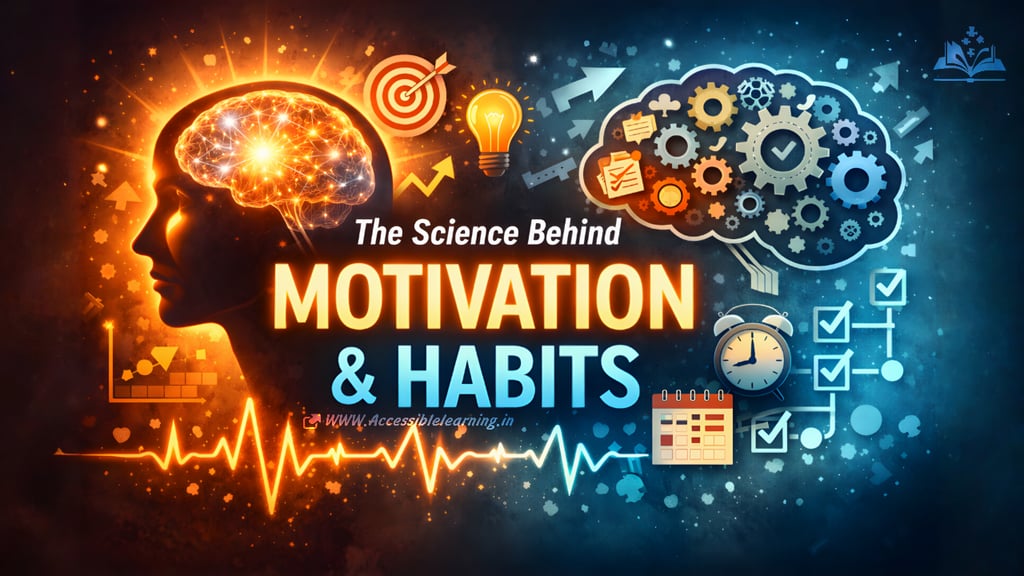
The Science Behind Motivation and Habits!
Motivation fades; habits don’t. This in-depth guide explains the science behind motivation and habit formation using neuroscience, psychology, and real-world behavior. Learn why willpower fails, how habits actually form, how environment shapes action, and how to build systems that work in today’s world and the future. Practical, human-centered, and grounded in how the brain truly works.
SCIENCE/PHILOSOPHYMODERN DISEASESA LEARNINGHEALTH/DISEASE
Kim Shin
2/27/20266 min read
Why understanding this matters now more than ever
Modern life demands constant self-direction. There is less external structure, more choice, more distraction, and higher cognitive load. People are expected to learn continuously, stay healthy, adapt to new technologies, and remain productive without burning out.
In this environment, motivation alone is not enough. It fluctuates too easily. Habits, on the other hand, quietly shape most of what we do every day.
To build a sustainable life, career, or creative practice, we need to understand how motivation starts behavior and how habits carry it forward long after motivation fades.
Motivation is a biological and psychological state, not a personality trait
Motivation is not something you “have” or “lack.” It is a temporary state produced by the interaction of brain chemistry, emotions, expectations, and context.
At a biological level, motivation is influenced by:
Anticipation of future outcomes
Perceived progress toward a goal
Emotional safety and stress levels
Energy availability (sleep, nutrition, mental fatigue)
This explains why the same person can feel highly motivated one day and completely drained the next, even with the same goal.
Key insight:
Low motivation is often a signal that the system around the goal is poorly designed, not that the person is weak.
Dopamine drives learning, not pleasure
Dopamine is central to motivation, but not in the way it is commonly described.
Rather than creating pleasure, dopamine helps the brain learn what actions are worth repeating. It responds strongly to:
Improvement
Novelty
Clear feedback
Unexpected positive outcomes
When progress is unclear or delayed, dopamine activity drops, and motivation declines.
Real-world problem:
Most meaningful goals offer delayed rewards. Learning, fitness, writing, and business growth do not provide immediate feedback, which makes them neurologically difficult to sustain.
Design solution:
Break long-term goals into short cycles with visible progress markers. The brain needs evidence that effort is working.
Motivation is context-dependent and fragile
Motivation does not exist in isolation. It is shaped by environment and emotional state.
Motivation drops sharply when:
Decisions pile up
Stress is high
The goal feels imposed rather than chosen
Failure feels threatening
This is why people often lose motivation during periods of change, uncertainty, or overload.
Important distinction:
Motivation works best as a planning and design tool, not as a daily fuel source.
Habits are automatic behaviors triggered by context
A habit is not repeated effort. It is a learned shortcut.
Once a habit forms:
The brain stops evaluating the goal
The environment triggers the behavior directly
Conscious decision-making is bypassed
This automaticity is handled by brain systems optimized for efficiency, not reflection.
Why this matters:
Habits allow humans to function in complex environments without constant mental strain. They are energy-saving mechanisms.
Repetition alone does not create habits. Context does
Many people repeat behaviors without forming habits because the context keeps changing.
Habits form fastest when:
The behavior happens in the same place
At the same time
After the same preceding action
Under similar emotional conditions
Without stable context, the brain treats each repetition as a new event rather than part of a pattern.
Example:
Exercising “whenever I have time” rarely becomes a habit. Exercising “after waking up, before checking my phone” has a much higher chance.

The real role of rewards in habit formation
Rewards help early learning, but they are not the core driver of long-term habits.
Early phase:
Rewards signal success
Reinforce repetition
Reduce emotional resistance
Later phase:
Context triggers behavior
The reward becomes irrelevant
The habit persists even without enjoyment
This is why many habits feel neutral rather than pleasurable once established.
Why small habits are neurologically superior
Large goals trigger resistance because the brain anticipates effort, risk, and potential failure.
Small habits work because they:
Lower emotional threat
Reduce friction to action
Increase consistency
Create frequent success signals
The brain prioritizes reliability over intensity.
Critical misunderstanding:
Small habits are not the final goal. They are the entry point that trains the habit system.
Scale comes later, naturally, once automaticity is in place.
The motivation–habit handoff
Successful change follows a sequence:
Motivation creates intention
Intention designs the habit
Repetition builds automaticity
Habit sustains behavior
Identity adapts to behavior
Most people fail by skipping step two and trying to power step four with motivation.
Correct strategy:
Use motivation to simplify, not to push.
Environment design is more powerful than self-control
Self-control is cognitively expensive. Environment design is not.
Behavior changes dramatically when:
Desired actions are visible and easy
Undesired actions require effort
Choices are limited by default
Examples:
Tools placed where the action happens
Distractions removed from primary spaces
Defaults aligned with long-term goals
Principle:
If a behavior requires discipline every time, the system is flawed.
Habit formation is non-linear and personal
There is no universal timeline for habit formation.
Automaticity depends on:
Behavioral complexity
Emotional resistance
Consistency of context
Individual neurological differences
Missing days does not destroy habits. What matters is how quickly the pattern resumes.
Better success measure:
Return speed, not perfection.
Identity emerges from repeated action
Identity is not a prerequisite for change. It is a result of it.
When behaviors repeat:
The brain updates self-perception
Internal resistance decreases
The behavior feels more natural
This creates a reinforcing loop:
Action changes identity
Identity lowers effort
Lower effort increases consistency
Long-term habits survive because they align with who a person believes they are.
Motivation and habits in the future world
As AI reduces friction in planning, reminders, and execution, the real challenge will shift from efficiency to meaning.
Future habit systems will focus on:
Personalized behavior design
Reduced cognitive overload
Adaptive feedback
Respect for autonomy and consent
Human motivation will depend less on pressure and more on:
Purpose
Mastery
Emotional sustainability
Those who understand how to design habits will have a significant advantage in learning, creativity, and well-being.
Motivation is powerful but unstable. Habits are quiet but dependable.
Lasting change does not come from wanting something badly or pushing harder. It comes from designing behaviors that fit how the human brain actually works.
When systems replace struggle, consistency becomes natural.
That is the real science behind motivation and habits.

FAQ's
Q: Why do I feel motivated at night but fail to act the next day?
Motivation often increases during low-pressure moments when no action is required. At night, the brain imagines future success without accounting for fatigue, stress, or friction. When morning arrives, real-world costs appear and motivation drops. This is why plans made without considering context often fail.
Q: Can habits form even if I do not enjoy the behavior?
Yes. Enjoyment is not required for habit formation. Habits depend more on repetition in a stable context than pleasure. Many strong habits, such as brushing teeth or checking notifications, persist even when they feel neutral or slightly annoying.
Q: Why do habits break during travel, illness, or schedule changes?
Habits are tied to context, not motivation. When location, timing, or routine changes, the cue disappears. The behavior does not fail. The trigger does. Rebuilding the habit requires anchoring it to a new stable cue.
Q: Is multitasking harmful to habit formation?
Yes. Multitasking weakens habit learning because it reduces attention to the cue-action link. Habits form faster when the behavior is performed with minimal distraction in a consistent environment.
Q: Why do bad habits feel harder to break than good ones?
Unwanted habits often provide immediate relief or stimulation, while good habits offer delayed benefits. The brain prioritizes short-term certainty over long-term outcomes, especially under stress or fatigue.
Q: Does missing days reset habit progress?
No. Habit formation is not a streak-based system. What matters most is how quickly you return to the behavior after interruption. Rapid recovery strengthens long-term consistency more than perfection.
Q: Can motivation be trained or increased long-term?
Motivation becomes more stable when progress is visible, goals feel chosen, and effort consistently leads to improvement. You do not train motivation directly. You train the conditions that support it.
Interesting Facts
Most daily actions are habitual
Studies estimate that around 40 percent of daily behaviors are driven by habits, not conscious decisions. This means your life outcomes are shaped more by systems than by intentions.
The brain prefers consistency over intensity
The brain values predictable repetition more than extreme effort. A small action repeated daily builds stronger neural pathways than large actions performed inconsistently.
Stress strengthens bad habits
Under stress, the brain shifts control from deliberate decision-making to automatic habit systems. This is why people revert to old habits during pressure, even when they know better options.
Habits require less brain energy over time
As habits form, brain activity related to decision-making decreases. This is why established habits feel easier and why starting new behaviors feels mentally exhausting.
Motivation increases after action, not before
Contrary to popular belief, action often creates motivation, not the other way around. Starting generates feedback, progress signals, and confidence, which then fuels further motivation.
Identity changes lag behind behavior
People often wait to feel like “a disciplined person” before acting. In reality, identity updates only after repeated action. Behavior leads. Identity follows.
Removing friction is more effective than adding rewards
Reducing steps, effort, or resistance increases behavior more reliably than offering rewards. Convenience beats incentives in most habit systems.
Habits never fully disappear
Habits do not get erased. They become dormant. When the original context returns, old habits can reactivate quickly, even after long breaks.
The brain dislikes vague goals
Clear, specific actions activate motivation circuits more effectively than abstract goals. “Write one paragraph at 9 am” produces more action than “work on writing.”
Future habit systems will focus on emotion, not discipline
As tools and AI handle reminders and tracking, the limiting factor will be emotional sustainability. Habits that respect energy, autonomy, and meaning will outperform rigid systems.
Subscribe to Frontier Intelligence
All © Copyright reserved by Accessible-Learning Hub
| Terms & Conditions
Accessible Learning Hub — Actionable clarity for high-agency minds.
Weekly breakdowns on AI breakthroughs, capital flow, and human performance systems. Zero fluff.