

The Role of Media Literacy in a Misinformation Age
Media literacy is essential in today’s misinformation age, where false news, AI-generated content, and algorithm-driven platforms shape what people see and believe. This article explores how media literacy helps individuals think critically, recognize manipulation, evaluate sources, and navigate digital information responsibly in a fast-moving, technology-driven world.
A LEARNINGEDUCATION/KNOWLEDGE
Shiv Singh Rajput
2/6/20265 min read
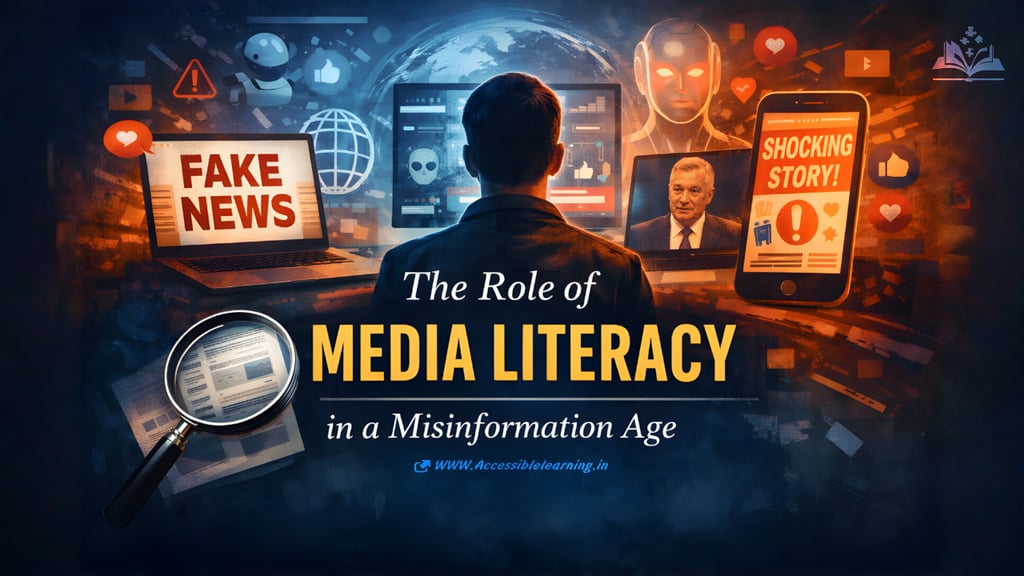
When Information Becomes a Risk
We are not living in an information age anymore. We are living in an interpretation age.
The problem today is not access to information. It is deciding what deserves trust. News, opinions, ads, AI-generated content, influencer narratives, political messaging, and personal posts exist on the same screen, often with no clear distinction between fact, persuasion, and fiction.
Misinformation is no longer rare or accidental. It is systematic, profitable, automated, and emotionally optimized. In this environment, media literacy is the skill that separates awareness from manipulation.
Understanding Media Literacy Beyond the Basics
Media literacy is often misunderstood as simply “spotting fake news.” In reality, it is a multi-layered competency that includes:
Cognitive awareness
Emotional regulation
Digital judgment
Ethical responsibility
Cultural and contextual understanding
True media literacy enables people to decode meaning, not just check facts.
It answers deeper questions like:
Why does this message exist?
Who gains power, money, or influence from it?
Why does it feel urgent or emotional?
Why am I seeing this now?
Types of Misinformation People Encounter Today
False Information (Unintentional)
Incorrect information shared without malicious intent. Often spreads through assumptions, outdated data, or misunderstanding.
Disinformation (Intentional)
Deliberately created false content designed to deceive, influence behavior, or manipulate public opinion.
Malinformation
True information taken out of context to harm, mislead, or distort reality.
Synthetic Media
AI-generated text, images, audio, and video designed to appear real. This includes deepfakes and automated news content.
Understanding these categories is essential to responding correctly instead of reacting emotionally.
The Psychology Behind Why Misinformation Works
Misinformation succeeds because it aligns with human psychology.
Emotional Hooks
Fear, anger, pride, and outrage override rational thinking. Content designed to trigger emotions spreads faster than neutral information.
Cognitive Shortcuts
People rely on mental shortcuts like familiarity, repetition, and social proof. If many people share something, it feels true.
Identity Protection
Information that challenges beliefs feels like a personal attack. People often reject facts to protect identity.
Information Fatigue
When overwhelmed, people stop verifying and start trusting headlines.
Media literacy trains individuals to recognize these psychological traps.
Media Literacy as a Defense Against Algorithmic Influence
Algorithms decide:
What content gets visibility
What ideas feel popular
What narratives feel dominant
Most people believe they are freely choosing content. In reality, content is choosing them.
Media literacy helps users:
Understand algorithmic bias
Recognize echo chambers
Diversify information sources
Break filter bubbles
Avoid radicalization loops
Without this awareness, perception becomes engineered.

Media Literacy and Visual Manipulation
Images and videos feel more trustworthy than text, but they are easier than ever to manipulate. Media literacy includes:
Understanding framing and cropping
Recognizing misleading charts and data visuals
Identifying edited or staged imagery
Questioning viral visuals without context
Understanding visual storytelling techniques
Seeing is no longer believing. Interpretation matters more than appearance.
Media Literacy and Language Manipulation
Language shapes reality. Media-literate individuals can identify:
Loaded words
Emotional framing
Euphemisms and exaggeration
False binaries
Misleading statistics
Sensational headlines
Words are tools. Media literacy teaches how they are used to persuade, distract, or control narratives.
The Role of Media Literacy in Combating Polarization
Misinformation thrives on division. Media literacy helps reduce polarization by:
Encouraging perspective-taking
Separating facts from opinions
Recognizing narrative framing
Understanding cultural context
Avoiding absolutist thinking
It doesn’t force agreement. It supports informed disagreement, which is essential for social stability.
Media Literacy in Professional and Workplace Environments
In professional settings, misinformation can lead to:
Poor decision-making
Financial losses
Reputational damage
Legal risks
Strategic failures
Media-literate professionals can:
Evaluate data sources
Detect biased reports
Assess AI-generated insights
Validate trends before action
Communicate responsibly
This is especially critical in journalism, marketing, policy-making, education, finance, and technology.
Media Literacy for Parents and Families
Children grow up inside digital ecosystems, not outside them. Media literacy helps families:
Teach children to question content
Understand influencer marketing
Identify harmful narratives
Build healthy screen habits
Prevent manipulation and exploitation
Digital literacy without media literacy is incomplete.
Ethical Responsibility in a Share-Driven Culture
Every share amplifies a message. Every repost extends influence. Media literacy includes ethical awareness:
Knowing when not to share
Understanding consequences of virality
Avoiding harm through misinformation
Respecting truth over attention
In the digital age, everyone is a publisher.
Media Literacy as a Civic Skill
Media literacy strengthens:
Informed voting
Public policy understanding
Community dialogue
Resistance to propaganda
Accountability of power
A media-literate population is harder to deceive, divide, or dominate.
Media Literacy in the Context of Global Crises
During pandemics, conflicts, elections, and disasters:
Misinformation spreads faster than official updates
Panic escalates through false narratives
Trust erodes quickly
Media literacy becomes a public safety tool, not just an academic concept.
The Long-Term Impact of Ignoring Media Literacy
Without widespread media literacy:
Truth becomes subjective
Trust collapses
Manipulation becomes normalized
Social cohesion weakens
Democracy erodes
AI-driven misinformation accelerates unchecked
The cost is not abstract. It is social, psychological, political, and economic.

Building Media Literacy at Scale
Effective media literacy requires:
Education system integration
Public awareness campaigns
Platform accountability
Ethical AI development
Community-based learning
Lifelong digital education
It is not a one-time lesson. It is a continuous practice.
Media Literacy Is the New Literacy
Media literacy is no longer optional, technical, or academic.
It is:
A thinking skill
A psychological defense
A civic responsibility
A digital survival tool
A human-centered capability
In a misinformation age, the most powerful skill is not knowing more information. It is knowing how to think about information.
Media literacy does not make people suspicious. It makes them conscious. And consciousness is the foundation of freedom in a digital world.
FAQ's
Q: What is media literacy in simple terms?
Media literacy is the ability to understand, question, and evaluate information from news, social media, videos, images, and digital platforms so you can decide what is reliable and what is misleading.
Q: Why is media literacy important in the age of misinformation?
Media literacy helps people avoid false information, emotional manipulation, online scams, and biased narratives. It allows individuals to make informed decisions instead of reacting based on fear, anger, or viral trends.
Q: How does media literacy help with fake news and deepfakes?
Media literacy teaches people how to verify sources, recognize emotional framing, check context, and question visual authenticity. This makes it easier to identify fake news, AI-generated content, and manipulated images or videos.
Q: Is media literacy only for students and journalists?
No. Media literacy is essential for everyone, including professionals, parents, business owners, voters, and everyday social media users. Anyone who consumes or shares digital content benefits from media literacy skills.
Q: How does media literacy relate to AI-generated content?
Media literacy helps people recognize AI-generated text, images, audio, and videos. It also helps users understand how algorithms and AI systems influence what content they see and trust.
Q: Can media literacy reduce online polarization?
Yes. Media literacy encourages critical thinking, fact-based evaluation, and awareness of bias. This reduces emotional reactions and helps people engage in informed discussions rather than extreme or polarized viewpoints.
Q: How can individuals improve their media literacy skills?
Individuals can improve media literacy by checking multiple sources, questioning headlines, understanding platform algorithms, verifying before sharing, and staying aware of emotional triggers in content.
Media Literacy Safety Tips
Pause Before You Share
If a post makes you feel angry, scared, or excited, pause. Emotional reactions are often a sign of manipulation.
Always Check the Source
Look beyond headlines. Check who created the content, when it was published, and whether the source has a history of credibility.
Cross-Verify Information
Reliable information usually appears across multiple trusted sources. If only one account or website is saying it, be cautious.
Be Skeptical of “Too Perfect” Content
Images, videos, or stories that look unreal or overly dramatic may be edited, staged, or AI-generated.
Watch for Language Tricks
Be alert to exaggerated words like “shocking,” “exposed,” “you won’t believe,” or “the truth they hide.” These are common manipulation tactics.
Pro Tips for Strong Media Literacy
Understand Platform Algorithms
Know that social media platforms show content based on engagement, not accuracy. What you see is curated, not neutral.
Separate Facts From Opinions
Facts can be verified. Opinions reflect beliefs or interpretations. Media literacy means knowing the difference.
Build a Balanced Information Diet
Follow diverse sources with different perspectives. This helps avoid echo chambers and one-sided narratives.
Learn Basic Verification Skills
Reverse image search, date checking, and source tracing are simple skills that significantly reduce misinformation risk.
Treat AI as a Tool, Not an Authority
AI-generated content can be helpful but is not always accurate. Use it as support, not as a final source of truth.
Teach Media Literacy Through Behavior
Children and peers learn more from what you do than what you say. Responsible sharing sets a powerful example.
Value Accuracy Over Speed
Being first is less important than being correct. Responsible consumption builds trust and credibility.
Subscribe to Frontier Intelligence
All © Copyright reserved by Accessible-Learning Hub
| Terms & Conditions
Accessible Learning Hub — Actionable clarity for high-agency minds.
Weekly breakdowns on AI breakthroughs, capital flow, and human performance systems. Zero fluff.