

The Rise of Self-Serve Clinics: How Pharmacies Are Becoming Diagnostic Hubs
Healthcare is entering a new phase where pharmacies, retail clinics, and diagnostic hubs are becoming the first point of care for millions of people. This in-depth article explores the rise of self-serve clinics, the technology behind them, their economic and social impact, regulatory challenges, and what this shift means for the future of healthcare in India and around the world. From AI-powered health kiosks to pharmacy-based diagnostics, understand how healthcare is moving closer to patients and becoming faster, more preventive, and more accessible.
MODERN DISEASESHEALTH/DISEASEAI/FUTURECOMPANY/INDUSTRY
Shiv Singh Rajput
2/25/20266 min read
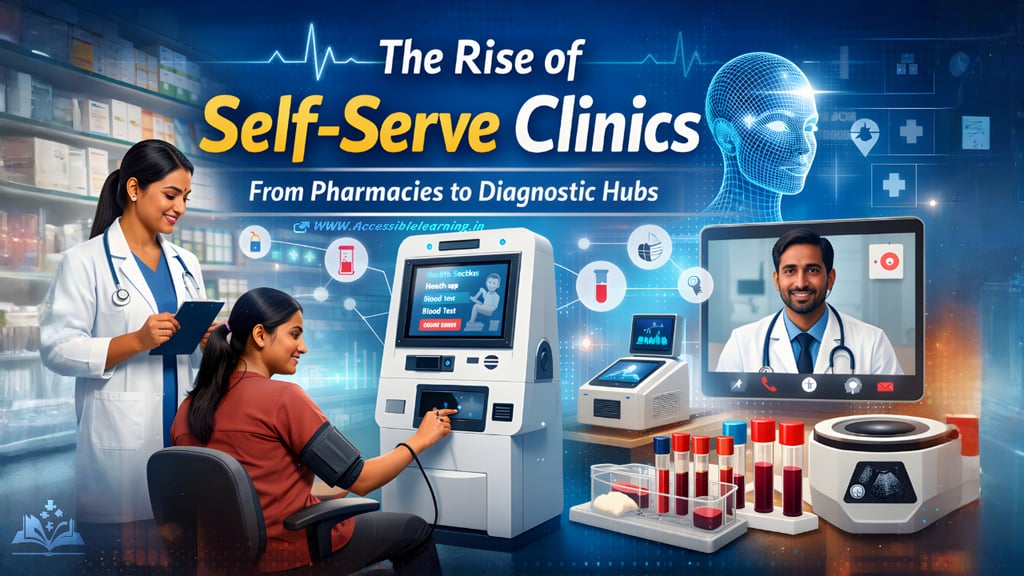
A comprehensive deep dive into the next phase of healthcare delivery!
Disclaimer
This article is for informational and educational purposes only and does not provide medical advice, diagnosis, or treatment. Always consult a qualified healthcare professional for any medical concerns or before making health decisions. Availability, services, and regulations related to self-serve clinics may vary by region.
Healthcare is shifting from centralized hospitals to distributed access points. Pharmacies, retail stores, mobile vans, diagnostic labs, and digital platforms are becoming everyday healthcare providers. This evolution is known as the self-serve clinic model.
It is not about removing doctors. It is about redesigning healthcare access so routine care becomes fast, affordable, and continuous. In countries with overloaded hospitals and uneven healthcare access, this model is becoming essential rather than optional.
What Defines a Self-Serve Clinic?
A self-serve clinic is a healthcare system that enables patients to complete most basic care steps independently or with minimal staff support.
Core Characteristics
Walk-in or appointment-free access
Technology-assisted diagnosis
Standardized testing protocols
Integrated pharmacy and diagnostics
Telemedicine support
Digital medical records
Transparent pricing
Types of Services Offered
Preventive screening
Chronic disease monitoring
Minor illness treatment
Vaccinations
Lab tests
Remote doctor consultation
Health counseling
These clinics focus on routine care, preventive care, and monitoring.
Historical Evolution of Self-Serve Healthcare
Phase 1: Traditional Pharmacy Advice
Pharmacists provided informal medical advice and OTC medicines.
Phase 2: Retail Clinics
Supermarkets and pharmacy chains added vaccination and screening services.
Phase 3: Diagnostic Integration
Labs started offering preventive packages and neighborhood testing centers.
Phase 4: Digital Telehealth
Apps, video consultations, and home sample collection became common.
Phase 5: AI-Powered Self-Serve Clinics
Health kiosks, automated labs, and predictive analytics now guide patient care.
The model evolved gradually, driven by demand, technology, and cost pressure.
Technologies Powering Self-Serve Clinics
Point-of-Care Diagnostics
Portable machines can run tests in minutes:
HbA1c
Lipid profile
Malaria or dengue detection
Rapid infection tests
ECG
These devices are accurate and require minimal training.
Artificial Intelligence
AI assists in:
Symptom triage
Lab interpretation
Risk scoring
Medication interaction alerts
Personalized health advice
AI improves speed and consistency.
Telemedicine Infrastructure
Telemedicine connects patients to specialists remotely. Benefits include:
Rural healthcare access
Lower consultation cost
Faster diagnosis
Multi-specialty consultation
Digital Health Records
Electronic health records allow:
Test history tracking
Medication history review
Doctor collaboration
Insurance integration
Interoperability is key.
Wearables and Remote Monitoring
Devices track:
Heart rate
Sleep patterns
Blood sugar
Oxygen levels
Physical activity
Self-serve clinics use this data to guide care.
Why the Model Is Expanding Globally
Healthcare Workforce Shortages
Many countries face doctor shortages. Self-serve clinics use nurses, pharmacists, and automation to fill the gap.
Urban Lifestyle Pressure
People prefer fast healthcare near home or office.
Preventive Healthcare Awareness
Health packages and wellness culture are increasing demand for regular testing.
Insurance Incentives
Insurance companies encourage preventive screening to reduce long-term treatment costs.
Pandemic Lessons
COVID-19 showed the importance of distributed healthcare systems.
Pharmacies became vaccination and testing centers worldwide.

Economic Impact of Self-Serve Clinics
Lower Healthcare Costs
Early detection reduces expensive treatments later.
New Revenue Streams
Retailers and pharmacy chains can expand services.
Job Creation
Roles include:
Lab technicians
Telehealth coordinators
Health data analysts
Pharmacist consultants
Reduced Hospital Burden
Emergency rooms can focus on serious cases.
Integration with Public Health Systems
Self-serve clinics can support government healthcare programs.
They can help with:
Vaccination drives
Disease surveillance
TB and HIV screening
Maternal health monitoring
Rural diagnostics
Community-based clinics improve early detection of outbreaks.
Self-Serve Clinics in Rural Healthcare
Rural areas face major healthcare gaps. Self-serve clinics can provide:
Telemedicine specialist access
Mobile diagnostic vans
Pharmacy-based screening
Health kiosks in community centers
Solar-powered health kiosks are already used in some remote regions. This reduces travel costs and delays.
Regulatory and Legal Considerations
Healthcare regulation must evolve with this model. Key issues include:
Licensing of pharmacy clinics
Diagnostic accuracy standards
Data privacy laws
Telemedicine compliance
Prescription control
Liability for misdiagnosis
Governments must balance innovation with patient safety.
Ethical Concerns
Over-Testing
Retail clinics may push unnecessary tests.
Patient Consent
Patients must understand test implications.
AI Bias
Algorithms trained on limited data may misjudge certain populations.
Healthcare Inequality
Premium clinics may serve wealthy areas only.
Ethics frameworks are necessary.
Business Models of Self-Serve Clinics
Subscription Healthcare
Monthly plans for screenings and teleconsultations.
Corporate Wellness Programs
Companies partner with clinics for employee health.
Insurance-Linked Clinics
Insurance companies run preventive care clinics.
Franchise Pharmacy Clinics
Pharmacy chains expand using franchise models.
Mobile Clinic Services
Diagnostic vans serve remote communities.
Role of Big Data in Self-Serve Clinics
Data collected from millions of tests can help:
Predict disease trends
Detect outbreaks early
Improve drug development
Understand lifestyle disease patterns
Population-level health insights improve policy planning.


Self-Serve Clinics and Chronic Disease Management
Chronic diseases require long-term monitoring. Self-serve clinics support:
Diabetes tracking
Hypertension monitoring
Thyroid testing
Kidney function checks
Cardiac risk assessment
Regular monitoring reduces complications.
Challenges to Scaling Self-Serve Clinics
Infrastructure Issues
Rural electricity and internet connectivity can be unreliable.
Trust Issues
Patients may distrust automated systems.
Staff Training
Pharmacists need additional medical training.
Data Integration
Different systems may not share records.
Financial Sustainability
Some retail clinic models struggle with profitability.
The Future of Diagnostic Hubs
Future diagnostic hubs may include:
Genetic testing
AI radiology analysis
Real-time disease detection
Personalized medicine plans
Home diagnostic kits connected to clinics
Diagnostics will become predictive, not reactive.
The Role of Startups and Innovation
Startups are building:
Portable lab devices
AI symptom checkers
Remote patient monitoring systems
Health record platforms
Home testing kits
Innovation is lowering healthcare barriers.
Self-Serve Clinics and Digital India
India’s digital health ecosystem supports this model through:
Digital health IDs
Telemedicine platforms
Online pharmacy regulation
UPI payments for healthcare
Health insurance expansion
Urban pharmacy chains and diagnostic networks are expanding rapidly into tier-2 and tier-3 cities.
Training Requirements for Self-Serve Clinics
Staff must be trained in:
Basic diagnosis protocols
Emergency handling
Patient counseling
Data security
Equipment maintenance
Telemedicine etiquette
Human interaction remains important.
Environmental Impact
Self-serve clinics can reduce environmental costs by:
Cutting patient travel
Reducing hospital overcrowding
Using compact equipment
Supporting digital records
However, diagnostic waste management must be handled carefully.
Self-Serve Clinics vs Traditional Healthcare
Traditional healthcare will not disappear. Instead, a hybrid model will emerge. Self-serve clinics handle:
Screening
Monitoring
Minor illness
Hospitals handle:
Surgery
Intensive care
Complex diagnosis
The two systems complement each other.
Long-Term Impact on Healthcare Culture
Self-serve clinics encourage a shift from reactive care to preventive care. Patients become active participants in their health. Healthcare becomes:
Continuous
Personalized
Data-driven
Community-based
This cultural shift may reduce disease burden over decades.
The self-serve clinic is one of the most important healthcare transformations of this century. Pharmacies are becoming community wellness centers. Diagnostic hubs are moving into neighborhoods. AI and telemedicine are connecting patients to doctors instantly.
This model improves access, reduces cost, and encourages preventive care. But it also requires strong regulation, ethical safeguards, and trust. Healthcare is moving from buildings to networks. And the center of that network is the patient.

FAQ's
Q: What is a self-serve clinic in simple terms?
A self-serve clinic is a healthcare setup where patients can get basic medical services quickly, often with minimal doctor interaction. These clinics use technology, trained pharmacists, nurses, and automated diagnostic tools to provide screenings, vaccinations, and teleconsultations.
They focus on routine care, preventive care, and monitoring rather than complex treatment.
Q: Are self-serve clinics safe?
Yes, when properly regulated and operated by trained professionals. Most tests used in self-serve clinics are standardized and approved medical diagnostics.
However, they are meant for basic care. Serious symptoms should always be evaluated by a qualified doctor in a hospital or full clinic.
Q: What services can self-serve clinics provide?
Typical services include:
Blood pressure and sugar testing
Cholesterol screening
Vaccinations
Minor infection treatment
Chronic disease monitoring
Teleconsultation with doctors
Preventive health check packages
Some advanced clinics also offer ECG, thyroid tests, and imaging referrals.
Q: How are pharmacy clinics different from traditional clinics?
Pharmacy clinics are faster and more accessible. They focus on basic care and preventive services.
Traditional clinics handle complex diagnoses, surgery, and specialized treatment.
Both systems work together rather than replacing each other.
Q: Can pharmacists diagnose diseases?
Pharmacists can provide advice and screening, but they usually cannot make full medical diagnoses unless trained under special programs.
They can identify symptoms that require doctor consultation and guide patients accordingly.
Q: Are health kiosks and health ATMs accurate?
Modern health kiosks use certified diagnostic devices and can give reliable readings for routine tests like blood pressure, glucose, and ECG.
Still, results should be reviewed by healthcare professionals for serious decisions.
Q: Why are self-serve clinics becoming popular in India?
India has:
High healthcare costs
Large rural population
Dense pharmacy network
Growing lifestyle diseases
Increasing digital health access
Self-serve clinics improve accessibility and reduce pressure on hospitals.
Q: Do self-serve clinics replace hospitals?
No. They complement hospitals. Self-serve clinics handle routine care, screening, and monitoring. Hospitals handle emergencies, surgery, and complex diseases. This division improves healthcare efficiency.
Q: Are self-serve clinics cheaper?
Usually yes. Costs are lower because of automation, fewer staff requirements, and shorter visits.
Preventive testing also reduces expensive hospital treatments later.
Q: How does AI help in self-serve clinics?
AI tools assist in:
Symptom checking
Lab result analysis
Drug interaction alerts
Health risk prediction
Personalized recommendations
AI improves speed and consistency but still requires human supervision.
Q: Is my health data safe in self-serve clinics?
Data security depends on the clinic’s systems. Reputable clinics use encrypted digital records and follow privacy laws.
Patients should choose trusted providers and avoid sharing medical data on unknown apps.
Q: Who benefits most from self-serve clinics?
People in rural areas
Busy urban workers
Chronic disease patients
Elderly patients needing monitoring
Preventive health seekers
They improve access and convenience for everyday healthcare needs.
Q: Can self-serve clinics handle emergencies?
No. They are not designed for emergencies like heart attacks, severe injuries, or critical illnesses.
Patients must go to hospitals or emergency services in such cases.
Q: What is the future of self-serve clinics?
Future clinics may combine:
AI diagnostics
Pharmacy care
Lab testing
Telemedicine
Home delivery
Wearable health tracking
Healthcare will become continuous and preventive rather than occasional.
Q: Are self-serve clinics profitable businesses?
They can be profitable when integrated with pharmacies, diagnostics, insurance partnerships, and corporate wellness programs.
However, success depends on trust, quality care, and proper regulation.
Q: How can patients choose a reliable self-serve clinic?
Look for:
Certified equipment
Licensed staff
Transparent pricing
Good reviews
Doctor teleconsultation support
Secure digital records
Trust and quality matter more than convenience.
Subscribe to Frontier Intelligence
All © Copyright reserved by Accessible-Learning Hub
| Terms & Conditions
Accessible Learning Hub — Actionable clarity for high-agency minds.
Weekly breakdowns on AI breakthroughs, capital flow, and human performance systems. Zero fluff.