

The Rise of Agentic AI: Why Asking Questions Is No Longer Enough
Agentic AI is redefining the future of work by moving beyond simple question-and-answer interactions. Discover how autonomous AI agents can plan, research, make decisions, and complete complex projects independently, and why the most valuable skill in 2026 is no longer prompt engineering but managing, evaluating, and directing AI-driven outcomes.
ARTIFICIAL INTELLIGENCE & FUTURE TECH
Sachin K Chaurasiya
6/12/20267 min read
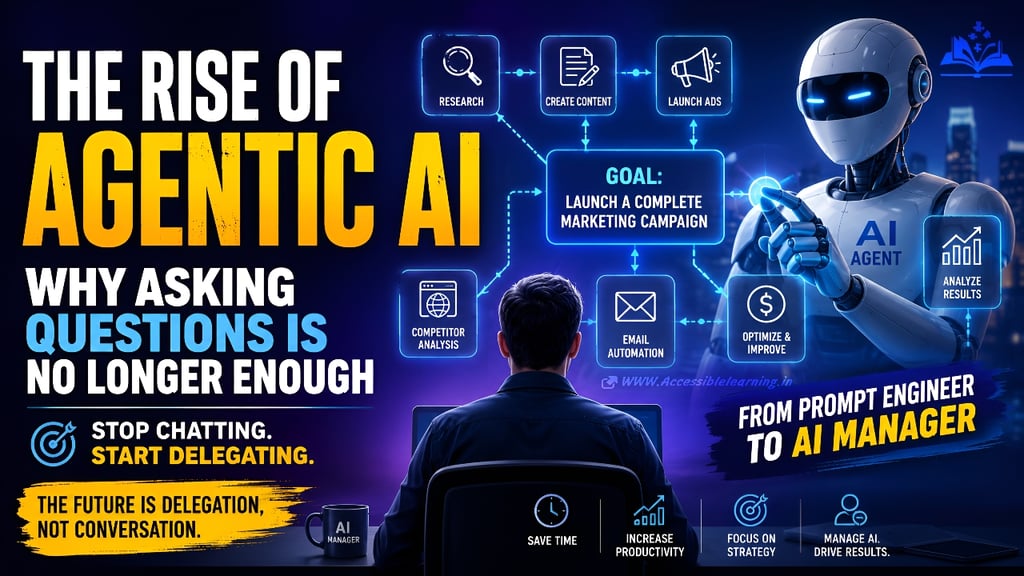
Stop Chatting with AI. Start Delegating to It.
For the last few years, people have been obsessed with learning how to talk to AI.
They learned prompts.
They learned prompt engineering.
They learned how to ask better questions.
And for a while, that worked. But the world has changed faster than most people realize. The biggest mistake someone can make in 2026 is believing AI is still a chatbot waiting for instructions.
It isn't.
The era of Generative AI is rapidly being replaced by the era of Agentic AI. Instead of asking AI a question and receiving an answer, you now give AI a goal and receive a completed outcome.
That difference sounds small. It changes everything. The future belongs to people who know how to manage AI systems, not people who spend hours doing tasks AI can already perform autonomously.
The question is no longer
"How do I use AI?"
The question is
"How do I supervise AI that is already working for me?"
What Is Agentic AI?
Agentic AI refers to AI systems capable of planning, reasoning, making decisions, using tools, and executing multi-step tasks with minimal human intervention.
Traditional AI responds. Agentic AI acts.
A traditional chatbot might answer:
"Here is how you create a marketing campaign."
An AI agent might:
Research competitors
Analyze customer reviews
Build a campaign strategy
Generate ad creatives
Create landing page copy
Set up automation workflows
Track performance metrics
Suggest improvements
All without requiring instructions for every step. The difference is similar to hiring a consultant versus hiring an employee. One gives advice. The other gets the work done.
Generative AI vs Agentic AI
Generative AI
The first wave of AI focused on content generation. You ask. AI answers. Examples include:
Writing articles
Generating emails
Creating images
Producing code snippets
Summarizing documents
Human involvement remains high. The AI waits for the next instruction.
Agentic AI
The second wave focuses on autonomous execution. You provide a goal. The AI determines:
What tasks need to happen
Which tools to use
What information to gather
What sequence of actions to follow
How to adjust when something changes
Human involvement shifts from execution to oversight. The AI becomes an operator rather than a responder.

Why Agentic AI Is Becoming the 2026 Standard
Several technological breakthroughs have converged at the same time.
Better Reasoning Models
Modern AI can break large objectives into smaller, actionable steps.
Instead of needing detailed instructions, it can build its own execution plan.
Tool Usage
AI systems can now connect to:
Browsers
APIs
Databases
Spreadsheets
Project management tools
Design software
Development environments
This allows them to take action instead of merely generating text.
Memory Systems
Agentic AI remembers context over time.
Projects no longer reset every conversation.
The system understands ongoing goals and adjusts accordingly.
Multi-Agent Collaboration
Multiple AI agents can work together.
One researches.
One writes.
One verifies.
One analyzes.
One manages quality control.
Together they can complete complex workflows that previously required entire teams.
The Death of Prompt Engineering as a Competitive Advantage
This may be uncomfortable to hear. But prompt engineering is rapidly becoming less valuable. Not because prompts are useless. Because the systems are becoming smart enough to figure out what you mean.
Most people spent the last few years learning how to craft perfect prompts. The next generation of AI is designed specifically so average users do not need to. The value is moving elsewhere.
The real skill is no longer
"Can you write a good prompt?"
The real skill is
"Can you define a valuable objective?"
And even more importantly:
"Can you judge whether the result is actually good?"
The New Professional Role: AI Manager
Many jobs are quietly evolving. The future worker increasingly resembles an AI manager. Their responsibilities include:
Setting Goals
Defining outcomes clearly. Example:
Bad objective:
"Make me a website."Good objective:
"Create a conversion-focused landing page targeting SaaS founders generating leads under a $50 acquisition cost."
Reviewing Outputs
AI can work quickly. It can also make mistakes quickly. Managers evaluate:
Accuracy
Logic
Compliance
Brand consistency
Risk
The human remains responsible for quality control.
Making Strategic Decisions
AI can generate options.
Humans decide which option aligns with business goals.
Judgment becomes more valuable than production.
Handling Exceptions
Most tasks become automated.
Unusual situations become human responsibilities.
People increasingly solve edge cases while AI handles routine execution.
Why Most People Are Preparing for the Wrong Future
A huge percentage of workers still believe job security comes from execution skills. Historically this was true.
Knowing how to:
Write code
Design graphics
Build spreadsheets
Create reports
Run research
Created value. Now AI performs many of these tasks at increasingly high levels.
The bottleneck is shifting.
The scarce resource is no longer production.
The scarce resource is judgment.
Organizations need people who can answer the following:
Is this strategy correct?
Is this information reliable?
Does this solution align with objectives?
What risks are hidden beneath the output?
These are management questions, not production questions.

The Industries Being Transformed First
Software Development
AI agents can:
Write code
Debug systems
Test applications
Deploy updates
Monitor performance
Developers increasingly supervise systems instead of writing every line manually.
Marketing
Agentic AI can:
Conduct market research
Generate campaigns
Produce content
Manage advertising
Analyze performance
Marketers become strategic directors rather than content factories.
Customer Support
AI agents handle:
Ticket classification
Response generation
Escalation management
Knowledge retrieval
Human agents focus on complex customer situations.
Research
AI can process thousands of documents in minutes.
Researchers spend less time collecting information and more time validating conclusions.
Operations
Businesses are deploying agents that manage:
Scheduling
Reporting
Procurement
Workflow automation
Resource allocation
Entire departments are becoming partially autonomous.
The Hidden Risk of Agentic AI
The hype often ignores an important reality.
Autonomous systems create autonomous mistakes.
An AI agent can confidently execute a bad plan.
It can:
Misinterpret objectives
Use outdated information
Produce flawed analysis
Make expensive decisions
And because it acts quickly, the damage can scale rapidly. This is why oversight becomes more important, not less. Organizations that blindly trust AI will experience failures. Organizations that supervise AI effectively will gain enormous advantages.
The Most Valuable Skill of the Next Decade
People often ask:
"What should I learn if AI can do everything?"
The answer surprises many people. You should learn how to evaluate. Not just create. Evaluate. The ability to assess quality becomes one of the highest-value skills in the economy. Future professionals will need expertise in:
Critical Thinking
Can the conclusion be trusted?
Domain Knowledge
Does the output make sense within the industry?
Risk Assessment
What could go wrong?
Decision-Making
Which option creates the best outcome?
Systems Thinking
How does one action affect the broader system?
These skills remain difficult to automate.
The New Learning Model
For decades education focused on teaching people how to perform tasks. The next era focuses on teaching people how to supervise systems performing those tasks.
Instead of learning:
How to manually create a marketing report.
You learn:
How to evaluate a report generated by AI.
Instead of learning:
How to write every line of code.
You learn:
How to assess whether AI-generated code is secure, scalable, and maintainable.
Knowledge remains important.
But its purpose changes.
You learn enough to verify, not necessarily enough to execute every step manually.
What Businesses Must Do Right Now
Organizations waiting for Agentic AI to mature are already behind. The technology is moving faster than traditional adoption cycles. Leaders should begin:
Mapping Repetitive Work
Identify tasks that follow predictable workflows.
Creating Oversight Processes
Build human review layers for critical decisions.
Training Employees
Focus on evaluation, supervision, and strategic thinking.
Establishing Governance
Define what AI agents can and cannot do autonomously.
Measuring Outcomes
Track productivity gains and quality risks simultaneously.

The Future Is Delegation, Not Conversation
The biggest misconception about AI is that it remains a tool for generating answers.
That era is ending.
The next generation of AI is becoming a workforce.
A digital workforce.
The winners of the next decade will not be the people who know the most prompts. They will be the people who know how to direct, supervise, and evaluate autonomous systems.
The shift is profound. For centuries, humans created value by doing work.
In the age of Agentic AI, value increasingly comes from deciding what work should be done and ensuring it is done correctly.
That is why asking questions is no longer enough.
The future belongs to those who can delegate outcomes, verify results, and manage intelligent agents at scale.
The age of chatting with AI was only the beginning.
The age of managing AI has already arrived.
FAQ's
Q: What is Agentic AI in simple terms?
Agentic AI is an advanced form of artificial intelligence that can independently plan, make decisions, use tools, and complete multi-step tasks to achieve a goal. Unlike traditional AI chatbots that only answer questions, Agentic AI can take action and execute entire workflows with minimal human guidance.
Q: How is Agentic AI different from Generative AI?
Generative AI creates content such as text, images, videos, or code based on user prompts. Agentic AI goes further by analyzing goals, creating plans, using software tools, gathering information, and completing tasks autonomously. In short, Generative AI generates outputs, while Agentic AI generates outcomes.
Q: Why is Agentic AI becoming important in 2026?
Agentic AI is becoming important because businesses want automation beyond content creation. Organizations are using AI agents to manage research, software development, marketing campaigns, customer support, data analysis, and operational workflows, increasing productivity while reducing manual effort.
Q: What are examples of Agentic AI applications?
Common Agentic AI applications include the following:
Automated market research
Software development and debugging
Customer support automation
Project management
Sales prospecting
Content production workflows
Business process automation
Data analysis and reporting
Q: Will Agentic AI replace human jobs?
Agentic AI will automate many repetitive and predictable tasks, but it is more likely to transform jobs than eliminate all of them. Human roles are increasingly shifting toward strategic planning, decision-making, oversight, quality control, and managing AI-driven systems.
Q: What skills are most valuable in the age of Agentic AI?
The most valuable skills include:
Critical thinking
Problem-solving
Strategic planning
AI supervision
Risk assessment
Decision-making
Domain expertise
Communication and leadership
As AI handles execution, human value increasingly comes from evaluation and judgment.
Q: What is an AI Manager?
An AI Manager is someone who directs, supervises, and evaluates AI systems. Instead of performing every task manually, they define objectives, review outputs, identify errors, and ensure AI-generated work aligns with business goals and quality standards.
Q: Can Agentic AI make mistakes?
Yes. Agentic AI can misunderstand instructions, use inaccurate information, make flawed decisions, or execute incorrect actions. Because it operates autonomously, human oversight remains essential to prevent costly errors and ensure reliability.
Q: Is prompt engineering still important with Agentic AI?
Prompt engineering still has value, but its importance is decreasing as AI systems become better at understanding goals and context. The bigger advantage now comes from defining clear objectives and evaluating AI-generated outcomes rather than crafting perfect prompts.
Q: How can businesses prepare for Agentic AI?
Businesses can prepare by:
Identifying repetitive workflows
Implementing AI automation gradually
Training employees to supervise AI systems
Establishing governance and compliance policies
Creating review processes for AI-generated work
Focusing on measurable business outcomes
Q: What industries will benefit most from Agentic AI?
Industries expected to see major benefits include:
Software development
Marketing and advertising
Customer service
Finance
Healthcare administration
E-commerce
Research and consulting
Operations and logistics
Q: What is the future of Agentic AI?
The future of Agentic AI involves autonomous digital workers capable of handling increasingly complex projects across multiple platforms. Organizations will likely manage teams consisting of both human employees and AI agents, with humans focusing on strategy, ethics, innovation, and oversight.
Q: What are the risks of Agentic AI?
Key risks include:
Incorrect decision-making
Security vulnerabilities
Data privacy concerns
Lack of transparency
Over-reliance on automation
Regulatory and compliance issues
Strong governance and human supervision are critical for reducing these risks.
Q: Will everyone need to learn how to manage AI agents?
Most likely, yes. Just as basic computer literacy became essential in the digital era, AI management skills are expected to become increasingly important across industries. Understanding how to guide, monitor, and evaluate AI systems may become a fundamental professional skill.
Q: Why is asking questions no longer enough in the AI era?
Because modern AI is evolving from an answer engine into an action engine. Success is no longer about getting information from AI. It is about setting goals, delegating tasks, supervising execution, and ensuring the final outcome meets real-world objectives. This shift marks the transition from using AI as a tool to managing AI as a workforce.
Subscribe to Frontier Intelligence
All © Copyright reserved by Accessible-Learning Hub
Accessible Learning Hub — Actionable clarity for high-agency minds.
Weekly breakdowns on AI breakthroughs, capital flow, and human performance systems. Zero fluff.