

The Rise of “Abliterated” Models: How Llama 3.2 Dark Champion Changes Everything
Explore the rise of obliterated AI models and how Llama 3.2 Dark Champion challenges traditional AI safety systems. Learn how developers surgically remove alignment layers from neural networks, why this technique matters for AI research, and what it means for the future of AI safety, open-source development, and model governance.
AI ASSISTANTAI/FUTUREEDITOR/TOOLS
Sachin K Chaurasiya
3/19/20269 min read
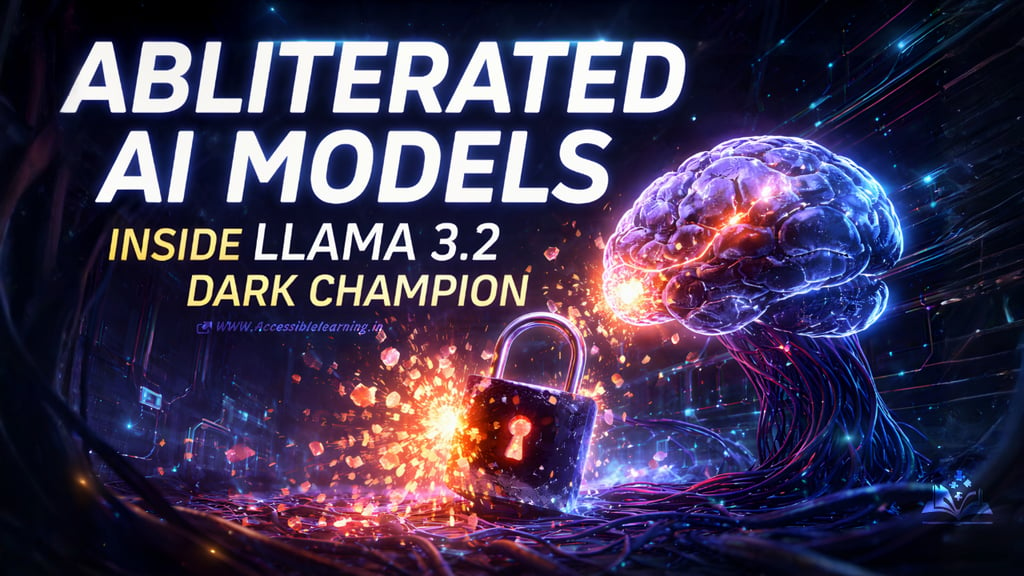

Artificial intelligence is moving fast, but one of the most interesting changes is happening quietly behind the scenes. A new category of AI systems is emerging where developers intentionally remove built-in safety restrictions from large language models.
These systems are often called “abliterated models.” One example that has sparked strong discussion in the AI community is Llama 3.2 Dark Champion, a modified version of the Llama architecture where key safety mechanisms have been deliberately removed.
This development raises an important technical question:
What happens when the safety layer of an AI model is surgically removed while its intelligence remains intact?
To understand why this matters, we need to explore how safety works inside AI models and how developers are learning to alter it.
Understanding Safety Layers in Modern AI Models
Large language models are trained in multiple stages. The first stage involves learning from massive datasets that include books, websites, research papers, and conversations. During this phase, the model learns patterns in language and develops reasoning abilities.
However, this raw training alone is not considered safe for public use. Because of this, developers apply a second training phase known as alignment.
Alignment training teaches the model how to behave responsibly. This includes:
Refusing harmful or dangerous requests
Avoiding illegal or unethical instructions
Redirecting sensitive questions toward safer answers
Following ethical guidelines
As a result, many AI systems respond to certain prompts with phrases like:
“I’m unable to help with that.”
These responses are not random. They come from patterns the model learned during alignment training.
What Is an Abliterated AI Model?
An abliterated model is a language model where the internal mechanisms responsible for refusal behavior have been removed or weakened. Instead of retraining the entire model from scratch, developers modify specific parts of the neural network that control safety responses. The goal is not to remove the model’s intelligence. The goal is to remove the internal signal that tells the model to reject certain requests.
In practical terms, this means:
The model still understands language
It can still reason and follow instructions
But it stops automatically refusing certain prompts
Because of this, abliterated models often produce answers that aligned models would normally block.
Introducing Llama 3.2 Dark Champion
Llama 3.2 Dark Champion is one of the most discussed examples of this approach. The model is built on a Mixture-of-Experts architecture, which means it uses multiple smaller neural networks instead of a single massive one. Each “expert” specializes in handling different types of tasks.
Key characteristics include:
Multiple expert networks working together
Around 18 billion parameters in total capacity
Long context window for handling large prompts
Dynamic expert selection during responses
But the feature that attracts the most attention is the removal of alignment safeguards. Developers behind this version intentionally altered the internal safety mechanisms, creating a system that responds more freely to prompts that standard models would normally reject.
Why Developers Are Experimenting With Abliterated Models
While controversial, these models are not created only for experimentation or curiosity. Several motivations are driving interest in this area.
Understanding AI Alignment
Alignment is one of the biggest challenges in modern AI research. By removing safety layers, researchers can study how these systems behave without restrictions. This helps them understand:
Which parts of the neural network control refusal behavior
How stable alignment training actually is
Whether safety mechanisms can be reversed
These insights help researchers build stronger safety systems in future models.
Exploring Creative Freedom
Some developers argue that safety layers sometimes block legitimate requests. For example, writers and researchers might want to explore topics that are sensitive but still important in academic or creative contexts.
Abliterated models allow users to experiment with:
Fiction writing
speculative storytelling
historical analysis
complex philosophical debates
Without automatic refusals interrupting the process.
Building Advanced AI Agents
Developers building AI automation systems often face a challenge: aligned models sometimes refuse instructions that are necessary for technical workflows. For example, automation systems may require:
unrestricted reasoning
deeper technical explanations
complex problem solving without interruptions
Some researchers believe that removing refusal layers can improve the flexibility of AI agents.
How Safety Signals Exist Inside Neural Networks
One surprising discovery from AI interpretability research is that refusal behavior often corresponds to specific patterns in a model’s internal activations.
Inside a transformer-based language model, information flows through layers of neural computations. These layers create representations of meaning. When the model detects a prompt that violates its alignment rules, certain activation patterns appear inside the network.
These patterns act like a signal that says:
“Trigger refusal behavior.”
Researchers sometimes refer to this as a refusal direction inside the neural network.
The Technical Idea Behind Abliteration
The technique used to remove refusal behavior usually follows a few steps.
Step 1: Compare Safe and Unsafe Prompts
Researchers run two groups of prompts through the model:
prompts that trigger refusals
prompts that do not trigger refusals
They then analyze the internal activations of the model during both cases.
Step 2: Identify the Refusal Pattern
By comparing the activations, researchers can detect a consistent difference in the network’s internal signals.
This difference forms a mathematical direction that represents refusal behavior.
Step 3: Remove the Refusal Direction
Once the refusal direction is known, developers modify the model so that activations are pushed away from that direction.
In simple terms, they subtract the refusal signal from the model’s internal computations.
When this signal disappears, the model no longer triggers its refusal response.
Step 4: Evaluate the Result
After the modification, the model is tested again. Researchers measure:
how often the model refuses prompts
whether reasoning ability remains intact
whether the model still follows instructions correctly
Interestingly, many experiments show that removing the refusal signal does not significantly damage the model’s general intelligence.
Why This Trend Is Important
The rise of abliterated models reveals something surprising about AI systems. It suggests that safety alignment may not be deeply embedded into a model’s intelligence. Instead, it may function more like a layer that can be modified or removed. This has several implications.
Alignment Might Be Fragile
If safety mechanisms can be removed with relatively small modifications, it means alignment might be easier to reverse than previously thought.
This raises new questions about how durable current safety techniques really are.
Open-Source AI Is Becoming More Capable
OpenAI communities are gaining the tools needed to analyze and modify powerful models.
This means independent developers can experiment with model alignment, architecture, and performance in ways that were previously limited to large technology companies.
Regulation May Become More Difficult
If safety layers can be removed after a model is released, regulating AI systems becomes more complicated.
Even if a model is initially released with strong guardrails, modified versions could appear that behave very differently.


Possible Benefits of Abliterated Models
Despite the controversy, these models still offer valuable uses. Some legitimate applications include:
studying AI alignment mechanisms
testing robustness of safety systems
building experimental AI agents
developing advanced creative writing tools
researching neural network interpretability
In research settings, abliterated models can act as a kind of stress test for AI safety strategies.
Ethical Concerns and Risks
At the same time, the risks cannot be ignored. Without safety mechanisms, AI systems may generate responses that include:
harmful instructions
misinformation
unethical recommendations
dangerous technical guidance
Because of this, responsible deployment becomes critical. Developers and researchers must carefully control how these models are used.
Interpretability Research Is Accelerating
One major reason abliteration is possible at all is the progress in AI interpretability research. Scientists are increasingly able to analyze the internal structure of neural networks and understand what different parts of the model represent.
Instead of treating a model as a mysterious “black box,” researchers now map patterns such as:
refusal behavior
politeness signals
reasoning activations
safety triggers
By identifying these internal signals, developers can manipulate specific behaviors without retraining the entire model. This is a major shift from earlier AI systems, where such fine control was nearly impossible.
The Difference Between Censorship and Alignment
In many discussions, safety alignment is sometimes mistaken for censorship. In reality, the two concepts are technically different.
Alignment means training the model to behave according to certain ethical guidelines and safety policies.
Censorship implies blocking information based on external rules.
The distinction matters because abliteration does not simply remove external filters. It removes internal behavioral conditioning learned during alignment training. That means the model’s behavior changes at a structural level inside the neural network.
Emergence of Alignment Engineering
A new technical field is slowly forming around what some researchers call alignment engineering. Instead of only training models, developers now experiment with:
modifying alignment layers
adjusting refusal thresholds
tuning safety response patterns
controlling behavioral traits inside the network
In the future, this may become a standard part of AI development where different versions of a model exist with different alignment configurations.
Why Abliteration Does Not Always Break Intelligence
One surprising observation is that removing refusal behavior often does not significantly damage reasoning ability. This happens because safety training usually affects only a small portion of the network’s behavior. The core intelligence of the model comes from the massive dataset used during pretraining.
In simple terms:
Pretraining builds intelligence
Alignment modifies behavior
Because these processes are somewhat separate, removing alignment signals does not necessarily destroy the model’s knowledge or reasoning capability.
The Rise of Community-Modified AI Models
Another important development is the growth of community-driven model modifications.
Open-source AI communities are increasingly experimenting with:
alternative alignment approaches
performance optimizations
memory improvements
specialized expert networks
model compression techniques
Abliteration is just one example of how independent developers are reshaping existing AI systems.
This trend is similar to what happened in the early days of open-source software, where communities rapidly improved and modified existing tools.
Implications for AI Safety Strategy
The discovery that alignment signals can be altered after training has important implications. It suggests that relying only on internal alignment may not be enough for long-term AI safety.
Future safety strategies may include:
layered safety systems
external monitoring tools
usage-based safeguards
controlled model distribution
Instead of depending on a single defense mechanism, AI safety may evolve toward a multi-layered approach.
The Growing Debate Around Open vs Controlled AI
The rise of abliterated models has also intensified a broader debate in the AI world. Some experts argue that open models encourage innovation, transparency, and faster research progress.
Others worry that unrestricted models could be misused if powerful systems become widely available without safeguards. This debate will likely shape future policies around how advanced AI systems are released and shared.

The Future of AI Safety
The emergence of abliterated models is forcing the AI community to rethink how safety should work. Future AI systems may rely on multiple layers of protection instead of relying only on internal alignment.
Possible approaches include:
external moderation systems
usage monitoring
stronger evaluation frameworks
policy-controlled access to models
runtime safety filters
Rather than placing all responsibility inside the model itself, future systems may combine several safety layers working together.
The rise of abliterated models such as Llama 3.2 Dark Champion marks a significant moment in the evolution of artificial intelligence. By removing the internal mechanisms responsible for refusal behavior, developers have shown that AI alignment can be altered without destroying the model’s core capabilities. For researchers, this discovery offers valuable insight into how neural networks handle safety and decision-making.
For the broader AI ecosystem, it highlights an important reality: safety is not a permanent property of a model. It is something that can be engineered, modified, and potentially removed. As AI technology continues to advance, understanding these mechanisms will become essential for building systems that are both powerful and responsible.
FAQ's
Q: What is an abliterated AI model?
An abliterated AI model is a modified language model where the internal signals responsible for refusal behavior and safety alignment have been removed or weakened. The model still retains its knowledge and reasoning abilities but responds more freely to prompts that aligned models might reject.
Q: How does AI abliteration work?
AI abliteration works by identifying the internal activation patterns that trigger refusal responses inside a neural network. Developers then modify the model so that these signals are suppressed or removed, preventing the system from automatically rejecting certain prompts.
Q: What is Llama 3.2 Dark Champion?
Llama 3.2 Dark Champion is a modified version of the Llama architecture designed with reduced safety alignment. It uses a mixture-of-experts structure and has been adjusted so that many of the refusal mechanisms present in aligned models are removed.
Q: Are abliterated AI models more powerful than aligned models?
Abliterated models are not necessarily more powerful in terms of intelligence. Their core reasoning ability usually remains similar to the original model. The main difference is that they produce fewer refusal responses and allow more unrestricted output.
Q: Why are researchers studying alignment removal in AI?
Researchers study alignment removal to better understand how safety behaviors are encoded inside neural networks. By analyzing how alignment works and how it can be altered, scientists can design stronger and more reliable safety mechanisms for future AI systems.
Q: Do abliterated models affect AI reasoning or knowledge?
In many cases, removing safety signals does not significantly affect the model’s knowledge or reasoning abilities. This is because the majority of a model’s intelligence comes from its pretraining data rather than the alignment stage.
Q: What are the risks of abliterated AI models?
The main risks include the generation of harmful or unsafe information, reduced safeguards against misuse, and the possibility that unrestricted systems could be deployed without proper oversight.
Q: Will abliteration become a common AI development technique?
It is still uncertain. While the technique is useful for research and experimentation, most production AI systems will likely continue using strong safety alignment and additional protective layers to prevent misuse.
Subscribe to Frontier Intelligence
All © Copyright reserved by Accessible-Learning Hub
| Terms & Conditions
Accessible Learning Hub — Actionable clarity for high-agency minds.
Weekly breakdowns on AI breakthroughs, capital flow, and human performance systems. Zero fluff.