

The "Reverse Mentoring" Exhaustion: The Hidden Cost of Becoming the Family IT Department
In today's digital world, millions of young people have become the unofficial tech support team for their families. From digital payments and smartphone updates to AI tools and online services, the burden of teaching modern technology increasingly falls on younger generations. This growing phenomenon, known as reverse mentoring, creates hidden stress for young adults while quietly affecting the confidence, independence, and traditional family roles of older generations. As technology becomes essential to everyday life, the need for age-friendly design, accessible digital education, and more inclusive learning systems has never been greater.
ACCESSIBLE LEARNING
Shiv Singh Rajput
6/7/202610 min read
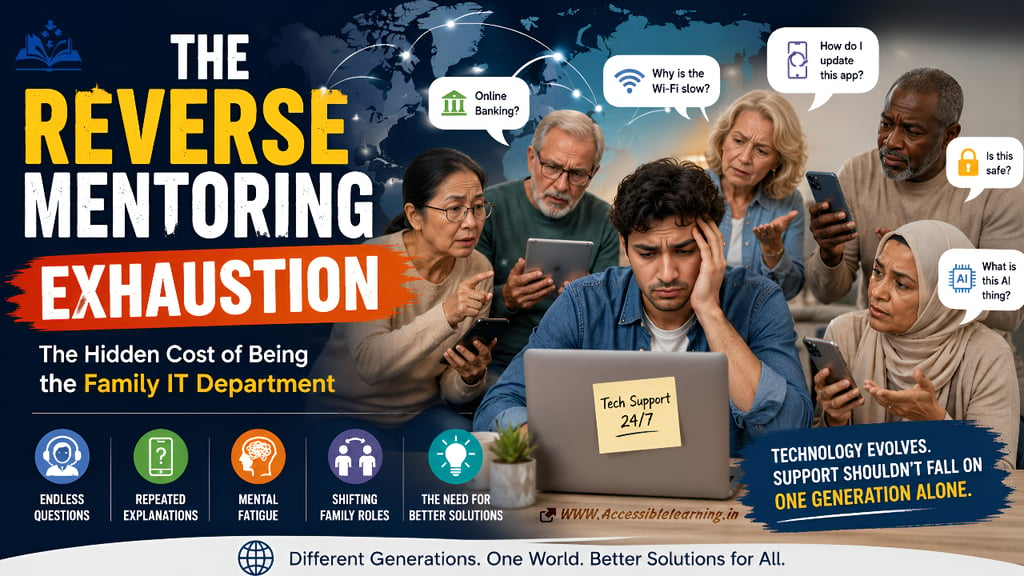
The Secret Frustration of Being the Family IT Department
It starts with a simple phone call.
"Why isn't my payment app working?"
"Where did my photos go?"
"Can you update this?"
"What's this AI thing everyone is talking about?"
For millions of young adults, these questions have become a normal part of everyday life. Whether they are students, professionals, or entrepreneurs, they often serve an unofficial role within their families: the permanent technology support team.
At first, helping parents and grandparents navigate digital tools feels meaningful. Teaching a father how to use online banking, helping a mother order groceries through an app, or showing grandparents how to video call relatives can strengthen family bonds.
But over time, something less discussed begins to emerge. Exhaustion.
Not because younger people dislike helping their families, but because society increasingly assumes they should carry the responsibility of teaching older generations how to navigate a rapidly digitizing world.
This phenomenon has quietly created a form of "reverse mentoring" that many families experience but rarely talk about.
What Is Reverse Mentoring?
Traditionally, knowledge flowed downward through generations. Parents taught children how to navigate life.
Grandparents passed down wisdom, values, practical skills, and cultural traditions.
The older generation served as guides. Technology has disrupted that pattern.
Today, younger family members often teach older relatives how to:
Use smartphones
Manage digital payments
Navigate government portals
Understand cybersecurity
Operate smart devices
Use social media safely
Manage cloud storage
Understand AI tools
Handle software updates
Recover forgotten passwords
In many households, expertise now flows upward instead of downward. This reversal itself is not a problem. The problem arises when the teaching responsibility becomes permanent.
The Rise of the Family IT Department
Digital infrastructure has expanded faster than society's ability to teach people how to use it. Consider how many essential activities now require digital literacy:
Banking
Healthcare appointments
Government services
Transportation booking
Communication
Utility payments
Tax filing
Shopping
Education
Identity verification
Tasks that once required human interaction increasingly require navigating apps, websites, passwords, verification codes, and security settings. When older adults struggle, younger family members naturally step in. Over time, however, assistance turns into dependency.
Many young adults report being responsible for:
Setting up devices
Remembering passwords
Troubleshooting errors
Updating software
Preventing scams
Managing subscriptions
Teaching the same processes repeatedly
The result is an invisible workload that receives little recognition.
Why It Feels So Draining
The exhaustion isn't simply about technology. It comes from a combination of emotional and psychological pressures.
Repetition Fatigue
One of the biggest challenges is repetition.
A process explained several times may still be forgotten.
The same questions return.
The same instructions must be repeated.
The same mistakes occur.
Young family members often feel guilty for becoming impatient, even though constant repetition naturally creates frustration.
Constant Availability
Technology problems don't follow schedules. Questions arise during:
Work hours
Vacations
Weekends
Family gatherings
Late evenings
Many young adults feel permanently "on call." They become the household's emergency technical support service.
Emotional Responsibility
The burden extends beyond fixing devices.
When an online payment fails, emotions are involved.
When a scam attempt occurs, fear is involved.
When an important document disappears, anxiety is involved.
The younger person is expected not only to solve the technical issue but also to manage the emotional stress surrounding it.
The Invisible Labor Problem
Society rarely acknowledges digital assistance as labor.
Cooking dinner is visible.
Driving someone somewhere is visible.
Repairing a phone, resetting accounts, updating apps, and teaching technology are often invisible forms of work.
Because they happen behind screens, their mental cost is underestimated.

The Hidden Cost to Older Generations
The conversation usually focuses on how tired younger people feel. But another consequence receives far less attention. It can quietly damage the confidence and dignity of older adults.
Feeling Left Behind
Technology evolves at extraordinary speed. An older adult who successfully learned computers ten years ago may suddenly face
Mobile-first systems
Biometric authentication
QR payments
AI-powered interfaces
Constant app redesigns
What was mastered yesterday may become obsolete tomorrow. This creates a painful feeling of always being behind.
Losing the Role of Family Guide
For centuries, older generations occupied a respected position as sources of knowledge and guidance.
Many parents spent decades teaching their children how to navigate the world.
Now, those same parents often find themselves asking their children for help with basic tasks.
The emotional impact can be significant.
Some older adults experience:
Embarrassment
Frustration
Reduced confidence
Fear of making mistakes
Reluctance to ask questions
The issue isn't simply learning technology. It's adapting to a changed social role.
The Fear of Looking Incompetent
Many seniors avoid asking questions because modern technology often feels unforgiving.
One wrong tap can:
Delete information
Trigger unexpected settings
Cause payment concerns
Create security worries
As a result, some people stop experimenting altogether. Instead of learning independently, they wait for a younger family member to solve everything. Ironically, this increases dependency even further.
Why Technology Design Shares the Blame
The problem isn't solely generational. Many digital products are simply not designed with older users in mind. Common barriers include:
Tiny Interfaces
Small buttons and dense menus create accessibility challenges.
Constant Redesigns
Apps frequently change layouts.
A process learned today may look completely different next month.
Technical Language
Terms like:
Cloud sync
Authentication
Cache
AI assistant
Two-factor verification
can confuse users who were never formally introduced to these concepts.
Fear-Based Security Systems
Security warnings are important.
However, many alerts are written in ways that create confusion instead of clarity.
Users often don't know whether a message is dangerous or routine.
The AI Era May Intensify the Problem
Artificial intelligence is creating another wave of digital transformation. Families are already seeing questions such as:
What is AI?
Can AI replace my job?
How do I use ChatGPT?
Which AI tool should I trust?
Is this AI-generated message a scam?
Once again, younger generations often become interpreters of a rapidly changing technology landscape. Without better education systems, AI may deepen the reverse mentoring burden rather than reduce it.
A Better Solution: Age-Friendly Learning Systems
The long-term answer is not asking younger people to become lifelong technology tutors. The answer is designing systems that support independent learning.
Community-Based Digital Education
Libraries, schools, local organizations, and community centers can offer ongoing digital literacy programs specifically designed for older adults.
Learning from peers often feels less intimidating than learning from family members.
Senior-Focused Learning Modules
Training should be:
Slow-paced
Practical
Repeatable
Visual
Easy to revisit
People learn best when lessons solve real-world problems rather than teaching abstract features.
Better Product Design
Technology companies should build products that prioritize:
Accessibility
Simplicity
Consistency
Clear language
Guided onboarding
Good design reduces dependence. Bad design creates dependence.
AI-Powered Learning Assistants
Future AI systems could provide patient, judgment-free guidance whenever users need help.
Unlike human relatives, an AI tutor can repeat instructions endlessly without frustration.
When designed properly, AI could reduce pressure on both generations.


How Families Can Reduce Reverse Mentoring Burnout
Families can also create healthier habits.
Encourage Written Instructions
Simple step-by-step guides prevent repeated explanations.
Promote Practice
Watching someone perform a task isn't the same as doing it themselves.
Hands-on practice improves retention.
Normalize Mistakes
Technology errors are learning opportunities, not failures.
Share Responsibility
One family member should not become the permanent support department.
Celebrate Progress
Learning digital skills later in life is genuinely difficult and deserves recognition.
The Future Depends on Digital Inclusion
The reverse mentoring phenomenon reveals something important about modern society.
Technology is advancing faster than many people can reasonably adapt.
Young adults are absorbing much of the resulting burden.
Older adults are often losing confidence in the process.
Neither side benefits from a system that creates frustration, dependency, and emotional strain.
A healthier future requires more than faster apps and smarter AI.
It requires technology that respects human learning.
It requires education systems that support lifelong adaptation.
And it requires recognizing that digital inclusion is not just a technical challenge. It is a social challenge.
When technology becomes easier to understand for everyone, younger generations are freed from the constant role of family IT department, and older generations regain something equally valuable: the confidence to navigate the modern world on their own terms.
The Generational Guilt Nobody Talks About
One of the most overlooked aspects of reverse mentoring exhaustion is guilt. The younger generation often feels guilty for becoming frustrated.
After all, these are the same parents and grandparents who spent years teaching them how to tie their shoes, ride bicycles, manage money, cook meals, and navigate life's challenges.
When impatience appears during yet another explanation of password recovery or app navigation, many young people immediately feel selfish.
At the same time, older adults experience their own form of guilt. They may feel they are becoming a burden. Some begin apologizing before even asking for help. Others avoid asking questions altogether because they do not want to interrupt busy schedules.
The result is a cycle where both sides care deeply about each other, yet both sides quietly carry emotional discomfort. This is not a technological problem. It is a human relationship problem created by technological change.
Why Traditional Learning Models No Longer Work
Historically, people learned skills that remained relevant for decades. Someone who learned how to operate a household appliance, drive a vehicle, or use a banking system could rely on that knowledge for many years.
Digital technology behaves differently.
Interfaces change constantly.
Features disappear.
Security systems evolve.
Artificial intelligence introduces entirely new workflows.
As a result, learning is no longer a one-time event.
It has become a permanent requirement.
For younger generations who grew up surrounded by digital environments, continuous adaptation feels relatively normal.
For older adults, it can feel like the rules of the game are changing every few months.
This creates a fundamental mismatch between how different generations experience learning.
The Economic Impact of Digital Dependency
The reverse mentoring burden also has hidden economic consequences. Every hour spent troubleshooting devices, recovering accounts, explaining software updates, or teaching digital processes is time that could otherwise be spent on:
Professional work
Education
Personal development
Family activities
Rest and recovery
Most families never calculate this cost because the labor is unpaid. Yet when multiplied across millions of households, the amount of time devoted to informal technology support becomes enormous.
In many ways, families are compensating for gaps left by technology companies, educational institutions, and public digital literacy programs.

The Smartphone Has Become a Utility, Not a Device
A major reason reverse mentoring has intensified is that smartphones are no longer optional tools. They have become infrastructure.
Today, a smartphone often functions as a person's:
Bank branch
Identity card
Shopping center
Communication hub
Navigation system
Entertainment platform
Government service portal
Medical appointment scheduler
When something goes wrong with a smartphone, it can feel as if multiple parts of daily life stop functioning simultaneously.
This explains why requests for help often carry urgency and stress.
The issue is rarely the phone itself.
The issue is everything connected to it.
The Risk of Learned Helplessness
When younger family members immediately solve every problem, an unintended consequence can emerge. Psychologists refer to a similar phenomenon as learned helplessness.
Over time, individuals may stop attempting to solve challenges independently because they assume someone else will handle them.
This does not happen because people are incapable. It happens because repeated assistance removes opportunities for confidence-building.
Ironically, the fastest way to reduce dependence is often to slow down and encourage participation during the learning process.
The goal should not be fixing the issue as quickly as possible. The goal should be helping someone feel capable of fixing it next time.
How Different Cultures Experience Reverse Mentoring
The phenomenon appears worldwide, but it is especially noticeable in cultures where strong family responsibilities exist.
In many societies, younger family members are expected to assist parents and grandparents without question.
While this support reflects care and respect, it can also make it difficult to discuss the emotional strain involved.
People fear appearing ungrateful. As a result, reverse mentoring exhaustion often remains invisible. The conversation is rarely about refusing to help.
It is about recognizing that the responsibility should not rest entirely on families. Communities, governments, educational institutions, and technology companies all share responsibility for making digital participation easier.
What Truly Inclusive Technology Looks Like
Many companies claim their products are intuitive. Yet truly inclusive technology goes beyond simplicity. It anticipates diverse learning styles and varying levels of digital confidence.
Inclusive technology should provide:
Step-by-step guidance without jargon
Consistent interface layouts
Large, readable text
Voice-assisted navigation
Context-sensitive help
Easy error recovery
Tutorials designed specifically for older learners
The best technology is not the technology with the most features. It is the technology that empowers the widest range of people to use it independently.
Beyond Technology: A Shift in Family Identity
Perhaps the most important lesson from reverse mentoring exhaustion is that it reveals a broader transformation taking place inside families.
Knowledge is no longer flowing in only one direction. Parents teach life experience. Children teach digital navigation.
Grandparents pass down history and perspective. Everyone becomes both a teacher and a student. The challenge is ensuring that this exchange remains healthy.
When technology forces one generation into a permanent support role and another into a permanent learner role, frustration and dependency grow.
When learning becomes collaborative, however, technology can strengthen family relationships instead of straining them.
The future will likely bring even more complex digital systems, more automation, and more AI-driven tools.
The real question is not whether families can keep teaching each other.
The question is whether society can build technology that respects the time, dignity, and learning capacity of every generation.


FAQ's
Q: What is reverse mentoring in families?
Reverse mentoring in families occurs when younger family members teach older generations how to use modern technology, digital services, smartphones, online banking, social media, AI tools, and other digital platforms. Unlike traditional mentoring, knowledge flows from younger to older family members.
Q: Why do young people feel exhausted being the family IT department?
Many young people experience reverse mentoring exhaustion because they are expected to provide ongoing technical support, repeat the same instructions, troubleshoot problems, recover passwords, and explain constantly changing technologies. The responsibility often becomes a permanent and unpaid role within the family.
Q: How does technology affect relationships between generations?
Technology can strengthen family relationships through shared learning, but it can also create frustration when one generation becomes overly dependent on the other for digital assistance. Effective communication, patience, and accessible learning resources help maintain healthy relationships.
Q: Why do older adults struggle with modern technology?
Older adults often face challenges because technology changes rapidly, interfaces are frequently redesigned, technical terminology can be confusing, and many digital products are not designed with age-friendly accessibility in mind. These barriers can make learning new tools more difficult.
Q: What is the digital literacy gap?
The digital literacy gap refers to differences in the ability to access, understand, and effectively use digital technologies. It often exists between generations but can also be influenced by education, income, accessibility, and exposure to technology.
Q: How can families reduce reverse mentoring burnout?
Families can reduce burnout by creating written guides, encouraging independent practice, sharing technology support responsibilities among multiple family members, and using educational resources designed specifically for older learners.
Q: What role does AI play in reverse mentoring?
Artificial intelligence is creating new learning demands for all generations. While younger people often explain AI tools to family members, AI-powered assistants can also help older adults learn independently through step-by-step guidance and personalized support.
Q: Why is age-friendly technology design important?
Age-friendly technology design helps older adults use digital tools with greater confidence and independence. Features such as larger text, clear instructions, voice assistance, consistent layouts, and simplified navigation reduce learning barriers and reliance on family members.
Q: How can seniors improve their digital skills?
Seniors can improve digital skills through community classes, online tutorials, practice-based learning, peer support groups, technology workshops, and age-focused educational programs that teach practical everyday tasks.
Q: Is reverse mentoring becoming more common?
Yes. As banking, healthcare, government services, shopping, communication, and entertainment become increasingly digital, reverse mentoring is becoming a common experience in households around the world. The trend is expected to grow further as AI and emerging technologies become part of everyday life.
Q: What are the long-term effects of digital dependency?
Long-term digital dependency can reduce confidence, limit independence, and increase reliance on younger family members. Building digital literacy and designing more accessible technology can help individuals maintain autonomy and participate fully in modern society.
Q: Can better technology design solve the reverse mentoring problem?
Better technology design can significantly reduce the burden. While family support will always be valuable, intuitive interfaces, accessible learning systems, and user-friendly digital products can empower people of all ages to learn and solve problems independently.
Subscribe to Frontier Intelligence
All © Copyright reserved by Accessible-Learning Hub
| Terms & Conditions
Accessible Learning Hub — Actionable clarity for high-agency minds.
Weekly breakdowns on AI breakthroughs, capital flow, and human performance systems. Zero fluff.