

The Pullman Railcar Empire: George Pullman's Revolutionary Impact on American Rail Travel
Discover the rise and fall of George Pullman's railcar empire, the 1894 Pullman Strike, the company town controversy, and how Pullman porters shaped labor history and civil rights in America.
EMPIRES/HISTORYCOMPANY/INDUSTRYUSAWEALTHY FAMILY
Sachin K Chaurasiya
1/22/20268 min read
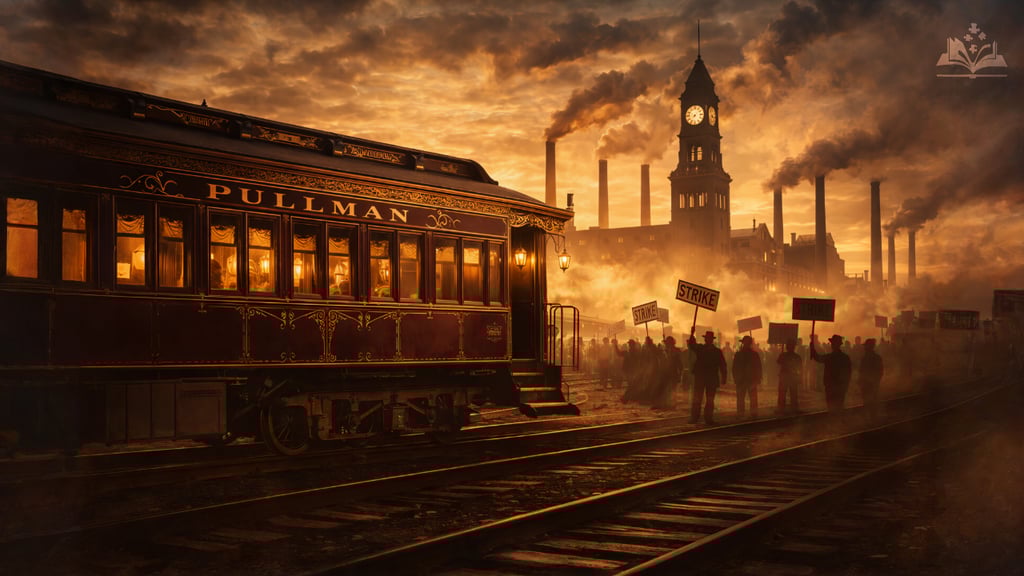
The Man Who Transformed Railroad Travel
George Mortimer Pullman (1831-1897) revolutionized American railroad travel by designing and manufacturing luxury sleeping cars that transformed cross-country journeys from grueling ordeals into comfortable experiences. His Pullman Palace Car Company became synonymous with elegant rail travel during the late 19th and early 20th centuries, operating what was effectively the largest hotel in the world on wheels.
The Pullman railcar empire represents both the pinnacle of American industrial innovation and a cautionary tale about labor relations during the Gilded Age. Understanding George Pullman's business model, his controversial company town, and the historic 1894 strike provides essential insights into American labor history and the evolution of workers' rights.
Who Was George Pullman? The Early Years
George Pullman began his career helping his father move buildings along the Erie Canal, developing expertise in engineering and construction. During the 1850s, he gained prominence in Chicago by raising entire buildings to accommodate the city's new elevated street levels and improved drainage systems.
His breakthrough came from personal experience. An uncomfortable overnight train journey inspired Pullman to recognize the vast market potential for comfortable passenger rail service. Drawing on his knowledge of compact sleeping arrangements from Erie Canal packet boats, he began developing sleeping car designs in the 1860s.
The Birth of Luxury Rail Travel
The first genuine Pullman car, called the "Pioneer," appeared in 1865 and featured folding upper berths and seat cushions that could be extended to make lower berths. This convertible design allowed daytime coach seating to transform into comfortable nighttime sleeping accommodations.
Pullman's marketing genius showed when he arranged for several of his cars to carry President Abraham Lincoln's body back to Springfield, Illinois, in 1865. This garnered national attention and established his brand as synonymous with dignity and comfort.
Building the Pullman Palace Car Company Empire
Revolutionary Business Model
George Pullman realized the marketing potential of leasing rather than selling his cars, creating a business model that gave him unprecedented control over the luxury rail travel market. Instead of railroads purchasing cars outright, they leased Pullman cars with operators included, ensuring consistent quality and service.
By 1890, the Pullman Palace Car Company was operating 2,135 railroad cars on approximately 160,000 miles of track in the United States with a workforce of 12,367 employees. The company had achieved near-monopoly status in the sleeping car market through aggressive expansion and acquisition of competitors.
Manufacturing Excellence and Diversity
The company's production capabilities extended far beyond sleeping cars. By 1883, Pullman had shops in St. Louis, Detroit, Elmira, and Wilmington, as well as several factories in Europe and England. The company manufactured a diverse range of railcars, including
Sleeping cars (palace cars)
Dining cars
Parlor cars
Boxcars
Coal cars
Refrigerated cars
Streetcars
Mail cars
Baggage cars
This diversification made Pullman one of America's most significant manufacturing enterprises during the Industrial Revolution.
The Model Company Town: Pullman, Illinois
A Utopian Vision
In 1880, Pullman purchased 4,000 acres near Lake Calumet, about 14 miles south of Chicago, for $800,000 to build both a factory and an integrated company town. He hired architect Solon Spencer Beman to design 1,300 original structures featuring housing, shopping areas, churches, theaters, parks, and a library.
The centerpiece was the Administration Building with its distinctive clock tower and the elegant Hotel Florence, named for Pullman's daughter. The town was designed to provide modern amenities, including an innovative sewage system, and was hailed as "the world's most perfect town."
The Dark Side of Paternalism
Despite its aesthetic appeal, the company town had serious problems. Workers were strongly encouraged to live in the town, and though rents averaged $14 a month, higher than surrounding areas, many chose to reside there because living conditions were better. However, Pullman expected the town to generate a 6% return on investment.
Workers faced several restrictive policies:
No option to purchase homes
Company-controlled newspaper
Prohibited labor meetings
Widespread company surveillance
Rent collected directly from paychecks on payday
A national commission later found George Pullman's paternalism partly to blame for labor unrest and described his company town operations as "un-American."
The Pullman Strike of 1894: A Turning Point in Labor History
Economic Crisis and Worker Grievances
The Panic of 1893 triggered a severe economic depression that devastated American industries. Responding to falling revenue, the Pullman Palace Car Company cut more than 2,000 workers and reduced wages by 25 percent but crucially refused to reduce rents or prices at company stores.
In 1885, wages had started at $1.30 per day, rising to $1.86 for unskilled workers and $2.28 for journeymen mechanics by 1897, but these cuts devastated families already struggling with high living costs in the company town.
The Strike Begins
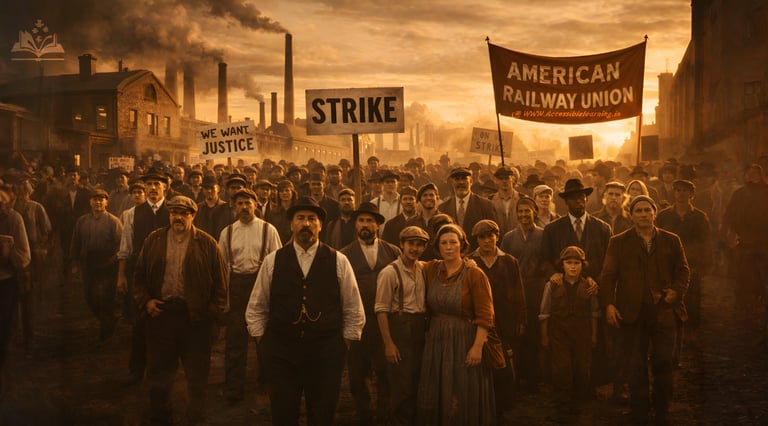
A delegation of workers tried to present their grievances to George Pullman, but he refused to meet with them and ordered them fired, leading workers to vote to strike on May 11, 1894.
The American Railway Union (ARU), led by Eugene V. Debs and boasting 150,000 members, voted to support the Pullman workers through a national boycott. ARU members refused to handle trains carrying Pullman cars, effectively shutting down rail traffic across the western United States.
Federal Intervention and Violence
Pullman refused to engage in negotiations, and federal court orders were obtained to end the strike. When Illinois Governor John P. Altgeld refused to call in state troops, President Grover Cleveland deployed federal troops on the grounds that mail delivery was being disrupted.
The violence that followed was devastating. Railroad yards became battlegrounds, and approximately 30 people were killed in confrontations between strikers, strikebreakers, and federal troops. Eugene Debs was arrested for violating a federal injunction and served six months in prison, where he began studying socialist writings.
Historic Significance
The massive disruption of rail traffic and violent confrontations convinced many Americans that class conflict between capital and labor had reached a crisis stage needing a solution in the public interest.
The strike had several lasting impacts:
Labor Law Precedent: The Supreme Court upheld the use of federal injunctions against strikes in the landmark case In re Debs (1895), establishing precedent for government intervention in labor disputes.
Creation of Labor Day: In 1894, Congress designated Labor Day as a federal holiday six days after the strike ended, attempting to conciliate organized labor.
End of Company Town: In 1898, the Illinois Supreme Court forced the Pullman Company to divest ownership in the town, ruling that its company charter did not authorize such operations.
Rise of Organized Labor: The strike galvanized the labor movement and contributed to the eventual formation of powerful industrial unions.
Pullman Porters: Pioneers of the Civil Rights Movement
Creating Economic Opportunities
The Pullman Company hired African-American men to staff the Pullman cars, who became known and widely respected as Pullman porters, providing elite service. By the 1920s, the company had become the largest employer of African Americans in the United States.
Pullman porters performed the intricate task of transforming coach cars into sleeping accommodations, catered to passenger needs, and maintained the high service standards that made Pullman cars famous. However, they were originally compensated primarily through tips rather than adequate wages.
The Brotherhood of Sleeping Car Porters
In 1925, Pullman porters organized the Brotherhood of Sleeping Car Porters, the first important Black labor union. Led by A. Philip Randolph, the union fought for better wages, working conditions, and dignity. After suing in federal court, the porters won their first contract with Pullman in the late 1930s.
Several union members later played key roles in the civil rights movement of the 1950s and 1960s, leveraging their organizing experience and networks developed through their work.
The Company's Later Years and Legacy
Leadership Transition
After Pullman's death from a heart attack in 1897, Robert Todd Lincoln, eldest son of Abraham Lincoln, succeeded him as company president and served until 1911. Lincoln transformed the company from a one-man autocracy to a more modern bureaucratic management system.
When Pullman died, he left behind an estate worth $7.6 million, 2,490 railroad cars, and a $63.5 million corporation. Fearing desecration by labor activists, his family buried him in an elaborately reinforced concrete vault at Graceland Cemetery.
Corporate Evolution and Decline
The company continued evolving throughout the 20th century:
1927: Pullman Company created as separate entity with Pullman Incorporated as holding company
1930: Merged with Standard Steel Car Company to become Pullman-Standard Company
1955: Closed its historic factory in Chicago's Pullman neighborhood
1982: Built its last passenger cars for Amtrak's Superliner fleet
1987: Remaining designs and assets purchased by Bombardier
The decline paralleled the general demise of American passenger rail service as automobiles and airlines became dominant transportation modes.
Pullman National Monument: Preserving History
In 2015, the Pullman neighborhood was designated as America's first National Monument dedicated to labor history. The 12-acre site preserves several historic buildings, including the iconic Administration Clock Tower Building.
The monument celebrates three distinct achievements: manufacturing excellence, labor movement history, and civil rights advancement through the Pullman porters' organizing efforts. Many original brick duplexes and row houses remain inhabited, making it one of Chicago's most unique historic neighborhoods.

A Complex Legacy
The Pullman railcar empire represents both the heights of American industrial achievement and the depths of labor exploitation during the Gilded Age. George Pullman's innovations in railroad comfort transformed American travel and created thousands of jobs, yet his paternalistic approach to labor relations sparked one of history's most significant labor uprisings.
Today, the story serves as a powerful reminder about the importance of fair wages, workers' rights, and the dangers of unchecked corporate power. The Pullman porters' struggle for dignity and fair treatment presaged the civil rights movement, while the 1894 strike helped establish labor organizing as a legitimate force in American democracy.
The physical legacy endures in Chicago's Pullman National Monument, where visitors can explore the remnants of this ambitious social and industrial experiment. The lessons remain relevant as society continues grappling with questions about employer responsibility, worker welfare, and the proper balance between capital and labor.
Frequently Asked Questions
Q: What made Pullman sleeping cars revolutionary?
Pullman sleeping cars transformed long-distance rail travel by providing comfortable berths that converted from daytime seating. The cars featured innovative folding mechanisms, clean linens, and attentive service, making overnight journeys comfortable rather than grueling ordeals.
Q: How did George Pullman make his fortune?
Pullman built his fortune through a leasing business model rather than selling railcars outright. Railroads leased his palace cars with operators included, allowing Pullman to maintain quality control while generating continuous revenue. His near-monopoly on luxury sleeping cars made him one of America's wealthiest industrialists.
Q: Why did the Pullman Strike happen?
The strike occurred when Pullman cut worker wages by 25% during the 1893 economic depression but refused to reduce rents or prices in his company town. When workers tried to negotiate and were fired instead, they walked out on May 11, 1894, eventually gaining support from the American Railway Union for a nationwide boycott.
Q: What was the significance of the Pullman Strike?
The strike became a pivotal moment in American labor history, demonstrating the power of organized labor while also showing the federal government's willingness to intervene on behalf of corporations. It led to the creation of Labor Day as a federal holiday and established legal precedents for using injunctions against strikes.
Q: Who were the Pullman porters?
Pullman porters were African American men hired to provide service aboard Pullman sleeping cars. They became the foundation of the first major African American labor union, the Brotherhood of Sleeping Car Porters, and many later became leaders in the civil rights movement.
Q: What happened to the Pullman Company?
The company continued operating through the mid-20th century, building its last cars for Amtrak in 1982. Its remaining assets were sold to Bombardier in 1987. The company town was annexed to Chicago, and the factory site is now part of Pullman National Monument.
Q: Can you visit the historic Pullman neighborhood today?
Yes, the Pullman neighborhood on Chicago's South Side is now a National Monument with a visitor center housed in the restored Administration Building. Many original structures remain standing and inhabited, offering a glimpse into 19th-century industrial America.
Q: How did the company town model affect workers?
While the town provided modern amenities and better living conditions than typical industrial neighborhoods, it also gave Pullman excessive control over workers' lives. High rents, company surveillance, and the inability to own property created resentment that contributed to the 1894 strike.
Subscribe to Frontier Intelligence
All © Copyright reserved by Accessible-Learning Hub
| Terms & Conditions
Accessible Learning Hub — Actionable clarity for high-agency minds.
Weekly breakdowns on AI breakthroughs, capital flow, and human performance systems. Zero fluff.