

The Portuguese Empire: A Comprehensive Guide to the First Global Maritime Power
Explore the Portuguese Empire's 584-year history—from pioneering global exploration to shaping trade, culture, and language across four continents.
EMPIRES/HISTORYEUROPEAN UNIONHISTORY
Kim Shin
1/30/202610 min read
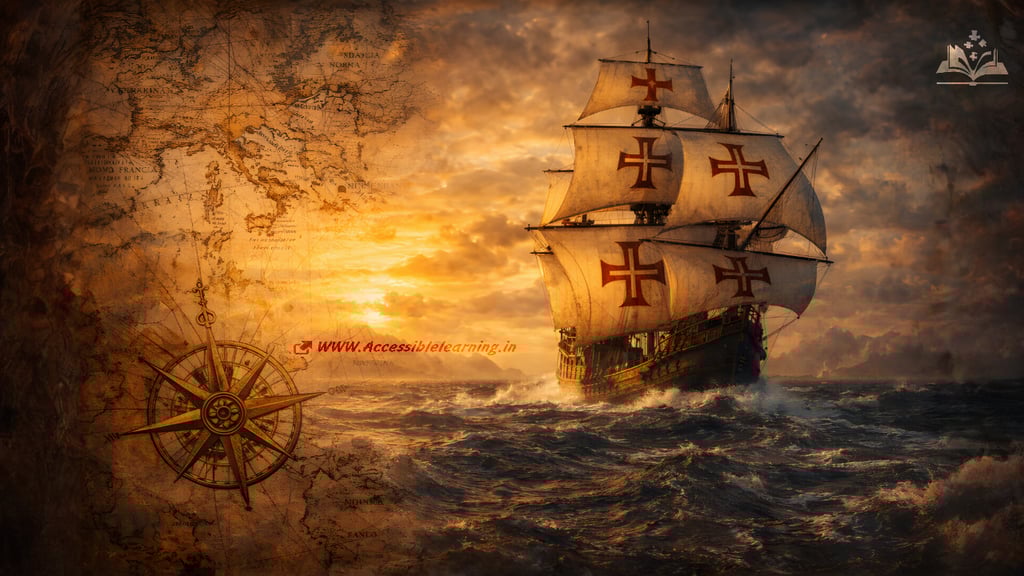
The Portuguese Empire stands as one of history's most remarkable achievements in exploration, trade, and cultural exchange. Spanning nearly six centuries (1415-1999), it became the first global empire, connecting Europe, Africa, Asia, and South America through an unprecedented network of sea routes and trading posts.
What Was the Portuguese Empire?
The Portuguese Empire (Império Português) was a vast colonial and commercial network established by Portugal beginning in the 15th century. Unlike land-based empires, Portugal's dominion was primarily maritime, consisting of strategic coastal settlements, trading posts, and colonies connected by mastery of ocean navigation.
At its zenith in the 16th century, Portuguese territories stretched across four continents, making it the world's first true global empire and earning Portugal the distinction of being Europe's longest-lived colonial power.
The Dawn of Portuguese Exploration: Why Did It Begin?
Geographic and Economic Motivations
Portugal's location on Europe's western edge, facing the Atlantic Ocean, positioned it uniquely for maritime exploration. Several factors converged to launch the Age of Discovery:
Strategic Geographic Position: Situated at the crossroads between the Mediterranean and Atlantic, Portugal had natural deep-water harbors ideal for shipbuilding and oceanic voyages.
Economic Necessity: As a small kingdom with limited agricultural resources, Portugal needed alternative wealth sources. The lucrative spice trade with Asia was controlled by Italian city-states and Ottoman intermediaries, making direct access to Eastern markets highly desirable.
Religious Zeal: The Reconquista had just concluded, and Portuguese monarchs saw overseas expansion as a continuation of the Christian mission, seeking to spread Catholicism and find the legendary Prester John, a mythical Christian king in Africa or Asia.
Technological Innovation: Portuguese shipwrights developed the caravel, a revolutionary vessel combining square and lateen sails, allowing ships to sail against the wind and navigate both open oceans and coastal waters efficiently.
Prince Henry the Navigator: Architect of Exploration
Prince Henry (1394-1460), though never commanding a voyage himself, transformed Portugal into a maritime powerhouse. From his base at Sagres on Portugal's southwestern tip, he established what historians consider Europe's first navigation school.
Henry's Contributions to Maritime Science
Centralized Knowledge: He gathered cartographers, astronomers, shipbuilders, and experienced sailors to pool knowledge about navigation, currents, and winds.
Systematic Exploration: Rather than random voyages, Henry sponsored methodical expeditions down Africa's western coast, with each journey pushing slightly farther than the last.
Chart Development: Portuguese navigators created increasingly accurate portolan charts, documenting coastlines, prevailing winds, and ocean currents.
Astronomical Navigation: Portuguese sailors refined the use of the astrolabe and quadrant for celestial navigation, enabling accurate latitude determination far from land.
Key Milestones in Portuguese Expansion
The Capture of Ceuta (1415)
Portugal's imperial journey began with the conquest of Ceuta, a Moroccan port city controlling the Strait of Gibraltar. This victory provided Portugal with:
Control over Mediterranean-Atlantic trade routes
Access to African gold trade networks
A strategic military foothold in North Africa
Confidence to pursue further expansion
African Coastal Exploration (1420s-1480s)
Portuguese explorers methodically charted Africa's western coastline:
Madeira (1419): Discovered and colonized by João Gonçalves Zarco, becoming Portugal's first overseas territory and a major sugar producer.
Azores (1427): A strategic mid-Atlantic archipelago that became a crucial waystation for trans-Atlantic voyages.
Cape Bojador (1434): Gil Eanes rounded this feared cape, disproving myths about boiling seas and sea monsters, opening the path southward.
Cape of Good Hope (1488): Bartolomeu Dias became the first European to round Africa's southern tip, proving a sea route to India existed.
Vasco da Gama and the India Route (1497-1499)
Vasco da Gama's voyage from Lisbon to Calicut (modern Kozhikode) revolutionized global trade. Departing in July 1497 with four ships, da Gama:
Sailed 24,000 miles round trip
Established direct European-Asian maritime trade
Bypassed Muslim and Venetian middlemen
Returned with spices worth 60 times the expedition's cost
Opened the Estado da Índia (State of India), Portugal's Asian empire
This single voyage fundamentally altered global economics, shifting trade power from the Mediterranean to Atlantic powers.
The Discovery of Brazil (1500)
Pedro Álvares Cabral, leading a fleet to India, was blown westward and landed on the Brazilian coast in April 1500. Though possibly accidental, some historians argue Portugal may have known of South American lands through prior secret voyages.
Brazil would eventually become Portugal's most valuable colony, producing:
Brazilwood (source of red dye)
Sugar (major 16th-17th century export)
Gold and diamonds (18th century)
Coffee (19th century)


The Estado da Índia: Portugal's Asian Empire
Strategic Trading Posts and Fortresses
Rather than conquering vast territories, Portugal established a network of fortified trading posts (feitorias) controlling key maritime chokepoints:
Goa (1510): Conquered by Afonso de Albuquerque, it became the capital of Portuguese India and the empire's Asian headquarters.
Malacca (1511): This Malaysian port controlled the strait connecting the Indian Ocean and South China Sea, giving Portugal monopolistic access to the Spice Islands (Moluccas).
Hormuz (1515): Controlling the Persian Gulf entrance, Hormuz dominated trade between Persia, Arabia, and India.
Macau (1557): Leased from China, Macau became the only European trading post in China and facilitated lucrative Chinese-Japanese trade, as direct contact was forbidden.
Nagasaki (1571): Though not controlled by Portugal, Portuguese merchants held exclusive European trading rights in Japan until 1639.
The Spice Trade Monopoly
Portugal's Asian empire focused on high-value, low-volume goods:
Black Pepper: The most valuable commodity, primarily from India's Malabar Coast
Cinnamon: Monopolized from Ceylon (Sri Lanka)
Cloves, Nutmeg, Mace: Exclusively from the Moluccas (Spice Islands)
Chinese Silk and Porcelain: Traded through Macau
Japanese Silver: Facilitated through the "Nanban trade"
This network generated enormous wealth. A successful cargo could yield profits of 500-1000%, though voyages carried significant risks from shipwrecks, pirates, and disease.
The Atlantic World: Africa and the Americas
Portuguese Africa
Portugal's African presence combined trading posts, coastal fortifications, and later, full colonies:
São Tomé and Príncipe (1470s): Island colonies that became major sugar producers using enslaved African labor, creating a template later applied in Brazil.
Cape Verde (1460s): Strategic islands serving as a slave trading center and Atlantic waystation.
Angola (1575): Originally a coastal trading network, it became Portugal's primary source of enslaved people for Brazilian plantations.
Mozambique (1498): A critical stopover on the India route, later developing into a major East African colony.
Brazil: The Crown Jewel
Brazil evolved from an afterthought to Portugal's most valuable possession.
Early Period (1500-1530s): Limited settlement, focus on brazilwood extraction
Captaincy System (1534): Divided Brazil into hereditary captaincies to encourage settlement, with mixed success
Sugar Boom (1550-1650): Northeast Brazil became the world's largest sugar producer, using enslaved African labor
Gold Rush (1690s-1760s): Discovery of gold and diamonds in Minas Gerais brought massive wealth and migration
Coffee Era (1800s): Brazil became the world's largest coffee producer
Capital Transfer (1763): Rio de Janeiro replaced Salvador as capital, reflecting the colony's economic center shifting southward
The Treaty of Tordesillas (1494): Dividing the World
This agreement between Portugal and Spain, mediated by Pope Alexander VI, divided all newly discovered lands outside Europe:
The Line: Drew a meridian 370 leagues west of the Cape Verde Islands
Portugal's Rights: Lands east of the line (Africa, Asia, and eastern South America)
Spain's Rights: Lands west of the line (most of the Americas)
Long-term Impact: Established Portugal's legal claim to Brazil and its African and Asian territories
The treaty reflected Portugal's superior maritime knowledge—the line's placement ensured Brazil fell within Portuguese territory, suggesting Portuguese navigators may have already known of South American lands.
Decline of the Portuguese Empire: What Went Wrong?
The Spanish Union (1580-1640)
When King Sebastian died without an heir after the disastrous Battle of Alcácer Quibir (1578), Spain's Philip II claimed the Portuguese throne, uniting the Iberian kingdoms. This sixty-year period weakened Portugal through:
Involving Portugal in Spain's conflicts with England and the Netherlands
Exposing Portuguese colonies to attacks by Spanish enemies
Draining Portuguese resources for Spanish wars
Allowing Dutch and English intrusion into Portuguese Asian trade networks
Dutch and English Competition
Dutch East India Company (VOC, 1602): Better capitalized and more aggressive than Portugal's fragmented trading system, the Dutch systematically captured Portuguese positions:
Malacca (1641)
Ceylon (1658)
Most Spice Islands (1600s)
Brief occupation of northeast Brazil (1630-1654)
English East India Company (1600): Gradually supplanted Portuguese influence in India, though Goa remained Portuguese until 1961.
Overextension and Administrative Inefficiency
Portugal, with barely one million inhabitants in the 16th century, struggled to:
Defend far-flung possessions simultaneously
Maintain sufficient naval forces across three oceans
Prevent corruption in distant trading posts
Compete with larger, wealthier European rivals
The Lisbon Earthquake (1755)
This catastrophic earthquake, tsunami, and fire destroyed Lisbon, killing tens of thousands and devastating Portugal's economy. The disaster, combined with expensive Pombaline reconstruction, weakened Portugal's ability to maintain its empire.
Brazilian Independence (1822)
When Napoleon invaded Portugal (1807), the royal family fled to Rio de Janeiro, making Brazil effectively the empire's center. After returning to Lisbon (1821), King João VI's son Pedro declared Brazilian independence, dividing the empire and removing Portugal's wealthiest territory.
The Late Colonial Period (1822-1975)
African Consolidation
After losing Brazil, Portugal intensified its focus on African colonies:
Berlin Conference (1884-1885): European powers formalized colonial claims. Portugal secured internationally recognized control over Angola, Mozambique, Guinea-Bissau, São Tomé and Príncipe, and Cape Verde.
Pink Map (1890): Portugal's ambitious plan to connect Angola and Mozambique (requiring control over present-day Zimbabwe, Zambia, and Malawi) was blocked by Britain's British Ultimatum, humiliating Portugal and damaging the monarchy's prestige.
Estado Novo (1933-1974): António de Oliveira Salazar's authoritarian regime clung to colonies as "overseas provinces," refusing decolonization pressures.
Colonial Wars (1961-1974)
Portugal fought independence movements across Africa:
Angola (MPLA, FNLA, UNITA)
Mozambique (FRELIMO)
Guinea-Bissau (PAIGC)
These conflicts drained resources and killed thousands, contributing to the Carnation Revolution (1974) that overthrew Portugal's dictatorship.
Decolonization (1974-1975)
The new democratic government rapidly granted independence:
Guinea-Bissau (1974)
Mozambique (June 1975)
Cape Verde (July 1975)
São Tomé and Príncipe (July 1975)
Angola (November 1975)
The End of Empire (1999)
Macau's handover to China on December 20, 1999, marked the Portuguese Empire's official end, making it the longest-lived European colonial empire (584 years).

Cultural and Historical Legacy
Language and Lusophone World
Portuguese is spoken by over 260 million people worldwide as a native or official language:
Major Portuguese-speaking Countries:
Brazil (215 million speakers)
Angola (33 million)
Mozambique (31 million)
Portugal (10 million)
Guinea-Bissau, Equatorial Guinea, Cape Verde, São Tomé and Príncipe, East Timor, Macau
The Community of Portuguese Language Countries (CPLP) unites these nations in cultural and economic cooperation.
Religious Impact
Portuguese missionaries, particularly Jesuits, Dominicans, and Franciscans, spread Catholicism throughout the empire. Today, Brazil has the world's largest Catholic population, and Catholicism remains dominant in former Portuguese territories.
Architectural Heritage
Portuguese colonial architecture blends European, African, and Asian influences:
Manueline Style: Ornate Gothic-Renaissance fusion seen in Lisbon's Jerónimos Monastery
Brazilian Baroque: Exemplified in Ouro Preto's churches
Indo-Portuguese: Goan churches combining European and Indian elements
Macanese: Unique Sino-Portuguese architecture in Macau
Culinary Fusion
Portuguese colonialism created distinctive fusion cuisines:
Brazilian: Feijoada, vatapá, moqueca (African-Portuguese-Indigenous fusion)
Goan: Vindaloo, xacuti, sorpotel (Portuguese-Indian fusion)
Macanese: African chicken, minchi (Portuguese-Chinese-Malay fusion)
Mozambican: Peri-peri chicken (Portuguese-African)
Scientific Contributions
Portuguese navigators advanced:
Cartography: Created detailed world maps incorporating African and Asian coastlines
Astronomy: Improved celestial navigation techniques
Oceanography: Documented trade winds, currents, and monsoon patterns
Natural History: Introduced European science to Asian and American flora and fauna
Economic Impact: The First Global Economy
The Columbian Exchange (Atlantic)
While Spanish colonies dominated, Portuguese Brazil participated significantly:
From Americas: Maize, potatoes, tomatoes, tobacco, cacao
To Americas: Cattle, horses, sugarcane, coffee, wheat
The Indian Ocean Trade Revolution
Portugal disrupted millennia-old trade patterns:
Broke Arab and Venetian monopolies
Introduced New World silver into Asian markets
Connected American, African, and Asian economies for the first time
Created the first truly global commodity markets
The Slave Trade
Portugal's role in the Atlantic slave trade represents its darkest legacy. Between the 16th and 19th centuries, Portuguese traders transported an estimated 5.8 million enslaved Africans:
4.9 million to Brazil
Hundreds of thousands to São Tomé and other Atlantic islands
Facilitated Spanish American slavery through the asiento contracts
This forced migration devastated African societies while building Portuguese and Brazilian wealth on human suffering.


Portugal's Imperial Legacy
The Portuguese Empire fundamentally shaped the modern world. It initiated the Age of Discovery, created the first global trade network, and connected previously isolated continents into an integrated economic system. Portuguese navigators proved the world's oceans were navigable, mapped unknown coastlines, and established maritime routes still used today.
Yet this achievement came with tremendous human cost. The empire's wealth was built on exploitation, slavery, and colonial subjugation. Millions of Africans were enslaved, indigenous populations were decimated, and local economies were restructured to serve Portuguese interests.
Today, Portugal's imperial legacy lives on through language, culture, cuisine, architecture, and religious practices across four continents. The lusophone world—united by the Portuguese language and cultural heritage—represents both the empire's enduring influence and the complex, often painful history of colonialism.
Understanding the Portuguese Empire requires acknowledging both its remarkable achievements in exploration and navigation and the exploitation and suffering that underwrote its centuries of global power. This balanced perspective helps us comprehend how a small European kingdom transformed world history and why its legacy remains contentious and consequential today.
Frequently Asked Questions
Q: How long did the Portuguese Empire last?
The Portuguese Empire lasted 584 years, from the conquest of Ceuta in 1415 to the handover of Macau to China in 1999, making it the longest-lived European colonial empire.
Q: What was the largest extent of the Portuguese Empire?
At its peak in the 16th century, the Portuguese Empire encompassed territories in South America (Brazil), Africa (Angola, Mozambique, coastal settlements), Asia (Goa, Malacca, Macau, Timor), and Atlantic islands (Azores, Madeira, Cape Verde).
Q: Why did Portugal explore before other European nations?
Portugal's early exploration resulted from strategic geographic location, economic necessity, royal patronage under Prince Henry the Navigator, superior maritime technology (the caravel), and a unified monarchy focused on overseas expansion.
Q: What was Portugal's most valuable colony?
Brazil became Portugal's most valuable colony, particularly after the 17th century. Its sugar, gold, diamonds, and later coffee generated enormous wealth, eventually becoming more important economically than Portugal itself.
Q: How did such a small country build a global empire?
Portugal succeeded through naval innovation, strategic focus on coastal trading posts rather than territorial conquest, first-mover advantage in ocean navigation, and control of key maritime chokepoints connecting major trade networks.
Q: What happened to Portuguese colonies in Asia?
Most Asian colonies were lost to Dutch and English competitors in the 17th-18th centuries. Only Goa (until 1961), Macau (until 1999), and East Timor (until 1975, relinquished 1999) remained under Portuguese control into the modern era.
Q: Why did Portugal keep its African colonies longer than other European powers?
Portugal's authoritarian Estado Novo regime (1933-1974) refused decolonization, viewing colonies as integral "overseas provinces." Only after the 1974 Carnation Revolution did Portugal rapidly grant independence to African colonies.
Q: What is the Community of Portuguese Language Countries (CPLP)?
Founded in 1996, the CPLP unites nine Portuguese-speaking nations (Portugal, Brazil, Angola, Mozambique, Cape Verde, Guinea-Bissau, São Tomé and Príncipe, East Timor, and Equatorial Guinea) for cultural, educational, and economic cooperation.
Subscribe to Frontier Intelligence
All © Copyright reserved by Accessible-Learning Hub
| Terms & Conditions
Accessible Learning Hub — Actionable clarity for high-agency minds.
Weekly breakdowns on AI breakthroughs, capital flow, and human performance systems. Zero fluff.