

The Persian (Achaemenid) Empire: Rise, Glory, and Legacy of Ancient Persia
Discover the Achaemenid Persian Empire's 220-year reign (550-330 BCE). Explore Cyrus the Great's legacy, Darius I's innovations, the Greco-Persian Wars, and how this ancient superpower shaped civilization across three continents.
EMPIRES/HISTORYHISTORY
Jagdish Nishad
2/24/20268 min read


The Persian Empire, formally known as the Achaemenid Empire, stands as one of history's most influential civilizations. Spanning three continents and ruling over nearly half the world's population at its peak, this ancient superpower fundamentally shaped the course of human history from 550 to 330 BCE.
What Was the Achaemenid Persian Empire?
The Achaemenid Empire was the first Persian Empire, founded by Cyrus the Great in 550 BCE. At its territorial zenith under Darius I, it stretched from the Indus Valley in the east to Thrace and Macedonia in the west, and from the Caucasus Mountains in the north to Egypt and the Arabian Peninsula in the south. This made it the largest empire the ancient world had ever seen, covering approximately 5.5 million square kilometers and governing an estimated 44% of the global population.
Origins and Foundation of the Persian Empire
The Achaemenid dynasty emerged from the region of Persis (modern-day Fars province in Iran). The name "Achaemenid" derives from Achaemenes, the semi-legendary ancestor of the royal house. However, the empire's true founder was Cyrus II, better known as Cyrus the Great.
Cyrus began his conquest by overthrowing his Median overlords around 550 BCE, establishing Persian independence. He then systematically expanded his territory through a combination of military prowess and diplomatic genius, conquering Lydia (546 BCE) and the Neo-Babylonian Empire (539 BCE). His conquest of Babylon was particularly significant, as it was achieved with minimal bloodshed and resulted in the famous Cyrus Cylinder, often considered the first declaration of human rights.
Key Rulers of the Achaemenid Dynasty
Cyrus the Great (r. 559-530 BCE)
Cyrus established the foundational principles that would characterize Persian rule: religious tolerance, respect for local customs, and sophisticated administration. His legacy includes:
Liberation of the Jews from Babylonian captivity
Establishment of the first charter of human rights
Creation of the imperial administrative system
Expansion of territory to create the largest empire of its time
Cambyses II (r. 530-522 BCE)
Son of Cyrus, Cambyses successfully conquered Egypt in 525 BCE, adding the wealthy Nile kingdom to Persian domains. His reign, though militarily successful, was marked by controversy and ended mysteriously during his return from Egypt.
Darius I, the Great (r. 522-486 BCE)
Darius transformed the empire from a collection of conquered territories into a sophisticated administrative state. His achievements include:
Division of the empire into satrapies (provinces) governed by satraps
Construction of the Royal Road, a 2,500-kilometer highway system
Standardization of weights, measures, and coinage
Development of Persepolis as the ceremonial capital
Creation of the first international postal system
Introduction of Aramaic as the administrative language
Darius also reorganized the military, improved infrastructure, and commissioned monumental architecture that showcased Persian power and artistry.
Xerxes I (r. 486-465 BCE)
Son of Darius, Xerxes is best known for his massive invasion of Greece (480-479 BCE), which included famous battles at Thermopylae and Salamis. Despite initial successes, the campaign ultimately failed, marking the beginning of gradual Persian decline in the Mediterranean region.
Later Achaemenid Rulers
The empire continued under rulers including Artaxerxes I, Darius II, Artaxerxes II, and Artaxerxes III. This later period saw internal conflicts, satrapal revolts, and gradual weakening of central authority, though the empire remained formidable until its final years.
Persian Empire Government and Administration
The Satrapy System
The Achaemenid administrative innovation that enabled control over vast territories was the satrapy system. The empire was divided into approximately 20-30 satrapies, each governed by a satrap (provincial governor). This system balanced centralized control with local autonomy:
Satraps collected taxes and maintained order
They commanded local military forces
They were monitored by royal inspectors called "the King's Eyes and Ears."
Local laws and customs were generally respected
Tribute was standardized but reasonable
Royal Road and Communication Network
The Royal Road connected Susa to Sardis, enabling rapid communication across the empire. Royal messengers could traverse the entire route in seven days, though ordinary travel took three months. This infrastructure supported:
Military mobilization
Administrative communication
Commercial trade
Cultural exchange
Taxation and Economy
The Persian economy was remarkably sophisticated. Darius introduced standardized gold coinage (the daric) and silver coins, facilitating trade across the empire. The tax system was:
Based on the productive capacity of each region
Collected in both precious metals and kind
Reasonable enough to prevent widespread rebellion
Used to fund massive building projects and military campaigns


Persian Military Power and Warfare
The Achaemenid military was the most formidable force of its era, combining various fighting traditions from across the empire.
Military Organization
The Immortals: Elite force of 10,000 infantry, so named because their numbers were immediately replenished
Cavalry: Heavily armored horsemen from Media and Persia
Archers: Highly skilled bowmen forming the backbone of Persian armies
Subject troops: Contingents from conquered peoples bringing diverse tactics
Military Tactics and Strategy
Persian warfare emphasized:
Numerical superiority through mobilization of imperial resources
Combined arms tactics integrating infantry, cavalry, and archers
Siege warfare technology
Naval power, particularly after conquering Phoenicia and Egypt
Psychological warfare and diplomacy to avoid unnecessary conflict
Persian Culture, Religion, and Society
Zoroastrianism and Religious Policy
Zoroastrianism, founded by the prophet Zoroaster, became the dominant religion of the Persian ruling class. This monotheistic faith emphasized:
The cosmic struggle between good (Ahura Mazda) and evil (Angra Mainyu)
Individual moral responsibility
The concepts of heaven, hell, and final judgment
Fire as a sacred symbol of divine truth
Remarkably, Persian rulers practiced religious tolerance, allowing subject peoples to maintain their own beliefs. This policy fostered loyalty and reduced resistance across the diverse empire.
Art and Architecture
Persian art synthesized influences from conquered civilizations while maintaining distinct characteristics:
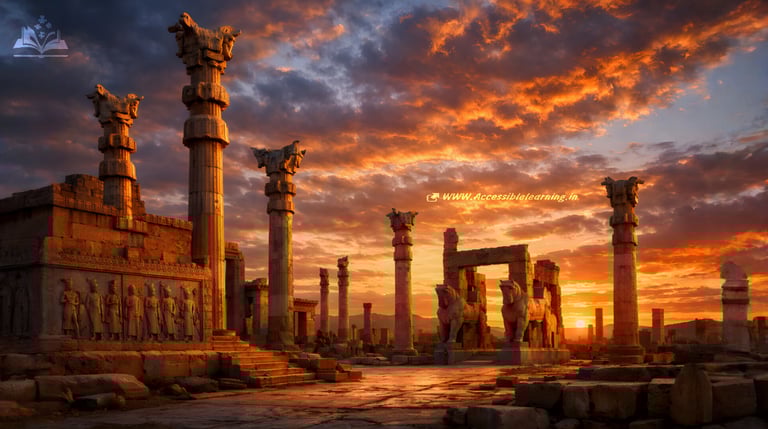
Persepolis: The magnificent ceremonial capital showcased Persian architectural grandeur with its Apadana (audience hall), intricate relief sculptures, and monumental gateways
Relief sculptures: Depicted subject peoples bringing tribute, demonstrating imperial diversity
Decorative arts: Persian craftsmen excelled in metalwork, jewelry, and textile production
Garden design: The Persians pioneered the paradise garden concept, influencing landscape architecture for millennia
Language and Literature
Old Persian was written in cuneiform script, primarily for royal inscriptions. Aramaic served as the administrative lingua franca, enabling communication across the multilingual empire. While much Persian literature was oral and subsequently lost, later texts preserve some Achaemenid-era traditions and wisdom literature.
The Greco-Persian Wars: East Meets West
The conflict between Persia and the Greek city-states defined classical history and has echoed through Western consciousness ever since.
First Persian Invasion (492-490 BCE)
Darius I launched the first major invasion to punish Athens and Eretria for supporting the Ionian Revolt. The campaign culminated in the Battle of Marathon (490 BCE), where Athenian forces achieved a stunning upset victory against the Persian expeditionary force.
Second Persian Invasion (480-479 BCE)
Xerxes assembled a massive force estimated at hundreds of thousands of soldiers. Key engagements included:
Battle of Thermopylae (480 BCE): 300 Spartans and allies held the pass before being outflanked
Battle of Salamis (480 BCE): Greek naval victory that destroyed Persian fleet supremacy
Battle of Plataea (479 BCE): Decisive Greek land victory ending the invasion
Impact and Legacy of the Wars
Though Persia remained powerful, the failed Greek campaigns:
Demonstrated the military effectiveness of Greek hoplite warfare
Inspired Greek cultural confidence and unity
Shifted the balance of power in the Aegean region
Provided subject matter for Herodotus, the "Father of History"
Became foundational narratives in Western civilization
Persian Empire Economy and Trade
The Achaemenid Empire facilitated unprecedented economic integration across three continents.
Trade Networks
The empire connected:
Indian subcontinent trade routes
Silk Road eastern terminus
Mediterranean commercial centers
Arabian incense trade
Egyptian grain production
Economic Innovations
Standardized coinage facilitating long-distance trade
Banking systems and letters of credit
Imperial quality standards for goods
Protected trade routes with imperial security
Harbor and road infrastructure investment
Agricultural Production
The empire's agricultural diversity included:
Egyptian grain serving as a breadbasket
Mesopotamian date and grain production
Iranian plateau livestock and horse breeding
Mediterranean viticulture and olive cultivation
Specialized crops from various climatic zones
Decline and Fall of the Persian Empire
Internal Weaknesses
By the 4th century BCE, several factors weakened imperial cohesion:
Succession disputes and palace intrigues
Satrapal rebellions challenging central authority
Economic strain from continuous military campaigns
Growing independence of distant provinces
Reliance on Greek mercenaries indicating military decline
Alexander the Great's Conquest (334-330 BCE)
The Macedonian king Alexander III launched his invasion in 334 BCE. Key battles include:
Battle of Granicus (334 BCE): First major engagement in Asia Minor
Battle of Issus (333 BCE): Alexander defeated Darius III despite numerical disadvantage
Battle of Gaugamela (331 BCE): Decisive defeat of the last Achaemenid army
By 330 BCE, Darius III was murdered by his own generals, and Alexander controlled the empire. The Achaemenid dynasty ended after 220 years of rule.
Legacy of the Achaemenid Empire
The Persian Empire's influence extended far beyond its political lifespan.
Political Legacy
Model of efficient multi-ethnic empire administration
Concepts of religious tolerance and cultural respect
Standardized administrative practices
Infrastructure development prioritizing communication and trade
Cultural Impact
Zoroastrian influence on Judaism, Christianity, and Islam
Architectural innovations spreading across regions
Administrative Aramaic influencing Middle Eastern languages
Garden design traditions influencing Islamic and Western landscapes
Historical Significance
The Achaemenid Empire:
Created the first truly global empire spanning three continents
Demonstrated that diverse peoples could be governed successfully
Preserved and transmitted cultural knowledge across civilizations
Established administrative and governmental models used by successor empires
Connected East and West in unprecedented ways
Modern Recognition
Contemporary Iran views the Achaemenid period as a golden age of Persian civilization. Persepolis remains a UNESCO World Heritage Site and symbol of national heritage. The Cyrus Cylinder, housed in the British Museum, continues to inspire discussions about human rights and governance.
The Enduring Impact of Ancient Persia
The Achaemenid Persian Empire represented a watershed moment in human civilization. Its innovations in governance, administration, infrastructure, and cultural tolerance established precedents that influenced subsequent empires from Rome to the Islamic Caliphates to modern nation-states.
The Persian model demonstrated that vast, diverse populations could be governed effectively through a combination of centralized authority and local autonomy, military strength and diplomatic flexibility, and cultural respect and economic integration. These lessons remain relevant to understanding empire, governance, and cultural exchange in our interconnected world.
From the Cyrus Cylinder's proclamation of human dignity to Persepolis's architectural grandeur, from the Royal Road's commercial facilitation to Zoroastrianism's theological innovations, the Achaemenid Empire created a legacy that transcends its political lifespan. Understanding this remarkable civilization provides essential context for comprehending the ancient world and the foundations of our own.
Frequently Asked Questions
Q: How long did the Persian Empire last?
The Achaemenid Persian Empire lasted approximately 220 years, from its foundation by Cyrus the Great around 550 BCE until its conquest by Alexander the Great in 330 BCE.
Q: What was the capital of the Persian Empire?
The Achaemenid Empire had multiple capitals serving different functions: Persepolis (ceremonial capital), Susa (administrative capital), Ecbatana (summer capital), and Babylon (political capital). This multi-capital system reflected the empire's vast geography and diverse populations.
Q: How large was the Persian Empire at its peak?
At its maximum extent under Darius I, the Persian Empire covered approximately 5.5 million square kilometers, making it the largest empire in ancient history up to that point. It governed an estimated 44% of the world's population, representing unprecedented imperial reach.
Q: Who defeated the Persian Empire?
Alexander the Great of Macedon conquered the Persian Empire between 334 and 330 BCE. His military genius, combined with internal Persian weaknesses, enabled a relatively small Macedonian-Greek force to overcome the massive Persian Empire.
Q: What language did the Persian Empire speak?
The Persian Empire was multilingual. Old Persian was the language of the ruling dynasty, written in cuneiform. However, Aramaic served as the administrative lingua franca, enabling communication across the diverse empire. Subject peoples continued speaking their own languages, including Greek, Egyptian, Babylonian, and many others.
Q: What religion did the Persian Empire follow?
The Persian ruling class primarily followed Zoroastrianism, though the empire was remarkably tolerant of other religions. Subject peoples were allowed to practice their own faiths, including Judaism, various Mesopotamian religions, Egyptian polytheism, and Greek cults.
Q: Why was the Persian Empire so successful?
Persian success resulted from several factors: military prowess, administrative innovation through the satrapy system, religious and cultural tolerance, sophisticated infrastructure including the Royal Road, economic integration through standardized coinage, and diplomatic skill in managing diverse populations.
Q: What did the Persian Empire contribute to civilization?
The Persian Empire contributed the first declaration of human rights (Cyrus Cylinder), efficient multi-ethnic administration models, religious tolerance as policy, infrastructure development including roads and postal systems, standardized coinage and economic practices, Zoroastrian religious concepts influencing later faiths, and architectural innovations.
Q: How did the Persian Empire treat conquered peoples?
Unlike many ancient empires, the Persians generally treated conquered peoples with remarkable tolerance. They allowed local customs and religions to continue, employed local administrators, respected existing legal systems, and maintained reasonable taxation. This approach fostered loyalty and reduced rebellions.
Q: What happened to Persia after Alexander the Great?
After Alexander's conquest, the Persian territories were divided among his generals (Diadochi). The Seleucid Empire controlled most of the former Achaemenid lands. Later, the Parthian Empire (247 BCE-224 CE) and then the Sasanian Empire (224-651 CE) would restore Persian power, continuing Persian cultural traditions until the Islamic conquest.
Subscribe to Frontier Intelligence
All © Copyright reserved by Accessible-Learning Hub
| Terms & Conditions
Accessible Learning Hub — Actionable clarity for high-agency minds.
Weekly breakdowns on AI breakthroughs, capital flow, and human performance systems. Zero fluff.