

The Parthian Empire: Ancient Persia's Forgotten Superpower That Challenged Rome
Discover the Parthian Empire (247 BCE–224 CE): the Persian superpower that challenged Rome, controlled the Silk Road, and bridged East and West for 500 years.
HISTORYEMPIRES/HISTORY
Jagdish Nishad
2/25/20267 min read
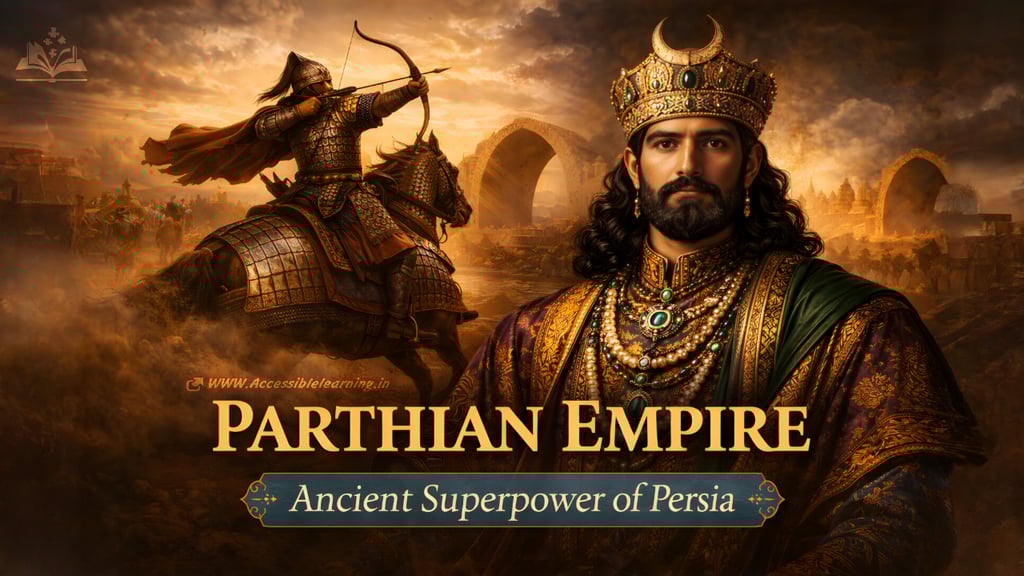
What Made the Parthian Empire One of History's Most Formidable Powers?
The Parthian Empire (247 BCE–224 CE) stands as one of ancient history's most fascinating yet overlooked civilizations. For nearly five centuries, this Iranian dynasty controlled vast territories stretching from the Euphrates River to the Indus Valley, creating a cultural and commercial bridge between East and West. While Rome dominated the Mediterranean, the Parthians ruled the Iranian plateau, challenging Roman expansion and preserving Persian heritage during a critical period of world history.
The Rise of Parthian Power: From Nomadic Warriors to Imperial Dynasty
How Did the Parthians Establish Their Empire?
The Parthian story begins with the Parni, a nomadic Iranian tribe from the Central Asian steppes. Around 247 BCE, their leader Arsaces I seized control of Parthia, a region in northeastern Iran, from the fragmenting Seleucid Empire—one of Alexander the Great's successor kingdoms. This marked the beginning of the Arsacid dynasty, which would rule for nearly 500 years.
The early Parthian kings systematically expanded their territory through a combination of military conquest and diplomatic maneuvering. By the reign of Mithridates I (171–132 BCE), the Parthians had captured Mesopotamia, including the ancient cities of Babylon and Seleucia on the Tigris, transforming themselves from a regional power into a true empire.
What Geographic Advantages Did the Parthians Possess?
The Parthian Empire's location proved strategically invaluable. Positioned along the Silk Road—the ancient network of trade routes connecting China with the Mediterranean—the Parthians controlled the flow of silk, spices, precious stones, and other luxury goods. This geographic position generated immense wealth and cultural influence, making their capital, Ctesiphon (near modern Baghdad), one of the ancient world's most cosmopolitan cities.
Parthian Military Innovation: The Devastating "Parthian Shot"
What Military Tactics Made the Parthians Nearly Invincible?
The Parthian military system combined heavy cavalry (cataphracts) with highly mobile horse archers, creating a formidable fighting force that repeatedly defeated Roman legions. Their most famous tactic, the "Parthian shot," involved mounted archers feigning retreat while turning backward in their saddles to fire arrows at pursuing enemies—a maneuver requiring extraordinary horsemanship and archery skill.
The Battle of Carrhae in 53 BCE demonstrated Parthian military superiority when they annihilated a Roman army of approximately 44,000 men under Marcus Licinius Crassus. Using superior mobility and devastating archery, Parthian forces under General Surena killed or captured most of the Roman force, including Crassus himself. This defeat shocked Rome and established the Euphrates River as the effective boundary between the two superpowers for centuries.
How Did Parthian Cataphracts Change Ancient Warfare?
Parthian cataphracts—heavily armored cavalry wearing scale or chain mail that protected both rider and horse—represented cutting-edge military technology. These shock troops charged enemy formations with long lances, breaking infantry lines and creating chaos. The combination of cataphracts and horse archers gave Parthian commanders tactical flexibility unmatched in the ancient world, influencing military development across Eurasia for centuries.

The Parthian-Roman Rivalry: A Clash of Civilizations
Why Did Rome and Parthia Remain Locked in Perpetual Conflict?
The Parthian-Roman rivalry defined geopolitics in the ancient world from the 1st century BCE through the 3rd century CE. Both empires sought control of Armenia, Syria, and Mesopotamia—regions rich in resources and strategically vital for trade and defense. Unlike Rome's conquests in Gaul or Egypt, Roman emperors repeatedly failed to permanently subjugate Parthian territory.
Major conflicts included:
Emperor Trajan's Parthian Campaign (114-117 CE): Rome's most successful invasion briefly captured Ctesiphon and reached the Persian Gulf, but logistics, disease, and Parthian resistance forced Roman withdrawal.
Lucius Verus's War (161-166 CE): Roman forces sacked Ctesiphon again but brought back a devastating plague that killed millions across the Roman Empire.
Septimius Severus's Campaigns (195-198 CE): Another temporary capture of Ctesiphon, but no lasting Roman occupation.
These conflicts demonstrate that while Roman armies could occasionally penetrate Parthian territory, maintaining control proved impossible due to the empire's vast distances, hostile terrain, and resilient population.
Parthian Society and Cultural Achievements
What Was Daily Life Like in the Parthian Empire?
Parthian society blended Iranian, Greek, and Mesopotamian influences. The empire operated as a feudal confederation where the king of kings (shahanshah) ruled with support from powerful noble families who controlled regional territories. This decentralized system provided flexibility but sometimes weakened central authority.
Urban centers like Ctesiphon, Ecbatana, and Hecatompylos featured impressive architecture, including grand palaces, temples, and public buildings. The Parthians developed distinctive artistic styles visible in their sculpture, metalwork, and textiles, though many examples have been lost to time and treasure hunters.
How Did the Parthians Contribute to Religious and Intellectual Development?
The Parthian period witnessed significant religious evolution. Zoroastrianism remained the dominant faith among the Iranian elite, but the empire's tolerant policies allowed Judaism, early Christianity, Buddhism, and various local cults to flourish. This religious pluralism facilitated cultural exchange and intellectual development.
Parthian merchants, scholars, and diplomats maintained extensive contacts with Chinese, Indian, Greek, and Roman counterparts, transmitting ideas, technologies, and artistic styles across continents. The empire served as a crucial cultural intermediary during a formative period in world history.
The Parthian Economy: Controlling Ancient Global Trade
How Did the Silk Road Transform Parthian Wealth and Power?
The Parthian Empire's control over central sections of the Silk Road generated extraordinary wealth. Luxury goods traveling between Rome and China passed through Parthian territories, generating substantial customs revenues and commercial opportunities. Parthian cities became multicultural trading hubs where merchants from diverse civilizations conducted business.
Archaeological evidence reveals that Parthian merchants traded in silk, spices, incense, glassware, metalwork, precious stones, horses, and other valuable commodities. This commercial dominance helped finance the empire's military campaigns and supported its sophisticated urban civilization.
What Agricultural and Resource Advantages Sustained the Empire?
Beyond trade, the Parthian Empire controlled fertile agricultural regions in Mesopotamia and the Iranian plateau. Ancient irrigation systems, some dating to earlier Persian and Babylonian periods, supported extensive agriculture. The empire also possessed valuable mineral resources, including gold, silver, and copper deposits.
The Fall of the Parthians: Internal Weakness and Sassanian Revolution
Why Did the Parthian Empire Ultimately Collapse?
After nearly five centuries of dominance, the Parthian Empire fell to internal revolution rather than external conquest. Several factors contributed to their decline:
Succession Crises: The Arsacid dynasty experienced frequent civil wars as rival claimants fought for the throne, weakening central authority and military effectiveness.
Noble Autonomy: Powerful aristocratic families gradually became semi-independent, reducing the king's actual power and ability to mobilize resources.
Roman Pressure: Continuous warfare with Rome drained resources and destabilized western provinces, though Rome never conquered the core Parthian territories.
Sassanian Challenge: In 224 CE, Ardashir I, a regional governor from Persis (modern Fars province), defeated the last Parthian king, Artabanus IV in battle. Ardashir established the Sassanian Empire, which would rule Iran until the Islamic conquest in the 7th century.
Archaeological Discoveries and Modern Understanding
What Have Recent Archaeological Findings Revealed About Parthian Civilization?
Modern archaeology has dramatically improved our understanding of Parthian culture. Excavations at sites like Nisa (Turkmenistan), Hatra (Iraq), and various locations across Iran have uncovered impressive architectural remains, sculptures, pottery, and written documents. These discoveries challenge earlier dismissive characterizations of Parthian culture as merely derivative or barbaric.
The Parthian city of Hatra, designated a UNESCO World Heritage Site, features remarkably preserved temples showcasing the distinctive Parthian architectural style—a fusion of Greek, Persian, and Mesopotamian elements. Unfortunately, some Parthian archaeological sites have suffered damage from modern conflicts and illegal excavation.


The Parthian Legacy: Influence Beyond Their Time
How Did the Parthians Influence Later Persian and Islamic Civilizations?
The Parthian period represented a crucial link between the ancient Achaemenid Persian Empire and the later Sassanian dynasty. Parthian administrative practices, feudal structures, and cultural patterns influenced subsequent Iranian civilizations. The Parthian emphasis on cavalry warfare and their military innovations shaped medieval Islamic armies and eventually influenced European knight culture through the Crusades.
Linguistically, the Parthian language contributed to the development of Middle Persian and influenced various Iranian languages still spoken today. Parthian artistic motifs and iconography appear in later Persian, Central Asian, and even Chinese art, demonstrating their wide cultural influence.
Remembering the Parthian Achievement
The Parthian Empire represents a remarkable chapter in human history—a civilization that successfully challenged Rome's eastern expansion, controlled global trade networks, and preserved Persian cultural identity during a transformative historical period. Though overshadowed by their more famous predecessors (the Achaemenids) and successors (the Sassanians), the Parthians created a sophisticated, multicultural empire that bridged continents and civilizations.
Their military innovations influenced warfare for centuries, their control of the Silk Road shaped global commerce, and their cultural synthesis created unique artistic and architectural traditions. Modern scholars increasingly recognize the Parthians not as historical footnotes but as major players whose achievements deserve recognition alongside better-known ancient empires.
Understanding the Parthian Empire enriches our comprehension of ancient geopolitics, cross-cultural exchange, and the complex interactions between Eastern and Western civilizations that continue shaping our world today.
Frequently Asked Questions
Q: Who founded the Parthian Empire and when?
Arsaces I founded the Parthian Empire around 247 BCE when he conquered the region of Parthia from the Seleucid Empire. The Arsacid dynasty he established ruled for nearly 500 years until 224 CE.
Q: Where was the Parthian Empire located geographically?
The Parthian Empire stretched from the Euphrates River in modern-day Iraq to the Indus Valley in modern-day Pakistan, encompassing present-day Iran, Iraq, Turkmenistan, Afghanistan, Pakistan, Syria, Armenia, Georgia, and parts of Turkey.
Q: What was the Parthian shot, and why was it so effective?
The Parthian shot was a cavalry tactic where mounted archers would feign retreat while turning backward to shoot arrows at pursuing enemies. This required exceptional horsemanship and allowed Parthian forces to inflict casualties while avoiding direct engagement, proving devastatingly effective against less mobile infantry-based armies.
Q: How long did the Parthian Empire last?
The Parthian Empire lasted approximately 471 years, from its founding around 247 BCE until its overthrow by the Sassanians in 224 CE.
Q: Why is the Parthian Empire important in world history?
The Parthian Empire served as a major power that prevented Roman expansion eastward, controlled crucial Silk Road trade routes, preserved Iranian culture and traditions, and acted as a cultural bridge between East Asian, Middle Eastern, and Mediterranean civilizations during a critical period of global development.
Q: What language did the Parthians speak?
The Parthians spoke Parthian, a Northwestern Iranian language related to modern Kurdish and Baluchi. They used both Parthian and Greek in official documents, reflecting their multicultural character.
Q: What ended the Parthian Empire?
The Parthian Empire ended when Ardashir I, founder of the Sassanian dynasty, defeated the last Parthian king, Artabanus IV in 224 CE. Internal political instability and succession crises had weakened the empire, making it vulnerable to this internal revolt.
Q: How did the Parthian Empire interact with ancient Rome?
The Parthian and Roman empires engaged in nearly constant rivalry and periodic warfare from the 1st century BCE through the 3rd century CE. Despite several Roman invasions, including the temporary capture of the Parthian capital, Ctesiphon, multiple times, Rome never permanently conquered Parthian territory.
Subscribe To Our Newsletter
All © Copyright reserved by Accessible-Learning Hub
| Terms & Conditions
Knowledge is power. Learn with Us. 📚

