

The Neurodivergent Sanctuary: Why Anime Is a Lifeline for the Misfits!
Discover why anime has become a safe haven for neurodivergent individuals. Explore how anime fandom, cosplay, conventions, and interest-based communities provide belonging, confidence, social connection, and learning opportunities for people with autism, ADHD, and social anxiety.
ANIME INDUSTRYENTREPRENEUR/BUSINESSMANCOMPANY/INDUSTRY
Hikari | Kim Shin
6/9/20268 min read
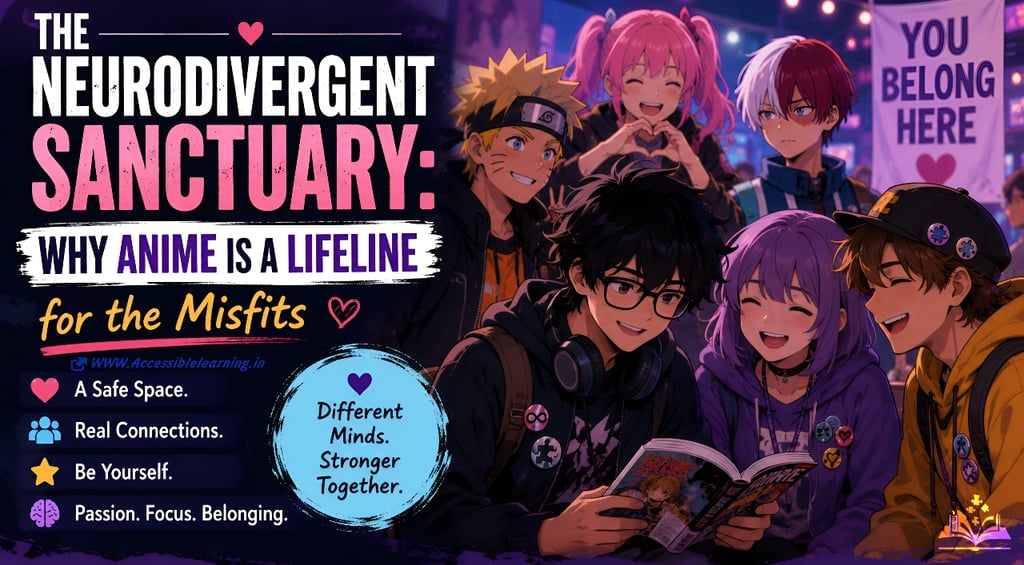
Why the "Weird" Kids Found Their Greatest Support System in Anime
For decades, society has had a habit of labeling people who think differently as "weird."
The child who memorizes every train route in the city. The teenager who can spend eight hours researching a favorite topic without losing focus. The student who struggles with eye contact but can passionately explain the lore of an entire fictional universe. The employee who excels at solving complex problems but finds office small talk exhausting.
These individuals often belong to a broad group known as neurodivergent people, including those with autism, ADHD, dyslexia, social anxiety, and other neurological differences.
Traditional social structures rarely accommodate them well.
Schools often reward conformity over individuality. Sports teams may prioritize social coordination and quick interpersonal communication. Corporate environments frequently emphasize networking, office politics, and unwritten social rules.
For many neurodivergent individuals, these environments can feel like obstacle courses designed by someone else. Yet in an unexpected corner of modern culture, many have discovered something remarkable.
Anime.
What began as a niche entertainment medium has quietly become one of the most welcoming communities for people who think differently. For countless neurodivergent fans, anime is more than entertainment. It is a sanctuary, a social bridge, and sometimes even a lifeline.
Understanding Neurodiversity
Before exploring anime's role, it helps to understand what neurodiversity means. Neurodiversity is the idea that neurological differences are natural variations of the human experience rather than defects that need to be fixed.
Autism, ADHD, dyslexia, and similar conditions are not simply collections of challenges. They often come with unique strengths:
Deep focus and concentration
Exceptional memory
Pattern recognition
Creativity
Innovative problem-solving
Strong honesty and authenticity
Passion-driven learning
The difficulty often arises not from the differences themselves but from environments built around a narrow definition of "normal."
When a person constantly feels misunderstood, excluded, or pressured to behave differently, emotional exhaustion follows. This is where fandom communities become important.
Why Traditional Social Structures Often Fail Neurodivergent People
Many social environments rely heavily on unspoken expectations. People are expected to:
Understand subtle body language
Interpret sarcasm instantly
Navigate shifting social hierarchies
Engage in casual conversation effortlessly
Adapt quickly to unpredictable situations
For neurodivergent individuals, these expectations can create continuous stress. Many learn to "mask" their natural behaviors.
Masking involves suppressing traits, rehearsing conversations, forcing eye contact, mimicking social behaviors, and constantly monitoring one's actions to appear socially acceptable.
While masking can help someone fit in temporarily, it often comes at a significant emotional cost. Research consistently links long-term masking to burnout, anxiety, depression, and reduced self-esteem.
The result is a painful paradox. Many neurodivergent people desperately want social connection but struggle in environments that demand constant performance. Anime communities often break this cycle.
Anime Creates a Different Kind of Social Space
Anime fandom operates differently from many mainstream social groups. Instead of beginning with social expectations, it begins with shared interests.
The question is not
"Are you socially skilled enough to belong?"
The question becomes the following:
"What anime do you love?"
This simple shift changes everything. Shared passion creates instant common ground.
Conversations no longer require navigating endless small talk. Instead, people discuss stories, characters, theories, artwork, music, worldbuilding, and creative projects.
For neurodivergent individuals, interest-based communication can feel dramatically more natural than conventional social interaction.

The Power of Hyper-Focus
One of the most misunderstood neurodivergent traits is hyperfocus. Many autistic and ADHD individuals develop intense interests that consume large amounts of attention and energy.
Traditional education sometimes treats these interests as distractions. Anime culture often celebrates them. A person who knows every detail of a fictional universe is not considered obsessive.
They are considered knowledgeable. A fan who can explain hundreds of episodes of lore gains social respect rather than criticism. This creates something many neurodivergent individuals rarely experience:
Validation. Their passion becomes a social asset instead of a social liability.
Why Anime Characters Are Easier to Read
Another overlooked reason anime resonates with neurodivergent audiences lies in communication itself.
Anime often uses highly expressive storytelling techniques:
Clear emotional reactions
Visual symbols for feelings
Explicit internal monologues
Distinct character archetypes
Strong emotional cues
Many characters openly explain what they think and feel.
Instead of relying exclusively on subtle facial expressions and social hints, anime frequently makes emotions visible and understandable. For individuals who struggle with decoding real-world social signals, this clarity can be comforting.
Characters become easier to understand than many real people. This doesn't necessarily replace social learning.
In many cases, it enhances it.
Anime can serve as a safe environment for exploring emotional concepts, relationships, empathy, conflict resolution, and communication.
Conventions: Structured Socialization at Its Best
Anime conventions represent one of the most fascinating examples of accidental inclusivity. At first glance, conventions appear chaotic. Thousands of attendees gather in crowded spaces filled with costumes, merchandise, performances, and events. Yet beneath the surface, conventions are highly structured.
There are:
Schedules
Maps
Panels
Rules
Designated activities
Clearly defined social expectations
For many neurodivergent attendees, this structure reduces uncertainty. Instead of guessing what to do next, they can follow organized systems.
Instead of unpredictable conversations, they participate in shared activities. Instead of wondering whether they belong, they are surrounded by people who already understand their interests.
The environment offers something rare:
Predictable social interaction.
The Cosplay Confidence Paradox
Parents and educators are often surprised by a common phenomenon.
A child who barely speaks in class can suddenly become the leader of a cosplay group. A teenager who avoids presentations can confidently perform on stage.
A socially anxious individual can coordinate events involving dozens of participants.
How does this happen? The answer lies in context.
Traditional social environments often focus attention directly on the individual.
Cosplay provides a framework. The person is no longer simply themselves.
They are portraying a character. The role creates psychological safety.
Expectations become clearer. Interactions become more structured.
Confidence emerges because the environment aligns with their strengths rather than highlighting their challenges.
Online Anime Communities and Digital Belonging
For many neurodivergent individuals, online fandom spaces serve as social training grounds. Forums, Discord servers, fan communities, and creative groups offer several advantages:
Time to process conversations
Reduced pressure from body language
Interest-focused discussions
Greater control over interactions
Opportunities for creative collaboration
These spaces allow relationships to develop around shared enthusiasm rather than social performance. Friendships formed through fandom often become some of the most meaningful connections in a person's life.

Anime as an Educational Gateway
One of the biggest misconceptions about anime is that it distracts young people from learning. In reality, anime frequently inspires learning. Fans often pursue:
Japanese language study
History
Mythology
Literature
Art
Animation
Music
Graphic design
Writing
Psychology
A teenager who appears uninterested in traditional coursework may spend hundreds of hours researching topics connected to favorite series.
This demonstrates an important educational principle:
People learn best when curiosity leads the process.
Anime often acts as the spark that ignites lifelong learning.
What Parents and Educators Should Understand
When a neurodivergent child becomes deeply invested in anime, many adults worry. Some fear isolation.
Others assume the interest is merely escapism. Sometimes those concerns are valid.
Any hobby can become unhealthy if it completely replaces real-world responsibilities.
However, dismissing anime outright misses a larger opportunity.
Anime often provides:
Community
Identity
Confidence
Motivation
Emotional understanding
Creative inspiration
Rather than asking, "How do I stop this interest?"
A better question may be
"How can I use this interest to help them grow?"
An anime-loving child might be encouraged to:
Write stories
Learn digital art
Study animation
Practice public speaking
Join clubs
Organize events
Learn a language
Explore technology
The passion itself is not the obstacle. It may be the bridge.
The Sociology of Belonging
Humans need more than acceptance. They need belonging.
Belonging occurs when people can participate without constantly hiding who they are.
Many neurodivergent individuals spend years feeling out of place in traditional environments.
Anime communities frequently offer the opposite experience.
Members are often encouraged to embrace their enthusiasm, creativity, knowledge, and individuality.
The result is a culture that unintentionally aligns with many neurodivergent needs.
It values expertise over popularity. Passion over conformity. Authenticity over performance.
The Future of Inclusive Communities
The growing popularity of anime reveals an important lesson about society. People thrive when communities are built around shared interests, clear expectations, and genuine acceptance.
What works inside anime fandom can teach schools, workplaces, and organizations valuable lessons about inclusion. Neurodivergent individuals do not need to be fixed.
They need environments where their strengths can emerge. Anime fandom demonstrates what happens when those environments exist.
People who once felt invisible become leaders. People who struggled to connect build thriving communities. People labeled "misfits" discover they were never broken. They simply needed a place where they belonged.

Anime is far more than entertainment for many neurodivergent individuals. It is a social language, a learning platform, a creative outlet, and a community built around shared passion rather than social conformity.
The same child who struggles to navigate a classroom may flourish in a convention hall. The same teenager who feels isolated at school may find lifelong friendships through fandom.
The same adult who feels misunderstood at work may discover confidence through cosplay, art, writing, or community leadership. The story of anime's relationship with neurodivergent people is ultimately not about cartoons.
It is about belonging. And in a world where many people spend their lives searching for acceptance, finding a place that celebrates who you are can change everything.
FAQ's
Q: Why is anime popular among neurodivergent individuals?
Anime often provides clear storytelling, structured social communities, and shared-interest environments that can feel more accessible to people with autism, ADHD, social anxiety, and other neurodivergent traits. Many fans find it easier to connect through common interests rather than traditional social expectations.
Q: Can anime help autistic people develop social skills?
Anime itself is not a therapy tool, but it can create opportunities for social learning. Through fandoms, conventions, cosplay groups, and online communities, autistic individuals may practice communication, teamwork, leadership, and relationship-building in low-pressure environments.
Q: Why do anime conventions feel more inclusive than other social events?
Anime conventions typically have clear schedules, structured activities, shared interests, and established community norms. These features reduce social uncertainty, making them more comfortable for many neurodivergent attendees.
Q: How does anime support people with ADHD?
Many anime series offer engaging visuals, fast-paced storytelling, and deep fictional worlds that capture attention. Additionally, fandom activities such as cosplay, fan art, content creation, and lore research can channel hyperfocus into productive and creative pursuits.
Q: Is anime a healthy form of escapism?
In moderation, yes. Anime can provide stress relief, emotional comfort, and inspiration. Like any hobby, it becomes problematic only when it completely replaces real-world responsibilities, relationships, or personal growth.
Q: What is masking, and how does anime fandom help reduce it?
Masking is the act of hiding natural behaviors or traits to fit social expectations. Many anime communities are accepting of unique interests, communication styles, and self-expression, allowing neurodivergent individuals to interact more authentically.
Q: Can anime improve emotional understanding?
Many anime stories explore complex emotions, friendships, conflicts, and personal growth. Because emotions are often expressed clearly through visuals and dialogue, some viewers find anime helpful for understanding emotional situations and interpersonal dynamics.
Q: Why do some neurodivergent people become deeply interested in anime?
Neurodivergent individuals often develop intense interests or "special interests." Anime offers rich worlds, detailed lore, memorable characters, and endless opportunities for exploration, making it a natural focus for passionate engagement.
Q: How can parents support a child who loves anime?
Parents can use anime as a gateway to learning and social development. Encouraging activities such as drawing, storytelling, language learning, video editing, animation, convention participation, or community involvement can help transform a hobby into valuable skills.
Q: Can anime communities help reduce loneliness?
Many fans report finding friendships, support networks, and a sense of belonging through anime fandom. Shared passions can make social interactions feel more natural and meaningful, particularly for people who struggle to connect in traditional social settings.
Q: What skills can anime fandom help develop?
Anime-related activities can contribute to skills such as:
Creative writing
Public speaking
Event organization
Graphic design
Video production
Leadership
Team collaboration
Language learning
Research and critical thinking
Q: What can educators learn from anime fandom communities?
Anime fandom demonstrates the power of interest-based learning. Educators can improve engagement by connecting lessons to students' passions, encouraging project-based learning, and creating inclusive environments where diverse thinking styles are valued.
Q: Is there scientific evidence supporting interest-based learning for neurodivergent students?
Yes. Educational research consistently shows that learners are often more motivated, attentive, and successful when instruction connects to their personal interests. For many neurodivergent students, special interests can become powerful pathways to academic growth.
Q: Can cosplay help build confidence?
Many people report increased confidence through cosplay because it provides a structured role, clear expectations, and opportunities for creative self-expression. Some individuals find it easier to interact socially while portraying a character than when focused solely on themselves.
Q: Why is anime considered a "neurodivergent sanctuary" by some fans?
The term reflects the way anime communities often value passion, creativity, expertise, and individuality over conventional social norms. For many neurodivergent people, this creates a rare sense of acceptance, belonging, and community.
Subscribe To Our Newsletter
All © Copyright reserved by Accessible-Learning Hub
| Terms & Conditions
Knowledge is power. Learn with Us. 📚

