

The Ming Dynasty (1368–1644): China's Golden Age of Power, Art, and Exploration
Discover the Ming Dynasty, its founding, the Forbidden City, Zheng He's voyages, the Great Wall's restoration, and its fall. A complete, SEO-optimized guide for students, historians, and curious readers.
CHINAEMPIRES/HISTORYHISTORY
Jagdish Nishad
4/4/20268 min read
What Was the Ming Dynasty?
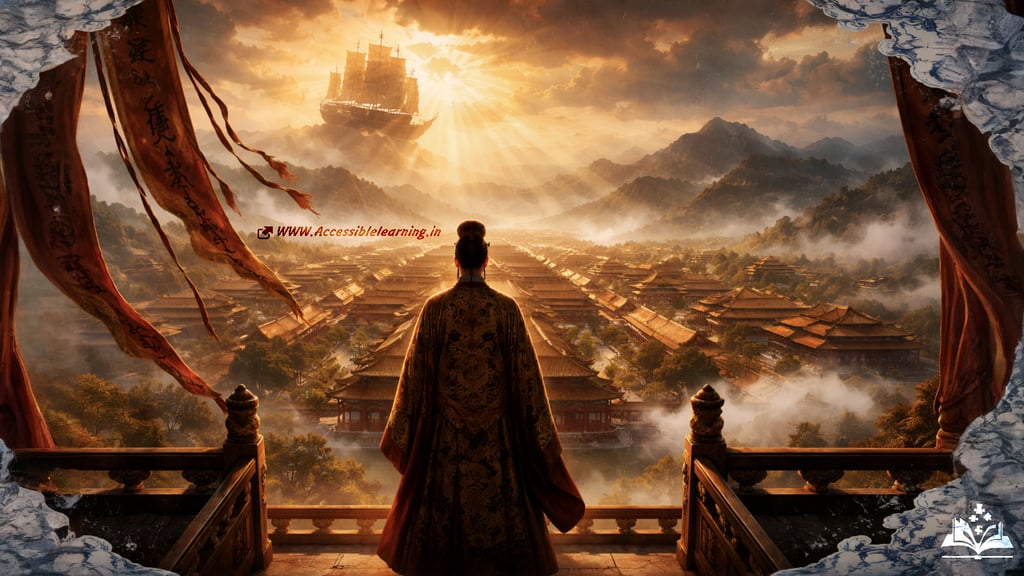
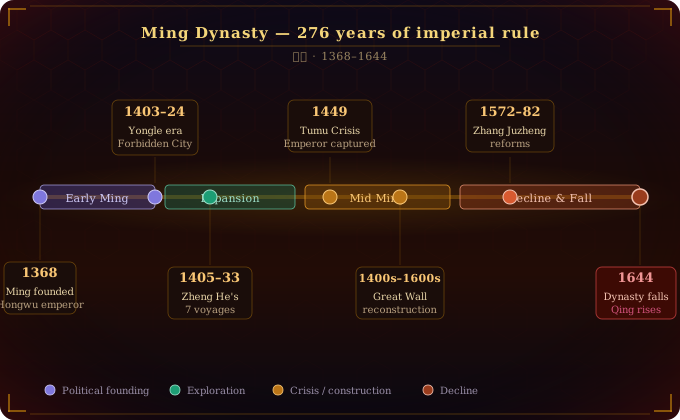
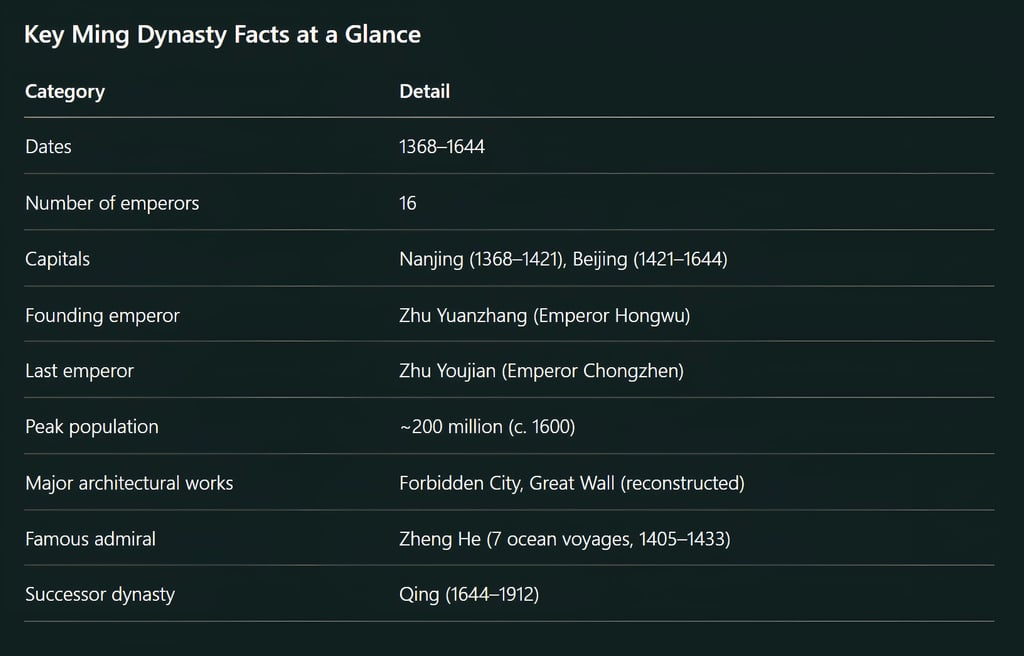
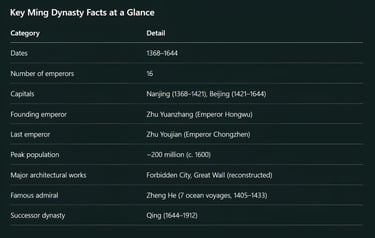
The Ming Dynasty was one of the most consequential imperial dynasties in Chinese history, ruling China from 1368 to 1644 a span of 276 years across 16 emperors. Founded by Zhu Yuanzhang (Emperor Hongwu) after overthrowing the Mongol-led Yuan Dynasty, Ming China became the world's largest economy, a cultural superpower, and a civilization that shaped modern East Asia.
The word "Ming" (明) translates to "brilliant" or "luminous" in Chinese a fitting name for a dynasty that produced some of humanity's most breathtaking architectural, artistic, and navigational achievements. From the towering walls of the Forbidden City in Beijing to the treasure fleets of Admiral Zheng He, the Ming era represents a peak of premodern Chinese civilization.
1. Founding of the Ming Dynasty: Zhu Yuanzhang's Rise from Peasant to Emperor
Few origin stories in world history match the sheer audacity of the Ming Dynasty's founding. Zhu Yuanzhang was born in 1328 to an impoverished peasant family in Anhui Province. After losing his family to famine and plague, he became a wandering Buddhist monk and then joined a rebel movement against the ruling Mongol Yuan Dynasty during the chaos of the Red Turban Rebellions.
Through military genius, political cunning, and iron discipline, Zhu Yuanzhang defeated rival warlords and expelled the Mongols from China. In 1368, he declared the new Ming Dynasty from Nanjing, taking the reign title Hongwu, meaning "vast military might."
As Emperor Hongwu, he:
Abolished the office of Prime Minister, concentrating all power in the emperor personally
Reorganized Chinese society into a rigid hereditary class system (farmers, artisans, soldiers, merchants)
Created the lijia system of neighborhood mutual surveillance and tax collection
Purged tens of thousands of officials, often entire families in spectacular bouts of imperial paranoia
His reign established the authoritarian, centralized template that would define Ming governance for generations.
2. The Yongle Emperor and the Age of Ambition (1402–1424)
The Ming Dynasty reached its most ambitious heights under Emperor Yongle, the fourth emperor, who seized the throne from his nephew in a civil war (the Jingnan campaign) in 1402. Yongle was a ruler of extraordinary energy and vision.
The Forbidden City
Yongle moved the imperial capital from Nanjing to Beijing and built the Forbidden City (紫禁城, Zǐjìn Chéng) between 1406 and 1420. Covering roughly 72 hectares with 980 surviving buildings, the Forbidden City remains the world's largest palace complex. It was constructed by an estimated one million laborers and craftsmen, using timber from Sichuan, stones from Beijing suburbs, and special bricks fired in kilns across Jiangsu Province.
The Forbidden City served as the home of 24 emperors across two dynasties (Ming and Qing) and is today a UNESCO World Heritage Site receiving over 19 million visitors annually, making it one of the most visited museums on Earth.
Zheng He's Treasure Fleets
One of history's most remarkable chapters unfolded between 1405 and 1433, when Admiral Zheng He led seven massive maritime expeditions across Southeast Asia, South Asia, the Arabian Peninsula, and the East African coast. His flagship, a "treasure ship," is estimated to have been approximately 120–130 meters long, dwarfing anything European navies of the time could build.
Zheng He's voyages were primarily diplomatic and commercial rather than colonial: he carried silk, porcelain, and Chinese goods while receiving tribute, exotic animals (including giraffes, famously presented to the Chinese court as unicorns), and diplomatic recognition from rulers across Asia and Africa. At their peak, the fleets comprised over 200 ships and 27,000 crew members.
After Yongle's death, Confucian officials hostile to maritime expansion gradually curtailed these voyages. By 1436, ocean-going ships were banned outright, one of history's most consequential decisions, leaving the seas to European powers, who would arrive in Asia's waters within decades.
3. Ming China's Economy: The World's Largest in the 16th Century
For most of the dynasty's history, China under Ming rule was the world's dominant economy. Some economic historians estimate China accounted for roughly 25–30% of global GDP in the early 16th century.
Key economic features included:
Agriculture: The introduction of New World crops—sweet potatoes, maize, and peanuts in the 16th century via Portuguese traders dramatically expanded China's agricultural output and supported population growth. China's population rose from approximately 65 million in 1368 to an estimated 200 million by 1600.
Silver monetization: The Ming dynasty gradually shifted from paper money (which the early Ming had used but which suffered from hyperinflation) to a silver-based economy. The Single Whip Reform of 1581, implemented by Grand Secretary Zhang Juzheng, consolidated tax payments into a single silver payment, streamlining revenue collection.
Global trade: Ming porcelain, silk, and tea were coveted worldwide. Spanish galleons carried New World silver from the Americas to Manila, where it was traded for Chinese goods, making Ming China the terminus of the first genuinely global trade network.
4. The Great Wall of China: A Ming Legacy
While the Great Wall had earlier incarnations under the Qin and Han dynasties, the iconic brick-and-stone Great Wall that most people picture today is largely a Ming construction. Major rebuilding and extension took place from the 1440s through the early 17th century, in response to persistent threats from Mongol tribes in the north.
The Ming Wall stretches approximately 8,850 kilometers from Jiayuguan in the west to Shanhaiguan on the Bohai coast in the east. It incorporated beacon towers for rapid communication, garrison forts at strategic passes, and the sophisticated Juyongguan and Badaling sections that remain among the most visited tourist sites in China today. The wall required millions of laborers soldiers, peasants, and prisoners many of whom died during construction and, according to legend, were buried within it.

5. Ming Art, Literature, and Intellectual Culture
The Ming period produced a flowering of Chinese culture that has had enduring global influence.
Porcelain: Ming blue-and-white porcelain, produced at the imperial kilns at Jingdezhen, is among the most recognized art forms in Chinese history. Cobalt-painted designs on white ceramic became a global luxury, inspiring European Delftware and fueling insatiable demand from Ottoman Turkey to Renaissance Italy.
Literature: The Ming period gave birth to several of the great Chinese classic novels: Journey to the West (西游记, attributed to Wu Cheng'en), Water Margin (水浒传, attributed to Shi Nai'an), and The Plum in the Golden Vase (金瓶梅). These works shaped Chinese storytelling traditions that persist today.
Philosophy: Wang Yangming (1472–1529) developed a school of Neo-Confucianism that emphasized intuitive moral knowledge (innate knowledge, or liangzhi) over rote study of classical texts an intellectual revolution with lasting impact in China, Japan, and Korea.
Encyclopedias and science: The late Ming saw remarkable encyclopedic works, including Song Yingxing's Tiangong Kaiwu (1637), an illustrated encyclopedia of agriculture and crafts that documented Chinese technology in extraordinary detail, and Li Shizhen's Compendium of Materia Medica (Bencao Gangmu, 1578), a pharmacological masterwork listing nearly 1,900 medicinal substances and remaining a foundational text of traditional Chinese medicine.
6. The Decline and Fall of the Ming Dynasty
The Ming Dynasty's fall was the result of compounding crises converging in the early 17th century.
Fiscal crisis: By the 1620s, the Ming state was effectively bankrupt. Years of military campaigns against the rising Jurchen (Manchu) power in Manchuria, combined with a weak tax base and endemic official corruption, drained the treasury.
Climatic catastrophe: the Little Ice Age: From roughly the 1620s onward, China experienced severe cooling associated with the global Little Ice Age. Crop failures, drought, and famine across northern China displaced millions of people, generating widespread social unrest.
Peasant rebellions: The most consequential rebel leader was Li Zicheng, a former postal worker turned warlord, whose rebel army captured Beijing in April 1644. The last Ming emperor, Chongzhen, hanged himself on Coal Hill (today's Jingshan Park) behind the Forbidden City as the city fell.
The Manchu conquest: Wu Sangui, the Ming general commanding the strategic Shanhaiguan pass, chose to open the gate to the Manchu Qing forces rather than submit to the rebels. Qing armies swept through China and established the Qing Dynasty (1644–1912), though Ming loyalist resistance continued in southern China for decades, including the kingdom maintained by the Zheng family in Taiwan until 1683.
7. Ming Dynasty Legacy: What It Left Behind
The Ming Dynasty's legacy is woven into the fabric of modern China and global civilization:
The Forbidden City remains China's most iconic monument and the centerpiece of Beijing
The Great Wall's most photographed sections are Ming constructions
Ming porcelain set global aesthetic standards and its blue-and-white ware remains instantly recognizable worldwide
The administrative systems developed by the Ming including the civil service examination system, the hukou household registration system, and patterns of provincial governance, left deep structural imprints on Chinese society
Zheng He has become a symbol of China's historical maritime power, invoked regularly in contemporary discussions of Chinese geopolitics and the "Maritime Silk Road" initiative
Ming-era fiction gave Chinese literature some of its canonical masterworks
Why the Ming Dynasty Still Matters
The Ming Dynasty stands as one of the great chapters of human civilization, a period that produced enduring wonders of architecture and art, sustained the world's largest population and economy, and came remarkably close to establishing Chinese maritime dominance across the Indian Ocean world. Its sudden withdrawal from overseas exploration in the mid-15th century ranks among history's great "what ifs," raising questions about how different the modern world might look if China, rather than Portugal and Spain, had established the first global oceanic trade networks.
For students, historians, and anyone seeking to understand China's contemporary identity its pride in its civilization, its relationship to the sea, its bureaucratic traditions, and its complex feelings about foreign domination, the Ming Dynasty is an essential starting point. The Forbidden City still stands. The Great Wall still traces the mountain ridges of northern China. And the blue-and-white porcelain still gleams in museums from London to Istanbul to Tokyo, a luminous trace of a brilliant age.
Frequently Asked Questions
Q: When did the Ming Dynasty start and end?
The Ming Dynasty ruled China from 1368 to 1644, a period of 276 years. It was founded by Emperor Hongwu (Zhu Yuanzhang) after the overthrow of the Mongol Yuan Dynasty and ended when rebel forces captured Beijing and the Manchu Qing Dynasty took power.
Q: Who was the most important Ming emperor?
Emperor Yongle (reigned 1402–1424) is widely considered the most consequential Ming ruler. He built the Forbidden City, moved the capital to Beijing, sponsored Zheng He's ocean voyages, and commissioned the Yongle Dadian, one of the world's largest encyclopedias. Emperor Hongwu, the founder, is equally significant for establishing the dynasty's governing institutions.
Q: Why did the Ming Dynasty end?
The Ming Dynasty collapsed due to multiple simultaneous crises: fiscal insolvency caused by costly military campaigns, widespread famines linked to the Little Ice Age, peasant rebellions (particularly Li Zicheng's), and the military pressure of the rising Manchu Qing Dynasty to the northeast. The last emperor, Chongzhen, died by suicide in 1644 as Beijing fell.
Q: What is the Ming Dynasty famous for?
The Ming Dynasty is famous for building the Forbidden City, reconstructing the Great Wall, producing iconic blue-and-white porcelain, sponsoring Zheng He's historic ocean voyages, and creating several classic Chinese novels. It was also the era during which China hosted the world's largest economy.
Q: Did Zheng He reach Africa?
Yes. Zheng He's later voyages (particularly the fourth through seventh expeditions, 1413–1433) reached the East African coast, including ports in modern-day Kenya and Tanzania. Artifacts from this contact have been found at archaeological sites in East Africa, and a 2010 excavation at Manda Island, Kenya, recovered a Chinese coin dating to the Yongle era.
Q: How many emperors did the Ming Dynasty have?
The Ming Dynasty had 16 emperors across its 276-year history, from Hongwu (1368–1398) to Chongzhen (1627–1644).
Q: What language did the Ming Dynasty speak?
The official spoken language of the Ming court and administration was an early form of Mandarin Chinese (官話, Guānhuà), based on the Beijing dialect. This official language tradition directly influenced the development of Modern Standard Chinese (Putonghua/Mandarin) used today.
Q: How big was the Ming Dynasty's population?
China's population grew substantially during the Ming period. Estimates suggest approximately 65–80 million people at the dynasty's founding (late 14th century), rising to approximately 200 million by 1600 — making Ming China by far the most populous nation on Earth at the time.
Subscribe To Our Newsletter
All © Copyright reserved by Accessible-Learning Hub
| Terms & Conditions
Knowledge is power. Learn with Us. 📚

