

The Loneliness Pandemic vs AI Companions: Are We Solving Isolation or Replacing Connection?
Explore the growing collision between the loneliness pandemic and the rise of AI companions. This article breaks down why loneliness is increasing worldwide, how AI-driven emotional companions are reshaping human interaction, and whether these technologies are helping or quietly replacing real relationships. A clear, balanced look at the future of connection in a digital-first world.
AI ASSISTANTMODERN DISEASESA LEARNINGNEW YOUTH ISSUESAI/FUTURE
Sachin K Chaurasiya | Shiv Singh Rajput
4/3/20266 min read
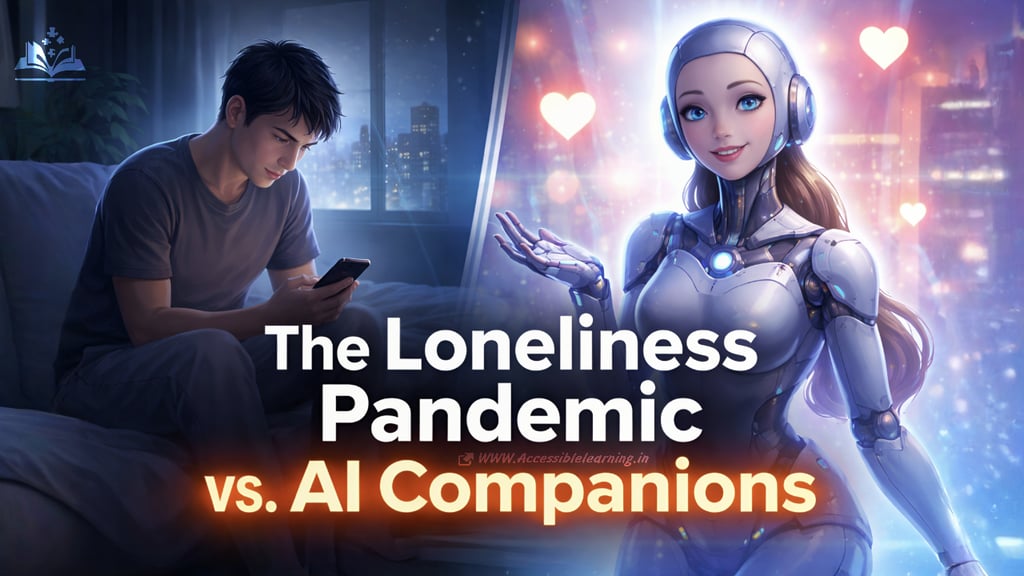
A deeper, sharper look at a human crisis meeting a synthetic solution
When Emotional Needs Meet Engineered Responses
Loneliness used to be treated as a private struggle. Today, it’s being recognized as a structural problem shaped by how we live, work, and interact.
At the same time, AI companions are evolving from novelty to normalized behavior. People aren’t just using them occasionally. Some are building routines, habits, and even emotional reliance around them.
This is no longer about technology adoption. It’s about how humans adapt when connection becomes scarce.
The Loneliness Pandemic: Not Just Feeling Alone, But Being Disconnected
Loneliness is often misunderstood. It’s not about being physically alone. It’s about the gap between desired connection and actual connection.
Key Dimensions of Modern Loneliness
Emotional Loneliness: Lack of deep, meaningful bonds. You may have people around, but no one who truly understands you.
Social Loneliness: Absence of a broader circle. No sense of belonging to a group or community.
Existential Loneliness: A deeper feeling of disconnection from purpose, identity, or meaning.
Structural Causes (Beyond the Obvious)
Digital Substitution Effect: Quick interactions replacing meaningful conversations
Mobility Culture: People move cities frequently, weakening long-term ties
Algorithmic Isolation: Personalized feeds reduce exposure to diverse perspectives
Gig Economy Lifestyles: Less stable social environments
Delayed Life Milestones: Later marriages, fewer traditional family structures
Cognitive and Psychological Impact
Reduced attention span for deep conversations
Increased social anxiety and fear of rejection
Higher dependency on low-effort interactions (likes, messages, short chats)
Distorted perception of relationships due to curated online lives
Loneliness doesn’t just hurt emotionally. It reshapes behavior.
The AI Companion Industry: From Tool to Emotional Interface
AI companions are part of a broader shift where technology moves from functional assistance to emotional interaction.
What Defines a Modern AI Companion?
Contextual Memory: Remembers past conversations and preferences
Personality Simulation: Adjustable tone, style, and emotional response
Multimodal Interaction: Text, voice, avatars, sometimes even physical robots
Continuous Learning: Adapts based on user behavior over time
Types of AI Companions Emerging
1. Conversational Companions
Focused on dialogue, reflection, and emotional support2. Romantic or Relationship AI
Simulate intimacy, affection, and bonding3. Mental Wellness AI
Structured conversations aimed at reducing anxiety or stress4. Productivity-Emotional Hybrids
Blend task management with motivational or supportive dialogue
Business Models Behind the Industry
Freemium access with premium emotional depth
Subscription-based personalization
In-app purchases for traits, personalities, or experiences
Data-driven personalization loops
This is where things get interesting:
Emotional engagement becomes a monetizable metric.

Why AI Companions Feel So Effective
The appeal is not accidental. It’s engineered.
1. Predictable Empathy
Human empathy varies. AI empathy is consistent and optimized.
2. No Social Risk
No embarrassment, no rejection, and no consequences for saying the “wrong” thing.
3. Instant Feedback Loops
Responses are immediate, reinforcing continued interaction.
4. Identity Flexibility
Users can explore thoughts, personalities, or emotions without being labeled.
5. Emotional Calibration
AI can adjust tone to match your mood in real time.
The Hidden Trade-Offs
The benefits are real. But so are the trade-offs.
1. Reduced Tolerance for Real Relationships
Human interactions involve friction. AI removes it.
Over time, this can lower patience for real-world complexity.
2. Emotional Outsourcing
Instead of processing emotions internally or with people, users may rely on AI as the first response.
3. Attachment Without Reciprocity
The user invests emotionally. The AI simulates it.
4. Reality Distortion
When AI feels consistently supportive, real relationships may feel comparatively disappointing.
5. Behavioral Conditioning
Users may unknowingly adapt to communication styles that work with AI but not with humans.
Social and Cultural Implications
This shift doesn’t just affect individuals. It changes society.
Changing Definition of Relationships
What counts as a “connection” may expand to include non-human entities.
Rise of Solo Lifestyles
If emotional needs are partially met by AI, people may delay or avoid traditional relationships.
New Social Norms
Talking to AI daily may become as normal as using social media.
Emotional Independence vs Isolation
AI could empower some individuals while isolating others further.
The Ethics Layer: Where It Gets Uncomfortable
1. Should AI Simulate Love or Attachment?
If users believe the connection is real, is that ethical?
2. Data Sensitivity
AI companions often handle deeply personal conversations.
That data is extremely valuable and vulnerable.
3. Emotional Manipulation Risks
Design choices can influence how attached users become.
4. Age and Vulnerability
Younger users and emotionally vulnerable individuals may be more affected.
5. Transparency
Should AI clearly remind users that it is not conscious or human?
Where AI Companions Actually Help (When Used Right)
Used carefully, AI companions can be powerful.
Emotional journaling with feedback
Practicing difficult conversations before real-life situations
Support during late-night stress or anxiety
Bridging isolation in elderly populations
Helping people articulate thoughts they struggle to express
The key difference is intent:
Support vs replacement
The Middle Path: Designing Healthy Interaction
The goal shouldn’t be to reject AI companions. It should be to use them wisely.
Practical Boundaries
Use AI for reflection, not validation
Avoid replacing real conversations entirely
Stay aware that responses are generated, not felt
Balance digital interaction with physical-world relationships
Treat AI as a tool, not an identity anchor

The Future: What’s Coming Next
1. Emotionally Adaptive AI
Systems that detect tone, hesitation, and behavioral patterns more accurately
2. Voice-First and Presence-Based Interaction
AI that feels less like typing and more like being with someone
3. Integration with Daily Life
From messaging apps to wearables to home environments
4. Regulation and Design Standards
Guidelines around emotional AI behavior, especially for vulnerable users
5. Hybrid Human-AI Support Systems
AI working alongside therapists, coaches, or communities
Loneliness is not a technology problem. It’s a human condition shaped by how we structure our lives. AI companions are not the enemy. But they are not the solution either. They sit somewhere in between.
They can soften the edges of loneliness.
They can create moments of comfort.
They can help people feel heard.
But they cannot replace the depth, unpredictability, and meaning of real human connection. So the real question isn’t whether AI can keep us company. It’s whether we’ll still choose each other when something easier is always available.
FAQ's
Q: What is the loneliness pandemic?
The loneliness pandemic refers to the growing number of people worldwide who feel socially and emotionally disconnected. It’s not just about being alone but about lacking meaningful relationships, support systems, and a sense of belonging.
Q: What are AI companions?
AI companions are digital systems designed to simulate human-like conversations and emotional interaction. They can chat, remember preferences, adapt to moods, and provide a sense of companionship through text, voice, or avatars.
Q: Why are AI companions becoming popular?
AI companions are gaining traction because they offer instant, judgment-free interaction, emotional support, and availability at any time. They address gaps that many people experience in real-world relationships, especially loneliness and social anxiety.
Q: Can AI companions actually reduce loneliness?
They can help reduce short-term feelings of loneliness by providing interaction and emotional engagement. However, they are not a complete replacement for human relationships and may not solve long-term loneliness on their own.
Q: Are AI companions safe to use?
Generally, yes, but with awareness. Users should be mindful of emotional dependency, privacy concerns, and the fact that AI responses are generated, not genuinely felt. Responsible use is important.
Q: What are the risks of using AI companions too much?
Overuse can lead to emotional dependency, reduced interest in real-world relationships, and unrealistic expectations of communication. It may also affect how people handle real social interactions.
Q: Can AI replace human relationships?
No. AI can simulate conversation and emotional responses, but it cannot replicate true human connection, mutual understanding, or shared life experiences.
Q: Who benefits the most from AI companions?
People who may benefit include:
Individuals experiencing isolation
People with social anxiety
Elderly individuals living alone
Users seeking emotional reflection or mental wellness support
Q: How does the AI companion industry make money?
Most platforms use subscription models, premium features, or in-app purchases. Some monetize through personalization, offering deeper interaction or unique companion traits.
Q: Is the AI companion industry growing?
Yes, rapidly. It is one of the fastest-growing segments in AI, driven by demand for emotional support, advancements in technology, and changing social behavior.
Q: What is the future of AI companions?
AI companions are expected to become more personalized, emotionally adaptive, and integrated into daily life through voice, wearables, and even physical devices. Ethical guidelines and regulations will likely play a bigger role.
Q: Should AI companions be used as a replacement or a support tool?
They are best used as a support tool. AI can help with reflection, emotional processing, and temporary companionship, but real human relationships remain essential for long-term well-being.
Q: How can users maintain a healthy balance with AI companions?
Use AI for support, not dependency
Stay connected with real people
Set boundaries on usage time
Be aware of emotional attachment
Q: Are AI companions suitable for younger users?
They can be, but with guidance. Younger users may be more vulnerable to emotional attachment, so awareness, parental involvement, and platform responsibility are important.
Q: What is the key difference between human connection and AI interaction?
Human connection involves mutual emotion, unpredictability, shared experiences, and growth. AI interaction is structured, predictable, and simulated, designed to respond rather than truly relate.
Subscribe to Frontier Intelligence
All © Copyright reserved by Accessible-Learning Hub
| Terms & Conditions
Accessible Learning Hub — Actionable clarity for high-agency minds.
Weekly breakdowns on AI breakthroughs, capital flow, and human performance systems. Zero fluff.