

The Isekai Trap: Escapism vs. Motivation
Why is the Isekai genre so popular? Explore the psychology behind escapism vs. motivation, how fantasy worlds reflect modern dissatisfaction, and whether Isekai inspires growth or encourages withdrawal from reality.
ACCESSIBLE LEARNING
Hikari | Kim Shin
6/14/20268 min read
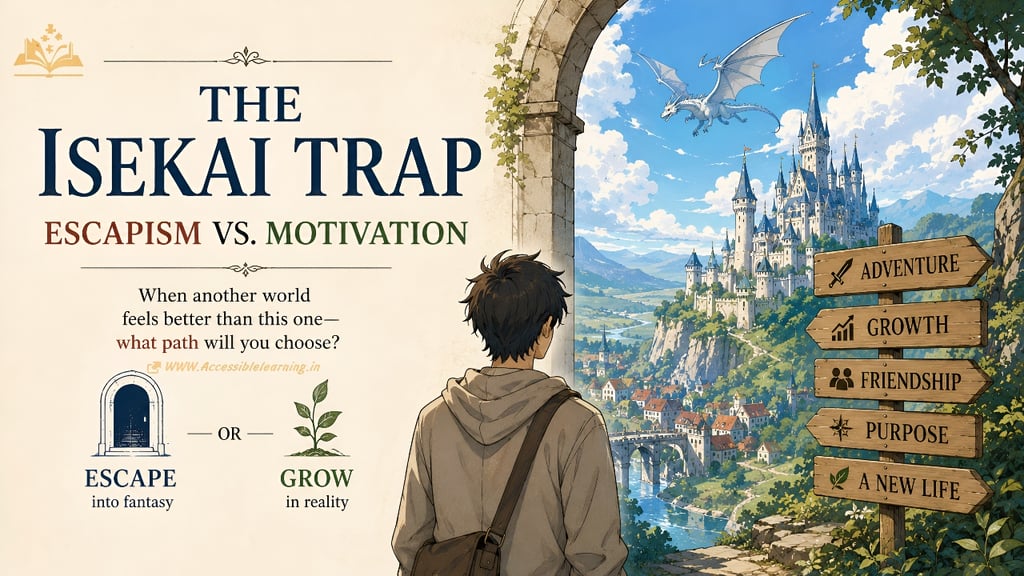
When Another World Becomes Better Than This One
Imagine waking up tomorrow and discovering that your ordinary life is gone.
No exams. No office politics. No endless notifications. No pressure to choose the perfect career path before you're old enough to understand yourself.
Instead, you are transported into a world where your talents matter. People recognize your potential. Every challenge feels meaningful. Every victory feels earned. You are no longer invisible.
This fantasy lies at the heart of the explosive popularity of Isekai.
Over the past decade, Isekai has evolved from a niche anime and light novel genre into a global cultural phenomenon. Stories about ordinary people being transported, reincarnated, or summoned into another world dominate streaming platforms, bookstores, gaming communities, and online discussions.
At first glance, the appeal seems obvious. These stories offer adventure, magic, and wish fulfillment. But beneath the fantasy lies something much deeper.
The rise of Isekai may be reflecting a growing dissatisfaction with modern life itself. For many young people, school feels disconnected from purpose. Careers feel uncertain. Economic pressures continue to rise. Social comparison never stops. The traditional promise that hard work guarantees success feels less convincing than it once did.
As a result, another world often feels more attractive than the one outside the screen.
This creates an important question:
Does Isekai inspire people to build better lives, or does it encourage them to quietly abandon the effort altogether?
The answer is more complicated than many fans or critics realize.
Why Isekai Resonates So Deeply
Every popular genre survives because it fulfills a psychological need. Romance fulfills the need for connection. Superhero stories fulfill the need for empowerment.
Mysteries satisfy curiosity. Isekai fulfills something equally powerful:
The desire for a fresh start.
Many people carry invisible burdens.
Failed opportunities.
Academic struggles.
Financial stress.
Social anxiety.
Regret.
Self-doubt.
Isekai presents a simple but seductive solution.
What if none of those things mattered anymore?
What if you could begin again with all the knowledge you've gained from your mistakes?
The fantasy isn't merely about entering a magical world. It's about escaping accumulated disappointment. For viewers and readers who feel trapped by circumstances, this concept can feel incredibly comforting.
In many ways, Isekai acts as an emotional pressure valve. It allows people to imagine possibilities that seem unreachable in everyday life. That psychological relief is not inherently unhealthy. In fact, it can be beneficial. The problem begins when fantasy stops serving reality and starts replacing it.
The Modern World and the School-to-Corporate Pipeline
Many successful Isekai protagonists begin their journeys from remarkably similar circumstances.
They are exhausted.
Overworked.
Ignored.
Underappreciated.
Socially disconnected.
Emotionally numb.
This pattern isn't accidental.
It mirrors widespread frustrations found throughout modern society. From an early age, many people are taught a predictable path:
Study hard.
Get good grades.
Attend a respected institution.
Find stable employment.
Work for decades.
Eventually achieve happiness.
For previous generations, this pathway often provided clear rewards. Today, however, many young adults experience a growing disconnect between effort and outcome.
Higher education costs continue to rise.
Housing becomes less affordable.
Competition intensifies.
Job security weakens.
Burnout increases.
As a result, many begin questioning whether the traditional system is delivering what it promised. Isekai stories tap directly into this frustration. The fantasy world becomes a symbolic rejection of systems perceived as unfair or meaningless. The protagonist doesn't simply travel somewhere else. They escape structures that failed them.

The Positive Side of Escapism
Escapism often receives criticism, but not all escapism is harmful.
Healthy escapism serves important psychological functions.
It allows the mind to recover from stress.
It creates emotional distance from overwhelming situations.
It fuels imagination and creativity.
It introduces new perspectives.
Many successful creators, entrepreneurs, artists, and innovators trace their inspiration back to fictional worlds that expanded their thinking. Isekai can offer several positive lessons.
Reinvention Is Possible
Most protagonists receive a second chance. This reinforces the idea that identity is not fixed.
People can change.
Skills can be learned.
Circumstances can improve.
Failures do not have to define the future.
This message can be genuinely empowering.
Growth Creates Opportunity
Despite criticism of overpowered protagonists, many Isekai stories emphasize development.
Characters train.
Learn.
Adapt.
Build relationships.
Solve problems.
These narratives can reinforce a growth mindset, encouraging viewers to believe that effort matters.
Alternative Ways of Living
Isekai often explores different economic systems, communities, leadership styles, and social structures.
By imagining alternative worlds, audiences naturally begin questioning assumptions about their own.
This can inspire innovation rather than resignation.
When Escapism Becomes an Escape Route
The danger emerges when fantasy transitions from inspiration to substitution. Psychologists often distinguish between healthy escapism and avoidant escapism.
Healthy escapism helps individuals recharge before returning to reality. Avoidant escapism encourages individuals to disengage from reality entirely.
This distinction is crucial. Someone who enjoys Isekai after work may return feeling refreshed and motivated. Someone who uses fantasy to avoid responsibilities may gradually lose motivation to address real-life challenges.
The issue isn't the content itself. The issue is the relationship people develop with it. If fictional success feels more attainable than real-world success, the brain may begin prioritizing fantasy rewards over real effort.
This can create a subtle cycle:
Real life feels difficult.
Fantasy provides comfort.
Comfort becomes preferred.
Reality feels even harder by comparison.
The person retreats further.
Over time, motivation can weaken.
Not because they are lazy, but because the contrast between fantasy and reality becomes too large.
The Wish Fulfillment Problem
A recurring criticism of modern Isekai involves excessive wish fulfillment. Many stories grant protagonists immediate power, admiration, wealth, or social status.
Conflict becomes minimal.
Growth becomes optional.
Success arrives without meaningful struggle.
These narratives can create unrealistic expectations.
Real life rarely works this way.
Mastery takes years.
Relationships require effort.
Careers involve setbacks.
Personal growth is often messy.
When audiences consume large amounts of instant-success fantasy, patience for real-world progress may decline.
The human brain naturally prefers immediate rewards.
Isekai sometimes amplifies this preference.
The result can be frustration whenever reality demands long-term effort.
Why Some Viewers Become More Motivated
Interestingly, not everyone responds to Isekai in the same way. Some viewers actually become more ambitious.
Why?
Because they focus on the underlying themes rather than the surface fantasy.
They see:
Character growth
Strategic thinking
Leadership development
Skill acquisition
Resilience
Adaptability
Instead of wishing they lived in another world, they apply those lessons to this one.
For these individuals, Isekai functions like mythology.
The magical setting becomes a metaphor for personal development.
The hero's journey becomes a framework for navigating real challenges.
In this context, fantasy becomes a motivational tool.
Why Others Quietly Check Out
Others interpret the same stories differently. They focus on escape rather than transformation. The fantasy world becomes a refuge from disappointment.
Rather than asking, "How can I improve my life?" They begin asking, "Why bother?" This mindset can be dangerous because it often develops gradually.
There is no dramatic moment.
No clear warning sign.
Just a slow reduction in engagement.
Less effort.
Less ambition.
Less belief that change is possible.
Eventually, the fantasy world feels more emotionally meaningful than reality itself. At that point, escapism becomes resignation.


The Hidden Lesson Most Isekai Fans Miss
Ironically, the best Isekai stories often contain the opposite message from what critics assume. The protagonist rarely succeeds because they escaped. They succeed because they take action after arriving.
They learn.
Experiment.
Fail.
Adapt.
Build relationships.
Accept responsibility.
Create value.
The world changes because they participate in it. The lesson is not that another world solves problems. The lesson is that engagement solves problems.
The fantasy setting merely makes this easier to see. Whether in a magical kingdom or a modern city, progress still requires effort. The environment changes. The principle does not.
Escapism vs. Motivation: Finding the Balance
Escapism is not the enemy. Human beings need stories. We need imagination. We need temporary relief from pressure. The real question is what happens after the story ends.
Do you return to reality with new ideas?
Or do you return feeling that reality is hopeless?
Healthy Isekai consumption leaves viewers energized. Unhealthy consumption leaves them detached. The difference lies in whether the fantasy serves as a bridge or a destination. A bridge helps you move forward. A destination keeps you standing still.
Another World Is Not Coming
The popularity of Isekai reveals something important about modern society. People are hungry for meaning. They want agency. They want recognition. They want a future that feels worth investing in. Fantasy worlds provide temporary access to those feelings. But eventually, the episode ends.
The book closes. The game logs out. And reality remains. The true challenge is not finding another world. It is creating a life in this one that feels meaningful enough that escape becomes optional rather than necessary.
Perhaps that is the greatest lesson hidden inside the genre.
The most important world was never the fantasy kingdom.
It was always the real one waiting outside the screen.
FAQ's
Q: What is the Isekai genre, and why is it so popular?
Isekai is a genre of anime, manga, novels, and games where a character is transported, reincarnated, or trapped in another world. Its popularity comes from its themes of reinvention, adventure, personal growth, and escaping the pressures of modern life.
Q: Is watching Isekai anime considered a form of escapism?
Yes, Isekai is often considered a form of escapism because it allows viewers to imagine life in a different world with new opportunities and fewer limitations. However, escapism itself is not necessarily negative when balanced with real-world responsibilities.
Q: Can Isekai anime motivate people in real life?
Many Isekai stories can be motivational. They often highlight perseverance, learning new skills, leadership, adaptability, and overcoming adversity. Viewers who focus on these themes may feel inspired to pursue personal growth in their own lives.
Q: How does Isekai reflect modern social frustrations?
Isekai often features protagonists who feel trapped, overworked, or dissatisfied with their lives. This reflects real-world concerns such as academic pressure, workplace burnout, economic uncertainty, and the desire for a more meaningful existence.
Q: What are the psychological effects of consuming too much escapist content?
Excessive reliance on escapist media can lead to avoidance behaviors, reduced motivation, unrealistic expectations, and decreased engagement with real-life goals. Healthy consumption, however, can provide relaxation, stress relief, and creative inspiration.
Q: Why do many Isekai protagonists start as ordinary or unsuccessful people?
The "ordinary person" archetype makes protagonists relatable. It allows audiences to imagine themselves in the character's position and reinforces the idea that transformation and personal growth are possible regardless of one's starting circumstances.
Q: Does Isekai encourage unrealistic expectations about success?
Some Isekai stories do. Overpowered protagonists who achieve wealth, status, or power with minimal struggle can create unrealistic perceptions of success. However, many well-written Isekai series still emphasize effort, learning, and resilience.
Q: What is the difference between healthy and unhealthy escapism?
Healthy escapism provides temporary relief from stress and helps individuals recharge before returning to real-life challenges. Unhealthy escapism becomes problematic when it is used to avoid responsibilities, relationships, or personal development.
Q: Why do younger audiences connect strongly with Isekai themes?
Many young people face academic pressure, career uncertainty, social comparison, and economic challenges. Isekai stories offer a fantasy of freedom, control, purpose, and recognition that can feel lacking in everyday life.
Q: What is the main lesson behind the "Isekai Trap" concept?
The core lesson is that fantasy can either inspire growth or encourage avoidance. The healthiest approach is to use fictional worlds as sources of inspiration while continuing to invest effort, creativity, and ambition into improving real life.
Q: Can Isekai anime improve mental well-being?
In moderation, Isekai can support mental well-being by reducing stress, encouraging imagination, and providing emotional comfort. However, it should complement real-world activities, relationships, and goals rather than replace them.
Q: Why is the debate between escapism and motivation important today?
As digital entertainment becomes increasingly immersive, understanding the balance between inspiration and avoidance is more important than ever. The discussion helps people consume media consciously while maintaining healthy engagement with reality.
Subscribe to Frontier Intelligence
All © Copyright reserved by Accessible-Learning Hub
Accessible Learning Hub — Actionable clarity for high-agency minds.
Weekly breakdowns on AI breakthroughs, capital flow, and human performance systems. Zero fluff.