

The "Human Premium": The Only Skills AI Can't Fake!
As AI automates coding, analysis, and routine knowledge work, the most valuable skills are becoming deeply human. Discover why emotional intelligence, ethical judgment, resilience, conflict resolution, and creative leadership are the new competitive advantages in the age of artificial intelligence.
EDUCATION/KNOWLEDGEAI/FUTUREENTREPRENEUR/BUSINESSMAN
Kim Shin | Sachin K Chaurasiya
6/17/20266 min read
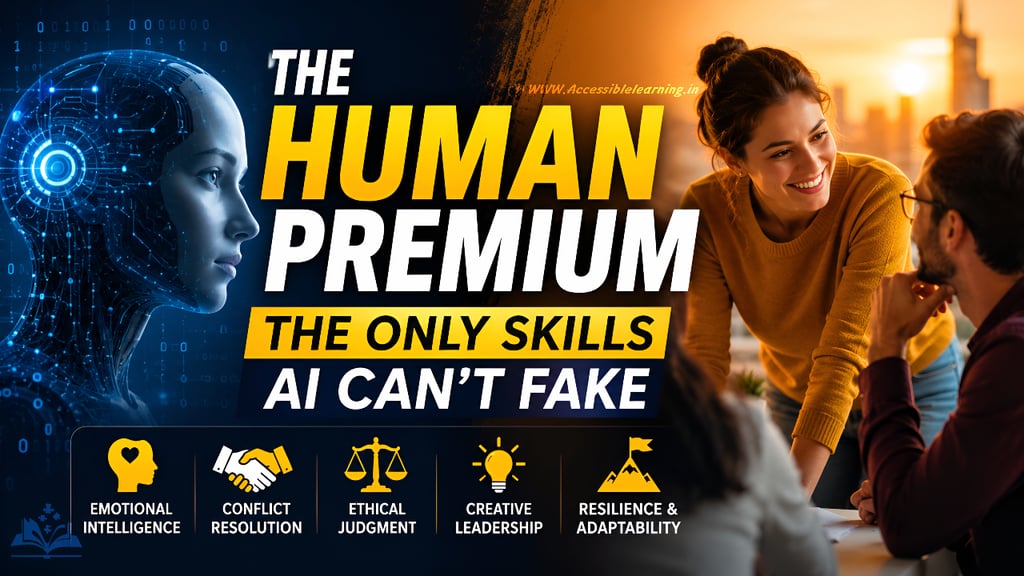
The Smarter the Machines Get, the More Your Humanity Is Worth
For decades, society sold a simple formula for success:
Study hard. Memorize information. Learn technical skills. Get a good job.
That formula is breaking down faster than most people realize.
Artificial intelligence can now write code, analyze spreadsheets, summarize research papers, generate marketing campaigns, design graphics, draft legal documents, and solve complex mathematical problems in seconds. Tasks that once required years of training are becoming accessible through a simple prompt.
The result is uncomfortable but unavoidable:
The more capable AI becomes, the less valuable purely technical competence becomes.
This does not mean expertise is dead. It means the market is changing what it rewards.
The future belongs to people who can do what machines cannot.
This emerging advantage can be called the Human Premium.
It is the growing economic value attached to deeply human abilities such as emotional intelligence, ethical judgment, resilience, leadership, persuasion, adaptability, and decision-making under uncertainty.
As AI commoditizes hard skills, humanity becomes the new scarce resource.
The people who understand this shift early will thrive.
The people who ignore it may discover that their most valuable skills have become software features.
Understanding the Great Skill Inversion
For most of modern history, information was scarce. Knowledge created value because access to knowledge was limited. A person who understood accounting, programming, engineering, law, or medicine possessed information that most people did not.
Today, AI systems have fundamentally changed this equation.
Information is abundant. Execution is increasingly automated.
Technical knowledge is becoming cheaper to access every year.
This creates what economists call a commoditization effect.
When something becomes abundant, its market value falls.
Consider what happened to:
Basic graphic design
Data entry
Translation
Simple programming
Research summarization
Customer support
Content production
Many of these tasks can now be completed by AI faster and cheaper than before. The same pattern is spreading into nearly every knowledge profession. This does not eliminate jobs overnight. Instead, it changes what employers pay premiums for.
The question is no longer:
"Can you perform the task?"
The question becomes the following:
"Can you perform the human parts of the task that AI cannot?"
That distinction changes everything.
Why Hard Skills Alone Are No Longer Enough
Hard skills remain important.
Engineers still need engineering knowledge.
Doctors still need medical expertise.
Lawyers still need legal understanding.
However, possessing technical knowledge alone is becoming less valuable because AI increasingly amplifies everyone’s technical capabilities.
Imagine two managers:
Manager A:
High technical expertise
Poor communication
Weak leadership
Low emotional awareness
Manager B:
Strong technical understanding
Excellent conflict resolution
Effective leadership
High emotional intelligence
Strong judgment
In an AI-enhanced workplace, Manager B becomes exponentially more valuable.
Why?
Because AI can help managers with technical work. Only one can effectively manage humans. The market rewards scarcity. Human-centered capabilities are becoming scarce. Therefore, they command a premium.
The Rise of Emotional Intelligence as an Economic Asset
For years, emotional intelligence was treated as a "soft skill." The label itself created a problem. It implied these abilities were optional. They are not.
In the AI era, emotional intelligence may become one of the most valuable professional assets available.
Emotional intelligence includes the following:
Self-awareness
Empathy
Emotional regulation
Active listening
Relationship management
Social awareness
AI can simulate empathy.
It cannot genuinely understand human experience.
It can recognize patterns in emotional language.
It cannot feel consequences.
It cannot build authentic trust.
Human relationships remain the foundation of:
Leadership
Sales
Negotiation
Team building
Mentorship
Crisis management
Organizations increasingly discover that technical failures are often easier to solve than human failures.
A coding problem can be fixed.
A broken team culture can destroy an entire company.

Conflict Resolution: The Billion-Dollar Skill
Every growing organization eventually encounters conflict.
Employees disagree.
Departments compete.
Stakeholders clash.
Customers become frustrated.
Partners break trust.
AI can suggest possible solutions. But resolving conflict requires something much deeper.
It requires:
Reading emotional context
Understanding competing interests
Managing tensions
Building consensus
Navigating uncertainty
These situations rarely have perfect answers. They involve people. And people are messy.
The ability to transform conflict into cooperation is becoming one of the most powerful career accelerators in modern business. Individuals who can solve human problems often become more valuable than those who can solve technical problems.
Ethical Judgment: The Skill Nobody Talks About
AI can generate recommendations. It cannot carry moral responsibility.
This distinction becomes increasingly important as AI systems influence the following:
Hiring decisions
Medical diagnoses
Financial lending
Criminal justice
Education
Military operations
Someone must decide:
Should we do this?
Not:
Can we do this?
That question requires ethical judgment. Ethical judgment involves balancing the following:
Long-term consequences
Human welfare
Organizational goals
Social impact
Risk assessment
The future workforce will need leaders capable of making difficult decisions where no algorithm can provide certainty.
As AI expands, ethical responsibility does not disappear. It becomes more important.
Why Creativity Is Becoming More Valuable, Not Less
Many people assume AI will replace creativity. The reality is more nuanced. AI can generate outputs.
It struggles to generate meaningful originality.
True creativity is not merely producing content.
It is connecting ideas from different domains.
It is recognizing opportunities nobody else sees.
It is challenging assumptions.
It is imagining futures that do not yet exist.
The most valuable creators of the future will not compete against AI. They will direct it. AI becomes the tool. Humans remain the visionaries.
The winners will be those who combine the following:
Curiosity
Imagination
Strategic thinking
Domain expertise
Creative leadership
The bottleneck is no longer production. The bottleneck is direction.
Resilience: The Skill That Survives Every Technological Revolution
Every major technological shift creates disruption.
The Industrial Revolution did.
The Internet did.
Artificial intelligence certainly will.
Many careers will change.
Some will disappear.
Entire industries may transform.
The people who thrive will not necessarily be the smartest.
They will often be the most adaptable.
Resilience means:
Recovering from setbacks
Learning continuously
Remaining effective during uncertainty
Adjusting to change quickly
Maintaining performance under pressure
Knowledge has a shelf life. Adaptability does not. The future belongs to lifelong learners. Not lifelong experts.
The Modern Education System Has It Backward
Most schools still operate according to an industrial-age model. Students are rewarded for:
Memorization
Compliance
Standardized answers
Predictable performance
These are precisely the areas where AI excels. Yet many of the skills most valuable in the future receive little attention:
Leadership
Communication
Negotiation
Decision-making
Resilience
Emotional intelligence
Ethical reasoning
Adaptability
Students spend years preparing for tests.
They spend very little time preparing for uncertainty.
That mismatch creates a dangerous gap between education and reality.
The future demands a different curriculum.
One centered on human capability rather than information retention.

The Human Premium Survival Guide
If you want to remain valuable in an AI-dominated economy, shift your focus.
Do not stop learning technical skills. But stop treating them as your only competitive advantage.
Invest heavily in abilities that become more valuable as AI improves.
Build Emotional Intelligence
Practice:
Active listening
Empathy
Self-awareness
Relationship building
These skills compound over time.
Develop Leadership Capacity
Learn how to:
Inspire teams
Manage conflict
Communicate vision
Create trust
Leadership remains deeply human.
Strengthen Decision-Making
Study:
Critical thinking
Risk analysis
Ethical reasoning
Strategic planning
Complex judgment cannot be automated easily.
Become Adaptable
Continuously:
Learn new tools
Explore new industries
Experiment with new ideas
Flexibility is a competitive advantage.
Master Human Communication
The ability to communicate clearly may become one of the highest-paying skills of the next decade.
People who can influence, persuade, teach, and inspire will always have leverage.
The Future Belongs to the Most Human People
The biggest misconception about AI is that it creates a competition between humans and machines. It does not.
Machines have already won the race for speed, scale, memory, and pattern recognition. Competing there is a losing strategy. The real opportunity lies elsewhere.
As AI becomes more intelligent, society places greater value on what remains uniquely human.
Empathy becomes more valuable.
Judgment becomes more valuable.
Leadership becomes more valuable.
Creativity becomes more valuable.
Resilience becomes more valuable.
Humanity itself becomes more valuable.
That is the Human Premium.
And in the coming decade, it may become the most important economic advantage a person can possess.
The future will not belong to those who merely know the most.
It will belong to those who can do what no machine can genuinely replicate.
The smartest career move in the age of artificial intelligence is not becoming more like a machine.
It is becoming more human.
FAQ's
Q: What is the Human Premium in the age of AI?
The Human Premium refers to the increasing value of uniquely human abilities such as emotional intelligence, leadership, ethical judgment, creativity, adaptability, and complex decision-making. As AI automates technical and repetitive tasks, these human-centered skills become more valuable in the workplace.
Q: Which skills can AI not replace?
AI struggles to replicate genuine empathy, ethical reasoning, relationship building, conflict resolution, creative vision, leadership, and decision-making in uncertain situations. These skills require human experience, emotional understanding, and contextual judgment.
Q: Why are soft skills becoming more important than hard skills?
Hard skills are increasingly being augmented or automated by AI tools. Soft skills, often called power skills, help people lead teams, solve complex human problems, build trust, and navigate uncertainty, making them critical for long-term career success.
Q: What are the most valuable AI-proof skills to learn?
Some of the most valuable AI-resistant skills include:
Emotional intelligence
Critical thinking
Leadership
Communication
Ethical decision-making
Adaptability
Negotiation
Creative problem-solving
Conflict resolution
Strategic thinking
Q: How is AI changing the future job market?
AI is automating routine tasks and increasing productivity across industries. This shift is reducing the value of repetitive knowledge work while increasing demand for professionals who can lead, collaborate, innovate, and make high-stakes decisions.
Q: Can emotional intelligence become more valuable than technical skills?
In many roles, yes. Technical skills remain important, but emotional intelligence often determines success in leadership, management, sales, customer relationships, and team collaboration. As AI handles more technical tasks, emotional intelligence becomes a stronger competitive advantage.
Q: What should students learn to prepare for an AI-driven future?
Students should focus on developing adaptability, communication, critical thinking, resilience, creativity, leadership, and ethical reasoning alongside technical knowledge. The ability to learn continuously will be more important than memorizing information.
Q: Why is adaptability considered a future-proof skill?
Technology, industries, and job requirements are changing faster than ever. Adaptable individuals can learn new tools, adjust to new environments, and remain valuable even as industries evolve, making adaptability one of the most important long-term career skills.
Q: Will AI replace managers and leaders?
AI can assist managers by providing data and recommendations, but effective leadership requires trust, empathy, motivation, conflict resolution, and strategic judgment. These human qualities remain difficult for AI to replicate.
Q: How can professionals increase their Human Premium?
Professionals can increase their Human Premium by improving emotional intelligence, communication, leadership abilities, decision-making skills, resilience, and creativity while using AI as a tool to enhance productivity rather than compete against it.
Subscribe To Our Newsletter
All © Copyright reserved by Accessible-Learning Hub
| Terms & Conditions
Knowledge is power. Learn with Us. 📚

