

The Harriman Railroad Empire: How E.H. Harriman Built America's Most Powerful Transportation Network
Discover how E.H. Harriman transformed bankrupt railroads into a 60,000-mile empire. Explore his Union Pacific turnaround, the 1901 Wall Street battle, the Alaska expedition, and his lasting legacy on American transportation.
EMPIRES/HISTORYCOMPANY/INDUSTRYWEALTHY FAMILY
Sachin K Chaurasiya
1/22/202618 min read
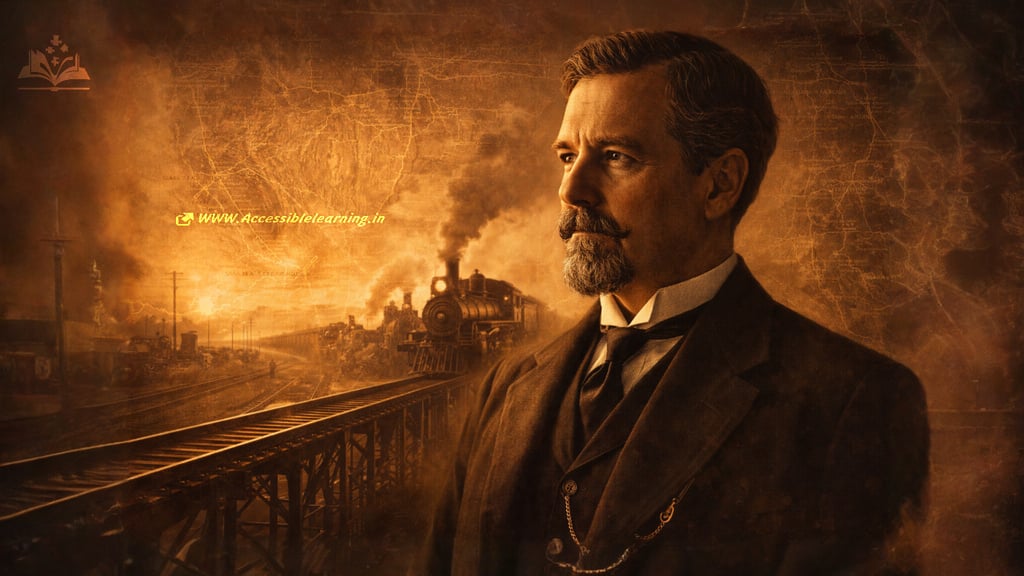
The Railroad Magnate Who Transformed American Transportation
Edward Henry Harriman stands as one of the most influential figures in American railroad history, a self-made financier who transformed failing rail lines into the most powerful transportation empire of the early 20th century. Born in 1848 in Hempstead, New York, Harriman rose from a Wall Street office boy to control over 60,000 miles of railroad track by the time of his death in 1909. His strategic vision, operational excellence, and willingness to take calculated risks revolutionized the railroad industry and helped shape modern America's economic infrastructure.
Unlike many of his contemporaries who focused on stock manipulation and financial engineering, Harriman prioritized operational efficiency, safety improvements, and long-term infrastructure investment. His approach to railroad management—emphasizing physical plant upgrades, standardization, and strategic expansion—set new industry standards that influenced American transportation for generations.
Early Life and Path to Wall Street Success
From Humble Beginnings to Financial Power
Edward Henry Harriman was born on February 20, 1848, to Orlando Harriman Sr., an Episcopal clergyman, and Cornelia Neilson. Despite coming from a modest background, young Harriman demonstrated remarkable business acumen from an early age. His great-grandfather, William Harriman, had emigrated from England in 1795 and established himself as a successful businessman and trader, perhaps providing the entrepreneurial DNA that would define Edward's career.
At just 14 years old, Harriman left formal education to work as an office boy on Wall Street, joining his uncle Oliver Harriman, who had already established a foothold in New York's financial district. This decision, though it ended his formal schooling, proved instrumental in shaping his future. By age 22 in 1870, Harriman had saved enough money—with help from an uncle's loan—to purchase a seat on the New York Stock Exchange for approximately $4,000 to $4,500, plus a $500 initiation fee.
Marriage and Entry into Railroad Finance
In 1879, Harriman married Mary Williamson Averell, daughter of William J. Averell, a prominent banker and president of the Ogdensburg and Lake Champlain Railroad Company. This marriage proved pivotal, not just personally but professionally, as it sparked Harriman's deep interest in railroad operations and finance. The connection to his father-in-law's railroad business provided invaluable insights into an industry that was rapidly becoming America's economic backbone.
Building the Empire: Strategic Acquisitions and Turnarounds
The First Success: Lake Ontario Southern Railroad
Harriman's railroad career began in 1881 when he acquired the small, bankrupt Lake Ontario Southern Railroad at age 33. This 34-mile line was in terrible condition, but Harriman recognized its strategic value. He renamed it the Sodus Bay & Southern, reorganized its operations and finances, and sold it to the Pennsylvania Railroad at a substantial profit.
This transaction established Harriman's reputation as a "rebuilder of bankrupt railroads" and taught him a crucial lesson: even railroads with limited intrinsic operational value could be profitable if positioned correctly within larger railroad systems. This insight would shape his acquisition strategy for decades to come.
Illinois Central: Learning Operational Excellence
By age 35, Harriman had become a director of the Illinois Central Railroad, and four years later, he was named vice president. His tenure at Illinois Central proved crucial to developing his management philosophy. Working alongside President Stuyvesant Fish, Harriman helped transform an already prosperous railroad into a model of efficiency.
At Illinois Central, Harriman implemented several innovations that would become his trademarks:
Physical plant improvements to enable higher traffic volumes at lower per-unit costs
Decentralized organizational structure based on operating divisions rather than centralized departments
A management philosophy that prioritized systems over personalities, famously stating: "We should first adopt a plan & then make our officers fit into it as best we can, & not make a plan to fit our officers."
These experiences at Illinois Central provided the operational blueprint Harriman would later apply to much larger railroad systems.
The Union Pacific Transformation: From Bankruptcy to Prosperity
Taking Control of a Failed Giant
The Union Pacific Railroad, one of America's first transcontinental railroads, had fallen into bankruptcy following the Financial Panic of 1893. The company was in receivership, its infrastructure deteriorated, and even financial titan J.P. Morgan wanted nothing to do with it. Most investors viewed Union Pacific as a lost cause.
Harriman saw opportunity where others saw disaster. In 1897, at nearly 50 years old, he became a director of Union Pacific. With backing from a powerful syndicate of investors—including the Vanderbilts, Rockefellers, Goulds, and the banking firm Kuhn, Loeb & Co.—Harriman's group paid $75 million for control of 1,800 miles of railroad. By May 1898, he chaired the executive committee, and by 1903, he had assumed the company's presidency.
Operational Revolution and Infrastructure Investment
Harriman immediately launched an ambitious rehabilitation program, investing tens of millions of dollars in upgrades that transformed Union Pacific from a decrepit operation into one of America's premier railroads. His improvements included:
Track and Infrastructure Upgrades:
Reducing grades and straightening curves to improve efficiency
Laying heavier rail capable of supporting larger locomotives and freight cars
Replacing outdated rolling stock with modern equipment
Building new bridges and reinforcing existing structures
Strategic Construction Projects: The crowning achievement was the Lucin Cutoff across the Great Salt Lake in Utah, which shortened the route by 43 miles and eliminated challenging mountain grades. This engineering marvel demonstrated Harriman's willingness to invest in expensive infrastructure projects that would pay dividends for decades.
Operational Efficiency Improvements:
Implementing standardized procedures across the system
Emphasizing safety, which made him popular among workers and superintendents
Increasing freight car load capacity and operational speed
Focusing on long-distance, high-volume freight at reduced rates
The results were spectacular. Within three years, the syndicate had recouped their entire $75 million investment in profits. Union Pacific became not just solvent but prosperous, laying a foundation that enabled the company to survive and thrive for over a century.

Expansion and the Western Railroad Empire
Acquiring Southern Pacific and Central Pacific
Emboldened by his Union Pacific success, Harriman set his sights on building a comprehensive western rail network. In 1901, he gained control of the Southern Pacific Railroad, which stretched from Portland, Oregon, to New Orleans, Louisiana, making it the dominant railroad in the western United States.
Like Union Pacific, Southern Pacific required massive investment in infrastructure. Harriman applied the same methodology: upgrading mainline tracks, expanding the network, and improving operational efficiency. He recognized that freight transportation was the key to profitability in western markets, where mining, agriculture, and timber operations generated enormous shipping volumes.
By controlling both Union Pacific and Southern Pacific, Harriman had created the most powerful transportation empire America had ever seen. For a brief period, he controlled a network that connected the Pacific Coast with the Midwest and South, giving him unprecedented influence over western commerce.
The Northern Pacific Battle: Wall Street's Greatest Railroad War
The Burlington Prize
By 1901, consolidation was reshaping the American railroad industry. The Chicago, Burlington & Quincy Railroad (the "Burlington") became the target of intense competition. This profitable line connected Chicago—the railroad hub of America—with the Twin Cities and the Midwest, with connections to Montana. Controlling the Burlington meant controlling east-west traffic flow across the northern United States.
Two titans competed for the Burlington: James J. Hill, head of the Great Northern Railway and major shareholder in the Northern Pacific, and E.H. Harriman, who controlled the Union Pacific and Southern Pacific. Hill, backed by financial giant J.P. Morgan, sought the Burlington to create routes between the Missouri River and his Northern Pacific system. Harriman wanted it to make Union Pacific the strongest railroad in America.
After intense negotiations, Burlington president Charles Perkins chose Hill over Harriman in early 1901, believing Hill's vision offered a better fit. The backing of Morgan certainly helped Hill's case.
The Secret Stock Raid
Harriman refused to accept defeat. What happened next created one of the most dramatic episodes in Wall Street history. Rather than competing directly for the Burlington, Harriman decided to seize control of Hill's Northern Pacific Railroad itself—which now owned the Burlington.
Working with banker Jacob Schiff of Kuhn, Loeb & Co., Harriman quietly began accumulating Northern Pacific stock in April 1901, when shares traded around $95. Their strategy was brilliant: focus on preferred shares (which carried equal voting rights) while also buying sufficient common stock. From April through early May 1901, they secretly purchased approximately $80 million in Northern Pacific stock.
By early May, Harriman and Schiff had acquired nearly all available Northern Pacific shares, securing majority voting power, while Hill and Morgan held only about 23% of outstanding stock. The raid went undetected for weeks due to low trading volume.
The May 1901 Panic
On May 6, 1901, Hill and Morgan realized their control of Northern Pacific—and with it, the Burlington—was threatened. They immediately began buying Northern Pacific stock themselves. The result was catastrophic for Wall Street.
Within days, two of the most powerful financial groups in America had cornered the market, collectively owning all Northern Pacific shares between them. Speculators who had sold shares short—betting on price declines—suddenly faced disaster. They had sold shares they didn't possess, expecting to purchase them later for delivery. Now there were no shares available to buy.
Northern Pacific stock, which had traded at $170 just days earlier, skyrocketed to $1,000 per share by May 9, 1901. Desperate short sellers, forced to cover their positions, sold everything else they owned, causing the entire stock market to plummet. The Dow Jones Industrial Average experienced its steepest one-day decline in history up to that point.
Brokerage houses teetered on the brink of collapse. Banks faced runs. The panic threatened to destroy the entire American financial system. Only a last-minute compromise between Harriman and Morgan prevented complete catastrophe. They agreed that shorts could settle their positions at $150 per share, preventing widespread bankruptcy.
Northern Securities: The Holding Company Solution
To resolve the standoff, Morgan brokered the creation of Northern Securities Company in November 1901. This massive holding company, capitalized at $400 million, controlled over 11,000 miles of track across the Great Northern, Northern Pacific, and Chicago, Burlington & Quincy lines. The structure allocated voting control among the previously warring factions, ostensibly ending the destructive stock battle.
Harriman had lost the battle for outright control but owned a substantial block of Northern Pacific shares. More importantly, he had demonstrated his willingness and ability to challenge even the House of Morgan and James J. Hill—previously considered unassailable in railroad finance.
Government Opposition and the Trust-Busting Era
Theodore Roosevelt and Northern Securities
The formation of Northern Securities Company occurred just as Theodore Roosevelt assumed the presidency following William McKinley's assassination in September 1901. Roosevelt was determined to establish federal authority over large corporations and saw Northern Securities as the perfect target for his "trust-busting" agenda.
In 1904, the U.S. Supreme Court ruled 5-4 that Northern Securities violated the Sherman Antitrust Act by restraining trade. The decision marked a watershed moment in American business history, establishing that even the most powerful corporate combinations were subject to federal regulation.
For Harriman, the ruling was personally devastating, particularly because Roosevelt's administration questioned his integrity and motives. The two men had once been friends, making Roosevelt's public attacks especially painful. The presidential condemnation did more to tar Harriman's public reputation than any other factor during his lifetime.
The ICC Investigation
The Interstate Commerce Commission (ICC) launched its own investigation into Harriman's railroad empire, examining his "communities of interest" and questioning whether his control over multiple railroads violated antitrust principles. The investigation portrayed Harriman as a monopolistic robber baron, reinforcing negative public perceptions.
However, many railroad professionals and superintendents who worked directly with Harriman developed great respect for his management skills, operational focus, and commitment to safety. The disconnect between public perception and professional reality created a complex legacy that historians continue to debate.
The Harriman Alaska Expedition: Science and Adventure
Planning the Expedition
In early 1899, Harriman's doctor ordered him to take an extended vacation due to exhaustion from his demanding work schedule. True to his character, Harriman transformed this prescribed rest into an extraordinary scientific endeavor.
Rather than simply taking a hunting trip to Alaska to pursue Kodiak bears—his original plan—Harriman conceived an ambitious scientific expedition to explore and document the Alaskan coastline. Working with the Washington Academy of Sciences but financing the entire venture himself, Harriman assembled one of the most distinguished scientific teams ever gathered for an American expedition.
The Scientific Team
The expedition included 23 scientists representing diverse fields, plus artists, photographers, naturalists, and support staff. Notable participants included:
John Muir: America's most famous naturalist and wilderness advocate
John Burroughs: Bestselling nature author and ornithologist (official expedition chronicler)
C. Hart Merriam: Chief of the Bureau of Biological Survey
Grove Karl Gilbert: Prominent geologist
Edward S. Curtis: Photographer (for whom the expedition launched a remarkable career documenting Native Americans)
Louis Agassiz Fuertes: Ornithological artist at the beginning of his career
Harriman brought his entire family, including his wife Mary and their children, along with servants, medical staff, hunters, guides, and taxidermists. With the crew of the steamship, 126 people participated in total.
The Journey and Discoveries
The SS George W. Elder, a 250-foot steamship, was luxuriously refitted for the expedition with lecture rooms, a library containing over 500 volumes on Alaska, taxidermy studios, animal stables, and well-appointed passenger accommodations. The ship departed Seattle on May 31, 1899, to cheering crowds and worldwide press coverage.
Over two months, the expedition traveled approximately 9,000 miles along the Alaskan coast, stopping at numerous locations including:
Glacier Bay
Sitka
Yakutat Bay
Prince William Sound (where they discovered a new glacier)
Kodiak Island
Shumagin Islands
Pribilof Islands
Port Clarence
A brief visit to Plover Bay, Siberia
Scientific Achievements:
Discovery of 9 new species of algae
Documentation of 240 plant species
Over 5,000 photographs taken
Extensive collections of birds, mammals, mollusks, and botanical specimens
Discovery and naming of Harriman Glacier (now known as Harriman Fiord)
The Cape Fox Controversy
On July 26, 1899, the expedition stopped at an abandoned Tlingit village at Cape Fox. The village had been uninhabited for about five years, but numerous pieces of Tlingit artwork and totem poles—some reaching 40 feet tall—remained at the site.
Several expedition members removed artifacts and totem poles to preserve them in museums, believing indigenous Alaskan cultures would soon be extinguished by modern civilization's advance. This action sparked immediate controversy within the expedition itself. John Muir strongly objected, considering it looting of tribal property without permission. He refused to pose for photographs with the taken items.
The artifacts were distributed to prominent institutions including the Smithsonian, Harvard, and the University of Washington. In 2001, when scientists retraced the 1899 expedition route, these museums cooperated in returning the artifacts to descendants of the Tlingit tribe in formal ceremonies that acknowledged the original removal as theft.
Scientific Publications
After the expedition's return to Seattle on July 30, 1899, Harriman funded the publication of comprehensive scientific findings. When he died in 1909, his widow Mary provided additional funds to continue the work. C. Hart Merriam served as editor for 12 years, ultimately producing 13 volumes of detailed scientific reports published between 1901 and 1914.
These volumes represented the most comprehensive documentation of Alaskan natural history available at the time, though they were intentionally technical, written primarily for scientific audiences rather than general readers.

Other Business Interests and Diversification
While railroads formed the core of Harriman's empire, his business interests extended significantly beyond rail transportation:
Steamship Operations
Harriman controlled the Pacific Mail Steamship Company, creating integrated land-sea transportation networks that connected his rail lines with Pacific shipping routes to Asia.
Express Services
He acquired Wells Fargo Express Company, recognizing synergies between express delivery services and railroad operations.
Additional Railroads
Beyond Union Pacific and Southern Pacific, Harriman's empire included:
Illinois Central
Central of Georgia Railway
Significant holdings in Erie Railroad
Various smaller connecting lines
At his peak, Harriman's influence extended across approximately 60,000 miles of railroad track throughout the United States, making his empire larger than some European nations' entire rail networks.
Personal Life and Character
Family and Home
In 1879, Harriman married Mary Williamson Averell, who proved to be not just a supportive spouse but an active philanthropist in her own right. Together they had six children, including:
W. Averell Harriman: Who became governor of New York (1955-1958), U.S. Secretary of Commerce under President Harry Truman, Ambassador to the Soviet Union, and a two-time presidential candidate
E. Roland Harriman: Who continued the family's involvement in finance and public service
Mary Harriman: Who married sculptor Charles Cary Rumsey
Cornelia Harriman: Who married Robert Livingston Gerry Sr.
Arden Estate
Beginning in 1885, Harriman purchased land near Tuxedo, New York, eventually acquiring over 20,000 acres. In 1905, he selected a dramatic 1,300-foot ridge overlooking the Ramapo River as the site for his country estate, Arden. The massive mansion was completed in the summer of 1909, just months before Harriman's death.
The estate was designated a National Historic Landmark in 1966, recognizing its architectural significance and historical importance.
Personality and Reputation
Contemporary accounts describe Harriman as a complex figure. Stephen Birmingham's book "Our Crowd" quotes James Stillman of National City Bank calling Harriman "not a safe man to do business with," yet acknowledging that the Illinois Central under Harriman's management was "one of the best-run and most profitable" railroads in the country.
Harriman was known for:
Even temperament and ability to maintain composure under extreme stress
Operational obsession focused on long-term performance rather than short-term profits
Financial conservatism compared to many railroad contemporaries
Intense work ethic that eventually damaged his health
Blunt, direct management style that prioritized results over personality
He famously stated, "I never cared for money except as power for work."
Unusual Interests
After visiting Japan in 1905 for two months, Harriman developed a fascination with jujitsu (judo). He brought back six Japanese wrestlers, including prominent judokas Tsunejiro Tomita and Mitsuyo Maeda. The troupe performed exhibitions throughout the United States, including a demonstration at Columbia University's gymnasium that drew 600 spectators on February 7, 1905.
Death and Immediate Legacy
Final Years and Passing
Harriman's final years were marked by continued legal battles, ICC investigations, and public controversy over his railroad empire. The stress and intense work schedule took a severe toll on his health.
On September 9, 1909, Edward Henry Harriman died of stomach cancer at age 61 at his Arden estate near Turner, New York. His death came just weeks after his beloved mansion was completed.
Estate and Wealth
At his death, Harriman's net worth was estimated to be between $70 million and $200 million (approximately $2.3 to $6.5 billion in today's dollars). He left his entire fortune to his wife, Mary, who continued his philanthropic legacy and worked to rehabilitate his public reputation.
In 1913, Mary established the E.H. Harriman Award to recognize outstanding achievements in railway safety. The award has been presented annually since then and remains one of the railroad industry's most prestigious honors.
The Harriman Legacy: Long-term Impact
Railroad Industry Transformation
Harriman's most enduring contribution was demonstrating that railroads could be both operationally excellent and financially successful. His approach to railroad management influenced industry practices for decades:
Operational Standards:
Emphasis on infrastructure investment over stock manipulation
Focus on safety and maintenance
Standardized procedures across large systems
Decentralized management structures
Financial Philosophy:
Long-term value creation over short-term extraction
Strategic acquisitions to build integrated networks
Willingness to invest heavily in physical plant improvements
Physical Legacy
Harriman State Park: In 1910, Mary Harriman donated 10,000 acres of their estate to New York State, creating what became Harriman State Park. Today, the park encompasses over 46,000 acres, making it New York's second-largest state park. It includes:
31 lakes and reservoirs
Over 200 miles of hiking trails
More than one million visitors annually
Infrastructure Still in Use: Many of Harriman's infrastructure improvements remain in use today:
The Lucin Cutoff across the Great Salt Lake (though modified) served Union Pacific until 2016
Track alignments and grade reductions he implemented still form the basis of western rail routes
The Union Pacific and Southern Pacific were ultimately reunited in 1996, fulfilling Harriman's original vision
Family Dynasty
The Harriman family remained influential in American business, politics, and philanthropy throughout the 20th century:
W. Averell Harriman served in senior government positions under Presidents Roosevelt, Truman, and Kennedy
The family's continued involvement in finance and public policy shaped American domestic and foreign policy
Harriman descendants continued supporting conservation, education, and public service causes
Named Landmarks
Numerous places honor Harriman's legacy:
Harriman State Park, New York
Union Pacific Harriman Dispatch Center, Omaha, Nebraska
Harriman, Alaska (formerly Cape Fox)
Harriman Glacier/Fiord, Alaska
The city of Sparks, Nevada was originally known as Harriman
Various schools, streets, and facilities throughout the western United States
Philanthropic Contributions
Beyond the state park, the Harriman family's charitable work included:
Tompkins Square Boys' Club (founded by E.H. Harriman in 1876, now The Boys' Club of New York)
Funding for Utah's state capitol building construction through estate taxes
Support for underprivileged children and educational programs
Conservation and environmental initiatives


Comparison to Contemporary Railroad Magnates
James J. Hill: The "Empire Builder"
Hill built the only transcontinental railroad that never went bankrupt—the Great Northern Railway. Where Harriman focused on rehabilitating failed railroads, Hill built without government land grants. Hill's philosophy emphasized developing the territories his railroad served, distributing purebred bulls to farmers, and promoting scientific agriculture.
Despite their fierce competition, including the 1901 Northern Pacific battle, both men shared a commitment to operational excellence and long-term infrastructure investment.
J.P. Morgan: The Financial Titan
While Morgan commanded more pure financial power, Harriman proved willing to challenge even the House of Morgan. The 1901 Northern Pacific battle demonstrated that Harriman could mobilize resources sufficient to threaten Morgan's railroad interests, forcing unprecedented compromises.
Cornelius Vanderbilt and the New York Central
The Vanderbilt family's New York Central focused on eastern routes, while Harriman dominated western railroads. Harriman's operational approach was more hands-on and detail-oriented compared to the Vanderbilts' more financially oriented management style.
The "Robber Baron" Debate
Historians debate whether Harriman deserves the "robber baron" label. Arguments on both sides:
Robber Baron Perspective:
Monopolistic control over western transportation
Stock manipulation in the Northern Pacific battle
Immense personal wealth extracted from public infrastructure
Opposition to government regulation
Positive Legacy Perspective:
Genuine operational improvements that benefited customers
Focus on safety and employee welfare
Infrastructure investments that served the public interest
Scientific and philanthropic contributions
Long-term value creation over short-term extraction
Most modern historians view Harriman as a complex figure who operated within the norms of his era while demonstrating unusual commitment to operational excellence.
The Union Pacific Today: Harriman's Enduring Foundation
The Union Pacific Railroad, Harriman's greatest achievement, remains one of America's premier freight railroads. The company survived the Great Depression, World War II, and numerous economic challenges, thanks largely to the solid operational foundation Harriman established.
Modern Union Pacific:
One of North America's largest freight railroad networks
Operates approximately 32,000 route miles across 23 western states
Employs over 30,000 people
Annual revenues exceeding $20 billion
The UP/SP merger Harriman envisioned was finally completed in 1996
Railroad industry professionals still study Harriman's management techniques and operational philosophies in business schools and railroad training programs worldwide.
The Railroad Baron Who Built Modern Transportation
Edward Henry Harriman's life embodied the contradictions of America's Gilded Age and Progressive Era. He accumulated immense wealth and power, yet channeled much of it into genuine operational improvements that served public interests. He battled competitors ruthlessly, yet emphasized worker safety and long-term infrastructure investment. He faced accusations of monopolistic behavior, yet his railroads became models of efficiency that benefited customers and employees alike.
Harriman's transformation of the Union Pacific from bankruptcy to prosperity demonstrated that American railroads could be both profitable and well-run. His infrastructure investments—the Lucin Cutoff, track improvements, grade reductions, and standardization efforts—established foundations that supported western economic development for over a century.
Beyond business, his scientific expedition to Alaska represented an extraordinary contribution to American natural history. His family's philanthropic legacy, particularly Harriman State Park, continues benefiting millions of Americans today.
Perhaps most significantly, Harriman proved that systematic, operations-focused management could succeed where pure financial engineering failed. His emphasis on building enduring value rather than extracting short-term profits provided a counterpoint to the era's excesses and influenced subsequent generations of business leaders.
The railroad industry Harriman helped shape remains fundamental to American commerce. Modern freight railroads still follow many operational principles he pioneered. The Union Pacific he rescued continues as one of America's premier railroads, and the 1996 reunification of Union Pacific and Southern Pacific fulfilled his century-old strategic vision.
Edward Henry Harriman remains a complex, controversial, yet undeniably transformative figure in American business history—a self-made financier whose impact on transportation infrastructure and management practice resonates well into the 21st century.

Frequently Asked Questions
Q: Who was E.H. Harriman?
Edward Henry Harriman (1848-1909) was an American railroad magnate and financier who controlled over 60,000 miles of railroad track, including the Union Pacific, Southern Pacific, Illinois Central, and Central of Georgia railroads. He transformed failing railroad companies into profitable operations through infrastructure investment and operational improvements.
Q: How did E.H. Harriman make his fortune?
Harriman built his fortune by acquiring bankrupt or struggling railroads, investing heavily in infrastructure improvements, and implementing efficient management practices. He started with a seat on the New York Stock Exchange at age 22, purchased his first railroad at 33, and gained control of the Union Pacific in 1897, turning it from bankruptcy to profitability within three years.
Q: What was the Harriman vs. Hill battle?
The Harriman-Hill battle was a dramatic 1901 stock market confrontation between E.H. Harriman and James J. Hill over control of the Northern Pacific Railroad and, indirectly, the Chicago, Burlington & Quincy Railroad. The battle caused the Northern Pacific Panic of May 1901, when the stock soared from $170 to $1,000 per share, nearly crashing Wall Street.
Q: What was the Harriman Alaska Expedition?
The 1899 Harriman Alaska Expedition was a two-month scientific voyage along the Alaskan coast funded entirely by E.H. Harriman. The expedition included 23 prominent scientists, including naturalist John Muir, traveled 9,000 miles, took over 5,000 photographs, and discovered numerous new species. The scientific findings were published in 13 comprehensive volumes.
Q: What happened to Harriman's railroads after his death?
After Harriman's death in 1909, his railroad empire gradually separated. The Supreme Court had already ordered the dissolution of Northern Securities in 1904. However, the Union Pacific remained a major railroad, and in 1996, Union Pacific and Southern Pacific were reunited, fulfilling Harriman's original vision nearly 90 years after his death.
Q: How much was E.H. Harriman worth?
At his death in 1909, Harriman's net worth was estimated to be between $70 million and $200 million, equivalent to approximately $2.3 to $6.5 billion in today's dollars. He left his entire fortune to his wife, Mary, who continued his philanthropic work and donated 10,000 acres for Harriman State Park.
Q: Was E.H. Harriman a robber baron?
Historians debate this characterization. While Harriman engaged in aggressive business practices typical of Gilded Age industrialists, he differed from many contemporaries by prioritizing operational excellence, safety improvements, and long-term infrastructure investment over pure financial manipulation. His railroads were among the best-run and most efficient in America.
Q: What is E.H. Harriman's legacy today?
Harriman's legacy includes Harriman State Park in New York (46,000+ acres), the continued success of Union Pacific Railroad, the E.H. Harriman Award for railway safety (presented annually since 1913), and the influence of his operational management principles on modern railroad practices. His son W. Averell Harriman became a prominent statesman and governor of New York.
Q: Did E.H. Harriman have any unusual interests or hobbies?
Yes, after visiting Japan in 1905, Harriman became fascinated with jujitsu and brought six Japanese wrestlers to America for exhibitions. He also organized and funded the famous 1899 Alaska Expedition, transforming what was supposed to be a hunting vacation into a major scientific endeavor that advanced knowledge of Alaskan natural history.
Q: What was the relationship between E.H. Harriman and Theodore Roosevelt?
Initially friends, Harriman and Roosevelt became adversaries when Roosevelt targeted Harriman's Northern Securities Company as part of his trust-busting campaign. The 1904 Supreme Court decision forcing dissolution of Northern Securities and Roosevelt's public attacks on Harriman's integrity deeply wounded the railroad magnate, contributing to his difficult final years.
Subscribe to Frontier Intelligence
All © Copyright reserved by Accessible-Learning Hub
| Terms & Conditions
Accessible Learning Hub — Actionable clarity for high-agency minds.
Weekly breakdowns on AI breakthroughs, capital flow, and human performance systems. Zero fluff.