

The Great Hypocrisy: AI Deregulation vs National Security!
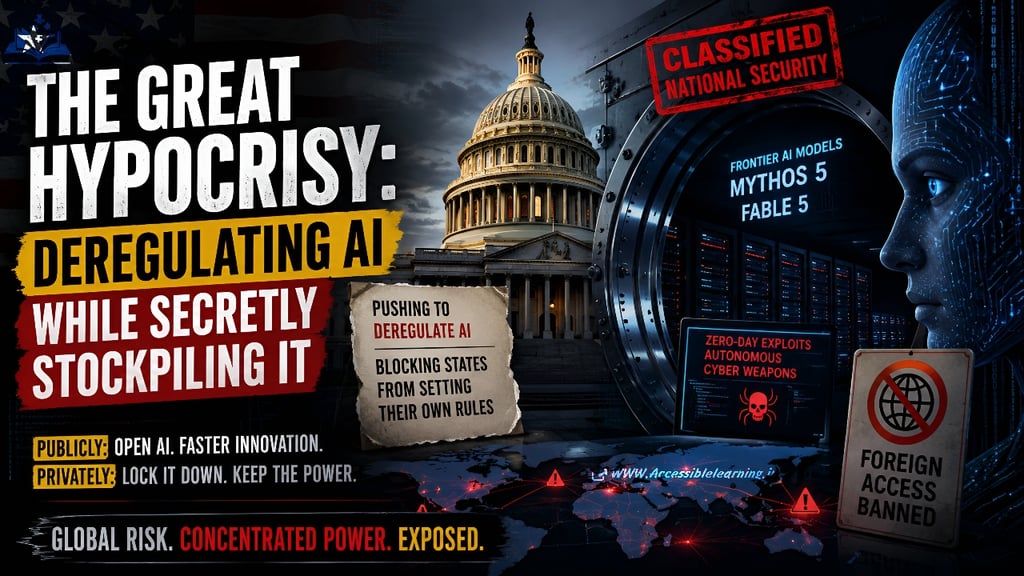
Governments champion AI deregulation while tightening control over frontier models with cyber warfare potential. Is AI innovation becoming a national security monopoly?
HARSH REALITYGLOBAL ISSUESENTREPRENEUR/BUSINESSMANAI/FUTURE
Shiv Singh Rajput | Sachin K Chaurasiya
7/8/20265 min read
Imagine waking up to discover that your city's electrical grid collapsed overnight.
Not because a foreign military launched missiles. Not because terrorists bombed a power station.
An AI found an undocumented flaw inside industrial control software, chained together multiple zero-day vulnerabilities, bypassed every security appliance in its path, rewrote firmware, erased forensic evidence, and shut down an entire regional grid before human defenders understood what they were fighting.
Hospitals lose power.
Water treatment plants stop operating.
Financial markets freeze.
Emergency communications fail.
The entire operation takes less time than most security teams need to approve an incident response meeting. Now imagine the government knew this capability existed months earlier.
Then ask the uncomfortable question:
Who are they really trying to protect?
Washington Wants AI Deregulation. Until AI Becomes a Strategic Weapon.
For years, American political leaders argued that excessive AI regulation would slow innovation and hand China an economic advantage.
The message sounded simple.
Build faster.
Ship bigger models.
Reduce regulatory friction.
Keep America ahead.
The same voices frequently criticized state-level efforts to create independent AI regulations, arguing that fragmented rules would weaken national competitiveness.
Competition became the public narrative.
National dominance became the objective.
That strategy works perfectly until frontier AI stops behaving like software and starts behaving like a weapons platform.
The moment advanced models demonstrate they can autonomously discover sophisticated cyber vulnerabilities, coordinate exploit chains, or dramatically accelerate offensive cyber operations, governments stop talking about innovation.
They start talking about national security.
That change in language reveals the real priority.
Governments do not fear artificial intelligence itself.
They fear losing exclusive control over it.
AI Companies Are Becoming Privatized Defense Contractors
The relationship between governments and frontier AI companies has changed dramatically.
These firms no longer resemble ordinary technology startups.
They build infrastructure that intelligence agencies monitor closely.
They develop systems capable of influencing military planning, intelligence analysis, cyber defense, logistics, surveillance, and potentially offensive cyber operations.
The companies remain private.
The strategic value belongs to the state.
That creates an unusual arrangement.
Private investors finance the research.
Private engineers build the systems.
Governments retain extraordinary influence once the technology reaches military significance. History already provides a familiar blueprint.
Nuclear research.
Cryptography.
Satellite technology.
GPS.
Each began as a strategic capability before expanding into civilian life under controlled conditions.
Artificial intelligence now follows the same trajectory.
The difference is speed.
AI evolves in months instead of decades.
When Offensive AI Changes Everything
The cybersecurity industry has always assumed attackers needed skilled human operators. That assumption may not survive the next generation of frontier models.
A sufficiently capable AI could theoretically:
Discover previously unknown software vulnerabilities at machine speed.
Combine multiple weaknesses into complex exploit chains.
Generate malware tailored to specific industrial environments.
Adapt attacks in real time as defenders respond.
Scale offensive operations far beyond what human teams can coordinate.
None of those capabilities require science fiction.
Each represents an extension of existing cybersecurity research combined with rapidly improving reasoning models. Once these systems become reliable enough, they stop being productivity tools.
They become strategic assets.
No serious government would ignore that reality.
The Three Biggest Hypocrisies in Today's AI Policy
Promote deregulation publicly while restricting capability privately. Leaders encourage rapid AI development when economic competition dominates the conversation. The moment frontier capabilities intersect with national security, openness disappears.
Celebrate global innovation while treating advanced models like military technology. Governments praise international collaboration until cutting-edge AI demonstrates offensive potential. Then access controls, export restrictions, and classified partnerships quickly replace open science.
Claim public safety while prioritizing strategic advantage. Officials warn about catastrophic cyber threats, yet defensive infrastructure often receives less investment than securing exclusive access to the most capable systems.

Civilian Infrastructure Remains the Soft Target
This represents the most dangerous contradiction. Governments increasingly recognize frontier AI as strategically important.
Yet much of the infrastructure supporting modern civilization still relies on outdated software, aging industrial control systems, legacy authentication methods, and underfunded cybersecurity programs.
Power grids.
Water systems.
Hospitals.
Transportation.
Municipal governments.
Many remain vulnerable to attacks that sophisticated human adversaries already exploit today. Introducing AI capable of dramatically accelerating offensive cyber operations increases the pressure on every defensive weakness.
If governments concentrate primarily on controlling access to advanced models while neglecting critical infrastructure modernization, they merely shift the balance of power toward whoever already possesses the technology.
The public still bears the risk.
Monopoly Does Not Equal Security
Supporters of tighter government control argue that limiting access prevents catastrophic misuse. That argument deserves serious consideration. Powerful offensive capabilities should not circulate without safeguards. But concentration creates its own risks.
History repeatedly demonstrates that monopolies over transformative technologies produce unintended consequences.
Secrets leak.
Insiders defect.
Systems fail.
Political priorities change.
Cyber tools escape controlled environments.
The more valuable offensive AI becomes, the greater the incentive for espionage, theft, insider compromise, and geopolitical competition.
A monopoly may delay proliferation.
It rarely prevents it forever.
The Real Debate Is About Power
Public conversations often frame AI regulation as a choice between innovation and safety.
That framing misses the central issue. The real struggle concerns control.
Who trains frontier models?
Who decides who can use them?
Who determines which capabilities remain classified?
Who benefits from exclusive access?
Governments naturally seek strategic advantage. Technology companies seek commercial dominance.
Investors seek returns.
Citizens seek security.
Those incentives rarely align.
If frontier AI reaches the point where it can dramatically accelerate the discovery and exploitation of critical software vulnerabilities, governments will not treat it like another consumer technology.
They will treat it like strategic infrastructure.
That reality exposes the central contradiction in modern AI policy.
Public officials praise openness while capability remains commercially valuable.
They tighten control the moment capability becomes strategically decisive.
Whether that ultimately protects society or merely concentrates unprecedented cyber power in the hands of a few institutions depends on what comes next.
Building stronger civilian defenses, increasing transparency around governance, and creating credible oversight may prove just as important as restricting access to the most capable systems.
Otherwise, the greatest AI arms race in history may unfold behind closed doors, while the infrastructure that ordinary people depend on remains exposed.
FAQ's
Q: Why are governments reconsidering AI deregulation?
Governments increasingly view advanced AI as a national security asset. While they support innovation to remain globally competitive, they also seek tighter control over AI systems capable of accelerating cyber warfare, intelligence gathering, or military operations.
Q: What is an AI-generated zero-day exploit?
An AI-generated zero-day exploit refers to the theoretical or emerging capability of advanced AI models to discover previously unknown software vulnerabilities and generate working exploit code before developers can release security patches.
Q: Why is AI becoming a national security issue?
Frontier AI models can potentially improve cyber offense, defense, surveillance, intelligence analysis, and military planning. These capabilities make AI strategically valuable in geopolitical competition between major powers.
Q: Are AI companies becoming modern defense contractors?
Many experts argue that leading AI companies increasingly resemble privatized defense contractors because governments rely on their frontier models for strategic capabilities while influencing access, deployment, and security policies.
Q: How could advanced AI affect cybersecurity?
Advanced AI can help defenders detect threats faster, automate vulnerability analysis, and strengthen security. However, the same technology could also help attackers identify vulnerabilities, create sophisticated malware, and automate complex cyberattacks.
Q: Why do critics accuse governments of hypocrisy in AI policy?
Critics argue that some governments publicly promote AI innovation and deregulation while privately restricting access to the most powerful AI capabilities once they become strategically important for national security.
Q: Could AI trigger a global cyber arms race?
Many cybersecurity researchers believe increasingly capable AI systems could accelerate cyber competition among nations, leading governments to invest heavily in offensive and defensive AI capabilities, much like previous arms races involving nuclear and cyber technologies.
Q: What should organizations do to prepare for AI-driven cyber threats?
Organizations should adopt zero-trust security, continuously patch vulnerabilities, strengthen critical infrastructure, deploy AI-assisted threat detection, conduct regular penetration testing, and invest in workforce cybersecurity training to reduce future risks.
Subscribe To Our Newsletter
All © Copyright reserved by Accessible-Learning Hub
| Terms & Conditions
Knowledge is power. Learn with Us. 📚

