

The German Empire: A Complete Historical Guide (1871-1918)
Explore the German Empire (1871-1918): its formation under Bismarck, industrial rise, military power, cultural achievements, and dramatic collapse in WWI.
GERMANYEMPIRES/HISTORYHISTORY
Keshav Jha
2/21/20267 min read
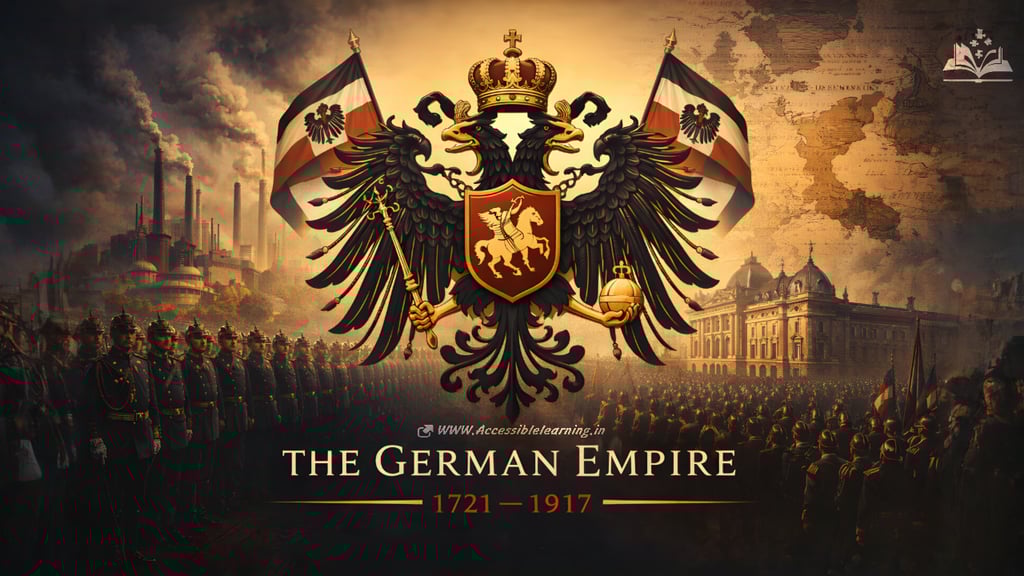
The German Empire, known in German as Deutsches Kaiserreich, represents one of the most transformative periods in European history. This unified German state existed from 1871 to 1918, fundamentally reshaping the political, economic, and military landscape of the continent during the late 19th and early 20th centuries.
What Was the German Empire?
The German Empire was a federal constitutional monarchy that united various German states under Prussian leadership. Proclaimed on January 18, 1871, in the Hall of Mirrors at Versailles, this new nation emerged from the political vision of Otto von Bismarck and the military victories of the Franco-Prussian War.
Formation and Unification of Germany
The path to German unification involved three strategic wars orchestrated by Prussian Chancellor Otto von Bismarck:
The Danish War (1864): Prussia and Austria jointly defeated Denmark, gaining control of the duchies of Schleswig and Holstein.
The Austro-Prussian War (1866): This seven-week conflict excluded Austria from German affairs and established Prussian dominance over the North German Confederation.
The Franco-Prussian War (1870-1871): The decisive conflict that brought the southern German states into union with the North German Confederation, creating the German Empire.
The proclamation ceremony at Versailles held deep symbolic significance. By crowning Wilhelm I as German Emperor in the palace of French kings, Bismarck demonstrated Germany's ascendance as the dominant continental power while humiliating France.
Political Structure and Governance
The Kaiser and Imperial Authority
The German Empire operated under a constitutional framework that balanced traditional monarchical power with emerging parliamentary institutions. Kaiser Wilhelm I (1871-1888) served as the first emperor, followed by Friedrich III (1888, ruling for only 99 days), and finally Wilhelm II (1888-1918).
The Kaiser wielded substantial executive power:
Commanded the armed forces
Appointed and dismissed the chancellor
Directed foreign policy
Could dissolve the Reichstag
The Role of the Reichstag
The Reichstag functioned as the imperial parliament, elected through universal male suffrage—a progressive feature for its time. However, its powers remained limited compared to modern democratic assemblies. The Reichstag could:
Approve or reject legislation
Control the budget
Debate policy matters
Critically, the Reichstag could not remove the chancellor, who answered solely to the Kaiser.
Bismarck's Political System
Otto von Bismarck served as the first Imperial Chancellor from 1871 to 1890. His political philosophy, often called "Realpolitik," prioritized practical outcomes over ideological purity. Bismarck's domestic policies included:
Kulturkampf (1871-1878): A campaign against Catholic political influence that ultimately proved counterproductive and was gradually abandoned.
Anti-Socialist Laws (1878-1890): Legislation that banned socialist organizations while simultaneously introducing progressive social welfare programs to undercut socialist appeal.
Social Insurance Programs: The German Empire pioneered modern welfare state concepts, establishing health insurance (1883), accident insurance (1884), and old-age pensions (1889).
Economic Transformation and Industrial Revolution
The German Empire experienced extraordinary economic growth that transformed it into an industrial powerhouse rivaling Britain and the United States.
Industrial Development Statistics
Between 1871 and 1914, Germany's economic indicators showed remarkable expansion:
Coal production increased from 37.7 million tons (1871) to 190 million tons (1913)
Steel production grew from 0.3 million tons (1871) to 17.6 million tons (1913)
Railway network expanded from 19,575 kilometers (1871) to over 63,000 kilometers (1913)
Population grew from approximately 41 million (1871) to 67 million (1914)
Key Industrial Sectors
Heavy Industry: The Ruhr Valley became Europe's industrial heartland, producing iron, steel, and coal on a massive scale.
Chemical Industry: German companies like BASF, Bayer, and Hoechst dominated global chemical production, developing synthetic dyes, pharmaceuticals, and industrial chemicals.
Electrical Engineering: Firms such as Siemens and AEG pioneered electrical technology, from power generation to telecommunications.
Precision Manufacturing: German optical instruments, scientific equipment, and machinery earned worldwide recognition for quality.
Banking and Finance
The German banking system, featuring major institutions like Deutsche Bank (founded 1870), provided crucial investment capital for industrial expansion. The close relationship between banks and industry, known as "organized capitalism," accelerated technological innovation and corporate growth.
Military Power and the Arms Race
The German Empire maintained Europe's most formidable land army, based on universal male conscription and the Prussian general staff system.
Military Organization
The Imperial German Army combined professional officers with conscripted soldiers serving two- to three-year terms. This system created a large trained reserve capable of rapid mobilization—a key factor in military planning before World War I.
Naval Expansion Under Wilhelm II
After Bismarck's dismissal in 1890, Kaiser Wilhelm II pursued a more aggressive foreign policy, including naval expansion to rival Britain's Royal Navy. Admiral Alfred von Tirpitz advocated for a powerful battle fleet through the Naval Laws of 1898 and 1900.
This naval arms race contributed significantly to Anglo-German tensions and the polarization of European powers into opposing alliance systems.

Foreign Policy and Diplomacy
Bismarck's Alliance System (1871-1890)
Bismarck's diplomatic strategy aimed to isolate France and prevent a two-front war against Germany. His alliance network included:
The Dreikaiserbund (Three Emperors' League, 1873): Linking Germany, Austria-Hungary, and Russia
The Dual Alliance (1879): A defensive pact between Germany and Austria-Hungary
The Triple Alliance (1882): Expanding the Dual Alliance to include Italy
The Reinsurance Treaty (1887): A secret agreement with Russia to maintain neutrality
Wilhelmine Weltpolitik (1890-1914)
Wilhelm II's "world policy" sought global prestige and colonial possessions, abandoning Bismarck's cautious continental focus. This approach included:
Colonial acquisitions in Africa, the Pacific, and China
Support for the Baghdad Railway project
Aggressive rhetoric and diplomatic blunders (such as the Daily Telegraph Affair of 1908)
Competition with Britain for naval supremacy
These policies contributed to the diplomatic tensions that culminated in World War I.
Colonial Empire and Overseas Territories
The German Empire acquired colonies relatively late compared to Britain and France, primarily between 1884 and 1914.
German Colonies
Africa: German East Africa (modern Tanzania, Rwanda, Burundi), German Southwest Africa (Namibia), Cameroon, and Togoland
Pacific: German New Guinea, Samoa, the Marshall Islands, Caroline Islands, and Mariana Islands
China: The leased territory of Kiautschou Bay (Tsingtao)
Colonial administration proved economically marginal and militarily costly. The brutal suppression of the Herero and Nama uprising in German Southwest Africa (1904-1907) resulted in what many historians now recognize as genocide.
Cultural and Scientific Achievements
The German Empire's cultural contributions extended far beyond its political and military influence.
Education and Universities
German universities achieved world leadership in research and scholarship. Institutions like Berlin, Göttingen, Heidelberg, and Munich attracted international students and produced groundbreaking work in:
Physics (Max Planck, Albert Einstein, Wilhelm Röntgen)
Chemistry (Emil Fischer, Fritz Haber)
Medicine (Robert Koch, Paul Ehrlich)
Philosophy (Friedrich Nietzsche, Edmund Husserl)
Literature and the Arts
The period witnessed rich artistic production, including:
Literature: Theodor Fontane's realist novels, Thomas Mann's early works, Rainer Maria Rilke's poetry
Music: Richard Wagner's operas, Johannes Brahms's compositions, Richard Strauss's tone poems
Visual Arts: The Munich Secession and Berlin Secession movements challenged academic traditions
Scientific Innovation
German scientists earned numerous Nobel Prizes in the empire's final decades. The systematic organization of research, including industrial research laboratories, established models followed worldwide.
Social Structure and Daily Life
Class Divisions
German society maintained distinct hierarchical layers:
Aristocracy and Junkers: Prussian landed nobility dominated the military officer corps and higher civil service
Industrial Bourgeoisie: Wealthy industrialists and financiers gained economic power but limited political influence
Middle Classes: Professionals, civil servants, and small business owners formed a growing educated middle class
Working Class: Industrial workers faced harsh conditions but benefited from social insurance programs and growing union organization
The Women's Movement
While women remained excluded from formal political participation, the German women's movement made significant strides in education and social reform. Organizations like the Federation of German Women's Associations (BDF) advocated for improved legal rights and educational opportunities.
Urbanization and Living Conditions
Rapid industrial growth drove massive urban migration. Cities like Berlin, Hamburg, and Munich expanded dramatically, creating both opportunities and challenges:
Modern infrastructure development (sewage systems, electric lighting, public transportation)
Housing shortages and tenement overcrowding
Emergence of urban culture and entertainment
Public health improvements reducing mortality rates

World War I and the Empire's Collapse
Outbreak of War
The assassination of Archduke Franz Ferdinand on June 28, 1914, triggered the alliance system that brought Germany into war. German military strategy relied on the Schlieffen Plan—a rapid defeat of France before turning east against Russia.
The War Experience
Germany fought a two-front war while maintaining forces in colonial theaters and supporting Ottoman and Bulgarian allies. The conflict saw:
Initial victories in 1914 followed by stalemate on the Western Front
Victories against Russia culminating in the Treaty of Brest-Litovsk (1918)
Unrestricted submarine warfare prompting American entry (1917)
Mounting economic hardship and social strain on the home front
Revolution and Abdication
Military defeat combined with internal unrest led to the German Revolution of 1918-1919. Naval mutinies at Kiel in October 1918 sparked wider uprisings. Kaiser Wilhelm II abdicated on November 9, 1918, and fled to the Netherlands.
The armistice ending the war took effect on November 11, 1918, marking the formal end of the German Empire.
The Treaty of Versailles and Legacy
The Treaty of Versailles (1919) imposed harsh terms on Germany:
Territorial losses including Alsace-Lorraine, territories to Poland, and all colonies
Military restrictions limiting the army to 100,000 troops
War guilt clause (Article 231) assigning responsibility for the war
Massive reparations payments
Occupation of the Rhineland
These provisions generated lasting resentment that influenced German politics throughout the Weimar Republic and contributed to the rise of extremism.
The German Empire transformed central Europe from a patchwork of small states into a unified industrial powerhouse. Its rapid economic development, scientific achievements, and military strength made it a dominant continental force. However, aggressive foreign policies, militaristic culture, and the catastrophe of World War I ended the empire and reshaped the 20th century.
The empire's legacy includes both remarkable achievements in science, industry, and social policy and cautionary lessons about nationalism, militarism, and the dangers of concentrated power. Understanding this complex period remains essential for comprehending modern German history and the forces that shaped contemporary Europe.
The German Empire's 47-year existence demonstrated both the possibilities and perils of rapid modernization, the tensions between traditional authority and democratic aspirations, and the consequences when military power outpaces diplomatic wisdom. Its story continues to inform our understanding of nation-building, industrialization, and the fragility of international peace.
Frequently Asked Questions
Q: How long did the German Empire last?
The German Empire existed for 47 years, from its proclamation on January 18, 1871, to the abdication of Kaiser Wilhelm II on November 9, 1918.
Q: Who unified Germany and created the German Empire?
Otto von Bismarck, serving as Prussian Chancellor under King Wilhelm I, orchestrated German unification through diplomacy and three wars (against Denmark, Austria, and France). Wilhelm I became the first German Kaiser.
Q: What was the difference between the German Empire and the Holy Roman Empire?
The Holy Roman Empire (962-1806) was a loose confederation of hundreds of German states under an elected emperor. The German Empire was a unified nation-state under Prussian leadership with a federal structure but centralized authority.
Q: Why did the German Empire collapse in 1918?
The empire collapsed due to military defeat in World War I, economic exhaustion, internal revolutionary movements, and the loss of public confidence in imperial leadership.
Q: What were the major achievements of the German Empire?
The German Empire achieved remarkable industrialization, pioneered social welfare programs, became a leader in scientific research and higher education, and established Germany as a major European power.
Q: How did the German Empire treat minorities?
The empire struggled with minority integration. Policies toward Poles, Danes, French speakers in Alsace-Lorraine, and Catholics during the Kulturkampf revealed tensions between Prussian dominance and the diverse populations within imperial borders.
Q: What role did Prussia play in the German Empire?
Prussia constituted about two-thirds of the empire's territory and population, dominated the military and civil service, and provided most chancellors and high officials. The King of Prussia automatically served as German Kaiser.
Subscribe to Frontier Intelligence
All © Copyright reserved by Accessible-Learning Hub
| Terms & Conditions
Accessible Learning Hub — Actionable clarity for high-agency minds.
Weekly breakdowns on AI breakthroughs, capital flow, and human performance systems. Zero fluff.