

The French Colonial Empire: A Complete Historical Guide
Explore the French Colonial Empire's 500-year history, from Caribbean plantations to African territories. Discover its legacy, impact, and modern influence today.
HISTORY & CIVILIZATIONS
Kim Shin
2/17/202610 min read
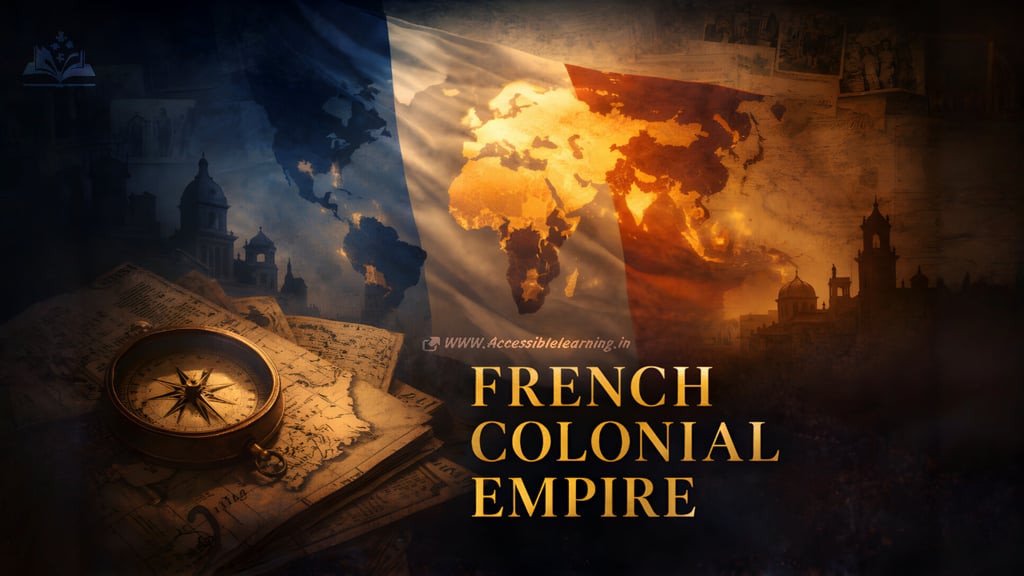
Understanding France's Global Imperial Legacy
The French Colonial Empire represents one of history's most extensive territorial expansions, spanning nearly five centuries and encompassing territories across six continents. At its peak in the 1920s and 1930s, this empire controlled approximately 13.5 million square kilometers of land, making it the second-largest colonial empire after the British Empire, with roughly 110 million people living under French colonial rule.
What Was the French Colonial Empire?
The French Colonial Empire (l'Empire colonial français) consisted of territories under French sovereignty from the 16th century until the mid-20th century. This vast network of colonies, protectorates, and mandates extended French political, economic, and cultural influence across North America, the Caribbean, Africa, Asia, and Oceania.
Two Distinct Periods of French Colonialism
French colonial expansion occurred in two major waves, each characterized by different motivations and methods:
The First French Colonial Empire (1534-1814) began with Jacques Cartier's exploration of Canada and focused primarily on the Americas. This period saw France establish territories in:
New France (present-day Canada and parts of the United States)
The Caribbean islands, including Saint-Domingue (Haiti), Martinique, and Guadeloupe
French Guiana in South America
Trading posts in India and West Africa
The first empire largely collapsed following military defeats in the Seven Years' War (1756-1763) and the Napoleonic Wars, culminating in the loss of Saint-Domingue after the Haitian Revolution (1791-1804).
The Second French Colonial Empire (1830-1962) emerged with France's conquest of Algeria in 1830 and became the primary focus of French imperialism. This period witnessed:
The colonization of most of West and Equatorial Africa
The establishment of French Indochina (Vietnam, Laos, Cambodia)
Expansion in North Africa (Tunisia, Morocco)
Acquisition of Pacific territories
League of Nations mandates in Syria and Lebanon after World War I
Key Territories of the French Colonial Empire
French Colonial Territories in Africa
France's African empire became the cornerstone of its colonial ambitions during the 19th and 20th centuries. The expansion created two major administrative regions:
French West Africa (Afrique Occidentale Française—AOF) unified eight territories under a single governor-general based in Dakar:
Senegal
French Sudan (Mali)
French Guinea (Guinea)
Ivory Coast
Niger
Upper Volta (Burkina Faso)
Dahomey (Benin)
Mauritania
French Equatorial Africa (Afrique Équatoriale Française—AEF) comprised four territories:
Gabon
Middle Congo (Republic of Congo)
Ubangi-Shari (Central African Republic)
Chad
North African Territories included Algeria (considered an integral part of France from 1848), Tunisia (established as a protectorate in 1881), and Morocco (protectorate from 1912).
Madagascar, seized in 1895, represented France's largest island colony in the Indian Ocean.
French Colonial Possessions in Asia
French Indochina formed the heart of France's Asian empire, established gradually between 1858 and 1893. This federation included:
Cochinchina (southern Vietnam, a direct colony)
Annam (central Vietnam, a protectorate)
Tonkin (northern Vietnam, a protectorate)
Cambodia (protectorate from 1863)
Laos (protectorate from 1893)
France also maintained trading posts in India, including Pondicherry, Chandannagar, Yanam, Mahe, and Karikal, which weren't ceded to India until 1954-1956.
French Territories in the Americas and Caribbean
Despite losing most North American territories by 1763, France retained significant Caribbean holdings:
Martinique and Guadeloupe (major sugar-producing islands)
French Guiana (South America, known for its penal colonies)
Saint-Pierre and Miquelon (islands off Newfoundland)
Parts of Saint Martin and Saint Barthélemy
Pacific Island Territories
France expanded into Oceania throughout the 19th century:
French Polynesia (including Tahiti, annexed 1880)
New Caledonia (annexed 1853, used as penal colony)
Wallis and Futuna

Why Did France Build a Colonial Empire?
French colonial expansion stemmed from multiple interconnected motivations that evolved across centuries:
Economic Drivers of French Colonialism
The pursuit of wealth remained paramount throughout both colonial periods. Colonies provided:
Raw materials such as rubber, cotton, coffee, cocoa, timber, and minerals
Exclusive markets for French-manufactured goods
Sources of cheap labor through systems including slavery and indentured servitude
Strategic resources like phosphates, bauxite, and later, petroleum
The mercantilist philosophy during the first empire viewed colonies as economic extensions of the mother country, designed to enrich France through favorable trade balances.
Political and Strategic Considerations
National prestige and great power status drove much of France's colonial ambition. After defeats in the Seven Years' War and Franco-Prussian War (1870-1871), colonial expansion offered France a means to:
Restore national pride and international standing
Compete with rival powers, particularly Britain and Germany
Secure strategic naval bases and coaling stations for military projection
Create buffer zones and spheres of influence
The "Civilizing Mission" (Mission Civilisatrice)
French colonial ideology centered on the concept of bringing French civilization, language, and culture to colonized peoples. This paternalistic philosophy claimed to:
Spread Enlightenment values and French Republican ideals
Introduce Western education, technology, and medicine
Replace local customs with French cultural norms
Create French-speaking populations loyal to France
This ideology of assimilation distinguished French colonialism from British indirect rule, though in practice, full assimilation remained limited and contradictory.
How Did France Govern Its Colonial Empire?
French colonial administration varied significantly based on territory type, timing of acquisition, and perceived strategic importance.
Direct Rule and Assimilation
Unlike British colonial practice, France theoretically promoted assimilation, aiming to transform colonial subjects into French citizens who would adopt French language, laws, and culture. This policy reached its apex with Algeria, declared an integral part of France.
The reality proved more complex. Only small numbers of colonized people gained French citizenship, typically those who:
Completed French education
Served in the French military
Demonstrated cultural assimilation
Resided in specific territories like the "Four Communes" of Senegal
Association Policy
By the early 20th century, France partially shifted toward association, recognizing the impracticality of full assimilation. This approach:
Acknowledged cultural differences between French and colonized peoples
Maintained traditional governance structures under French oversight
Created separate legal systems for colonizers and colonized
Emphasized economic development over cultural transformation
Administrative Structures
Colonies experienced direct French rule with governors appointed by Paris, French legal codes, and metropolitan administrative systems.
Protectorates maintained nominal local rulers (like the Bey of Tunis or the Sultan of Morocco) while France controlled foreign relations, defense, and increasingly, internal affairs.
Mandates, acquired after World War I through the League of Nations, theoretically prepared territories for independence under French "guidance," though this rarely materialized quickly.
The Indigénat System
From 1887, the Code de l'indigénat created a discriminatory legal framework throughout French Africa and Indochina. This system:
Allowed colonial administrators to punish indigenous people without trial
Imposed forced labor requirements
Restricted movement and assembly
Maintained separate and unequal justice for colonized populations
What Was Life Like in the French Colonial Empire?
Daily existence varied dramatically based on social position, location, and time period, creating stark inequalities between colonizers and colonized.
Economic Exploitation and Labor Systems
Colonial economies were structured to benefit France, often through extractive industries:
Forced Labor remained widespread despite official abolitions. Systems included:
Corvée labor for infrastructure projects
Plantation work under coercive contracts
The prestations system requiring unpaid labor on public works
Taxation placed heavy burdens on colonized populations through head taxes, hut taxes, and cultivation requirements, forcing many into cash economies and wage labor.
Plantation Agriculture dominated the Caribbean and some African economies, initially using enslaved labor (until abolition in 1848) and subsequently indentured workers and coercive labor systems.
Education and Cultural Policy
French colonial education aimed at creating French-speaking elites while limiting educational access:
Primary education remained scarce and focused on French language and culture
Secondary and higher education was accessible to only tiny minorities
Curricula emphasized French history and geography, often ignoring local contexts
Mission schools provided much education, blending religious conversion with French cultural transmission
Social Hierarchies and Racial Discrimination
Colonial societies developed rigid hierarchies:
French settlers (colons) enjoyed full political rights and economic privileges
Évolués or assimilated individuals, occupied intermediary positions with limited rights
Indigenous populations faced legal discrimination and economic marginalization
Mixed-race populations occupied ambiguous positions varying by territory
Segregation was common in housing, employment, and public facilities, though less formalized than in some other colonial systems.
Resistance and Collaboration
Colonized peoples responded to French rule in diverse ways:
Armed resistance movements occurred throughout the colonial period
Political organizations emerged demanding reforms or independence
Some local elites collaborated with colonial authorities for advantages
Cultural resistance maintained languages, religions, and traditions
Labor strikes and protests challenged colonial economic systems


The Decline and End of the French Colonial Empire
World Wars and Colonial Contributions
Both world wars accelerated the empire's decline while highlighting colonial contributions:
World War I saw approximately 600,000 colonial subjects serve in French forces, with over 70,000 dying. Colonial labor supported the war effort through the tirailleurs sénégalais and workers in French factories.
World War II brought complex dynamics:
Vichy France controlled some territories while Free France claimed others
Colonial troops were crucial to Free French forces
The war exposed French vulnerability and inspired independence movements
The Atlantic Charter and emerging international norms challenged colonialism
The Wars of Decolonization
France resisted decolonization more violently than many colonial powers:
The First Indochina War (1946-1954) resulted from France's attempt to reassert control after Japanese occupation. The devastating defeat at Dien Bien Phu in 1954 ended French rule in Southeast Asia, partitioning Vietnam at the 17th parallel.
The Algerian War of Independence (1954-1962) became the bloodiest decolonization conflict, with estimates of 400,000 to 1.5 million Algerian deaths. The war:
Caused political crisis in France, bringing Charles de Gaulle to power
Involved widespread violence, torture, and terrorism on both sides
Displaced approximately one million pieds-noirs (European settlers) and Algerian supporters of France
Ended with Algerian independence in 1962 following the Évian Accords
The Path to Independence
Most French African territories achieved independence in 1960, the "Year of Africa," following:
The 1956 loi-cadre (framework law) granting limited autonomy
The 1958 French constitutional referendum offering territories a choice
Limited violence compared to Indochina and Algeria
Continued French influence through economic and military agreements
What Remains of the French Colonial Empire Today?
France maintains sovereignty over territories known as Overseas France (France d'outre-mer):
Current French Overseas Territories
Overseas Departments and Regions with status equivalent to mainland France:
Guadeloupe (Caribbean)
Martinique (Caribbean)
French Guiana (South America)
Réunion (Indian Ocean)
Mayotte (Indian Ocean)
Overseas Collectivities with varying degrees of autonomy:
French Polynesia
Saint Barthélemy
Saint Martin
Saint Pierre and Miquelon
Wallis and Futuna
Special Status Territories:
New Caledonia (with independence referendums held 2018-2021)
French Southern and Antarctic Lands
These territories represent approximately 2.6 million people and give France the world's second-largest exclusive economic zone (EEZ) for maritime resources.
The Legacy of French Colonialism
Françafrique and Neo-Colonialism
The term "Françafrique" describes France's continued influence in former African colonies through:
The CFA franc currency zone binding fourteen African countries to French monetary policy
Military bases and intervention agreements
Economic preferential relationships benefiting French corporations
Political influence in former colonies' internal affairs
Educational and cultural ties through the Organisation internationale de la Francophonie
Critics argue these relationships perpetuate dependency and limit former colonies' sovereignty, while defenders emphasize mutual benefits and historical ties.
Cultural and Linguistic Impact
French remains an official or widely spoken language in 29 countries, with approximately 300 million French speakers worldwide. The Francophonie represents:
Shared administrative and legal traditions based on French models
Educational systems modeled on French curricula
Cultural products, literature, and arts influenced by French traditions
International organizations promoting French language and culture
Contemporary Debates and Reckoning
France continues grappling with its colonial past through:
Debates over memory, commemoration, and teaching of colonial history
Controversies regarding artifacts taken during colonization
Discussions of reparations and formal apologies
Recognition of colonial violence, including the 2021 acknowledgment of French responsibility in the Rwandan genocide
Immigration and integration challenges linked to colonial histories
Continued sovereignty disputes and independence movements in remaining territories

France's Colonial Past in Contemporary Context
The French Colonial Empire shaped modern global geography, politics, economics, and culture in profound ways that persist into the 21st century. From the languages spoken across Africa to ongoing debates about immigration in France, from monetary policy in West Africa to political instability in parts of Southeast Asia, the colonial legacy remains deeply relevant.
Understanding this history requires grappling with contradictions: Enlightenment ideals alongside brutal exploitation, promises of equality within systems of discrimination, and cultural exchange mixed with cultural destruction. As France and former colonies continue navigating this complex heritage, honest engagement with both colonial violence and the agency of colonized peoples remains essential for understanding our contemporary world.
The story of the French Colonial Empire is ultimately a human story—of ambition and resistance, exploitation and resilience, collaboration and rebellion. It reminds us that empires, however powerful, ultimately face accountability to the peoples they seek to dominate, and that the pursuit of justice and self-determination, though long and difficult, has repeatedly proven stronger than imperial ambitions.
Frequently Asked Questions
Q: When did the French Colonial Empire begin and end?
The French Colonial Empire began in 1534 with Jacques Cartier's exploration of Canada and effectively ended in 1962 with Algerian independence, though France retains overseas territories today. The empire experienced two major phases: the First Colonial Empire (1534-1814) focused on the Americas, and the Second Colonial Empire (1830-1962) centered on Africa and Asia.
Q: What was the largest extent of the French Colonial Empire?
The French Colonial Empire reached its maximum extent between 1920 and 1930, controlling approximately 13.5 million square kilometers across six continents with roughly 110 million inhabitants. This made it the second-largest colonial empire in history after the British Empire, representing about 9% of the world's land area.
Q: How did French colonialism differ from British colonialism?
French colonialism emphasized cultural assimilation and direct rule, aiming to create French citizens who spoke French and adopted French culture. In contrast, British colonialism more commonly employed indirect rule, governing through existing local structures. France theoretically offered citizenship to assimilated subjects, while British colonies typically maintained clearer racial and legal separations. However, in practice, both systems involved significant exploitation and discrimination.
Q: Why did France lose most of its colonial empire?
France lost its colonial empire due to multiple factors: rising anti-colonial nationalism in colonized territories, weakening of European powers after two world wars, international pressure against colonialism from the United Nations and new superpowers, costly and unsuccessful wars in Indochina and Algeria, and changing global norms about self-determination. Economic costs of maintaining colonies increasingly outweighed perceived benefits.
Q: What countries were part of French Indochina?
French Indochina consisted of modern-day Vietnam (divided into three administrative regions: Cochinchina, Annam, and Tonkin), Cambodia, and Laos. This federation existed from 1887 until 1954, when France was defeated in the First Indochina War. The Geneva Accords partitioned Vietnam, granted independence to Cambodia and Laos, and ended French colonial rule in Southeast Asia.
Q: How many African countries were French colonies?
Over 20 African countries were former French colonies or protectorates, including Algeria, Tunisia, Morocco, Senegal, Mali, Guinea, Ivory Coast, Burkina Faso, Benin, Niger, Mauritania, Chad, Gabon, the Republic of Congo, the Central African Republic, Cameroon, Togo, Madagascar, Djibouti, and Comoros. Most achieved independence in 1960, while Algeria gained independence in 1962 after a brutal war.
Q: Does France still have colonies today?
France no longer has "colonies" in the traditional sense but maintains sovereignty over thirteen overseas territories collectively known as Overseas France, including Guadeloupe, Martinique, French Guiana, Réunion, Mayotte, French Polynesia, New Caledonia, and others. These territories have varying levels of autonomy but are considered integral parts of the French Republic, with residents holding French citizenship. Some territories have held independence referendums in recent years.
Q: What was the Code de l'indigénat?
The Code de l'indigénat was a discriminatory legal system implemented across French colonies from 1887, allowing colonial administrators to punish indigenous people without trial for various offenses. This code created separate and unequal justice systems, imposed forced labor, restricted movement and assembly, and maintained French authority through arbitrary punishment. It was progressively abolished between 1944 and 1947 but shaped colonial administration for over half a century.
Subscribe to Frontier Intelligence
All © Copyright reserved by Accessible-Learning Hub
| Terms & Conditions
Accessible Learning Hub — Actionable clarity for high-agency minds.
Weekly breakdowns on AI breakthroughs, capital flow, and human performance systems. Zero fluff.