

The Emotional Curriculum: Who Is Actually Teaching Kids Resilience?
Are schools teaching students how to handle failure, grief, and resilience? Explore how anime has become the emotional curriculum for a generation seeking guidance, emotional intelligence, and mental strength in a high-pressure world.
ACCESSIBLE LEARNING
Hikari | Kim Shin
6/6/20267 min read
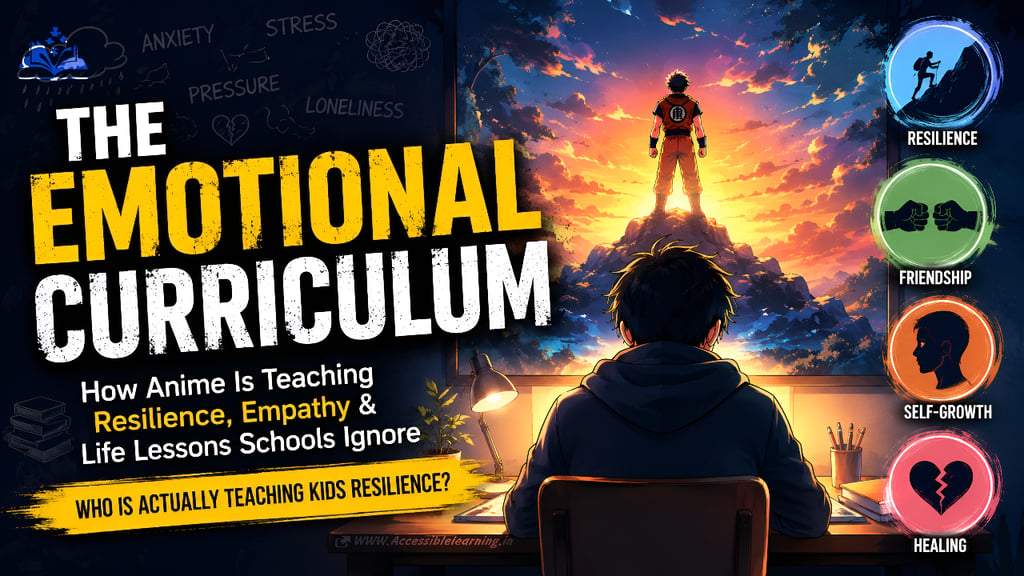
The Lessons Missing From the Classroom
Ask most adults what schools teach, and the answers are predictable: mathematics, science, history, literature, economics, and technology. These subjects are important. They prepare young people for careers, exams, and participation in society.
But there is another set of skills that often determines whether someone thrives or struggles in life.
How do you recover after failure?
How do you process grief?
How do you handle rejection?
How do you remain hopeful when circumstances seem impossible?
How do you build meaningful friendships, maintain loyalty, and continue moving forward despite disappointment?
These questions form what could be called the emotional curriculum. Yet in many educational systems, this curriculum barely exists.
Modern students are growing up in an environment marked by academic pressure, economic uncertainty, social comparison, digital overstimulation, and increasing feelings of loneliness. They are expected to navigate emotional challenges with little formal guidance.
As a result, many young people are finding lessons about resilience, perseverance, and emotional growth somewhere unexpected. They are learning them through stories. More specifically, many are learning them through anime.
Whether intentionally or not, anime has become an emotional teacher for a generation searching for guidance beyond textbooks.
What Is the Emotional Curriculum?
An emotional curriculum is the collection of life lessons that teach individuals how to understand, regulate, and navigate emotions.
It includes:
Emotional intelligence
Self-awareness
Resilience
Empathy
Coping with loss
Managing failure
Building confidence
Maintaining relationships
Developing purpose
Understanding personal identity
Unlike academic subjects, these lessons cannot be mastered through memorization. They require experience, reflection, and meaningful examples.
The problem is that traditional education often treats emotional development as secondary. Schools may offer occasional counseling programs or awareness campaigns, but emotional education rarely receives the same attention as academic achievement.
Students spend thousands of hours learning equations and facts. They spend comparatively little time learning how to handle heartbreak, anxiety, disappointment, or uncertainty. Yet these challenges affect daily life far more frequently than advanced algebra.
The Emotional Gap in Modern Education
For decades, educational systems have focused heavily on measurable outcomes.
Grades can be quantified.
Test scores can be compared.
Graduation rates can be tracked.
Emotional growth is harder to measure.
As a result, many institutions prioritize academic performance while emotional development remains largely informal. This creates a significant gap.
Students may graduate knowing:
Chemical formulas
Historical dates
Economic theories
Programming languages
But they may never formally learn:
How to recover from failure
How to build self-worth
How to process grief
How to handle social rejection
How to overcome self-doubt
The irony is that these emotional skills often determine long-term success more than technical knowledge alone.
Employers increasingly value adaptability.
Relationships require emotional maturity.
Mental health requires emotional awareness.
Life itself demands resilience.

Why Modern Young People Need Emotional Guidance More Than Ever
Today's generation faces unique psychological pressures.
Constant Comparison
Social media exposes young people to carefully curated versions of other people's lives.
Success appears instant.
Beauty appears effortless.
Achievement appears constant.
This creates unrealistic expectations and feelings of inadequacy.
Information Overload
Young people consume more information in a day than previous generations could access in weeks.
The result is often mental fatigue, anxiety, and difficulty focusing.
Reduced Face-to-Face Interaction
Digital communication offers convenience but sometimes reduces opportunities for deeper social connection.
Many young people report feeling connected online while simultaneously experiencing loneliness.
Fear of Failure
Competitive educational environments can make failure feel catastrophic.
Instead of viewing mistakes as learning opportunities, students often see them as personal shortcomings.
This environment creates a demand for emotional mentorship that schools frequently struggle to provide.
Stories step into that vacuum.
How Anime Became an Emotional Teacher
Anime's influence extends beyond entertainment because many of its narratives are fundamentally about personal growth. Unlike stories that focus solely on winning, many anime series emphasize transformation.
The hero often begins weak, uncertain, afraid, or emotionally damaged. The journey is not simply about becoming stronger. It is about becoming emotionally stronger.
Viewers watch characters confront:
Failure
Loss
Betrayal
Fear
Loneliness
Responsibility
Self-doubt
And most importantly, they watch them continue moving forward. This emotional journey resonates deeply with audiences facing similar challenges in real life.
The Power of Shonen Values
One of anime's most influential genres is the shonen genre.
While often associated with action and adventure, its deeper appeal lies in its emotional framework.
Shonen stories repeatedly teach values such as:
Persistence
Characters rarely succeed immediately.
They fail repeatedly.
Progress comes through effort, adaptation, and endurance.
This reinforces a critical life lesson:
Failure is not the end of the story.
Growth Through Adversity
Challenges are presented as opportunities for development rather than reasons to quit.
Difficult experiences become catalysts for transformation.
Loyalty
Friendship is not treated as a convenience.
It is portrayed as a responsibility and commitment.
Characters stand by one another during hardship, demonstrating the importance of trust and mutual support.
Responsibility
Many protagonists learn that power comes with obligations.
Personal growth often involves accepting responsibility for oneself and others.
Purpose
Characters frequently search for meaning beyond achievement.
Their journeys encourage viewers to reflect on their own goals and values.
Learning How to Process Grief
One of anime's most significant emotional contributions is its willingness to engage with loss.
Many stories do not avoid grief.
They explore it directly.
Characters lose family members, mentors, friends, dreams, and opportunities.
Importantly, these losses are rarely resolved instantly.
Viewers witness:
Denial
Anger
Sadness
Reflection
Acceptance
This process mirrors real emotional experiences.
For young audiences who may not receive guidance on handling loss elsewhere, these narratives provide emotional frameworks that feel authentic.
The lesson is not that pain disappears. The lesson is that people can continue living despite pain. That distinction is powerful.


The Truth About Effort and Success
Perhaps one of anime's most valuable lessons is its rejection of simplistic success narratives.
Many motivational messages suggest that hard work always guarantees victory.
Reality is more complicated. Sometimes people work incredibly hard and still fail.
Sometimes circumstances are unfair. Sometimes talent matters. Sometimes luck matters.
Anime frequently acknowledges these realities.
Characters may lose despite giving their best effort.
Dreams may be delayed. Goals may need adjustment.
Yet the stories continue to emphasize growth.
Success becomes more than achieving a desired outcome.
Success becomes the ability to continue despite setbacks.
This perspective is psychologically healthier than the belief that effort always guarantees rewards.
Emotional Intelligence Through Storytelling
Stories create emotional simulations. Viewers experience situations through characters and mentally rehearse responses to challenges they may later encounter themselves.
Through storytelling, young audiences practice:
Empathy
Perspective-taking
Emotional recognition
Moral reasoning
Decision-making
These experiences contribute to emotional intelligence. Research consistently shows that narratives help individuals understand emotions and social situations more effectively.
Anime often amplifies this effect because it places significant emphasis on internal struggles and character development. The emotional journey matters as much as the external plot.
Why These Lessons Feel More Authentic
Many educational programs teach emotional skills directly. Anime often teaches them indirectly.
This distinction matters. People tend to resist lectures. They connect with stories.
When viewers become emotionally invested in characters, the lessons feel earned rather than imposed.
Instead of hearing, "Never give up," they witness someone endure hardship over dozens of episodes.
Instead of being told, "Friendship matters," they observe relationships tested through adversity.
The emotional impact becomes stronger because the audience experiences the lesson rather than simply receiving it.
The Risks of Outsourcing Emotional Education
While anime can provide meaningful emotional lessons, it should not be the sole source of emotional guidance. Stories are valuable teachers, but they cannot replace:
Parents
Mentors
Teachers
Counselors
Community support systems
The growing reliance on entertainment for emotional education highlights a broader societal issue. If fictional characters are becoming primary emotional role models, it may indicate that real-world emotional support structures are insufficient. The solution is not to dismiss anime. The solution is to strengthen emotional education everywhere else.
Building a Better Emotional Curriculum
Imagine if schools treated emotional development with the same seriousness as mathematics or science. Students could learn:
Emotional Literacy
Understanding emotions and recognizing them accurately.
Resilience Training
Developing healthy responses to setbacks and challenges.
Conflict Resolution
Learning practical communication and relationship skills.
Stress Management
Building techniques for handling pressure and uncertainty.
Meaning and Purpose
Encouraging reflection on values, goals, and identity.
These skills would not replace academics.
They would complement them.
A well-rounded education should prepare students not only for careers but also for life.
The Lessons That Matter Long After Graduation
The most important lessons people learn are not always found in textbooks.
Life demands resilience, empathy, courage, patience, and emotional strength.
Yet these qualities often receive minimal attention within traditional educational systems.
As a result, many young people seek emotional guidance elsewhere.
Anime has become one of the most influential sources of that guidance because it addresses struggles that feel real. It explores failure without shame, grief without avoidance, friendship without cynicism, and growth without shortcuts.
Its popularity reveals something larger than a cultural trend. It reveals a need.
A generation is searching for an emotional curriculum. The question is not why anime is teaching these lessons.
The question is why so few institutions are teaching them alongside everything else.
Because in the end, success in life depends on more than what people know.
It depends on who they become when life tests them.

FAQ's
Q: What is the emotional curriculum in education?
The emotional curriculum refers to the life skills and emotional competencies that help individuals navigate challenges, relationships, stress, failure, and personal growth. It includes emotional intelligence, resilience, empathy, self-awareness, and mental well-being, which are often underemphasized in traditional academic education.
Q: Why is emotional intelligence important for students?
Emotional intelligence helps students understand and manage their emotions, build healthy relationships, communicate effectively, and cope with setbacks. Research consistently shows that emotional intelligence contributes to academic success, career growth, leadership abilities, and overall life satisfaction.
Q: How does anime teach resilience and emotional growth?
Anime often portrays characters overcoming adversity, dealing with loss, facing failure, and pursuing long-term goals despite obstacles. Through these narratives, viewers learn valuable lessons about perseverance, self-improvement, emotional recovery, and personal responsibility.
Q: Can anime positively impact mental health?
While anime is not a substitute for professional mental health support, many viewers find comfort, inspiration, and emotional validation through its stories. Themes such as friendship, hope, resilience, and overcoming hardship can provide meaningful psychological encouragement during difficult periods.
Q: Why do many young people relate to anime characters?
Anime characters frequently struggle with challenges that mirror real-life experiences, including loneliness, self-doubt, social pressure, grief, and identity issues. Their emotional journeys often feel authentic, making it easier for audiences to connect with and learn from them.
Q: What emotional skills are often missing from traditional education?
Many educational systems focus heavily on academic performance while giving limited attention to skills such as emotional regulation, stress management, conflict resolution, resilience, empathy, communication, and coping with failure. These skills are essential for long-term personal and professional success.
Q: Should schools include emotional education alongside academics?
Many educators and psychologists argue that emotional education should be integrated into school curricula. Teaching emotional literacy, resilience, mental well-being, and interpersonal skills can help students become more adaptable, confident, and prepared for real-world challenges.
Q: How does storytelling help develop emotional intelligence?
Stories allow individuals to experience different perspectives, understand complex emotions, and observe how characters respond to difficult situations. This process enhances empathy, emotional awareness, critical thinking, and social understanding, making storytelling a powerful tool for emotional development.
Q: What are the core values commonly taught in shonen anime?
Shonen anime frequently emphasizes values such as perseverance, loyalty, courage, discipline, friendship, self-improvement, responsibility, and determination. These themes resonate with audiences because they address universal human struggles and aspirations.
Q: Can emotional resilience be learned?
Yes. Emotional resilience is a skill that can be developed over time through experience, reflection, supportive relationships, emotional awareness, healthy coping strategies, and exposure to stories and role models that demonstrate perseverance in the face of adversity.
Subscribe to Frontier Intelligence
All © Copyright reserved by Accessible-Learning Hub
| Terms & Conditions
Accessible Learning Hub — Actionable clarity for high-agency minds.
Weekly breakdowns on AI breakthroughs, capital flow, and human performance systems. Zero fluff.