

The “Ego” of the State: When Leaders Confuse Themselves with the Nation
Explore how the psychology of power influences global conflicts. This article examines how some leaders begin to equate their personal ego with the nation itself, creating cycles of escalation where wars continue even after their strategic purpose disappears. Through ideas like the fragile ego theory, the narcissistic loop, and the shadow of Nuremberg accountability, it reveals why political pride, legacy, and personal identity can shape decisions that affect millions of lives.
PSYCHOLOGYHARSH REALITYAWARE/VIGILANTA LEARNING
Shiv Singh Rajput
3/15/20268 min read
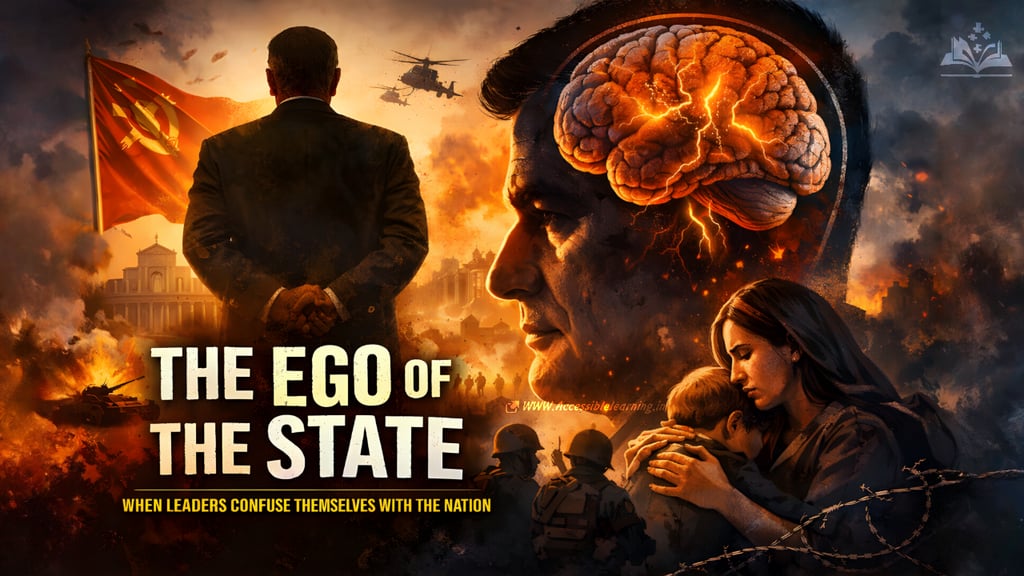
Wars are often explained through strategy, ideology, or national security. Governments talk about protecting borders, defending sovereignty, or preserving political influence. But when we look closely at many long conflicts in history, a troubling pattern appears. Some wars continue even when they no longer make practical sense.
Cities are destroyed, economies collapse, and thousands of lives are lost long after the original reasons for the war have faded. In many cases, the explanation is not purely strategic. It is psychological.
Sometimes leaders begin to see themselves as the living embodiment of the nation. Their pride becomes national pride. Their humiliation becomes national humiliation. Their personal victory becomes the state’s victory.
When that mental shift happens, war can turn into something very different. It stops being about national interests and becomes a battle to protect the ego of those in power. Understanding this dynamic helps explain why some conflicts refuse to end, even when everyone can see the cost.
When Leaders Start Believing They Are the Nation
In healthy political systems, the nation is larger than any one leader. Governments change, leaders come and go, but institutions remain. Laws, courts, and democratic systems exist to ensure that no individual person becomes bigger than the country itself. But in some political systems, that balance slowly disappears.
A leader’s image begins to dominate national identity. Political speeches, state media, and public messaging repeatedly present the leader as the defender of the nation, the architect of its future, or the only person capable of protecting it from enemies. Over time, a dangerous idea takes root.
Criticizing the leader begins to look like criticizing the nation. Political disagreement becomes framed as betrayal. Opposition voices are labeled enemies rather than participants in democratic debate.
When this psychological fusion happens, stepping back from conflict becomes extremely difficult. If the leader retreats, it can appear as if the entire nation has been defeated.
The Fragile Ego Behind Strongman Leadership
Many powerful leaders project an image of extreme confidence. They appear decisive, fearless, and unwavering. Yet psychology suggests that some of these personalities may actually be driven by a fragile sense of self.
The “Fragile Ego” theory describes how certain leaders react strongly to criticism or opposition because they perceive it as a personal attack rather than a normal part of politics. For leaders with narcissistic traits, political disagreement can feel like humiliation.
Instead of seeing criticism as feedback, they interpret it as disrespect that must be punished or corrected. This emotional reaction can shape national policy in dangerous ways.
Rather than adjusting strategy or accepting compromise, leaders may escalate conflicts to prove their strength. Military victories, territorial expansion, or displays of force become ways to restore personal pride. Ironically, this often leads to decisions that make the situation worse.
The Narcissistic Loop: Why Escalation Becomes Inevitable
Once a leader’s identity becomes tied to national pride, a self-reinforcing cycle can emerge. This cycle is sometimes described as a narcissistic loop. First, the leader positions themselves as the symbol of national strength. Any challenge to their authority becomes an insult to the nation.
Next, critics or international pressure appear. Instead of treating these challenges as political disagreements, the leader interprets them as threats to personal legitimacy. To restore authority, the leader escalates actions. This may involve military action, harsher rhetoric, or aggressive policy decisions.
But escalation creates new resistance and criticism. The leader then responds with even stronger actions. The cycle repeats. Over time, the original purpose of the conflict becomes less important than maintaining the appearance of strength.

Why Wars Continue After Their Purpose Disappears
Many conflicts begin with clear objectives. Governments may want to secure territory, weaken a rival, or protect strategic resources. But as wars drag on, those objectives sometimes fade or become unreachable. Yet the fighting continues. Several psychological forces contribute to this pattern.
Fear of Admitting Failure
Leaders who built their reputation on strength often fear the political consequences of admitting mistakes. Ending a war without victory can be interpreted as weakness.
For leaders whose legitimacy depends on appearing powerful, that outcome can feel unacceptable.
The Sunk Cost Trap
Human beings struggle to abandon projects after investing heavily in them. When a nation has already sacrificed lives, money, and resources, leaders may feel pressured to continue the conflict.
Stopping the war might make those sacrifices seem pointless. So the war continues in the hope that future victories will justify past losses.
Domestic Image and Power
War can also strengthen a leader’s domestic control. During conflict, governments often centralize authority, restrict dissent, and promote patriotic unity.
In some cases, maintaining a state of tension or conflict helps leaders stay in power. Peace can reopen political debates that leaders prefer to avoid.
Sovereignty and the “Nuremberg Shadow”
For centuries, leaders justified their actions by claiming they were acting on behalf of the state. National sovereignty meant that outside powers could not judge or interfere with those decisions.
But the world changed after the Second World War. The Nuremberg Trials introduced a powerful legal and moral principle: individuals can be held responsible for crimes committed in the name of the state.
This idea created what some analysts call the “Nuremberg Shadow.” Leaders now operate in a world where their decisions may one day be judged personally, not just politically. Yet the language of national interest still provides a powerful shield.
By presenting policies as necessary for national survival, leaders can hide personal motivations behind patriotic rhetoric. Ambition, revenge, pride, or the desire for historical recognition can be reframed as acts of national duty.
The Role of Propaganda in Protecting the Leader’s Image
For the ego of the state to survive, public perception must support it. Propaganda helps build and maintain this narrative. State messaging often portrays the leader as a heroic figure standing against powerful enemies. Military actions are framed as necessary defensive measures. Failures are blamed on foreign conspiracies or internal traitors.
This messaging gradually reshapes public understanding. Citizens begin to associate the leader with national survival and stability. Removing the leader or challenging their decisions can feel risky or dangerous. The result is a political environment where questioning war policies becomes socially and politically difficult.
The Emotional Power of National Pride
National pride is a powerful emotion. It can unite societies, inspire resilience, and encourage collective sacrifice. But when leaders manipulate this emotion, it can also become a tool for sustaining conflict.
Leaders may frame wars as historic missions or civilizational struggles. They may promise glory, redemption, or national revival through victory.
These narratives create emotional momentum that makes compromise seem dishonorable. When pride becomes the central driver of policy, rational discussions about cost and benefit can disappear.
The Gap Between Political Vision and Human Reality
Political leaders often speak about history, strategy, and national destiny. Their language focuses on large ideas and long-term goals. But the human experience of war is very different. For ordinary people, war is not about geopolitical influence. It is about daily survival.
It is the shop owner who can no longer open their business.
It is the child who grows up without a parent.
It is the family that suddenly loses its only source of income.
While leaders talk about victory, ordinary citizens experience loss. This gap between political vision and human reality is one of the most tragic aspects of prolonged conflicts.


The Importance of Institutional Limits on Power
One of the strongest defenses against the “ego of the state” is strong democratic institutions. Independent courts, free journalism, and political opposition create barriers against unchecked personal power.
When journalists can investigate decisions, when lawmakers can challenge military actions, and when citizens can vote leaders out of office, it becomes harder for any individual to claim ownership of the nation.
Institutional accountability reminds leaders that they represent the state, but they do not embody it.
Why Political Psychology Matters
Understanding wars only through strategy and economics leaves out an important piece of the puzzle. Human psychology plays a major role in how leaders make decisions. Ego, pride, fear, and the desire for historical recognition can influence choices just as much as military calculations.
Recognizing these psychological patterns can help observers understand why some conflicts escalate even when the practical benefits disappear. It also highlights the importance of political systems that prevent personal ambition from turning into national tragedy.
The idea that a leader and the nation are the same entity is one of the most dangerous illusions in politics. Countries are not defined by a single person. They are built by millions of individuals who work, raise families, and contribute to society in countless ways. When leaders begin to treat their personal pride as national destiny, the consequences can be devastating.
Wars fought for ego rarely produce lasting stability or peace. Instead, they leave behind economic damage, social trauma, and generations of people trying to rebuild their lives. Understanding the psychology of power helps reveal an uncomfortable truth. Sometimes the greatest threat to a nation’s well-being is not an external enemy, but the moment when a leader begins to believe that they alone are the nation itself.
FAQ's
Q: What does “the ego of the state” mean?
The “ego of the state” refers to a situation where political leaders begin to identify themselves with the nation itself. In this mindset, the leader’s personal pride, reputation, and authority become tied to national identity. As a result, criticism of the leader is framed as criticism of the country, and political decisions may be driven by personal ego rather than the true interests of citizens.
Q: Why do some wars continue even when they no longer make strategic sense?
Wars can continue due to psychological and political pressures rather than strategic necessity. Leaders may fear losing credibility, admitting mistakes, or appearing weak to their supporters or rivals. The “sunk cost effect” also plays a role, where leaders feel compelled to continue a conflict because so much has already been sacrificed in terms of lives and resources.
Q: What is the “Fragile Ego” theory in political leadership?
The Fragile Ego theory suggests that some leaders with strong narcissistic traits react aggressively to criticism or opposition because they perceive it as a personal attack. Instead of viewing dissent as a normal part of politics, they interpret it as humiliation. This can lead to overreactions, escalation of conflicts, and policies aimed at restoring personal authority rather than solving real problems.
Q: How does propaganda reinforce the connection between a leader and the nation?
Propaganda helps build the narrative that a leader is the protector or symbol of the country. Through speeches, media messaging, and national symbolism, governments may portray the leader as the only person capable of defending national interests. Over time, this messaging can make citizens associate loyalty to the nation with loyalty to the leader.
Q: What is the “Nuremberg Shadow” in modern politics?
The “Nuremberg Shadow” refers to the lasting principle established after World War II that individuals can be held personally responsible for actions taken in the name of the state. It challenges the idea that leaders can avoid accountability by claiming they were simply acting on behalf of their country. This concept continues to influence debates about war crimes, international law, and political responsibility.
Q: How do democratic institutions prevent the “ego of the state” problem?
Strong democratic systems create checks and balances that limit the power of individual leaders. Independent courts, free media, political opposition, and transparent elections ensure that leaders remain accountable to the public. These institutions help prevent any one person from claiming ownership of national identity or making unchecked decisions that could lead to prolonged conflict.
Q: Why is understanding political psychology important in global conflicts?
Political psychology helps explain how personal motivations, emotions, and identity influence leadership decisions. By studying these factors, analysts and citizens can better understand why certain conflicts escalate or continue unnecessarily. It also highlights the importance of accountability, transparency, and institutional safeguards in preventing wars driven by personal ambition or ego.
Subscribe to Frontier Intelligence
All © Copyright reserved by Accessible-Learning Hub
| Terms & Conditions
Accessible Learning Hub — Actionable clarity for high-agency minds.
Weekly breakdowns on AI breakthroughs, capital flow, and human performance systems. Zero fluff.