

The Edge Computing Revolution: Running Compressed Deep Learning on Mobile
Learn how Edge AI runs compressed deep learning models on mobile devices, delivering faster performance, offline intelligence, stronger privacy, and lower cloud costs.
ARTIFICIAL INTELLIGENCE & FUTURE TECH
Sachin K Chaurasiya | Lin Yue
7/16/20265 min read
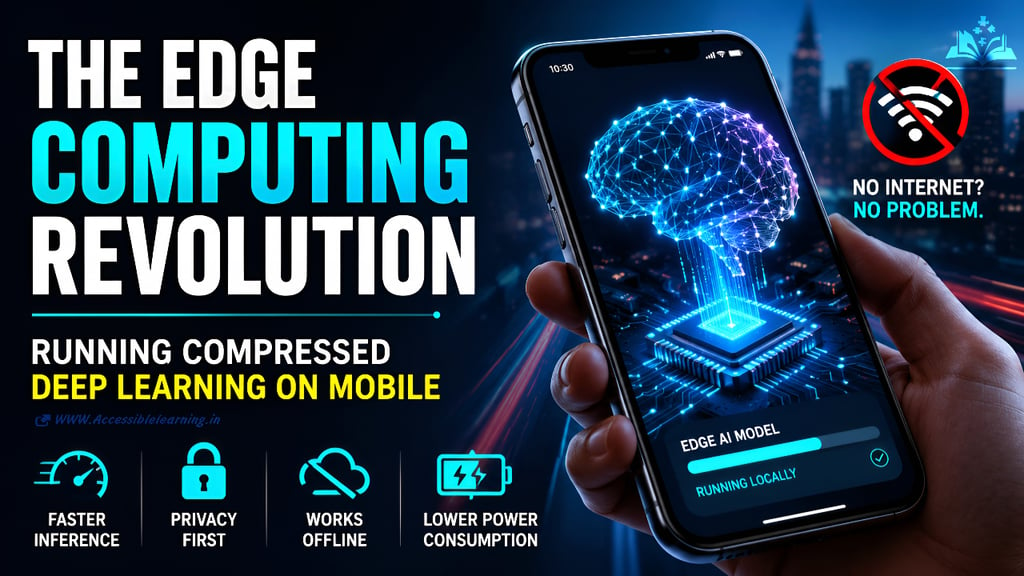

A major cloud provider suffers an outage. Millions of users open their AI-powered apps and stare at loading screens that never end. Voice assistants stop listening. Translation tools fail during emergencies. Medical apps cannot classify images. Customer support floods with complaints while executives scramble for answers.
The disaster did not begin with the outage.
It began years earlier when leadership built every intelligent feature around constant internet access, ignored mounting technical debt, and refused to modernize aging architecture. They accepted higher latency, larger cloud bills, expanding attack surfaces, and a growing dependency on centralized infrastructure.
The companies that survive the next decade will build AI that keeps working after the network disappears. That future already exists. It runs at the edge.
Cloud AI Breaks When Connectivity Breaks
Most mobile AI applications still depend on remote inference. Every prediction requires a request to cloud servers. Every delay depends on network quality. Every user interaction travels through infrastructure the customer never sees.
This architecture creates obvious problems:
High latency damages the user experience.
Cloud inference costs grow with every active user.
Privacy risks increase because sensitive information leaves the device.
Poor connectivity destroys application reliability.
Network outages instantly cripple critical features.
Users do not care why an application stopped working. They simply uninstall it. Modern mobile software must assume unstable networks instead of perfect connectivity.
Edge AI Changes the Rules
Edge AI moves neural network inference directly onto smartphones, tablets, wearables, drones, cameras, and embedded hardware.
Instead of transmitting data across the internet, the application processes information locally using hardware already inside the device.
Modern smartphones include specialized hardware built specifically for AI workloads:
These chips execute billions of operations every second while consuming remarkably little power.
The result changes everything.
Applications respond almost instantly.
Sensitive data never leaves the device.
Internet failures become minor inconveniences instead of catastrophic outages.
Compression Makes Mobile Deep Learning Possible
Large language models and computer vision networks cannot simply move from cloud servers onto smartphones. Developers must compress them aggressively without destroying accuracy.
The most effective optimization techniques include:
Quantization
Instead of storing weights as 32-bit floating-point numbers, developers reduce them to 16-bit, 8-bit, or even 4-bit representations.
Benefits include:
Smaller model size
Faster inference
Lower memory usage
Reduced battery consumption
Pruning
Many neural network connections contribute almost nothing to predictions.
Pruning removes unnecessary parameters while preserving performance.
The network becomes leaner without losing meaningful intelligence.
Knowledge Distillation
A massive "teacher" model trains a smaller "student" model.
The smaller network learns nearly identical behavior while requiring only a fraction of the computation.
This technique powers many production mobile AI systems.
Efficient Neural Architectures
Developers increasingly design models specifically for mobile hardware instead of shrinking enormous cloud models afterward.
Architectures such as lightweight convolutional networks and efficient transformer variants dramatically reduce computational requirements while maintaining competitive accuracy.
Speed Is Only Half the Story
Most discussions about Edge AI focus on latency. That misses the larger revolution.
Running inference locally transforms security and privacy.
A face recognition application no longer uploads photographs.
A health application no longer transmits sensitive biometric data.
A language translator no longer sends every conversation to remote servers.
Data remains on the device.
Attackers lose valuable interception opportunities.
Regulatory compliance becomes significantly easier.
Privacy becomes an engineering decision instead of a marketing slogan.

Mobile Hardware Finally Caught Up
Five years ago, running advanced neural networks on smartphones required major compromises. Today, flagship mobile processors include dedicated AI hardware capable of trillions of operations per second.
Frameworks now expose these accelerators through optimized runtimes, allowing developers to execute compressed models with remarkable efficiency.
Modern devices can perform the following:
Real-time object detection
Speech recognition
Image enhancement
Background removal
Gesture recognition
Offline language translation
Document scanning
Predictive text generation
Many of these features execute entirely without contacting cloud infrastructure.
The Executive Mistake That Keeps Repeating
Technology failures rarely originate inside engineering teams. They begin in boardrooms. Executives demand rapid feature releases while delaying architectural improvements. They postpone refactoring.
They reject modernization because customers cannot immediately see the return on investment.
They accumulate technical debt quarter after quarter until every deployment becomes dangerous.
Eventually one security incident, one infrastructure outage, or one unexpected traffic spike exposes years of neglected engineering decisions.
The financial damage arrives quickly.
Customer trust disappears even faster.
Careers end because leadership ignored architecture until reality forced accountability.
Edge AI does not eliminate technical debt.
Poor architecture can cripple Edge AI projects just as easily as cloud systems.
Compressed models cannot compensate for fragmented codebases, insecure update pipelines, bloated applications, or unmanaged dependencies.
Three Warning Signs of Lethal Technical Debt
Every engineering organization should treat these as immediate threats:
Critical systems rely on outdated libraries that nobody wants to upgrade. Unsupported dependencies create security vulnerabilities and eventually block modernization.
Every new feature requires developers to modify unrelated parts of the application. Tight coupling signals architectural decay that will slow delivery and multiply defects.
Nobody fully understands the deployment pipeline or model update process. Hidden complexity creates operational failures, security gaps, and costly downtime when incidents occur.
Ignore these warnings long enough and the software becomes impossible to evolve safely.
Edge AI Requires Discipline, Not Just Better Chips
Successful Edge AI applications combine optimized hardware with disciplined software engineering.
Development teams should prioritize:
Small, purpose-built neural networks
Continuous benchmarking across real devices
Secure on-device model storage
Efficient memory management
Battery-aware inference scheduling
Incremental model updates
Rigorous testing under offline conditions
Every optimization compounds.
Milliseconds saved during inference improve responsiveness.
Megabytes removed from the model reduce download size.
Lower power consumption extends battery life.
The cumulative result creates software that feels dramatically better than cloud-dependent competitors.
The Future Belongs to Offline Intelligence
The next generation of AI applications will not ask whether the internet works. They will simply work.
Users increasingly expect instant responses, stronger privacy, and uninterrupted performance regardless of network conditions. Edge AI delivers all three.
Cloud infrastructure will remain essential for training large models, synchronizing data, and performing massive computations. But inference continues moving toward the device because physics favors local execution over network round trips.
Developers who master compressed deep learning, hardware acceleration, and efficient mobile architectures will build applications that outperform competitors on speed, reliability, and trust.
Companies that continue treating every smartphone as a thin client will discover an uncomfortable truth.
Customers no longer judge AI by how intelligent it appears during perfect network conditions.
They judge it by whether it still works after the Wi-Fi disappears.
FAQ's
Q: What is Edge AI, and how does it differ from cloud AI?
Edge AI runs artificial intelligence models directly on a device, such as a smartphone or IoT device, instead of relying on remote cloud servers. This delivers faster responses, better privacy, and offline functionality.
Q: How can deep learning models run efficiently on mobile devices?
Developers use model compression techniques such as quantization, pruning, and knowledge distillation to reduce model size and computational requirements while maintaining high accuracy.
Q: What are the biggest benefits of running AI on smartphones instead of the cloud?
On-device AI offers lower latency, improved privacy, reduced cloud costs, offline operation, lower bandwidth usage, and a more reliable user experience.
Q: Which hardware components accelerate Edge AI on modern smartphones?
Modern smartphones use dedicated AI hardware such as Neural Processing Units (NPUs), mobile GPUs, Digital Signal Processors (DSPs), and AI accelerators to execute deep learning models efficiently.
Q: What is model quantization in deep learning?
Model quantization reduces the numerical precision of neural network weights, such as converting 32-bit values to 8-bit or 4-bit formats, making models smaller, faster, and more energy efficient.
Q: Can AI applications work without an internet connection?
Yes. AI applications powered by Edge AI can perform tasks like image recognition, speech recognition, language translation, and text prediction entirely offline, provided the required models are stored on the device.
Q: Is Edge AI more secure than cloud-based AI?
In many cases, yes. Since sensitive data remains on the user's device instead of being transmitted to external servers, Edge AI reduces data exposure and lowers the risk of interception or large-scale data breaches.
Q: What are the biggest challenges when deploying deep learning models on mobile devices?
The main challenges include limited memory, battery consumption, processor performance, thermal constraints, model optimization, and maintaining accuracy after compression.
Subscribe to Frontier Intelligence
All © Copyright reserved by Accessible-Learning Hub
| Terms & Conditions
Accessible Learning Hub — Actionable clarity for high-agency minds.
Weekly breakdowns on AI breakthroughs, capital flow, and human performance systems. Zero fluff.