

The Economic Clock of War: When Earth Becomes the Battlefield
An in-depth look at how modern war disrupts global energy systems, weaponizes interdependence, and drives hidden environmental destruction, raising a critical question: are we destroying the very resources needed to survive?
HARSH REALITYGLOBAL ISSUESNEPOTISM/SOCIAL ISSUES
Kim Shin
3/22/20264 min read
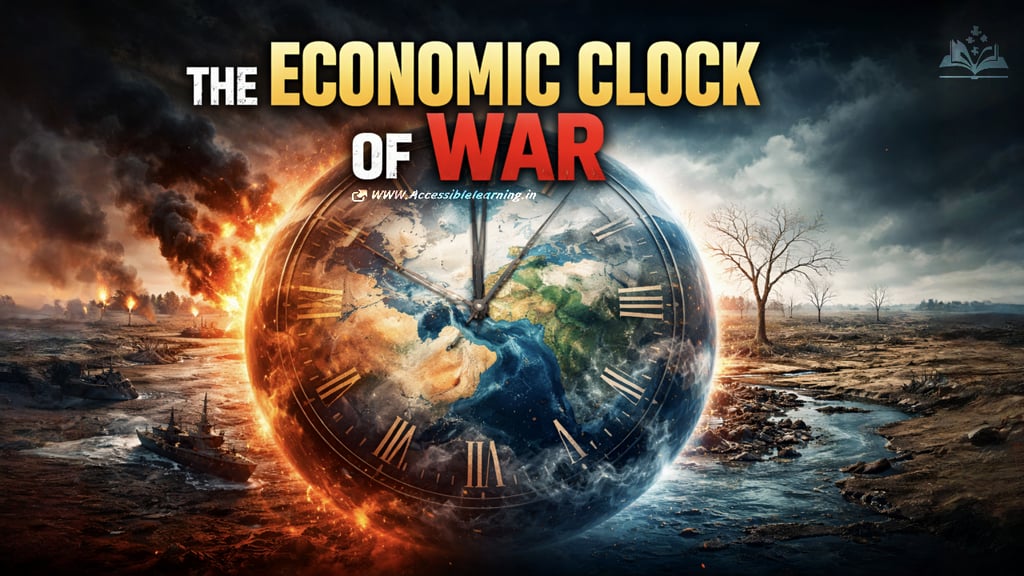
War today is not just about capturing land. It’s about controlling systems.
In 2026, as conflict escalates across the Middle East, the battlefield stretches far beyond borders. It runs through oil fields, shipping lanes, pipelines, and power grids. When strikes hit energy infrastructure and tensions choke the Strait of Hormuz, the impact is immediate. Oil and gas flows tighten. Prices surge. Economies react within days.
This is the “economic clock” of war. Every escalation speeds it up, linking conflict directly to inflation, energy security, and everyday life. But the deeper consequence is harder to see. War is no longer just destroying cities. It is destabilizing the very systems that sustain human survival.
Weaponizing Global Interdependence
Modern economies are deeply interconnected. Trade routes, energy networks, and infrastructure bind nations together. What once created stability is now being used as leverage. This is weaponized interdependence.
Instead of direct confrontation, conflict targets key nodes:
Energy facilities
Shipping chokepoints
Supply chains
Critical infrastructure
The Strait of Hormuz is a clear example. A narrow corridor carrying a large share of the world’s oil becomes a pressure point. Disrupt it, and the shock spreads globally. This changes the nature of war. Power is no longer defined only by military strength but by control over systems that others depend on.
Every disruption triggers a chain reaction. Fuel prices rise. Flights are canceled. Shipping routes shift. Food production becomes more expensive. Inflation spreads quietly but quickly. The war may be regional. The consequences are global.
The Hormuz Effect: When Geography Controls the Economy
The Strait of Hormuz is not just a location. It is a switch.
When tensions rise and movement through the strait slows or stops, global energy markets react instantly. Supply fears push prices upward. Insurance costs climb. Governments scramble to secure reserves.
For developed economies, this means inflation and policy pressure. For developing nations, it can mean energy shortages, disrupted daily life, and economic strain.
This is the reality of modern conflict. A single chokepoint can influence the stability of entire continents. War no longer needs to spread geographically to become global. The system itself carries the shock outward.
Ecocide: The Silent Cost of War
While markets track oil prices, the environment absorbs the deeper damage. Modern warfare increasingly targets infrastructure that, when destroyed, triggers ecological collapse:
Burning oil fields release massive emissions
Damaged pipelines contaminate land and water
Explosions spread toxic chemicals into ecosystems
Power and water systems collapse under strain
This is not collateral damage. It is systemic destruction.
Air becomes polluted. Soil becomes unusable. Water becomes unsafe. These effects do not disappear when conflict ends. They persist for years, sometimes decades.
In some cases, environmental damage reaches extreme forms. Toxic rainfall, long-term contamination, and ecosystem collapse begin to reshape entire regions. War doesn’t just take lives in the moment. It reduces the quality of life for the future.
Survival vs. Sustainability
Conflict forces governments into difficult decisions. In the short term, survival dominates:
Increase fossil fuel production
Reopen coal-based energy systems
Secure immediate supply regardless of long-term cost
These are practical responses under pressure. But they deepen dependency on the very systems that make countries vulnerable in the first place.
At the same time, the crisis reveals another path. Renewable energy offers a form of resilience. Countries with stronger solar, wind, or diversified energy systems are less exposed to global shocks. They have more flexibility, more stability, and fewer external dependencies.
But transitions take time. And war compresses time. So nations face a real dilemma: solve today’s crisis quickly or invest in a system that prevents the next one.

A Self-Destructive Model of Victory
Traditional war assumes a winner. But in a world where economies and ecosystems are deeply connected, that idea becomes questionable. What does victory mean if:
Water sources are contaminated
Agricultural land is damaged
Air quality is degraded
Climate risks intensify
Even the “winner” inherits these conditions.
War, in this sense, becomes self-destructive. It damages the resources that every society depends on, regardless of borders or outcomes. Control over land means little if that land can no longer sustain life.
When Earth Becomes the Battlefield
The most important shift is this: war is no longer contained. Environmental damage spreads. Economic shocks travel. Climate effects amplify everything. There is no clear boundary between conflict zones and the rest of the world.
The battlefield has expanded to include:
The atmosphere
The oceans
Food systems
Energy networks
And that changes everything.
The “economic clock” is not just measuring financial cost. It is measuring how quickly war erodes the foundations of survival. Every escalation accelerates that process.
Modern war forces a choice that goes beyond politics or strategy. Continue down a path where conflict disrupts systems, deepens dependency, and damages the environment. Or treat these crises as signals to redesign how energy, infrastructure, and global cooperation work.
War has always been destructive. But in a connected world, it risks becoming something more. Not just a tool of conflict, but a mechanism of collective self-destruction. When Earth itself becomes the battlefield, there are no real winners left.
FAQ's
Q: What is the “economic clock” of war?
The “economic clock” of war refers to how quickly conflict triggers global economic consequences. As soon as critical systems like energy supply or trade routes are disrupted, effects such as inflation, fuel shortages, and market instability begin to spread across countries.
Q: What does “weaponized interdependence” mean in modern warfare?
It means using global economic connections as a strategic tool. Instead of direct attacks, nations disrupt key systems like oil routes, supply chains, or infrastructure to pressure other countries economically and politically.
Q: Why is the Strait of Hormuz so important to global stability?
The Strait of Hormuz is one of the world’s most critical energy chokepoints, carrying a significant portion of global oil and gas. Any disruption there immediately affects global fuel prices, trade, and economic stability.
Q: How does war contribute to environmental destruction (ecocide)?
War damages ecosystems through oil fires, toxic leaks, infrastructure destruction, and pollution. These impacts contaminate air, water, and soil, often causing long-term environmental harm that continues even after the conflict ends.
Q: Does war increase dependence on fossil fuels?
In the short term, yes. Countries often rely more on fossil fuels during crises to maintain stability. However, such disruptions can also push nations to accelerate renewable energy adoption for long-term resilience.
Q: Can renewable energy reduce the impact of war on economies?
Yes. Countries with strong renewable energy systems are less dependent on global fuel supply chains, making them more resilient to geopolitical shocks and price volatility.
Q: Is modern war becoming self-destructive?
In many ways, yes. Modern war damages critical resources like water, land, and air, which are essential for survival. This means even the “winning” side faces long-term environmental and economic consequences.
Q: How does war affect everyday people globally?
Even if the conflict is far away, people feel its effects through rising fuel prices, higher food costs, supply shortages, and economic instability. Global systems ensure that no one is completely isolated from its impact.
Subscribe to Frontier Intelligence
All © Copyright reserved by Accessible-Learning Hub
| Terms & Conditions
Accessible Learning Hub — Actionable clarity for high-agency minds.
Weekly breakdowns on AI breakthroughs, capital flow, and human performance systems. Zero fluff.