

The Dutch Empire: A Comprehensive History of Global Maritime Power and Colonial Expansion
Explore the Dutch Empire's 400-year history—from VOC dominance and spice trade monopolies to colonial expansion across Asia, Africa, and the Americas, and its lasting global impact.
EMPIRES/HISTORYHISTORYFRANCEEUROPEAN UNION
Keshav Jha
1/28/202615 min read
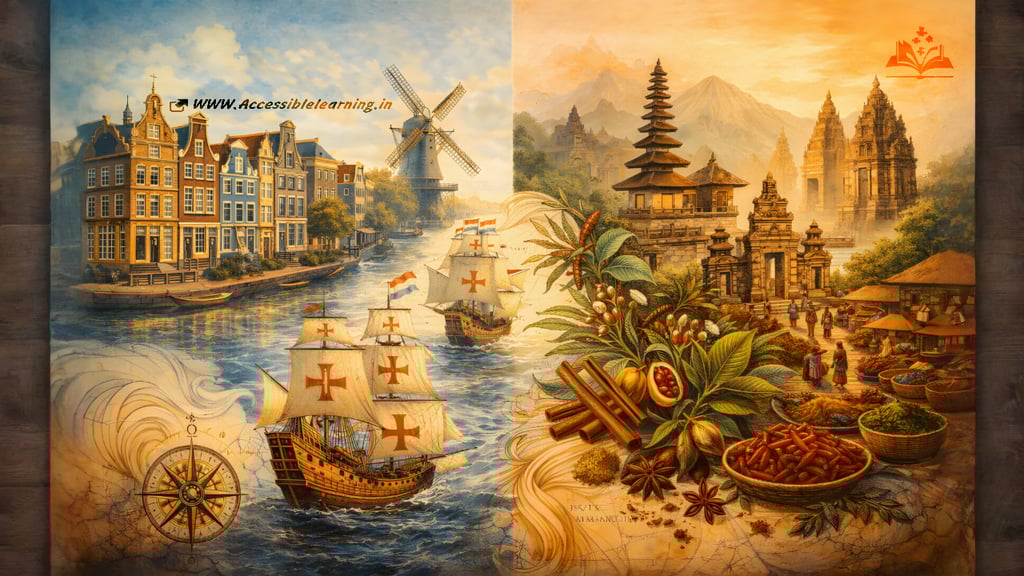
Understanding the Dutch Golden Age and Colonial Reach
The Dutch Empire represents one of history's most remarkable transformations—a small, waterlogged republic in northwestern Europe that became a global superpower through maritime innovation, commercial acumen, and colonial ambition. Spanning from the late 16th century through the mid-20th century, Dutch colonial influence reached across five continents, fundamentally reshaping global trade networks, cultural exchanges, and geopolitical power structures.
Unlike land-based empires built primarily through military conquest, the Dutch Empire emerged as a commercial enterprise, driven by chartered trading companies that blurred the lines between corporate profit and state power. This unique character made the Dutch colonial experience distinct from Spanish, Portuguese, British, or French imperialism, yet equally impactful on world history.
Origins and Rise: How Did the Dutch Empire Begin?
The Revolt Against Spanish Rule and the Birth of a Maritime Nation
The foundation of Dutch imperial power paradoxically emerged from vulnerability. During the Eighty Years' War (1568-1648), the Dutch provinces fought for independence from Spanish Habsburg rule. This prolonged conflict forced the Dutch to look seaward for economic survival, as Spanish control of European trade routes threatened their commercial lifelines.
The Union of Utrecht (1579) united seven northern provinces—Holland, Zeeland, Utrecht, Gelderland, Overijssel, Friesland, and Groningen—forming the foundation of what would become the Dutch Republic. This decentralized political structure, dominated by wealthy merchant classes rather than hereditary nobility, created a unique environment where commercial interests directly shaped national policy.
The Dutch East India Company: Corporate Colonialism Pioneer
In 1602, the Dutch established the Vereenigde Oostindische Compagnie (VOC), or Dutch East India Company, marking a revolutionary moment in both corporate and colonial history. The VOC represented the world's first multinational corporation, the first company to issue publicly traded stock, and the first entity granted quasi-governmental powers, including the right to wage war, negotiate treaties, establish colonies, and mint currency.
The VOC's structure solved a critical problem: individual Dutch merchants lacked resources to compete with established Portuguese and Spanish colonial powers. By pooling capital from thousands of investors and receiving monopoly rights over Asian trade, the VOC could mount large-scale expeditions, maintain permanent trading posts, and sustain military operations across vast distances.
Strategic Advantages in the Age of Exploration
Several factors enabled Dutch colonial success despite the nation's small size and population:
Shipbuilding Innovation: Dutch shipyards pioneered the fluyt (or flyboat), a cargo vessel designed specifically for bulk transport rather than warfare. These ships required smaller crews, carried more cargo, and cost significantly less than traditional vessels, giving Dutch merchants decisive economic advantages in competitive trade routes.
Financial Sophistication: Amsterdam developed Europe's most advanced financial infrastructure, including the Amsterdam Stock Exchange (1602), sophisticated banking systems, and insurance mechanisms that distributed risk across multiple investors. This financial depth allowed sustained investment in long-distance trade ventures.
Cartographic Excellence: Dutch mapmakers and navigators produced the era's most accurate charts and navigational instruments. This knowledge advantage proved invaluable in claiming new territories and establishing efficient trade routes.
Religious Tolerance and Human Capital: Relative religious tolerance attracted skilled workers, merchants, and intellectuals fleeing persecution elsewhere in Europe, concentrating talent and expertise in Dutch cities.
Geographic Extent: Where Did the Dutch Empire Reach?
Asia: The Heart of Dutch Colonial Power
Dutch East Indies (Indonesia): The crown jewel of Dutch colonial possessions, this archipelago became the longest-lasting and most economically significant Dutch territory. Beginning with the establishment of Batavia (modern Jakarta) in 1619, the Dutch gradually extended control across Java, Sumatra, parts of Borneo, Sulawesi, the Moluccas (Spice Islands), and eventually the entire Indonesian archipelago.
The Dutch implemented the Culture System (Cultuurstelsel) in 1830, forcing Javanese farmers to dedicate portions of their land to export crops like sugar, coffee, indigo, and tea. This exploitative system generated enormous profits for the Dutch state while causing widespread famine and suffering among Indonesian populations. The Dutch East Indies remained under Dutch control until Indonesian independence in 1949, making it one of the last major colonial territories to achieve sovereignty.
Ceylon (Sri Lanka): Captured from the Portuguese between 1638 and 1658, Dutch Ceylon became a crucial source of cinnamon, the era's most valuable spice. The Dutch controlled coastal regions and cinnamon-producing areas until British conquest in 1796.
Taiwan (Formosa): From 1624 to 1662, the Dutch maintained Fort Zeelandia and Fort Provintia on Taiwan, using the island as a trading base for commerce with China and Japan. Chinese Ming loyalist Koxinga expelled the Dutch in 1662.
Japanese Trade Monopoly: Through the trading post at Dejima in Nagasaki harbor (1641-1854), the Dutch maintained exclusive European trading rights with Japan during its period of self-imposed isolation. This unique position provided valuable intelligence about East Asian affairs and profitable trade in Japanese copper, silver, and luxury goods.
Indian Subcontinent: Dutch trading posts dotted India's coasts, including significant settlements at Pulicat, Nagapattinam, Cochin, and Surat. Though never matching British or French territorial control, these outposts facilitated textile trade crucial to Indonesian colonial operations.
Africa: Strategic Waypoints and Limited Territorial Control
Cape Colony (South Africa): Established in 1652 as a refreshment station for VOC ships traveling between Europe and Asia, the Cape Colony grew into a significant settler colony. Dutch and French Huguenot settlers developed agriculture and viticulture, while interactions with indigenous Khoikhoi and San peoples, along with the importation of enslaved people from East Africa and Asia, created the complex ethnic foundations of modern South Africa.
The development of the Afrikaans language and Boer (farmer) culture laid the groundwork for later conflicts with British imperial forces and the eventual apartheid system. British seizure of the Cape Colony during the Napoleonic Wars (1806) marked a significant loss for Dutch imperial ambitions.
West African Trading Posts: The Dutch West India Company maintained forts and trading posts along the Gold Coast (modern Ghana) and was involved in the transatlantic slave trade. Major establishments included Elmina Castle (captured from Portugal in 1637) and Fort Coenraadsburg.
Americas: Caribbean Strongholds and Brief Mainland Ventures
Dutch Brazil: Between 1630 and 1654, the Dutch West India Company controlled significant portions of northeastern Brazil, particularly the sugar-producing region around Pernambuco. Under Governor Johan Maurits van Nassau-Siegen, Dutch Brazil saw relative religious tolerance and cultural flourishing, but Portuguese resistance eventually expelled Dutch forces.
Caribbean Colonies: The Dutch established a lasting presence in the Caribbean with colonies including:
Curaçao: Captured from Spain in 1634, becoming the administrative center for Dutch Caribbean operations and a major slave-trading hub
Aruba and Bonaire: Completing the "ABC islands" off Venezuela's coast
Sint Maarten (shared with France from 1648)
Sint Eustatius: A critical free-trade port and major commercial hub in the 18th century
Saba: Small but strategically positioned island
Suriname: Gained from Britain in exchange for New Netherland (New York) in 1667, Suriname became a plantation colony producing sugar, coffee, and cocoa through enslaved African labor. Suriname remained Dutch until independence in 1975.
New Netherland (North America): From 1614 to 1674, the Dutch controlled territory along the Hudson River valley, Delaware River valley, and parts of Connecticut. New Amsterdam (modern New York City) served as the colony's capital until English conquest in 1664. Though brief, Dutch influence left lasting cultural and architectural marks on the American Northeast, including place names like Harlem, Brooklyn (Breukelen), and the Bronx (Jonas Bronck).
Guyana Region: Brief Dutch presence in what is now Guyana, later ceded to Britain.
Oceania: Exploration Without Sustained Settlement
Dutch explorers made significant discoveries in the Pacific, including:
Australia: Abel Tasman and other Dutch navigators charted substantial portions of Australia's western and northern coasts during the 17th century, naming it "New Holland." However, perceived lack of commercial value prevented colonial settlement.
New Zealand: Tasman's 1642 voyage made the first European contact with New Zealand, though violent encounters with Māori discouraged further exploration.
Tasmania, Fiji, and Tonga: Dutch navigators documented numerous Pacific islands without establishing permanent settlements.


Economic Foundations: What Made the Dutch Empire Profitable?
The Spice Trade Monopoly
Control of spice production in the Moluccas (Maluku Islands) formed the initial economic foundation of Dutch colonial power. Nutmeg, mace, and cloves—found nowhere else on Earth—commanded extraordinary prices in European markets. The VOC employed ruthless methods to maintain monopoly control:
Forced Cultivation: Local populations were compelled to grow spices exclusively for Dutch purchase at artificially low prices.
Violent Suppression: The infamous Banda Islands massacre (1621) saw Dutch forces under Jan Pieterszoon Coen systematically kill or enslave the indigenous population, replacing them with Dutch colonists and enslaved workers to ensure complete control over nutmeg production.
Destruction of Competing Production: The VOC regularly destroyed spice trees on islands outside their direct control to prevent supply exceeding demand and driving down prices.
Commodity Diversification and Plantation Systems
As the spice monopoly weakened in the 18th century due to smuggling and cultivation elsewhere, the Dutch expanded into other commodities:
Coffee: Introduced to Java in the late 17th century, coffee became a major export crop. The Dutch transported coffee plants to their Caribbean colonies, making them important players in global coffee markets.
Sugar: Plantation agriculture in Dutch Brazil, Suriname, and Caribbean islands produced vast quantities of sugar for European consumption, powered by the brutal exploitation of enslaved African labor.
Textiles: Indian cotton textiles purchased through Dutch trading posts served both European markets and Indonesian colonies, where they were traded for spices and other local products.
Timber and Naval Stores: Strategic commodities for shipbuilding and maritime operations.
The Triangular Trade and Slave Commerce
The Dutch West India Company actively participated in the transatlantic slave trade, transporting an estimated 550,000-600,000 enslaved Africans across the Atlantic between the 1630s and 1803. This horrific commerce formed one leg of triangular trade routes connecting Europe, Africa, and the Americas.
Dutch participation in slavery extended beyond transportation to ownership and exploitation in plantation colonies, particularly Suriname, which maintained legal slavery until 1863—among the last Western nations to abolish the practice.
Financial Returns and Amsterdam's Golden Age
At its peak in the mid-17th century, VOC dividends averaged 18% annually—extraordinary returns that enriched Dutch investors and funded the cultural and artistic flourishing known as the Dutch Golden Age. Painters like Rembrandt, Vermeer, and Frans Hals created masterpieces, while Amsterdam's elegant canal houses and public buildings reflected unprecedented urban wealth.
However, these profits came at devastating human costs in colonized territories, through violence, exploitation, forced labor, and the destruction of indigenous economic and social systems.
Administration and Governance: How Was the Dutch Empire Managed?
The Chartered Company Model
Unlike Spanish or Portuguese colonies directly administered by royal governments, Dutch imperial territories operated primarily through chartered trading companies—the VOC for Asian operations and the Dutch West India Company (WIC) for the Atlantic world.
These companies exercised extraordinary powers:
Military Forces: Maintaining armies and navies for territorial conquest and defense
Diplomatic Authority: Negotiating treaties with indigenous rulers and competing European powers
Legal Systems: Establishing courts and enforcing company regulations
Currency Rights: Minting coins and managing monetary systems
Territorial Administration: Appointing governors and colonial officials
This corporate structure prioritized profit maximization over other colonial objectives, leading to particularly exploitative policies when commercial interests conflicted with human welfare.
Governor-General System in the East Indies
The VOC's Governor-General in Batavia wielded near-absolute authority over Dutch Asian operations. Notable Governors-General shaped colonial policy and territorial expansion:
Jan Pieterszoon Coen (1619-1623, 1627-1629): Founded Batavia and employed brutal methods to establish Dutch supremacy, including the Banda Islands massacre.
Antonio van Diemen (1636-1645): Commissioned Abel Tasman's exploratory voyages and expanded Dutch territorial control in the Indonesian archipelago.
Herman Willem Daendels (1808-1811): Implemented modernizing reforms and constructed the Great Post Road across Java, though his authoritarian methods sparked resistance.
Relationship with Indigenous Rulers
Dutch colonial strategy often involved indirect rule through existing indigenous power structures. The VOC signed contracts with local sultans and rulers, theoretically respecting their authority while monopolizing external trade and gradually eroding genuine sovereignty.
This approach allowed the Dutch to maintain control over vast territories with relatively small European populations. However, it also created complex political dynamics, with indigenous rulers sometimes playing Dutch and rival European powers against each other.
Cultural and Social Impact: What Were the Human Consequences?
Colonial Violence and Exploitation
Dutch colonial rule involved systematic violence and exploitation. Major atrocities included:
Banda Islands Genocide (1621): Near-total extermination of the indigenous Bandanese population to establish spice monopoly control.
Javanese Famines: The Culture System and forced cultivation policies caused recurring famines, killing hundreds of thousands during the 19th century.
Punitive Expeditions: Military campaigns against resistant populations employed scorched-earth tactics, mass killings, and collective punishment.
Cultural Exchange and Hybrid Societies
Despite violent foundations, Dutch colonialism created complex cultural exchanges and hybrid societies:
Language: Dutch influenced local languages, while colonial administrators learned indigenous tongues. Afrikaans emerged as a distinct language blending Dutch with African and Asian linguistic elements. Malay-Portuguese creoles developed in trading communities.
Architecture: Colonial buildings blended European and indigenous design elements, creating distinctive architectural styles visible in surviving structures across former Dutch territories.
Cuisine: Food cultures merged, with Indonesian dishes incorporating European ingredients and cooking techniques, while Dutch cuisine absorbed Indonesian influences (modern Dutch-Indonesian fusion restaurants reflect this ongoing exchange).
Legal Systems: Dutch legal traditions influenced colonial legal frameworks, some persisting after independence.
Religious Conversion and Education
The Dutch Reformed Church supported missionary activities in colonial territories, though conversions remained limited compared to Spanish or Portuguese Catholic missions. Educational institutions established by missionaries and colonial administrators created indigenous educated classes who would later lead independence movements.
The Legacy of Slavery and Indentured Labor
After slavery's abolition, Dutch colonies imported indentured laborers from India, China, and Java, creating multi-ethnic societies particularly in Suriname and the Caribbean. These migration patterns fundamentally shaped the demographic and cultural character of these regions, effects visible today in their diverse populations.

Decline and Decolonization: Why Did the Dutch Empire End?
18th-Century Challenges and British Competition
The VOC's dominance eroded during the 18th century due to multiple factors:
Corruption and Mismanagement: Company officials prioritized personal enrichment over corporate interests, while bureaucratic inefficiency increased operational costs.
British Naval Superiority: British maritime power eclipsed Dutch capabilities, particularly after the Anglo-Dutch Wars (1652-1784). British control of global sea lanes undermined Dutch trading advantages.
Financial Crisis: The VOC declared bankruptcy in 1799, its assets assumed by the Dutch state. The WIC had dissolved earlier in 1791.
Napoleonic Wars and British Occupation
The French conquest of the Dutch Republic (1795) and the establishment of the Batavian Republic, followed by incorporation into Napoleon's empire, disrupted colonial administration. Britain occupied Dutch colonial possessions during the Napoleonic Wars, returning some (like the East Indies) after Napoleon's defeat but permanently retaining others (notably the Cape Colony and Ceylon).
19th-Century Colonial Consolidation
Rather than expanding, 19th-century Dutch colonialism focused on consolidating control over existing territories, particularly the East Indies. The brutal Aceh War (1873-1904) exemplified this period's violent consolidation, as Dutch forces fought a protracted guerrilla conflict to subjugate the independent Aceh Sultanate in northern Sumatra.
World War II and Japanese Occupation
The Japanese invasion and occupation of the Dutch East Indies (1942-1945) during World War II shattered Dutch colonial authority. Indonesian nationalists, led by Sukarno and Mohammad Hatta, declared independence on August 17, 1945, immediately after Japan's surrender.
Indonesian Independence Struggle
The Dutch refused to recognize Indonesian independence, leading to the Indonesian National Revolution (1945-1949). This bitter conflict involved guerrilla warfare, international diplomatic pressure (particularly from the United States), and "police actions" (Dutch euphemism for military operations) that drew international condemnation.
The Renville Agreement (1948) and Round Table Conference (1949) ultimately forced Dutch recognition of Indonesian sovereignty on December 27, 1949. Western New Guinea (Papua) remained under Dutch control until 1962, when it was transferred to Indonesia following United Nations mediation.
Caribbean and South American Decolonization
Dutch Caribbean and South American colonies followed different trajectories:
Suriname: Gained independence in 1975 after extended negotiations, though economic ties to the Netherlands remained strong.
Netherlands Antilles: Dissolved in 2010, with constituent islands becoming either independent countries within the Kingdom of the Netherlands (Curaçao and Sint Maarten) or special municipalities of the Netherlands proper (Bonaire, Sint Eustatius, and Saba).
Aruba: Achieved separate status within the Kingdom of the Netherlands in 1986.
These territories maintain constitutional connections to the Netherlands while exercising substantial internal autonomy.
Contemporary Legacy: How Does the Dutch Empire Shape Today's World?
Ongoing Debates About Colonial History
Recent years have seen intensified debates in the Netherlands about colonial legacy:
Historical Acknowledgment: In 2020, Dutch Prime Minister Mark Rutte apologized for the country's role in slavery. Calls continue for a more comprehensive reckoning with colonial violence and exploitation.
Museum Representation: Dutch museums increasingly address colonial history critically, with exhibitions examining colonialism's violence and contemporary impacts. The Rijksmuseum and Tropenmuseum have reorganized collections to provide colonial context.
Language and Terminology: Debates about how to discuss colonialism in educational materials, with movements away from euphemistic language toward direct acknowledgment of exploitation and violence.
Reparations Discussions: Growing movements advocate for reparations to descendant communities affected by Dutch slavery and colonialism, though the Dutch government has not committed to comprehensive reparations programs.
Economic and Cultural Connections
Former Dutch colonies maintain economic and cultural ties to the Netherlands:
Migration: Large diaspora communities from Indonesia, Suriname, and the Caribbean live in the Netherlands, contributing to Dutch multiculturalism while maintaining connections to ancestral homelands.
Trade Relations: The Netherlands remains an important trading partner for several former colonies, though relationships are now theoretically equal rather than exploitative.
Language: Dutch remains an official language in Suriname and the Caribbean Netherlands, while Indonesian contains numerous Dutch loanwords.
Educational Exchange: Scholarship programs and educational partnerships connect Dutch universities with institutions in former colonies.
Influence on International Law and Corporate Governance
The VOC's pioneering corporate structure influenced modern multinational corporations and shareholder capitalism. The legal frameworks developed for chartered companies informed international commercial law, though with vastly different ethical standards than contemporary corporate governance principles.
Architectural and Urban Heritage
Dutch colonial architecture survives in former colonies, creating complicated heritage questions. Some communities preserve these structures as historical evidence, while others debate whether they glorify oppression. Cities like Jakarta, Paramaribo, and Willemstad contain significant Dutch colonial architecture, now often adapted for contemporary use.

Lessons from the Dutch Imperial Experience
The Dutch Empire's history offers critical insights into colonialism's character and consequences. As a commercially driven enterprise, it demonstrated how corporate profit motives could drive territorial expansion and systematic exploitation with devastating human costs. The VOC's pioneering corporate structure influenced modern global capitalism while establishing patterns of resource extraction and labor exploitation that persist in different forms today.
For contemporary audiences, understanding the Dutch Empire means confronting how wealth accumulation in one region often occurred through violence and exploitation elsewhere—connections between historical colonialism and current global inequalities. The ongoing debates in the Netherlands about colonial legacy reflect broader questions facing former colonial powers: how to acknowledge historical wrongs, address their continuing impacts, and build more equitable relationships with formerly colonized peoples.
The Dutch colonial experience reminds us that technological sophistication, commercial innovation, and cultural achievement can coexist with systematic violence and oppression—a sobering lesson for evaluating our own era's power structures and economic systems. As we navigate questions of historical justice, cultural heritage, and international relations, the Dutch Empire's complex legacy continues to demand careful examination, honest acknowledgment, and thoughtful response.
Frequently Asked Questions
Q: What was the Dutch Empire known for?
The Dutch Empire became renowned for its commercial character, operating primarily through chartered trading companies rather than direct state administration. It dominated the lucrative spice trade from the Indonesian archipelago, pioneered corporate structures like publicly traded stock, and established a global network of trading posts across five continents. The empire's maritime prowess and financial innovation allowed a small European nation to become a major colonial power during the 17th and 18th centuries.
Q: How long did the Dutch Empire last?
The Dutch Empire's duration varied by region. Colonial expansion began in the late 16th century, with major territorial acquisitions starting in the early 1600s. While the empire began declining in the 18th century and lost many territories during the Napoleonic Wars, Dutch colonial rule persisted into the mid-20th century. Indonesia gained independence in 1949, Suriname in 1975, with the Netherlands Antilles dissolved only in 2010. The entire imperial period thus spanned approximately 350-400 years, depending on how one measures beginning and end points.
Q: Why did the Dutch Empire decline?
Multiple factors caused Dutch imperial decline: corruption and mismanagement within the VOC, rising British naval and commercial competition, financial crises leading to company bankruptcies, French occupation during the Napoleonic Wars, British seizure of key territories, the high costs of maintaining distant colonies, and ultimately, powerful independence movements in colonized territories. The shift from commercial to territorial empire in the 19th century increased administrative costs without proportional profit increases, while 20th-century decolonization movements made colonial rule politically and economically untenable.
Q: What countries were part of the Dutch Empire?
Major Dutch colonial territories included Indonesia (Dutch East Indies), Sri Lanka (Ceylon), South Africa (Cape Colony), Suriname, Curaçao, Aruba, Sint Maarten, Sint Eustatius, Bonaire, Saba, parts of Brazil, New York (New Netherland), Taiwan (Formosa), and trading posts in India, West Africa, and elsewhere. The Dutch also explored but didn't permanently settle Australia, New Zealand, and various Pacific islands. Not all territories were held simultaneously, with some like Brazil and New Netherland, being lost relatively quickly.
Q: How did the Dutch East India Company differ from British colonial administration?
The VOC operated as a quasi-governmental corporation with shareholders and profit mandates, while British colonialism evolved toward direct state administration. The VOC possessed military, diplomatic, and administrative powers but remained fundamentally a commercial enterprise prioritizing dividends over other colonial objectives. British colonialism, while certainly economically motivated, developed more comprehensive governmental structures, settler populations, and ostensibly "civilizing" ideological justifications. The VOC's corporate structure made it innovative financially but often brutally exploitative in practice.
Q: What role did the Dutch play in the slave trade?
The Dutch West India Company actively participated in the transatlantic slave trade, transporting approximately 550,000-600,000 enslaved Africans to colonies in the Americas between the 1630s and early 1800s. Dutch colonies in Suriname, the Caribbean islands, and briefly Brazil relied heavily on enslaved labor for plantation agriculture. The Netherlands maintained legal slavery in colonies until 1863, among the last Western nations to abolish the practice. This history represents one of the darkest aspects of the Dutch colonial legacy.
Q: How did Indonesian independence affect the Dutch economy?
Indonesian independence eliminated the Netherlands' most valuable colonial asset, forcing significant economic adjustment. However, post-WWII Netherlands had already begun transitioning toward European-focused trade and industrialization. Marshall Plan aid helped rebuild the Dutch economy, while the loss of Indonesian revenues forced beneficial economic modernization and diversification. Many Dutch citizens living in Indonesia returned to the Netherlands, initially straining resources but eventually contributing skills and experience to economic development. Long-term, independence proved economically manageable for the Netherlands while being essential for Indonesian sovereignty.
Q: What is the relationship between the Netherlands and its former colonies today?
Relationships vary significantly by territory. The Caribbean islands maintain constitutional connections within the Kingdom of the Netherlands. Suriname is an independent nation with substantial cultural and economic ties to the Netherlands, including a large Surinamese diaspora community in Dutch cities. Indonesia maintains diplomatic and economic relationships but with historical tensions regarding colonial legacy, war crimes recognition, and repatriation of cultural artifacts. Recent years have seen increased Dutch acknowledgment of colonial violence, though debates continue about adequate reckoning with this history.
Subscribe to Frontier Intelligence
All © Copyright reserved by Accessible-Learning Hub
| Terms & Conditions
Accessible Learning Hub — Actionable clarity for high-agency minds.
Weekly breakdowns on AI breakthroughs, capital flow, and human performance systems. Zero fluff.