

The DuPont Empire: From Gunpowder to Global Innovation Powerhouse
Discover the 220-year DuPont Empire legacy—from 1802 gunpowder mills to Kevlar, nylon, and Teflon innovations. Explore the current 2025 strategy, controversies, and impact.
WEALTHY FAMILYEMPIRES/HISTORYCOMPANY/INDUSTRYUSA
Sachin K Chaurasiya
1/15/20268 min read
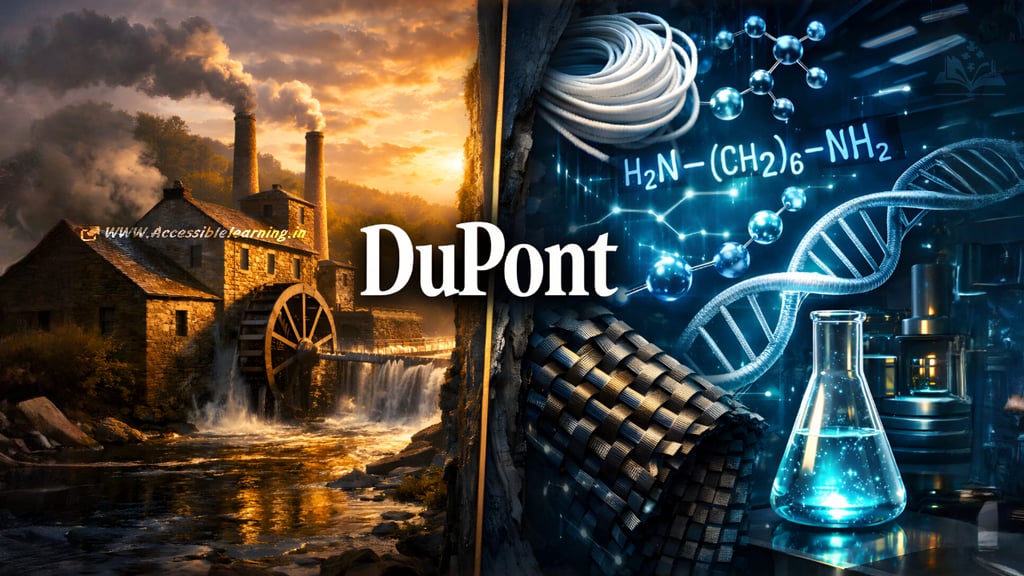
A 220-Year Legacy of American Industrial Dominance
The DuPont Empire stands as one of America's most enduring corporate dynasties, transforming from a humble gunpowder mill along Delaware's Brandywine River into a multinational chemical and materials science giant. Founded in 1802 by French émigré Éleuthère Irénée du Pont de Nemours, this family business evolved into a Fortune 500 powerhouse that revolutionized industries from textiles to aerospace, defense to healthcare.
Today, DuPont reported $3.1 billion in fourth-quarter 2024 net sales and is planning a strategic separation of its Electronics business targeted for November 1, 2025. This article explores how a single gunpowder factory became an innovation empire that literally changed the material world we live in.
The Origins: French Revolution to American Innovation (1802-1850)
Fleeing Revolution, Building an Empire
The du Pont family fled France in 1800 to escape the French Revolution and religious persecution against Huguenot Protestants. Pierre Samuel du Pont de Nemours, a French economist and advisor to King Louis XVI, brought his family to America seeking opportunity and safety.
In 1802, Éleuthère Irénée du Pont established a gunpowder mill called Eleutherian Mills on the Brandywine Creek near Wilmington, Delaware, after recognizing that America's gunpowder industry lagged behind Europe. The location was strategic—water power for the mills, abundant willow trees for charcoal, and proximity to the Delaware River for importing sulfur and saltpeter.
Early Growth and Military Dominance
By the mid-19th century, DuPont had become the largest supplier of gunpowder to the U.S. military, providing one-third to one-half of the powder used by the Union Army during the Civil War. This military relationship would define DuPont's trajectory for generations, establishing patterns of government contracts and technological innovation that persist today.
The business wasn't without tragedy. The "Great Explosion" on March 19, 1818, killed 34 people and was one of the most devastating accidents for the company. Despite such setbacks, the du Pont family maintained control and continued expanding.
Building a Chemical Empire (1900-1945)
The Antitrust Challenge and Corporate Transformation
In 1902, three great-grandsons of the founder—Pierre S. du Pont, Alfred I. du Pont, and T. Coleman du Pont—purchased the company to keep it in family hands, transforming it from a family partnership into a modern departmentalized corporation.
However, success brought scrutiny. In 1912, the courts declared that DuPont's dominance of the explosives business constituted a monopoly under the Sherman Antitrust Act and ordered divestment. This resulted in the creation of Hercules Powder Company and Atlas Powder Company, though DuPont retained substantial market share.
The Dawn of Polymer Science
The early 20th century marked DuPont's transformation from explosives manufacturer to materials science pioneer. DuPont established the Experimental Station research center in 1903 across Brandywine Creek from the original powder mills, creating one of America's first industrial research laboratories.
Revolutionary Inventions That Changed the World
Nylon (1935): Wallace Hume Carothers made the breakthrough in 1934 by combining hexamethyldiamine and adipic acid, producing long, strong, and elastic molecules called Nylon 66. DuPont was granted U.S. patent No. 2,071,250 on February 16, 1937, for synthetic polymers capable of being drawn into strong, pliable fibers.
In its first year of sale, sixty-four million pairs of nylon stockings were sold, making nylon DuPont's first and greatest success in the commercial mass market. Nylon would deliver half of DuPont's profits for decades.
Neoprene (1931): DuPont scientist Wallace Carothers invented neoprene, a synthetic rubber that became crucial for industrial applications.
Teflon (1938): The invention of Teflon, a fluorocarbon resin with non-stick properties, followed and became one of DuPont's most recognizable consumer products.
World War II: The Manhattan Project Connection
During World War II, DuPont was instrumental in the Manhattan Project, designing, building, and operating the Hanford plutonium plant in Washington State, which produced plutonium for the first atomic bombs. This cemented DuPont's position as a critical national security partner.

The Golden Age of Innovation (1945-1980)
Post-War Material Revolution
The post-war era represented DuPont's peak as an innovation powerhouse:
Kevlar (1965): Stephanie Kwolek, one of the few women chemists at DuPont in the 1960s, developed Kevlar while experimenting with polymers to create lightweight, heat-resistant fibers. Pound for pound, Kevlar is five times stronger than steel and found applications in bullet-resistant vests, boat hulls, fiber-optic cables, and sporting equipment.
Nomex (1967): Nomex emerged as a flame-resistant fiber that became essential for firefighting gear due to its exceptional thermal resistance.
Lycra/Spandex: Revolutionary elastic fibers that transformed the fashion and athletic wear industries.
Mylar, Kapton, Tyvek, and Corian: DuPont developed polymers such as Vespel, neoprene, nylon, Corian, Teflon, Mylar, Kapton, Kevlar, Nomex, Tyvek, Sorona, and Lycra.
Recognition and Accolades
DuPont has been awarded the National Medal of Technology four times, first in 1990 for its invention of high-performance polymers, and in 1996 when scientist Stephanie Kwolek was recognized for the discovery and development of Kevlar.
An Unexpected Innovation: Return on Investment
Perhaps DuPont's most influential business innovation was the development of the Return on Investment (ROI) formula by DuPont explosives salesman Donaldson Brown in 1912. When DuPont bought a stake in General Motors in the 1920s, Brown became GM's CFO, and his ROI analysis techniques spread throughout American corporations, fundamentally changing how businesses measure success.
Controversies and Environmental Challenges
The PFAS Crisis
While DuPont's innovations improved countless lives, some products created lasting environmental and health problems. DuPont developed Freon (chlorofluorocarbons) for the refrigerant industry and Teflon, which later became associated with PFOA (perfluorooctanoic acid) contamination.
In 2014, the International Agency for Research on Cancer designated PFOA as "possibly carcinogenic" in humans. In 2023, DuPont agreed to pay $400 million to U.S. water suppliers for issues related to PFAS chemicals and also agreed to pay $27.5 million to the state of Ohio.
The 2019 film "Dark Waters" dramatized DuPont's PFOA contamination in Parkersburg, West Virginia, bringing widespread attention to the company's environmental legacy.
Modern Transformations and Strategic Pivots (2000-Present)
The Dow-DuPont Mega-Merger
In 2015, DuPont and the Dow Chemical Company agreed to a reorganization plan to merge and split into three companies. On August 31, 2017, the merged entity became DowDuPont, which subsequently split into three independent companies in 2019: DuPont (specialty products), Dow (materials science), and Corteva (agriculture).
Current Business Structure and Performance
DuPont ended 2024 with net sales increasing 3% year-over-year to $12.4 billion, driven by strong demand in electronics, water, and medical packaging. The company currently operates in five key segments:
Electronics & Industrial - Semiconductor technologies, interconnect solutions
Water & Protection - Filtration systems, safety solutions
Healthcare - Medical device manufacturing, biopharma applications
Industrial Technologies - Advanced materials
Automotive & Mobility - Lightweight materials, thermal management
The 2025 Electronics Spinoff
In January 2025, DuPont announced the acceleration of its Electronics business separation, now targeting November 1, 2025, to complete the tax-free spin-off. The company decided that the Water business will remain within DuPont's portfolio, providing strategic flexibility alongside its Healthcare division.
The company expects Electronics business sales to grow up to 7% in 2025, driven by semiconductor sector demand from ongoing AI adoption and advanced node transitions.
The du Pont Family Legacy
Wealth and Influence
The du Pont family has been one of America's richest families since the mid-19th century, expanding their wealth through the chemical industry and automotive industry, with substantial interests in the DuPont company, General Motors, and various other corporations.
Philanthropic Contributions
The family has played an important role in historic preservation and land conservation, helping to found the National Trust for Historic Preservation and establishing numerous museums such as Winterthur and the Delaware Museum of Natural History.
Several du Pont estates are now open to the public as museums and gardens, including Winterthur (housing one of the foremost collections of American decorative arts), Hagley (the original gunpowder works), Nemours (a Versailles-style mansion with elaborate gardens), Longwood Gardens, and Mt. Cuba Center botanical garden.
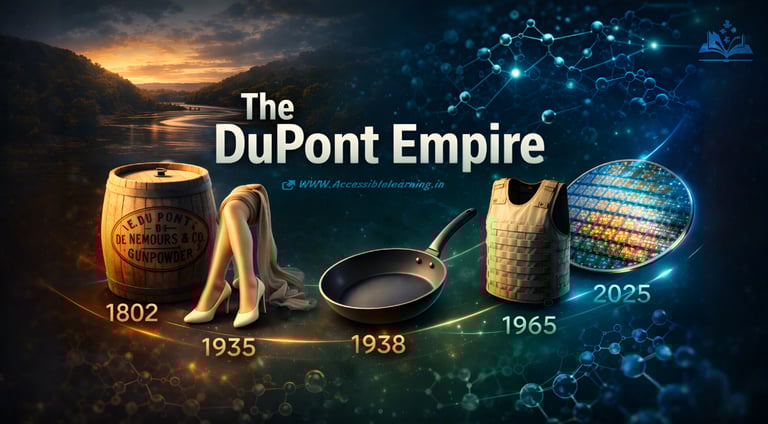
DuPont's Impact on Delaware and American Industry
DuPont is the oldest industrial company on the Fortune 500 list and one of only six Fortune 500 companies with a link to the nation's Founding Fathers. The company purchased its original land from Jacob Broom, a signer of the U.S. Constitution from Delaware.
DuPont shaped Delaware's development, providing employment for generations and funding infrastructure. T. Coleman du Pont designed, built, and paid for The DuPont Highway, U.S. Route 13, which became the transportation backbone in Delaware.
Key Innovations Timeline
1802 - Gunpowder mill founded
1818 - Major explosion kills 34 workers
1912 - Antitrust breakup creates Hercules and Atlas
1931 - Neoprene synthetic rubber introduced
1935 - Nylon invented by Wallace Carothers
1938 - Teflon discovered
1943 - Manhattan Project participation
1965 - Kevlar developed by Stephanie Kwolek
1967 - Nomex flame-resistant fiber
2017 - Merger with Dow creates DowDuPont
2019 - Split into three companies
2025 - Planned Electronics business spinoff
The DuPont Empire represents more than corporate success—it embodies American industrial ambition, scientific innovation, and economic transformation. From a single gunpowder mill built by French refugees to a multinational materials science powerhouse, DuPont's 220-year journey reflects the evolution of American capitalism itself.
Today's DuPont continues adapting to new challenges and opportunities. With strong 2024 financial performance showing 17% adjusted EPS growth and 105% cash conversion, the company demonstrates resilience despite environmental controversies and market pressures.
As DuPont prepares for its 2025 Electronics spinoff and focuses on water, healthcare, and specialty materials, the empire built along the Brandywine River continues shaping our material world—from the clothes we wear to the devices we use, from the water we drink to the vehicles we drive.
The DuPont story reminds us that innovation carries both promises and perils. While Kevlar saves lives and nylon revolutionized fashion, PFAS contamination reminds us of corporate responsibility's weight. As we look toward the future, DuPont's legacy challenges us to pursue innovation that serves humanity while protecting the planet that sustains us all.
Frequently Asked Questions
Q: What is the DuPont Empire known for?
The DuPont Empire is renowned for pioneering chemical innovations, including nylon, Kevlar, Teflon, Nomex, Lycra, and Mylar. Founded as a gunpowder manufacturer in 1802, DuPont transformed American industry through breakthrough materials science that enabled advances in textiles, aerospace, defense, construction, and consumer products.
Q: Who founded DuPont and when?
Éleuthère Irénée du Pont de Nemours founded E.I. du Pont de Nemours and Company in 1802 after fleeing the French Revolution with his family. He established the first gunpowder mill at Eleutherian Mills on the Brandywine River near Wilmington, Delaware.
Q: Is DuPont still a family-owned company?
No, DuPont is no longer family-owned. While the du Pont family controlled the company from 1802 to 1940 and maintained significant influence through the Christiana Securities Company until 1977, today DuPont is a publicly traded corporation (NYSE: DD) with professional management led by CEO Lori Koch.
Q: What are DuPont's most significant inventions?
DuPont's most transformative inventions include:
Nylon (1935) - First synthetic fiber
Kevlar (1965) - Bullet-resistant material five times stronger than steel
Teflon (1938) - Non-stick coating
Nomex - Flame-resistant fiber for firefighters
Neoprene (1931) - Synthetic rubber
Lycra/Spandex - Elastic fibers for clothing
Q: What controversies has DuPont faced?
DuPont has faced significant environmental litigation related to PFAS chemicals, particularly PFOA used in Teflon production. The company agreed to pay $400 million to U.S. water suppliers in 2023 for PFAS contamination. The 2019 film "Dark Waters" dramatized DuPont's environmental legacy in Parkersburg, West Virginia.
Q: What is DuPont's current business focus?
As of 2025, DuPont focuses on specialty industrial solutions across electronics, water filtration, healthcare, industrial technologies, and automotive applications. The company plans to spin off its Electronics business in November 2025, with projected 2025 net sales between $12.8 and $12.9 billion.
Q: How did DuPont contribute to World War II?
DuPont played a critical role in World War II by designing, building, and operating the Hanford plutonium plant in Washington State as part of the Manhattan Project. The company also supplied nylon for parachutes, powder bags, and tires, ranking 15th among U.S. corporations in wartime production contracts.
Q: What happened to the DuPont-Dow merger?
DuPont and Dow Chemical merged in 2017 to form DowDuPont, which then split into three independent companies in 2019: DuPont (specialty products), Dow (materials science), and Corteva (agriculture). This restructuring aimed to create focused companies with distinct market positions.
Q: Where can I visit DuPont historical sites?
Several du Pont family estates and DuPont historical sites are open to the public in Delaware, including Hagley Museum (the original powder mills), Winterthur Museum and Garden, Nemours Estate, Longwood Gardens, and Mt. Cuba Center. These sites preserve over two centuries of American industrial and decorative arts history.
Q: What is DuPont's role in semiconductor technology?
DuPont is a major supplier of advanced materials for semiconductor manufacturing, including photoresists, dielectric materials, and chemical mechanical planarization solutions. The company's Electronics division, planned for separation in November 2025, is experiencing strong growth driven by AI-related semiconductor demand.
Subscribe to Frontier Intelligence
All © Copyright reserved by Accessible-Learning Hub
| Terms & Conditions
Accessible Learning Hub — Actionable clarity for high-agency minds.
Weekly breakdowns on AI breakthroughs, capital flow, and human performance systems. Zero fluff.