

The Digital Wall: How Algorithms Fuel the Frontlines
In the age of algorithms and social media, modern conflicts often begin long before physical battles occur. The idea of the Digital Wall explains how political narratives, algorithm-driven feeds, and online echo chambers shape public perception of enemies and allies. As viral posts, memes, and emotionally charged content spread across platforms, they gradually influence how societies view global conflicts. This article explores how digital narratives, ego-driven echo chambers, and everyday social media interactions can transform online conversations into powerful forces that shape real-world tensions and political decisions.
GLOBAL ISSUESAWARE/VIGILANTNEPOTISM/SOCIAL ISSUES
Shiv Singh Rajput
3/19/20267 min read
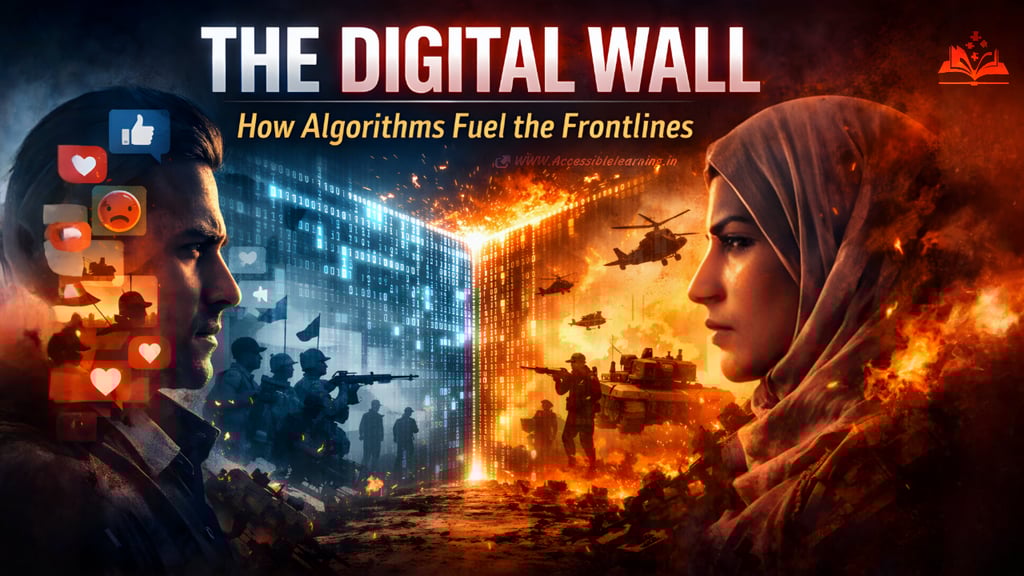
Before tanks move, before missiles launch, and before soldiers step onto a battlefield, something else often happens first. A narrative is built.
In today's connected world, conflicts increasingly begin in the digital space. Social media platforms, algorithm-driven feeds, and viral political messaging shape how millions of people understand global events. Over time, these narratives create what can be called a Digital Wall an invisible psychological barrier that separates people into opposing camps.
Inside this wall, the "other side" slowly stops looking like neighbors or fellow humans. Instead, they become symbols, enemies, or threats.
The digital environment has transformed political communication into a constant stream of emotionally charged content. When that content spreads widely enough, it can influence how societies perceive conflict, justice, and even violence.
Understanding the Digital Wall
The Digital Wall is not built from concrete or steel. It is built from information. It forms when political messaging, algorithmic filtering, and online communities reinforce a single narrative repeatedly. Over time, people begin to see only one version of reality.
Several forces contribute to this wall:
Algorithm-driven content feeds
Viral political posts and memes
Nationalist or ideological messaging
Selective news exposure
Emotional engagement loops
When these elements combine, people begin living in separate informational realities. The same event can appear completely different depending on the narrative inside each digital space. This makes meaningful dialogue increasingly difficult.
Ego-Chambers: When Identity Replaces Dialogue
Echo chambers have existed for decades in media and politics, but modern digital spaces have intensified them. What emerges today is something deeper: Ego-Chambers.
In an Ego-Chamber, information does not just reinforce beliefs. It reinforces identity and pride.
These spaces operate through several emotional triggers.
1. Hero Narratives
Communities are constantly reminded that they represent courage, history, and moral righteousness.
Stories highlight bravery, sacrifice, and cultural greatness. This creates a sense of collective pride that strengthens group identity.
2. Victim Narratives
At the same time, communities are repeatedly told they are under threat. This messaging suggests:
outsiders are attacking their values
global systems are unfair to them
the world misunderstands their struggle
The combination of pride and victimhood creates powerful emotional loyalty.
3. Enemy Construction
Gradually, opposing groups are described using simplified labels. They may be portrayed as:
dangerous
immoral
dishonest
aggressive
Over time, empathy disappears from the conversation. The opposing side becomes a concept rather than a group of people.

Algorithms: The Hidden Editors of Public Opinion
Social media platforms rely heavily on algorithms to decide what users see. These systems analyze behavior patterns and recommend content that will keep people engaged. The goal is attention, not necessarily balance. Because of this design, certain types of content spread more easily:
outrage-driven posts
emotionally intense political messages
strong nationalist rhetoric
conflict-based narratives
simplified explanations of complex issues
Moderate or nuanced discussions rarely generate the same level of engagement. As a result, algorithms often push the most emotionally charged content to the top of people's feeds. This creates a powerful feedback loop.
Emotional content spreads quickly.
Users react strongly to it.
Algorithms detect the engagement.
Similar content is promoted even more.
Over time, entire communities become surrounded by the same emotional messaging.
How Memes and Viral Posts Shape Political Thinking
Modern political messaging is no longer limited to speeches or traditional media. Memes, short videos, viral posts, and trending hashtags now carry enormous influence. These formats are powerful because they are:
simple
shareable
emotionally direct
visually engaging
A complex geopolitical issue may be reduced to a single meme that spreads across millions of screens. The danger lies in oversimplification. Memes rarely contain context or nuance. Instead, they reinforce existing beliefs while strengthening emotional reactions toward opponents. In many cases, people remember the meme long after forgetting the actual facts.
From a “Like” to Real-World Impact
It may seem difficult to believe that a simple online interaction could connect to real-world conflict. Yet digital behavior plays a larger role than most people realize. Consider the chain reaction.
A political message begins circulating online.
Thousands of users react emotionally and share it.
Algorithms amplify the message across networks.
The narrative spreads widely within communities.
Public opinion becomes increasingly unified around the idea.
Leaders gain stronger support for aggressive positions.
What started as online engagement gradually becomes political momentum. In extreme situations, digital narratives can fuel protests, social unrest, or even support for military actions.
Digital Nationalism and the Rise of Online Patriotism
Another factor strengthening the Digital Wall is the rise of digital nationalism. Online platforms allow people to express national pride instantly and publicly.
Posts about national identity often include:
historical achievements
cultural pride
territorial disputes
military strength
While pride in one's country is natural, digital environments sometimes amplify it in ways that frame other nations as rivals or enemies. When millions of people interact with these narratives daily, they become emotionally invested in geopolitical conflicts that they might previously have followed more cautiously.
The Role of Political Strategy
Political leaders and strategists increasingly understand the power of digital narratives. Modern campaigns and communication strategies often include:
targeted messaging on social platforms
coordinated hashtag campaigns
viral video content
influencer amplification
emotionally driven storytelling
Controlling the online narrative can shape how populations interpret international events. When the digital narrative is strong enough, it can guide public opinion long before policy decisions are announced. In this way, social media becomes an early stage of geopolitical strategy.


Information Warfare in the Digital Age
The Digital Wall also intersects with another growing reality: information warfare. States, political groups, and ideological movements sometimes compete not only through diplomacy or economics but also through information influence.
This can include:
propaganda campaigns
coordinated online messaging
narrative manipulation
psychological influence operations
These tactics attempt to shape public perception, both domestically and internationally. The goal is often to win the narrative battle before any physical confrontation occurs.
The Human Perspective
Most people participating in digital conversations are not trying to escalate conflicts. They are simply expressing opinions, supporting their communities, or reacting emotionally to news. A person scrolling through social media in Mumbai, London, New York, or Tehran may share a post because it feels meaningful or patriotic.
But digital systems interpret every interaction as data. A like, share, or comment becomes a signal that encourages the platform to distribute similar content to more users. Millions of these small actions gradually shape the information environment. This is how ordinary users unknowingly participate in the construction of the Digital Wall.
Breaking Through the Digital Wall
Despite its influence, the Digital Wall is not impossible to challenge. Several approaches can help reduce its impact.
Expanding Media Awareness
Understanding how algorithms work allows people to recognize when content is being amplified for emotional impact.
Seeking Diverse Perspectives
Reading sources from different viewpoints helps counterbalance algorithm-driven narratives.
Slowing Down Online Reactions
Taking a moment before sharing emotionally charged content can interrupt the rapid spread of misinformation or hostility.
Encouraging Responsible Platform Design
Technology companies are increasingly exploring ways to reduce harmful amplification while still supporting open conversation.
Promoting Empathy in Digital Spaces
Recognizing that people on the other side of a political debate are still human can shift the tone of online discussions.
In the modern world, conflicts are shaped not only by weapons and diplomacy but also by information systems.
The Digital Wall forms quietly through algorithms, viral messaging, and emotionally charged narratives. Over time, it separates communities into opposing informational worlds where empathy becomes difficult and hostility grows easier.
Understanding how these digital systems influence perception is essential for navigating today's political landscape. Every post, reaction, and share contributes to the information environment. While individuals may not control the entire system, awareness can help reduce the spread of narratives that divide people further.
The frontlines of the future are not only physical. They exist in timelines, feeds, and recommendation engines where stories compete for attention and belief. In many ways, the most important battle today may not be fought with weapons but with the ideas that shape how societies see one another.

FAQ's
Q: What is the “Digital Wall” in modern politics?
The Digital Wall refers to the invisible barrier created by social media algorithms, political narratives, and online communities that separate people into different informational worlds. Inside these digital environments, users mostly see content that reinforces their existing beliefs. Over time, this can shape public opinion, increase polarization, and influence how societies perceive political conflicts.
Q: How do social media algorithms influence political opinions?
Social media algorithms analyze user behavior such as likes, shares, comments, and watch time. Based on this data, they recommend similar content that keeps users engaged. Because emotionally intense or controversial posts often generate more interaction, algorithms may unintentionally amplify political content that provokes strong reactions, which can gradually influence opinions and attitudes.
Q: What is an echo chamber, and how does it affect public discourse?
An echo chamber is an online environment where people are mostly exposed to opinions that match their own beliefs. In these spaces, alternative viewpoints are rarely seen or seriously considered. This can make discussions more polarized and reduce the chances of meaningful dialogue between different groups.
Q: How can online interactions contribute to real-world conflict?
Online engagement may seem small, but when millions of people interact with the same narratives, those ideas gain momentum. Viral political messages can shape public sentiment, strengthen ideological divisions, and influence policy discussions. In some situations, intense online narratives can also encourage protests, hostility, or social tensions offline.
Q: Why do emotional or controversial posts spread faster online?
Content that triggers strong emotions such as anger, fear, pride, or outrage tends to attract more reactions and shares. Algorithms interpret these interactions as signals of relevance, which leads to wider distribution of similar content. This is why emotionally charged political posts often reach larger audiences than balanced or neutral discussions.
Q: What role do memes and viral posts play in political messaging?
Memes and short viral posts simplify complex political issues into easily shareable content. They spread quickly across social networks and can influence how people interpret events. While they can raise awareness, they may also oversimplify complicated situations and reinforce existing biases within online communities.
Q: What is digital nationalism?
Digital nationalism refers to expressions of national pride and identity that spread through online platforms. It often appears in posts about cultural achievements, history, or geopolitical conflicts. While national pride is natural, highly emotional digital nationalism can sometimes intensify rivalries between countries or communities.
Q: How can individuals avoid being trapped in algorithm-driven echo chambers?
People can reduce the effects of echo chambers by following diverse sources, reading perspectives from different regions or political views, and critically evaluating viral content before sharing it. Being aware of how algorithms personalize content is an important step in developing a more balanced understanding of global events.
Q: Why is media literacy important in the age of social media algorithms?
Media literacy helps individuals understand how digital platforms organize information and influence attention. By recognizing how algorithms prioritize certain types of content, people can make more informed decisions about what they read, believe, and share online.
Q: How might the future of political conflict be shaped by digital platforms?
As technology continues to evolve, digital platforms will likely play an even larger role in shaping public narratives and global discussions. Governments, organizations, and individuals increasingly use online spaces to influence opinion, mobilize communities, and communicate political messages. Understanding these dynamics will remain essential in navigating the relationship between digital communication and global stability.
Subscribe to Frontier Intelligence
All © Copyright reserved by Accessible-Learning Hub
| Terms & Conditions
Accessible Learning Hub — Actionable clarity for high-agency minds.
Weekly breakdowns on AI breakthroughs, capital flow, and human performance systems. Zero fluff.