

The "Deep Synthesis" Researcher: Automating the Knowledge Grind
The Deep Synthesis Researcher is transforming knowledge work by using AI to analyze documents, uncover insights, automate data analysis, and generate interactive reports. Explore how Gemini Deep Research, Pandas AI, and AutogenAI are changing research workflows.
DIGITAL MARKETINGENTREPRENEUR/BUSINESSMANAI/FUTURECOMPANY/INDUSTRY
Sachin K Chaurasiya
6/19/20266 min read
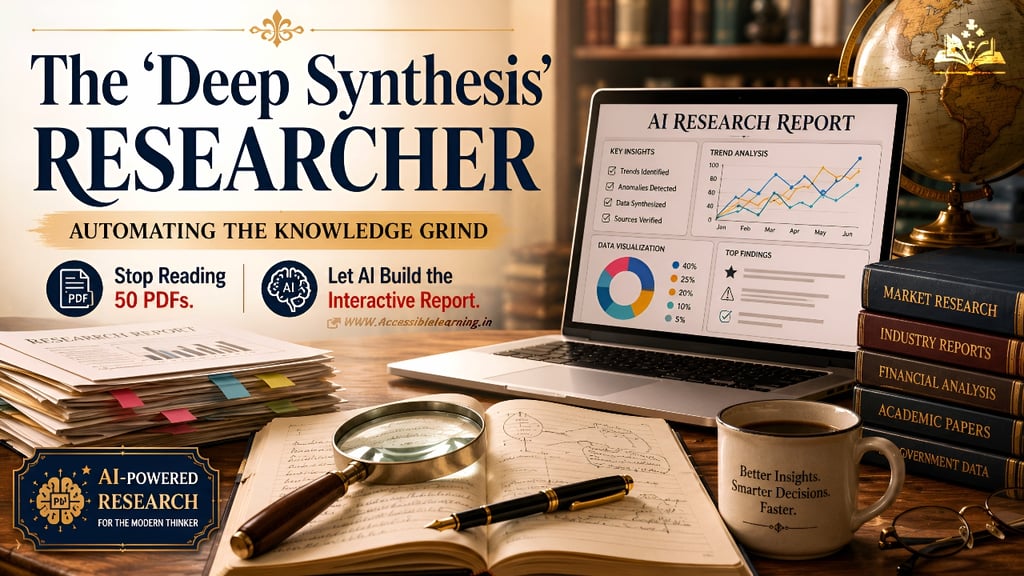
Stop Reading 50 PDFs. Let AI Build the Interactive Report.
For decades, serious research followed a predictable pattern.
Open dozens of browser tabs.
Download countless PDFs.
Highlight important sections.
Copy statistics into spreadsheets.
Cross-reference conflicting sources.
Spend days creating charts.
Then spend even more time turning all of that work into something stakeholders can actually understand. The process was exhausting, repetitive, and painfully inefficient.
The uncomfortable truth is that most researchers do not spend their time discovering insights. They spend their time searching for them.
That distinction matters.
In academia, consulting, market intelligence, policy analysis, competitive research, and corporate strategy, the real bottleneck is no longer access to information. The bottleneck is synthesis.
The internet has already solved the information problem.
Artificial intelligence is now solving the synthesis problem.
A new category of AI systems is emerging that can read hundreds of documents, identify patterns, compare conflicting viewpoints, detect anomalies, perform statistical analysis, generate visualizations, and compile interactive reports with minimal human intervention.
This is the rise of the Deep Synthesis Researcher.
And it is changing the economics of knowledge work.
The End of Manual Research
Research traditionally operates on a flawed assumption:
The more information you collect, the better your conclusions will be.
In practice, information overload creates the opposite effect.
When researchers face hundreds of reports, whitepapers, datasets, studies, transcripts, and industry publications, several problems emerge:
Critical findings get buried.
Contradictory evidence gets overlooked.
Valuable data remains unused.
Analysis becomes slow and expensive.
Human bias influences interpretation.
The modern researcher is often trapped in an endless cycle of reading rather than thinking.
Many professionals spend 70% of their research time collecting and organizing information and only 30% interpreting it. That ratio is backwards.
The future researcher delegates collection, categorization, and preliminary analysis to AI systems while focusing on judgment, strategy, and decision-making.
What Is a Deep Synthesis Researcher?
A Deep Synthesis Researcher is not a single AI tool. It is an AI-powered workflow that combines:
Large-scale document analysis
Automated source verification
Data extraction
Pattern recognition
Statistical analysis
Visualization generation
Narrative report creation
Instead of acting like a search engine, the system behaves more like an experienced research team.
Imagine giving an AI agent:
200 industry reports
75 academic papers
30 government publications
15 competitor filings
Internal company documentation
Then asking:
"Identify emerging trends, conflicting viewpoints, market opportunities, and statistical anomalies and produce a fully sourced executive report."
That is the job description of the Deep Synthesis Researcher.
Why Traditional Search Is No Longer Enough
Search engines answer questions. Researchers need answers to problems. There is a major difference.
A search engine might show the following:
One article
One statistic
One opinion
A synthesis engine attempts to answer the following:
What does the entire body of evidence suggest?
Which sources disagree?
Which conclusions are strongest?
What trends appear repeatedly?
What risks are hidden beneath the data?
The value is no longer in finding information. The value is in discovering meaning.

Gemini Deep Research: Google's Research Powerhouse
Among the newest generation of AI research systems, Gemini Deep Research stands out because it was designed specifically for large-scale knowledge synthesis. Instead of responding to a single prompt, it creates a multi-step research plan and executes it autonomously. The workflow resembles a professional analyst.
It can:
Break down complex research questions
Gather information from multiple sources
Cross-reference findings
Evaluate source quality
Build comprehensive reports
Create structured summaries
Present fully cited conclusions
The biggest advantage is scale.
A human researcher may struggle to review dozens of sources in a day.
Gemini Deep Research can process enormous quantities of information and return a structured report within hours.
For consultants, academics, market researchers, and policy analysts, this changes the speed at which insight can be generated.
Instead of manually assembling information, researchers can focus on validating conclusions and making decisions.
Pandas AI: Turning Data Analysis into a Conversation
Data analysis traditionally requires specialized skills. Analysts often spend years learning:
Python
SQL
Data visualization
Statistical modeling
Spreadsheet automation
Pandas AI changes the interaction model entirely. Instead of writing code, users communicate with datasets using natural language.
For example:
"Show revenue growth trends over the last five years."
"Identify unusual spending patterns."
"Compare customer retention across regions."
"Generate a forecast model for next quarter."
The system performs the analysis and returns results automatically. This creates a significant productivity advantage. Researchers no longer need to spend hours writing scripts for routine investigations.
The AI handles the mechanics while humans focus on interpretation.
The result is faster analysis, quicker experimentation, and more accessible data science.
AutogenAI: Institutional Knowledge at Scale
One of the most overlooked challenges in research-heavy organizations is knowledge fragmentation. Critical information often exists across the following:
Internal reports
Policy documents
Compliance records
Technical documentation
Previous proposals
Departmental archives
Finding and assembling these materials manually is a major source of inefficiency. AutogenAI approaches this challenge differently. Instead of acting as a research assistant, it functions as an institutional knowledge engine.
The platform ingests organizational information and uses it to generate highly detailed business proposals, government submissions, grant applications, and RFP responses.
The implications are substantial. Organizations frequently spend hundreds of hours creating large proposals.
AutogenAI reduces much of this workload by the following:
Retrieving relevant information
Matching compliance requirements
Structuring responses
Generating detailed drafts
The result is faster proposal generation and more consistent use of organizational knowledge.
The New Research Stack
The most productive researchers are no longer relying on a single AI platform. They are building interconnected research systems.
A modern workflow may look like this:
Step 1: Discovery
Gemini Deep Research scans hundreds of documents and identifies important themes.
Step 2: Extraction
Key statistics, findings, and datasets are collected automatically.
Step 3: Analysis
Pandas AI examines quantitative information and uncovers patterns.
Step 4: Synthesis
Insights are consolidated into structured reports.
Step 5: Application
AutogenAI transforms findings into proposals, recommendations, and strategic documents.
This workflow creates something powerful:
A self-reinforcing knowledge engine.

The Hidden Competitive Advantage
Most organizations believe AI creates value through automation. That is only partially true. The greatest value comes from acceleration of insight.
When a company can understand:
Markets faster
Competitors faster
Risks faster
Customers faster
Emerging technologies faster
It gains a strategic advantage.
Research speed becomes decision speed.
Decision speed becomes a competitive advantage.
This is where Deep Synthesis Research creates its greatest impact.
What AI Still Cannot Do
Despite impressive capabilities, AI research systems remain imperfect. They cannot reliably replace:
Critical thinking
Expert judgment
Domain expertise
Ethical reasoning
Strategic decision-making
AI can identify patterns.
Humans determine significance.
AI can summarize evidence.
Humans decide what matters.
Organizations that blindly trust AI-generated conclusions will make expensive mistakes. The winning model is augmentation, not replacement. The best researchers use AI to remove the mechanical work while retaining control over interpretation.
The Future: Interactive Knowledge Systems
The next evolution is already becoming visible. Research outputs are moving beyond static reports. Instead of receiving a PDF, stakeholders will receive interactive knowledge environments where they can:
Ask follow-up questions
Explore source material
Generate new charts instantly
Test assumptions
Drill into evidence
Create customized views
The report becomes a living system.
Knowledge becomes dynamic.
Research becomes conversational.
This fundamentally changes how organizations consume information.
The era of manually reading fifty PDFs to find a single insight is ending.
Knowledge work is entering a new phase where AI systems can collect information, analyze data, generate visualizations, identify anomalies, and assemble comprehensive reports with unprecedented speed.
Tools such as Gemini Deep Research, Pandas AI, and AutogenAI are not simply productivity enhancements.
They represent a shift in how research itself is performed.
The professionals who thrive in the coming decade will not be the ones who can read the most documents.
They will be the ones who can direct intelligent systems to discover, validate, and synthesize knowledge at scale.
The future researcher is not a faster reader.
The future researcher is an orchestrator of intelligence.

FAQ's
Q: What is a Deep Synthesis Researcher?
A Deep Synthesis Researcher is an AI-powered research workflow that can analyze large volumes of documents, datasets, reports, and sources; then automatically extract insights, identify patterns, generate visualizations, and create comprehensive research reports. It focuses on knowledge synthesis rather than simple information retrieval.
Q: How does AI-powered research differ from traditional research methods?
Traditional research requires manually reviewing documents, collecting data, and building reports. AI-powered research automates these tasks by reading multiple sources simultaneously, detecting trends, highlighting anomalies, and generating structured reports, allowing researchers to focus on analysis and decision-making.
Q: What is Gemini Deep Research, and how does it help researchers?
Gemini Deep Research is Google's advanced AI research tool designed to handle complex research projects. It can gather information from numerous sources, evaluate evidence, organize findings, and generate fully sourced reports, significantly reducing the time required for large-scale research tasks.
Q: Can AI analyze spreadsheets and datasets without coding?
Yes. Tools like Pandas AI allow users to interact with spreadsheets and datasets using natural language. Instead of writing Python or SQL queries, users can ask questions such as "Show sales trends" or "Identify unusual patterns," and the AI performs the analysis automatically.
Q: What industries benefit most from Deep Synthesis AI workflows?
Deep Synthesis AI is particularly valuable for:
Academic research
Market intelligence
Business consulting
Financial analysis
Healthcare research
Government policy analysis
Legal and compliance teams
Enterprise knowledge management
Q: How does AutogenAI improve proposal and RFP writing?
AutogenAI uses organizational knowledge, historical documents, and compliance requirements to generate detailed business proposals, grant applications, and RFP responses. It helps organizations reduce manual writing effort while improving consistency and accuracy.
Q: Can AI replace human researchers?
No. AI can automate information gathering, data analysis, and report generation, but human expertise remains essential for critical thinking, strategic judgment, fact verification, and interpreting complex findings. The most effective approach combines AI efficiency with human oversight.
Q: What are the main benefits of using AI for research?
Key benefits include the following:
Faster information processing
Reduced manual workload
Improved data analysis
Automated report generation
Better pattern recognition
Enhanced decision-making
Increased research scalability
Q: What is an interactive AI-generated research report?
An interactive research report allows users to explore data, review sources, generate custom charts, ask follow-up questions, and investigate findings dynamically instead of relying on a static PDF document.
Q: What is the future of AI-driven knowledge work?
The future of knowledge work involves AI systems acting as research assistants, analysts, and synthesis engines. These systems will automate repetitive research tasks, enabling professionals to focus on strategy, innovation, and high-value decision-making while accessing insights faster than ever before.
Subscribe To Our Newsletter
All © Copyright reserved by Accessible-Learning Hub
| Terms & Conditions
Knowledge is power. Learn with Us. 📚

