

The Death of the Semester: Nanolearning and Stackable Credentials!
The traditional semester-based education model is losing relevance in a fast-moving, AI-driven economy. Discover how nanolearning, stackable credentials, and skills-first hiring are transforming education, career development, and the future of professional success in 2026 and beyond.
EDUCATION/KNOWLEDGE
Sachin K Chaurasiya | Shiv Singh Rajput
6/14/20266 min read
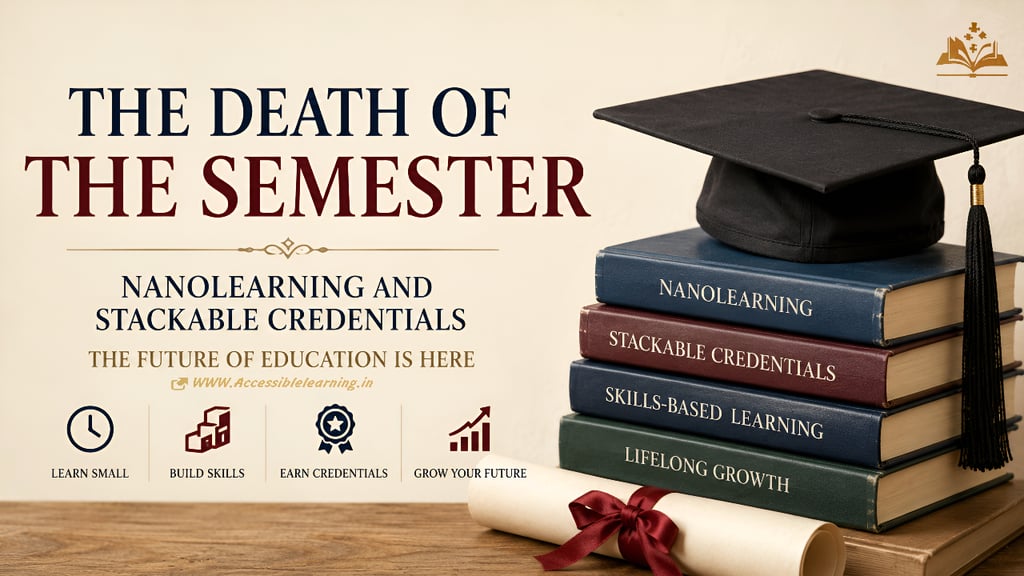
Why a 6-Week Digital Badge Might Be Worth More Than a 4-Year Diploma
For more than a century, education followed a simple formula:
Spend four years in a university.
Attend classes on a fixed schedule.
Pass exams.
Graduate with a degree.
Enter the workforce.
That model worked when industries evolved slowly. It does not work in 2026.
Technology changes faster than most universities can update a syllabus. New AI tools emerge every month. Entire job categories appear and disappear within a few years. Skills that were valuable in January can become automated by December.
Meanwhile, students are still being asked to commit four years, enormous tuition fees, and significant opportunity costs before they can even begin applying what they've learned.
The result is a growing disconnect between education and employment.
The semester is no longer the unit of learning.
The future belongs to nanolearning and stackable credentials.
And in many industries, a verified six-week badge is already creating more opportunities than a four-year diploma.
The Traditional Degree Has a Speed Problem
The biggest weakness of the university model is not quality. It is speed.
Most degree programs are designed around academic calendars that change slowly. Curriculum approvals can take months or years. By the time a course reaches students, portions of the material may already be outdated.
Consider fields like the following:
Artificial Intelligence
Prompt Engineering
Cybersecurity
Cloud Computing
Data Analytics
Digital Marketing
Automation Systems
Extended Reality (XR)
These industries evolve continuously. Employers increasingly need workers who can solve current problems, not simply demonstrate knowledge acquired years ago.
This creates a dangerous gap.
A graduate may possess a respected degree while lacking the exact skills employers currently need.
The labor market has noticed.
Skills-First Hiring Is Reshaping Recruitment
One of the biggest workforce shifts of the decade is the rise of skills-first hiring. Employers are becoming less interested in educational pedigree and more interested in proven capability.
The question is changing from:
"Where did you study?"
to:
"What can you actually do?"
A candidate who can demonstrate:
AI workflow design
Automation building
Data visualization
Cybersecurity auditing
Cloud deployment
Video production
UX design
often becomes more attractive than someone holding a general degree without practical evidence.
This is why recruiters increasingly value the following:
Industry certifications
Professional badges
Portfolio projects
Verified assessments
Skills demonstrations
Work simulations
Employers are reducing risk. A badge that proves competency today may provide more hiring confidence than a diploma earned years ago.
What Is Nanolearning?
Nanolearning is exactly what it sounds like.
Learning delivered in extremely small, focused sessions.
Instead of attending a 90-minute lecture, learners consume content in short bursts, often lasting:
5 minutes
10 minutes
15 minutes
Each lesson targets one specific skill or concept. Examples include:
Writing better AI prompts
Configuring a cloud server
Using a spreadsheet formula
Understanding phishing attacks
Building a marketing funnel
Creating a data dashboard
The objective is simple:
Learn one thing.
Apply it immediately.
Move on.
This approach matches how modern professionals actually learn. Most people do not have three uninterrupted hours every day. But almost everyone can find ten minutes.

Why Nanolearning Works Better for Adults
Traditional education was designed for students. Nanolearning is designed for working professionals. Adults learn differently because they need the following:
Immediate relevance
Practical application
Flexible scheduling
Faster outcomes
A software developer does not need an entire semester on machine learning theory.
They may need a 12-minute lesson explaining a new AI framework released last week.
A marketer may not need a year-long program.
They may need a 10-minute update about changes to search algorithms.
Nanolearning removes unnecessary friction.
Instead of consuming information "just in case," learners acquire knowledge precisely when needed.
This dramatically improves retention and application.
The Rise of Stackable Credentials
Nanolearning alone is not enough.
Employers still need proof.
This is where stackable credentials enter the picture.
A stackable credential is a verified certification earned through smaller learning experiences.
Think of it as educational building blocks.
One badge proves competency in a specific skill.
Multiple badges combine into larger qualifications.
For example:
AI Specialist Path
Prompt Engineering Badge
AI Workflow Design Badge
Automation Badge
AI Ethics Badge
Model Evaluation Badge
Together these create a highly specialized professional profile.
The same concept applies to:
Cybersecurity
Marketing
Software Development
Healthcare
Project Management
Data Science
Rather than earning one giant credential every four years, professionals continuously assemble skills throughout their careers.
The Continuous Learning Chain
The most successful professionals of the next decade will not be those who learn once.
They will be those who never stop learning.
This creates what can be called a Continuous Learning Chain.
Imagine this process:
Daily
10-minute nanolearning lesson.
Weekly
One practical exercise.
Monthly
One verified assessment.
Quarterly
One new badge or credential.
Annually
A significantly expanded professional portfolio.
After five years, the result is extraordinary.
Instead of possessing a static degree earned years ago, professionals accumulate hundreds of validated learning experiences aligned with current industry needs.
The learning never ends. But neither does the career growth.
Why Employers Love Stackable Credentials
Companies face a hiring challenge.
Resumes are full of claims.
Credentials provide evidence.
A stackable certification system allows employers to verify the following:
What a candidate knows
When they learned it
Whether skills are current
How competencies connect together
This matters because modern workplaces evolve rapidly. A cybersecurity certificate earned six months ago may carry more practical relevance than coursework completed six years earlier.
Employers increasingly prefer signals that are:
Recent
Verifiable
Specific
Demonstrable
Stackable credentials satisfy all four requirements.
The Economics Are Impossible to Ignore
Traditional degrees are expensive. Students often spend:
Four years learning
Thousands of hours in classrooms
Significant tuition costs
Additional living expenses
Many graduate carrying debt. Nanolearning dramatically changes the equation. Instead of paying for a broad educational package, learners purchase only the skills they need.
The benefits include:
Lower costs
Faster completion
Immediate application
Reduced career interruption
Professionals can continue working while learning. That alone changes the return on investment.

The Portfolio Replaces the Transcript
A transcript tells employers what courses someone completed. A portfolio shows what someone can actually do. The modern workforce increasingly values proof over promises.
Future portfolios may include:
Digital badges
Verified credentials
Project repositories
AI-generated assessments
Practical demonstrations
Peer-reviewed work
Employers can evaluate competence directly. The need to infer skill from a degree becomes less important. This shift is fundamental. The portfolio is becoming the new diploma.
What Universities Must Do to Survive
Universities are not disappearing. But they must adapt. Institutions that survive will likely:
Offer modular programs
Provide stackable certifications
Create industry partnerships
Deliver flexible learning schedules
Integrate AI-driven education
Support lifelong learning models
Instead of selling education once, they will support learners continuously. The future university may function more like a learning subscription than a one-time educational experience.
The Risks Nobody Talks About
Nanolearning is powerful, but it is not perfect. There are legitimate concerns.
Fragmented Knowledge
Micro-lessons can create isolated skills without deeper understanding.
Credential Inflation
Too many badges may reduce credibility.
Quality Control
Not all certifications maintain rigorous standards.
Missing Foundational Thinking
Complex disciplines often require broader frameworks and theoretical understanding.
The solution is balance.
The future is not learning less.
The future is learning differently.
The Future: Education as a Living System
The most important shift is philosophical. Education is moving from an event to a process.
For generations, society treated learning as something completed early in life.
That assumption is collapsing. Knowledge now evolves too quickly.
The professionals who thrive in the coming decade will not be those with the most impressive degrees.
They will be those with the strongest learning systems. They will learn continuously.
Adapt constantly. Earn credentials regularly. Update skills relentlessly.
And they will do it without disappearing into a classroom for four years.

The semester was designed for an industrial-age world where knowledge changed slowly and careers remained predictable. That world no longer exists. The modern economy rewards adaptability, speed, and demonstrated capability.
Nanolearning and stackable credentials are not simply educational trends. They represent a structural shift in how expertise is built, verified, and rewarded. The question is no longer whether continuous learning will replace traditional educational pathways.
The question is how quickly employers, universities, and professionals will accept that the future belongs to learning systems measured in days and weeks, not semesters and years.
In the age of AI, the most valuable credential may not be a degree hanging on a wall. It may be a living portfolio that proves what you learned this month.
FAQ's
Q: What is nanolearning?
Nanolearning is a learning approach that delivers educational content in short, focused lessons, typically lasting 5 to 15 minutes. It helps learners acquire specific skills quickly and apply them immediately in real-world situations.
Q: What are stackable credentials?
Stackable credentials are certifications, badges, or micro-credentials that can be accumulated over time to demonstrate expertise in a specific field. Multiple credentials can be combined to build a comprehensive professional skill profile.
Q: Why are employers valuing skills-based credentials over traditional degrees?
Many employers now prioritize demonstrated skills and verified competencies because they provide direct evidence of a candidate's abilities. Skills-based credentials often reflect current industry requirements more accurately than older degree programs.
Q: Can micro-credentials replace a four-year degree?
In some industries, especially technology, digital marketing, cybersecurity, and AI-related fields, micro-credentials can provide a faster and more relevant pathway to employment. However, certain professions such as medicine, law, and engineering still require formal degree qualifications.
Q: What is a continuous learning chain?
A continuous learning chain is an ongoing process of acquiring new skills through regular nanolearning modules, certifications, and practical projects. It enables professionals to keep their knowledge current and adapt to changing industry demands.
Q: How do stackable credentials improve career growth?
Stackable credentials allow professionals to continuously expand their expertise, showcase specialized skills, and create a verifiable learning record. This can improve employability, promotion opportunities, and career flexibility.
Q: Are digital badges recognized by employers?
Yes. Many employers recognize digital badges issued by reputable organizations, technology companies, universities, and professional certification providers. Recognition is highest when the badge verifies practical and industry-relevant skills.
Q: What are the benefits of nanolearning compared to traditional education?
Nanolearning offers greater flexibility, lower costs, faster skill acquisition, better knowledge retention, and the ability to learn while working. It is particularly effective for professionals who need to keep pace with rapidly changing industries.
Q: Which industries benefit most from stackable credentials?
Industries experiencing rapid technological change benefit the most, including:
Artificial Intelligence (AI)
Data Analytics
Cybersecurity
Cloud Computing
Digital Marketing
Software Development
UX/UI Design
Project Management
Q: Is lifelong learning becoming essential in the AI era?
Yes. As AI continues to automate routine tasks and reshape job requirements, continuous learning is becoming a critical career strategy. Professionals who regularly update their skills are more likely to remain competitive and adaptable in the modern workforce.
Subscribe To Our Newsletter
All © Copyright reserved by Accessible-Learning Hub
| Terms & Conditions
Knowledge is power. Learn with Us. 📚

