

The Death of the “9-to-5” and the Rise of the Agentic Solopreneur
The traditional 9-to-5 job is slowly losing its dominance as technology reshapes the way people work. With the rise of AI tools, automation, and digital platforms, a new kind of professional is emerging: the agentic solopreneur. These individuals combine human creativity with intelligent AI agents to run lean, scalable businesses without large teams. This article explores why the classic work model is fading, how AI-powered entrepreneurship is growing, and what skills are needed to thrive in the new era of independent digital work.
A LEARNINGAI/FUTURECOMPANY/INDUSTRY
Vishwajeet Chaurasiya
3/13/20266 min read
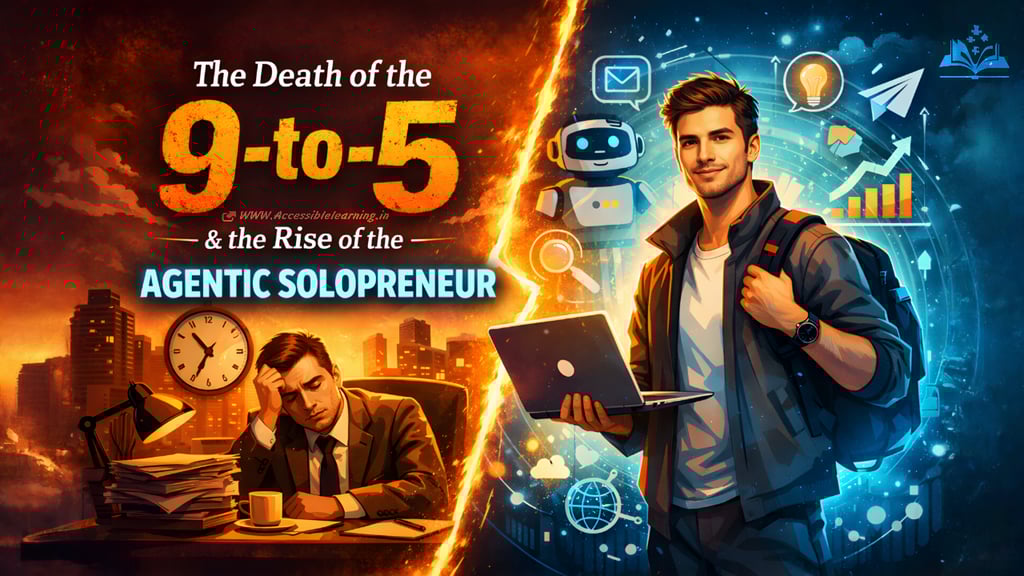

For more than a century, the 9-to-5 job represented stability. People worked fixed hours, received predictable salaries, and built careers within a single organization. That model shaped modern economies and defined what “a job” meant. But the nature of work is undergoing a major transformation.
Advances in AI, automation, remote collaboration, and digital platforms are creating new opportunities for individuals to operate independently. Instead of working inside large organizations, many professionals are building AI-powered micro-businesses.
This shift is giving rise to the agentic solopreneur: a person who uses AI tools, automation systems, and digital platforms to run scalable businesses without traditional teams. The result is a world where one person can manage operations that previously required an entire company department.
Why the Traditional 9-to-5 Model Is Fading
The decline of the traditional work model is not caused by one single factor. It is the result of several technological and cultural shifts happening at the same time.
The Digital Economy Changed How Work Happens
Most knowledge work today is digital. Tasks like writing, designing, coding, marketing, and consulting can all be done online. Because of this, work is no longer tied to a specific location or time schedule. Companies now hire talent globally, and workers can collaborate from anywhere. This flexibility makes the rigid 9-to-5 structure less relevant.
The Rise of the Creator and Knowledge Economy
Many professionals now earn money through content creation, consulting, online education, and digital products. Platforms allow individuals to monetize knowledge, creativity, and niche expertise. People can build audiences and sell services or products directly to customers without traditional gatekeepers. This trend has created millions of independent digital businesses run by individuals or small teams.
Automation Is Replacing Repetitive Work
Technology has always replaced repetitive tasks. AI is accelerating that process. Many administrative, research, and support tasks can now be handled automatically. This changes how organizations structure their workforce. Instead of hiring large teams for repetitive tasks, companies increasingly rely on software systems and automation.
Workers Are Seeking Flexibility and Autonomy
Another major factor is cultural.Many professionals no longer see lifelong employment at one company as the ideal career path. People want:
flexibility in schedules
control over projects
the ability to work from anywhere
multiple income streams
The traditional corporate path often limits these freedoms.
Understanding the Agentic Solopreneur
The term "agentic solopreneur" describes a new kind of entrepreneur who operates independently while using AI agents to automate and scale operations. In simple terms, it means one person running a business with the help of intelligent software systems.
These AI agents can perform tasks such as:
market research
writing and editing content
generating marketing campaigns
analyzing business data
organizing workflows
managing customer interactions
Instead of hiring employees for every function, the solopreneur coordinates a network of digital tools. This approach dramatically increases productivity.

The Key Technologies Powering the Solopreneur Revolution
The rise of agentic entrepreneurship is supported by several technological developments.
Artificial Intelligence Assistants
AI systems can assist with writing, coding, research, analysis, and creative tasks. These tools help individuals complete complex work much faster.
Instead of starting from scratch, professionals can use AI to generate drafts, explore ideas, and automate repetitive steps.
Automation Platforms
Automation tools connect multiple apps together and allow tasks to run automatically. For example:
customer data can move automatically into email systems
marketing campaigns can trigger based on user actions
reports can be generated automatically
This reduces the need for manual administrative work.
No-Code and Low-Code Development
In the past, building digital products required advanced programming knowledge.
Today, no-code platforms allow entrepreneurs to build websites, applications, and workflows without writing complex code.
This means individuals can launch software products and digital tools much faster.
Cloud Infrastructure
Cloud computing allows businesses to operate without owning expensive hardware.
Entrepreneurs can access powerful computing resources, databases, and storage through online platforms.
This infrastructure makes it possible for small businesses to operate globally.
The New Business Models of the Agentic Solopreneur
Agentic solopreneurs often operate through flexible and scalable business models. Some of the most common include:
Digital Products
These include:
online courses
eBooks
templates
design assets
software tools
Digital products can be sold repeatedly without additional production costs.
Subscription Businesses
Membership communities, newsletters, and subscription services create recurring revenue.
These models provide stability compared to one-time sales.
Consulting and Advisory Services
Professionals with specialized expertise often offer consulting services.
AI tools can help them prepare research, presentations, and reports faster.
Content-Driven Businesses
Many solopreneurs build audiences through blogs, videos, podcasts, or newsletters.
These audiences can later be monetized through sponsorships, products, or services.
AI-Powered Micro-Startups
Some entrepreneurs build small software tools or AI services that solve specific problems.
Because development tools are more accessible, individuals can launch these projects with minimal teams.
How AI Agents Function as Digital Team Members
AI agents can be thought of as virtual coworkers that assist with specific tasks. Each agent may specialize in a different function. For example:
Research Agents
These tools gather information, summarize reports, and identify trends.
They help entrepreneurs make informed decisions quickly.
Content Agents
These systems help produce blog posts, marketing copy, email campaigns, and product descriptions.
They dramatically reduce content creation time.
Development Agents
AI coding tools assist with writing and debugging software, making development faster even for small teams.
Marketing Agents
Marketing automation tools help manage campaigns, analyze performance, and optimize advertising.
Customer Support Agents
AI chat systems handle basic customer questions, manage support tickets, and provide assistance around the clock.
Together, these agents function like a small digital workforce managed by a single person.
Advantages of the Agentic Solopreneur Model
This new work model offers several clear benefits.
Greater Independence
Solopreneurs control their schedules, projects, and direction of work.
They are not limited by corporate hierarchies or rigid job structures.
Higher Potential Leverage
Because AI tools increase productivity, individuals can operate at a much larger scale.
One person can manage operations that previously required entire teams.
Faster Innovation
Independent creators can test new ideas quickly.
If something doesn’t work, they can pivot without navigating layers of management.
Global Market Access
Digital platforms allow solopreneurs to sell products and services to customers worldwide.
Geographic limitations are far less important in the digital economy.

Challenges Facing Agentic Solopreneurs
Despite the opportunities, this path also comes with challenges.
Income Volatility
Unlike salaried jobs, independent work can fluctuate. Solopreneurs must plan financially and maintain multiple income streams.
Overreliance on Technology
Heavy reliance on AI tools means technical issues or platform changes can disrupt workflows.
Skill Overload
Running a business alone requires knowledge across many areas, such as marketing, finance, and strategy.
Learning these skills takes time.
Market Competition
As digital tools become more accessible, more people enter the market. Differentiation becomes critical.
How the Workforce May Evolve
The future of work will likely combine traditional employment with independent digital entrepreneurship. Some professionals will still prefer stable roles within organizations. Others will build independent businesses powered by AI tools.
We may see the rise of hybrid careers, where people maintain part-time employment while running their own projects on the side. Organizations themselves may also become smaller and more flexible, relying on networks of independent specialists rather than large permanent teams.
The decline of the traditional 9-to-5 job does not mean work is disappearing. Instead, work is becoming more flexible, decentralized, and technology-driven. The rise of the agentic solopreneur reflects a deeper shift in how people create value in the modern economy.
With the help of AI tools and digital platforms, individuals can now build businesses, reach global audiences, and scale ideas without needing large organizations behind them. The future of work may not belong solely to corporations or employees. It may belong to individuals who learn how to combine human creativity with intelligent machines.
FAQ's
Q: What is an agentic solopreneur?
An agentic solopreneur is an independent professional who runs a business using AI agents, automation tools, and digital platforms. Instead of hiring large teams, they rely on intelligent software systems to handle tasks such as research, marketing, content creation, and customer support.
Q: Why is the traditional 9-to-5 job model declining?
The traditional work model is fading due to several factors, including remote work, digital platforms, the gig economy, and advancements in AI automation. These changes allow individuals to work independently, manage multiple income streams, and build businesses without needing large organizations.
Q: How do AI agents help solopreneurs run businesses?
AI agents can perform repetitive and time-consuming tasks such as data analysis, content writing, scheduling, marketing automation, and customer support. This allows solopreneurs to focus on strategy, creativity, and decision-making while automation handles routine work.
Q: Can one person really run a scalable business using AI tools?
Yes, many entrepreneurs are already doing this. With the help of AI tools, automation platforms, and cloud software, a single person can manage operations that previously required multiple employees. AI significantly increases productivity and efficiency.
Q: What skills are important for becoming an agentic solopreneur?
Key skills include AI workflow design, prompt writing, digital marketing, content creation, strategic thinking, and understanding online platforms. Learning how to combine AI tools with human creativity is essential.
Q: Is the agentic solopreneur model suitable for everyone?
Not necessarily. Some people prefer the stability and structure of traditional jobs. The solopreneur path requires self-discipline, adaptability, and the ability to manage uncertainty and fluctuating income.
Q: What types of businesses can agentic solopreneurs build?
Agentic solopreneurs often build businesses around digital products, consulting services, online education, content creation, SaaS tools, newsletters, and niche marketplaces. Many of these models are scalable and can reach global audiences.
Q: Will AI replace traditional jobs completely?
AI is more likely to change how work is done rather than eliminate all jobs. Many roles will evolve, with humans focusing on creative thinking, strategy, and decision-making while AI handles repetitive tasks.
Q: What are the biggest challenges of becoming a solopreneur?
Common challenges include income unpredictability, increased competition, managing multiple responsibilities alone, and staying updated with fast-changing technology.
Q: What does the future of work look like with AI and solopreneurs?
The future of work will likely combine traditional employment with independent digital entrepreneurship. Many professionals may work alongside AI tools, managing intelligent systems while focusing on innovation and human-centered work.
Subscribe To Our Newsletter
All © Copyright reserved by Accessible-Learning Hub
| Terms & Conditions
Knowledge is power. Learn with Us. 📚

