

The Danish-Norwegian Empire: A Comprehensive Guide to Scandinavia's Maritime Powerhouse
Discover the Danish-Norwegian Empire (1524-1814): a 290-year maritime union that shaped Scandinavia. Explore its rise, territories, conflicts, and lasting legacy.
EMPIRES/HISTORYHISTORY
Kim Shin
2/14/20268 min read
What Was the Danish-Norwegian Empire?
The Danish-Norwegian Empire represents one of Europe's most enduring political unions, spanning from 1524 to 1814. This composite monarchy unified Denmark and Norway under a single crown, creating a formidable maritime power that controlled strategic Arctic and North Atlantic territories while shaping Northern European politics for nearly three centuries.
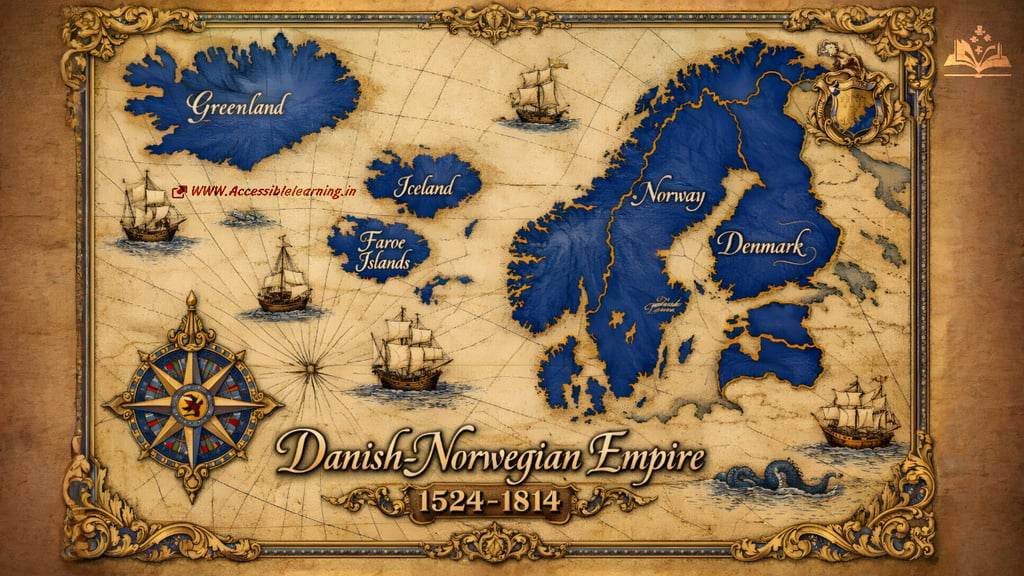
Unlike typical colonial empires, this union functioned as a twin kingdom where Norway maintained its own legal system, social structures, and regional governance, though political power increasingly centralized in Copenhagen. At its zenith, the realm encompassed modern-day Denmark, Norway, Iceland, Greenland, the Faroe Islands, and former territories, including the Duchy of Schleswig, the Duchy of Holstein, and colonial possessions in the Caribbean, West Africa, and India.
Historical Formation and Evolution
Origins: The Kalmar Union to Union of Denmark-Norway
The Danish-Norwegian partnership originated from the Kalmar Union (1397-1523), which united Denmark, Norway, and Sweden under Danish monarchs. When Sweden achieved independence in 1523 under Gustav Vasa, Denmark and Norway formalized their continued alliance.
The Union of Denmark-Norway officially began in 1524, though historians often reference 1536 as a pivotal year when Norway's status changed following the Protestant Reformation. Christian III of Denmark implemented Lutheranism as the state religion, simultaneously restructuring Norway's administrative relationship with Denmark. Norway's Council of the Realm was dissolved, and the country became more tightly integrated into Danish administration.
The Twin Kingdoms Period (1536-1814)
Despite constitutional changes, Norway retained distinct characteristics:
Separate legal codes based on Norwegian customary law
Regional governance through local officials (fogeds)
Norwegian nobility continued to hold significant regional power
Economic autonomy in key sectors like fishing, timber, and mining
The empire reached its territorial peak during the 17th century under rulers like Christian IV (1588-1648), who expanded Danish influence in Northern Germany and invested heavily in Norwegian resource extraction. The empire controlled vital maritime trade routes connecting the Baltic Sea to the North Atlantic, positioning Denmark-Norway as a crucial player in European commerce.
Atlantic and Colonial Territories
The Danish-Norwegian Empire extended far beyond Scandinavia:
North Atlantic Territories:
Iceland: Under Norwegian-Danish control since 1262, administered from Copenhagen
Greenland: Colonized by Denmark-Norway in 1721 under Hans Egede's missionary efforts
Faroe Islands: Part of the Norwegian realm since the Viking Age, continuing under Danish-Norwegian authority
Colonial Possessions:
Danish West Indies (now U.S. Virgin Islands): Acquired between 1672-1733, major sugar production centers
Danish Gold Coast (parts of modern Ghana): Trading posts established in the 1650s for gold and slave trade participation
Tranquebar (India): Danish trading colony from 1620-1845
Economic Foundation and Maritime Power
The Norwegian Economy's Role
Norway contributed substantially to the empire's wealth through natural resources:
Timber Industry: Norwegian forests supplied shipbuilding materials across Europe. By the 18th century, Norway provided approximately 80% of Britain's timber imports, making it economically indispensable.
Mining Operations: The Kongsberg silver mines (established 1623) and Røros copper mines (founded 1644) generated significant royal revenue. The Kongsberg mines alone produced over 1,350 tons of silver during their operational peak.
Fisheries: Norwegian cod fisheries, particularly from Lofoten, created a massive dried fish (stockfish) export industry serving Mediterranean and Baltic markets.
Danish Agricultural and Trade Networks
Denmark's fertile lands supported agricultural prosperity, while Copenhagen emerged as Northern Europe's premier commercial hub. The Sound Dues (Øresundstolden), taxes levied on ships passing through the Øresund strait, provided substantial royal income from 1429 until their abolition in 1857.
Danish-Norwegian merchant fleets competed with Dutch and British shipping, particularly in the lucrative Baltic grain trade and Atlantic commerce. The empire maintained a significant naval presence, with the Royal Dano-Norwegian Navy ranking among Europe's strongest maritime forces during the 17th and 18th centuries.
Political Structure and Governance
Centralized Monarchy with Regional Administration
The Danish-Norwegian Empire operated as an absolute monarchy from 1660, when Frederick III transformed the elective monarchy into hereditary absolutism through the Lex Regia (King's Law) of 1665—Europe's only codified absolutist constitution.
Administrative Hierarchy:
The King: Supreme authority over all territories
The Council of State: Advisory body primarily composed of Danish nobles
Governors (Statholder): Royal representatives in Norway and dependencies
Regional Officials (Fogeds): Local administrators managing districts
Municipal Authorities: Town councils handling local affairs
Norway received dedicated administrative attention through the Office of the Norwegian Viceroy (later called Statholder), though this position's power fluctuated throughout the union's history.
Language and Cultural Identity
A defining characteristic emerged regarding language: Danish became the official written language throughout the realm. Norwegian dialects continued in daily speech, but administration, literature, law, and education used Danish. This linguistic policy created lasting impacts on Norwegian national identity, contributing to 19th-century movements to develop distinctly Norwegian written standards.

Military Conflicts and Strategic Challenges
The Northern Wars
The Danish-Norwegian Empire engaged in numerous conflicts defending and expanding its territories:
Torstenson War (1643-1645): Swedish forces invaded Danish territory, resulting in Denmark ceding the Norwegian provinces of Jemtland and Herjedalen.
Dano-Swedish Wars (multiple conflicts, 17th-18th centuries): Recurring hostilities with Sweden over Baltic dominance. The 1658-1660 war proved catastrophic—Denmark lost Scania, Halland, and Blekinge (previously Danish for centuries) and the Norwegian territories of Båhuslen and Trøndelag temporarily.
Great Northern War (1700-1721): Denmark-Norway allied with Russia and Poland against Swedish expansion. Though ultimately successful in limiting Swedish power, the conflict drained resources and demonstrated the empire's vulnerability.
Napoleonic Wars: The Beginning of the End
The empire's participation in the Napoleonic Wars proved fatal to the union. Initially attempting neutrality, Denmark-Norway faced British aggression due to a feared French alliance.
British Attacks on Copenhagen (1801, 1807): The British navy bombarded Copenhagen twice, destroying much of the Danish fleet and capital. The brutal 1807 bombardment particularly devastated civilian areas, killing approximately 2,000 people and burning large sections of the city.
Forced into a French alliance after these attacks, Denmark-Norway found itself on the losing side when Napoleon fell. The Treaty of Kiel (January 14, 1814) compelled Denmark to cede Norway to Sweden as punishment for supporting France.
The End of Empire: Norway's Transfer to Sweden
The Treaty of Kiel transferred Norway to Swedish control, though Denmark retained Greenland, Iceland, and the Faroe Islands—territories that had been Norwegian possessions before the union.
Norway briefly declared independence in 1814, adopting one of Europe's most liberal constitutions on May 17, 1814. However, Swedish military pressure forced Norway into a new union with Sweden (1814-1905), though on more favorable terms than the Danish arrangement, maintaining greater autonomy.
Why Norway Went to Sweden Instead of Independence:
Military reality: Sweden possessed superior military forces
Great Power politics: Britain and Russia supported Swedish territorial compensation
Economic vulnerability: Norway lacked international recognition and faced blockades
Internal divisions: Norwegian society split between independence advocates and pragmatists
Legacy and Historical Significance
Cultural and Linguistic Impacts
The nearly 300-year union created lasting cultural interconnections:
Bokmål Norwegian: Modern Norwegian's dominant written form evolved directly from Dano-Norwegian administrative language
Shared Lutheran heritage: The Reformation's implementation created unified religious institutions and practices
Legal traditions: Norwegian law retained Danish influences until comprehensive reforms in the 20th century
Architectural styles: Danish baroque and neoclassical architecture spread throughout Norwegian cities
Economic Development Patterns
Norwegian industrial development occurred largely under Danish rule, establishing patterns that continued post-union:
Modern forestry management techniques
Mining technology and expertise
Shipbuilding traditions that made Norway a maritime leader
Commercial networks connecting Scandinavia with broader European markets
Political Consciousness and Nationalism
Paradoxically, the union's inequality fueled Norwegian nationalism. By the 19th century, Norwegian intellectuals, writers, and politicians increasingly advocated for cultural and political distinctiveness:
Henrik Wergeland and Henrik Ibsen: Literary figures who explored Norwegian identity
Ivar Aasen: Linguist who developed Nynorsk (New Norwegian) as alternative to Danish-influenced Bokmål
Constitutional movements: The 1814 Constitution became a symbol of Norwegian political aspirations
The Danish-Norwegian Empire's Enduring Influence
The Danish-Norwegian Empire shaped modern Scandinavia in profound ways. Though dissolved over two centuries ago, its legacy persists in:
Linguistic patterns: Bokmål Norwegian remains the dominant written form despite nationalist alternatives
Legal systems: Shared legal traditions continue influencing both nations
Cultural connections: Mutual cultural intelligibility and historical understanding
Territorial arrangements: Denmark's retention of Greenland and the Faroe Islands stems from this period
National identities: Norwegian nationalism developed partly in reaction to Danish dominance
Understanding this empire requires moving beyond simplistic "colonizer-colonized" frameworks while acknowledging genuine power imbalances. The Danish-Norwegian union represented a complex partnership where geographical, economic, and political factors created an asymmetrical but functional political entity that endured through wars, economic changes, and social transformations for nearly three centuries.
For contemporary observers, the empire demonstrates how political unions can simultaneously create shared heritage and generate nationalist reactions, how economic interdependence shapes political relationships, and how historical legacies continue influencing modern nations long after formal political structures dissolve.
The story of the Danish-Norwegian Empire remains relevant today as Europe grapples with questions of sovereignty, union, and national identity—reminding us that these challenges have deep historical roots in Scandinavia's own experience of transnational political organization.


Frequently Asked Questions
Q: How long did the Danish-Norwegian Empire last?
The Danish-Norwegian Empire lasted approximately 290 years, from 1524 to 1814. Some historians date the union from 1536, following Norway's constitutional reorganization, making it 278 years. Regardless of the starting date, it represents one of Europe's longest-lasting political unions.
Q: Why did Denmark and Norway unite initially?
Denmark and Norway united through royal inheritance and strategic partnership following the Kalmar Union's dissolution. When Sweden left the Kalmar Union in 1523, Denmark and Norway maintained their alliance due to shared interests in controlling North Atlantic trade routes, mutual defense against Swedish expansion, and existing dynastic ties between ruling families.
Q: Was Norway a colony of Denmark?
Historians debate this characterization. Norway was not a traditional colony—it retained its own laws, social structures, and significant internal autonomy. However, with political power concentrated in Copenhagen, Danish became the official language, and Norwegian resources served broader Danish interests, leading some scholars to describe the relationship as "colonial" in nature, while others prefer "composite monarchy" or "twin kingdoms."
Q: What territories did the Danish-Norwegian Empire control?
At its peak, the empire controlled Denmark, Norway, Iceland, Greenland, the Faroe Islands, the Duchies of Schleswig and Holstein, the Danish West Indies (U.S. Virgin Islands), parts of the Gold Coast (Ghana), and Tranquebar in India. The empire also briefly held territories in modern Germany and claimed portions of the North American Arctic.
Q: Why did the Danish-Norwegian Empire end?
The empire ended due to Denmark's alliance with Napoleon during the Napoleonic Wars. After Napoleon's defeat, the victorious powers punished Denmark by forcing it to cede Norway to Sweden through the Treaty of Kiel (1814). The British bombardments of Copenhagen (1801, 1807) and subsequent economic blockades had already severely weakened Denmark's ability to maintain the union.
Q: What happened to Denmark's colonies after the union ended?
Denmark retained Greenland, Iceland, and the Faroe Islands despite losing Norway. The Danish West Indies were sold to the United States in 1917 (becoming the U.S. Virgin Islands). The Gold Coast territories were sold to Britain in 1850. Tranquebar was sold to Britain in 1845. Iceland gained independence in 1944, while Greenland and the Faroe Islands remain Danish territories today with extensive self-governance.
Q: How did the Danish-Norwegian Empire compare to other European empires?
The Danish-Norwegian Empire was mid-sized compared to contemporary empires. It never matched the territorial extent of British, Spanish, or Russian empires but maintained significant influence through strategic maritime control. Its economic impact came primarily through trade dominance in the Baltic and North Atlantic rather than vast colonial holdings. The empire's longevity and administrative stability distinguished it from many short-lived European unions.
Q: What was daily life like in the Danish-Norwegian Empire?
Daily life varied dramatically by location and social class. In Norway, most people worked in agriculture, fishing, or forestry, living in rural communities with limited contact with Danish authorities beyond tax collection. Urban centers like Bergen and Copenhagen featured cosmopolitan merchant classes engaged in international trade. The Lutheran Church structured social life, education, and community organization throughout the empire. Social mobility remained limited, with aristocratic families dominating political and economic power.
Modern Perspectives and Historical Reassessment
Contemporary historians increasingly examine the Danish-Norwegian Empire through multiple lenses:
Postcolonial Analysis
Recent scholarship applies postcolonial frameworks to understand power dynamics within the union. Scholars like Ståle Dingwall and Finn-Einar Eliassen explore how Danish cultural hegemony operated through language policy, educational systems, and administrative structures, while acknowledging Norway's privileged position compared to actual colonies.
Economic History Approaches
Economic historians emphasize the empire's role in early modern European capitalism. Norwegian timber and fish exports integrated Scandinavia into Atlantic trade networks, while Danish agricultural exports and Sound Dues created capital accumulation that funded colonial ventures and naval expansion.
Environmental History
New research examines the empire's environmental impacts, particularly deforestation in Norway due to timber exports and mining operations. The empire's whaling activities in Arctic waters and colonial agricultural practices in the West Indies represent early examples of resource extraction with long-term ecological consequences.
Subscribe to Frontier Intelligence
All © Copyright reserved by Accessible-Learning Hub
| Terms & Conditions
Accessible Learning Hub — Actionable clarity for high-agency minds.
Weekly breakdowns on AI breakthroughs, capital flow, and human performance systems. Zero fluff.