

The "Context-Aware" Workspace: The Death of the Amnesiac Chatbot
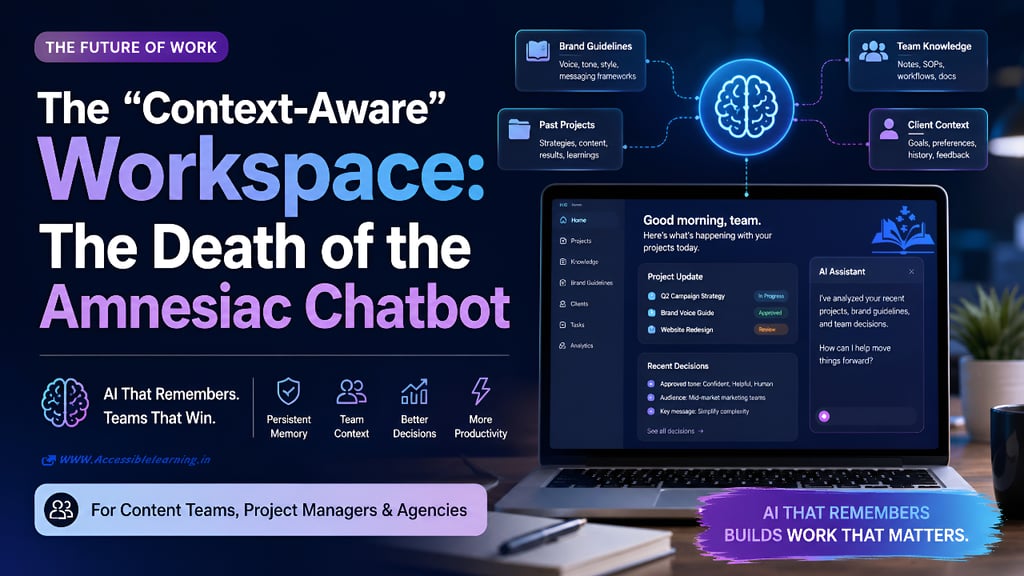
Most AI tools still suffer from a critical flaw: they forget everything. Every new conversation starts with re-explaining your brand voice, project goals, client requirements, and team decisions. This constant context rebuilding wastes time and limits AI's true potential. The rise of context-aware workspaces is changing that. By combining persistent memory, organizational knowledge, and workflow intelligence, platforms like Kollab, Duet, and other AI-native workspaces enable teams to build systems that learn, adapt, and improve over time. Here's why the future of productivity belongs to AI that remembers.
AI/FUTUREEDUCATION/KNOWLEDGEENTREPRENEUR/BUSINESSMANDIGITAL MARKETING
Sachin K Chaurasiya
6/16/20266 min read
Your AI Shouldn't Forget Your Brand Guidelines Every Time You Open a New Tab
For the past three years, businesses have been told that AI would transform productivity. In many ways, it has.
Content gets drafted faster. Research happens in seconds. Marketing teams generate campaign ideas instantly. Project managers automate repetitive tasks. Agencies produce more work with fewer people.
Yet beneath the excitement lies a frustrating reality that almost every professional team has experienced. The AI never remembers.
Open a new chat window and the system suddenly forgets your client, your audience, your messaging strategy, your content standards, your workflow preferences, and every important decision made last week.
You start over.
Again.
And again.
And again.
What was marketed as intelligence often behaves more like short-term memory loss.
This is the hidden productivity crisis of modern AI.
The biggest bottleneck is no longer model quality.
It's context loss. And in 2026, a new category of software is emerging to solve exactly that problem. The Context-Aware Workspace.
These systems don't simply answer prompts. They accumulate organizational knowledge. They learn project history. They understand brand standards. They remember previous decisions.
Most importantly, they get smarter the longer they are used. The age of the amnesiac chatbot is ending.
Why Traditional AI Is Fundamentally Flawed for Team Work
Most AI products were designed around conversations.
Not projects. Not organizations. Not long-term collaboration.
Conversations. The architecture itself creates a problem. Every chat becomes an isolated island of information.
Your team's knowledge becomes scattered across:
Chat histories
Slack channels
Notion pages
Google Docs
Project boards
Meeting transcripts
Internal databases
The AI sees fragments. Humans see fragments. Nobody sees the complete picture. As a result, organizations repeatedly pay what can be called the Context Tax.
The Context Tax
The Context Tax is the time, effort, and money spent re-explaining information that should already be known.
Examples include:
Re-uploading client documentation
Repeating brand guidelines
Rewriting campaign objectives
Explaining target audiences
Summarizing previous meetings
Restating content requirements
For a freelancer, this is annoying. For an agency managing 30 clients, it becomes expensive. For enterprise teams, it becomes a scalability problem.
Many organizations estimate that employees spend between 20% and 40% of their AI interactions rebuilding context rather than producing value.
That is not automation. That is inefficiency disguised as innovation.
The Shift from Prompt Engineering to Context Engineering
For years, AI users focused on prompt engineering. The assumption was simple:
Better prompts create better outputs.
While true, it misses the bigger picture.
The future belongs to context engineering.
Prompt engineering asks:
"What should I tell the AI?"
Context engineering asks:
"What should the AI already know?"
This is a much more powerful question. When an AI understands:
Your customers
Your products
Your brand voice
Your previous campaigns
Your project goals
Your internal processes
The need for complex prompts decreases dramatically. Instead of writing 500-word prompts, teams provide a simple instruction. The workspace supplies the context automatically.
What Makes a Workspace Truly Context-Aware?
Not every platform claiming "memory" actually has meaningful memory. True context-aware systems possess five critical capabilities.
Persistent Memory
Information survives beyond individual sessions.
Knowledge remains available tomorrow, next month, and next year.
Relationship Awareness
The AI understands how people, projects, documents, and decisions connect.
This creates deeper reasoning than simple document retrieval.
Decision Tracking
The system remembers why choices were made.
This may be more valuable than remembering the choices themselves.
Continuous Learning
Every interaction contributes to future understanding.
The workspace improves rather than resets.
Organizational Knowledge Retention
Knowledge remains inside the company instead of disappearing when employees leave.
This transforms AI from a productivity tool into an institutional asset.

Why Agencies Stand to Gain the Most
Agency work is context-heavy. Every client represents an entirely different universe.
Different goals.
Different products.
Different audiences.
Different compliance requirements.
Different approval workflows.
Traditional AI treats each client interaction as a new experience. Context-aware AI treats every client as an evolving knowledge base.
Imagine an AI that remembers:
Brand voice guidelines
Previous campaign performance
Approved messaging frameworks
Stakeholder preferences
Historical feedback
Competitor positioning
The result isn't just faster execution. It's strategic continuity. That continuity becomes a competitive advantage. Agencies that preserve client intelligence create better work than agencies constantly rebuilding context.
The Rise of the AI Operating System
One of the most important trends in 2026 is the emergence of AI operating systems. These platforms are becoming the central nervous system of modern organizations. Instead of acting as standalone assistants, AI systems increasingly connect to:
Documents
Meetings
Communications
Tasks
CRM platforms
Knowledge bases
Analytics systems
The AI becomes aware of the entire operational environment. This shift is profound. The future workplace won't revolve around apps. It will revolve around context layers. Applications become data sources. Context becomes the product.
Kollab: Building Memory Into Team Operations
Kollab represents one of the clearest examples of the context-aware movement. Rather than existing as another chat application, the platform embeds AI directly into collaborative workflows. The key differentiator is accumulated decision intelligence.
As projects evolve, the system develops an understanding of:
Team discussions
Strategic choices
Documentation history
Operational patterns
Workflow behaviors
This creates a living knowledge environment. The longer teams use it, the more valuable it becomes. Unlike traditional AI systems that reset with every conversation, Kollab compounds knowledge over time.
Duet: The Unified Intelligence Workspace
Duet approaches the problem from another angle. Instead of forcing organizations to connect multiple disconnected tools, it combines the following:
AI conversations
Long-term memory
Internal knowledge
Workflow execution
Into a single environment. The value isn't simply convenience. It's contextual continuity. Every action contributes to a larger organizational understanding. This reduces fragmentation and allows teams to operate with a shared intelligence layer rather than isolated information silos.
Other Context-Aware Platforms Defining 2026
Several platforms are helping push the industry toward persistent organizational memory.
Notion AI
Transforms documentation into an intelligent knowledge system.
Coda AI
Connects structured operational workflows with AI reasoning.
ClickUp AI
Creates context from tasks, projects, timelines, and documentation.
Mem
Built specifically around long-term knowledge capture and retrieval.
Slite AI
Focuses on transforming team documentation into actionable organizational intelligence.
Microsoft Copilot Ecosystem
Increasingly connects context across meetings, emails, files, and business applications.
Atlassian Intelligence
Expands AI understanding across software development, project management, and team collaboration environments.
The New Competitive Advantage: Organizational Memory
Historically, companies competed using the following:
Talent
Capital
Technology
Distribution
A new advantage is emerging. Organizational memory. The companies that capture, structure, and leverage institutional knowledge effectively will outperform those that don't.
Because every campaign, meeting, project, and decision creates data.
Most organizations lose that knowledge. Context-aware workspaces preserve it.
Over time, this creates compounding intelligence. The organization becomes smarter every quarter.
Not because employees work harder. Because knowledge stops disappearing.

How to Build a Context-Aware Organization
Technology alone won't solve the problem. Organizations need systems.
Create a Single Source of Truth
Scattered information creates weak AI outputs.
Centralized knowledge creates strong ones.
Document Decisions, Not Just Outcomes
Future teams need reasoning, not merely results.
Record the "why."
Standardize Information Architecture
Consistent naming conventions, documentation structures, and workflows improve memory quality.
Connect Systems Together
Context grows when data flows across platforms.
Isolation destroys intelligence.
Treat Knowledge as an Asset
Most companies manage finances carefully.
Very few manage knowledge with the same discipline.
That must change.
The Future Belongs to Memory
The AI race is no longer about who builds the biggest model. It's about who builds the most useful memory. Raw intelligence is becoming a commodity. Context is becoming the differentiator.
The organizations that thrive in the next decade will not be the ones generating the most content. They will be the ones accumulating the most knowledge. Because the real promise of AI was never faster text generation.
It was organizational amplification. And that only becomes possible when systems remember. The era of the blank-slate chatbot is ending. The era of the context-aware workspace has already begun.
FAQ's
Q: What is a context-aware workspace?
A context-aware workspace is an AI-powered environment that retains organizational knowledge across projects, conversations, and workflows. Unlike traditional chatbots that start from scratch each session, it remembers brand guidelines, project history, team decisions, and business context to provide more relevant and consistent assistance.
Q: How is a context-aware workspace different from a traditional AI chatbot?
Traditional AI chatbots are session-based and often forget information once a conversation ends. Context-aware workspaces maintain long-term memory, connect with documents and workflows, and continuously build knowledge from past interactions, making them far more effective for teams and organizations.
Q: Why is AI memory important for content teams and agencies?
AI memory helps teams maintain brand consistency, reduce repetitive prompting, preserve client knowledge, and streamline collaboration. It allows content creators and agencies to focus on strategy and execution rather than repeatedly explaining context to AI tools.
Q: What are the benefits of persistent AI memory?
Persistent AI memory can:
Improve content consistency
Reduce onboarding time for projects
Preserve institutional knowledge
Minimize context switching
Increase productivity across teams
Deliver more accurate and personalized outputs over time
Q: Which AI tools offer long-term memory and context awareness in 2026?
Leading platforms in this space include Kollab, Duet, Notion AI, ClickUp AI, Coda AI, Mem, Slite AI, and enterprise AI ecosystems that integrate memory across documents, meetings, tasks, and communications.
Q: What is context engineering, and why is it replacing prompt engineering?
Prompt engineering focuses on crafting better instructions for AI. Context engineering focuses on ensuring AI already understands relevant business information, project history, and organizational knowledge before receiving a prompt. As AI systems become more integrated into workflows, context engineering is becoming a more scalable and effective approach.
Q: Can context-aware AI improve brand consistency?
Yes. Because the AI retains brand voice guidelines, messaging frameworks, audience insights, and content standards, it can generate outputs that remain aligned with a brand's identity across campaigns, channels, and teams.
Q: Are context-aware workspaces the future of workplace productivity?
Many organizations believe so. As AI becomes embedded into daily operations, the ability to retain and utilize organizational memory is emerging as a key competitive advantage. Context-aware workspaces help businesses accumulate knowledge rather than lose it between sessions, projects, or team changes.
Subscribe To Our Newsletter
All © Copyright reserved by Accessible-Learning Hub
| Terms & Conditions
Knowledge is power. Learn with Us. 📚

