

The "Cinematic Director": The Next-Gen Video Production Workflow
Discover how the new Cinematic Director workflow is transforming video production through AI. Learn how tools like Google Veo, Runway Gen-4.5, Luma Dream Machine, and Reap enable creators, editors, and agencies to generate cinematic footage, automate editing, create AI-powered B-roll, and scale multilingual content production from a single workstation.
AI/FUTUREEDITOR/TOOLSAI ART TOOLSDIGITAL MARKETING
Sachin K Chaurasiya
6/17/20267 min read
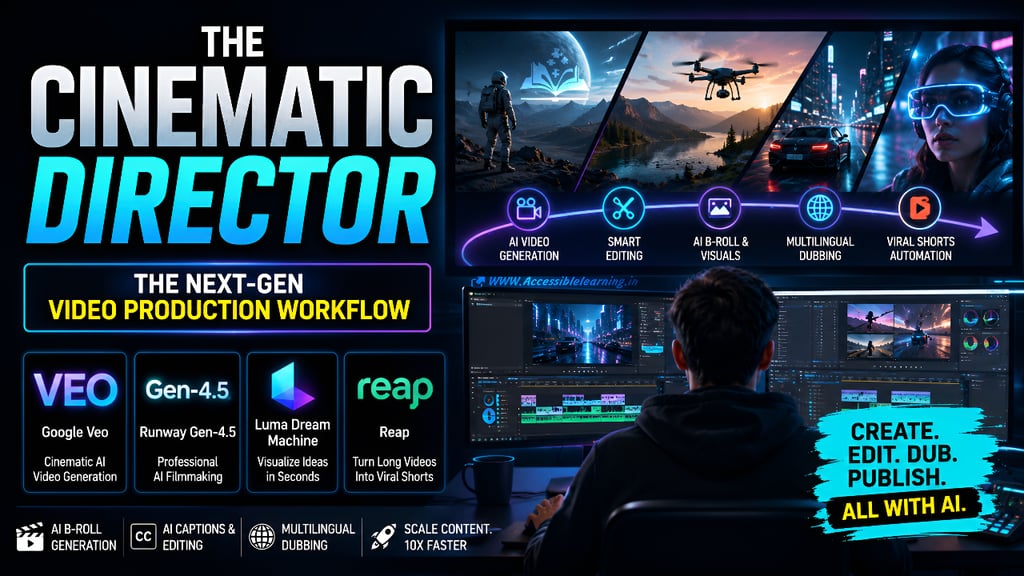
You Don't Need a Camera Crew Anymore; You Just Need the Right AI
For decades, high-quality video production belonged to teams.
You needed directors, camera operators, lighting specialists, motion designers, editors, translators, voice artists, and post-production experts. Creating a cinematic video meant coordinating schedules, renting equipment, booking locations, and spending weeks in production.
That reality is disappearing.
A new class of AI-powered creative tools is fundamentally changing how videos are conceived, produced, edited, localized, and distributed. Today, a single creator can generate cinematic footage from text prompts, animate static images, create multilingual voiceovers, and produce dozens of social media clips from a single source video.
The role of the modern creator is no longer just "video editor." The new role is Cinematic Director.
Instead of manually creating every asset, creators now orchestrate AI systems that handle large portions of production. The human remains responsible for vision, storytelling, creative judgment, and strategy, while AI accelerates execution.
This shift is not a future prediction. It is happening right now.
The Evolution of Video Production
Traditional video workflows were built around scarcity.
Scarcity of equipment.
Scarcity of talent.
Scarcity of production budgets.
Scarcity of time.
Every new scene required another shoot. Every missing shot required another production day. Every localization effort required new voice actors and translators. AI removes those constraints.
Modern workflows are becoming the following:
Faster
Cheaper
More scalable
More experimental
More globally accessible
The result is a production model where ideas move from concept to finished content in hours instead of weeks. The creators who understand this shift will dominate the next decade of content. The ones who don't may find themselves competing against individuals producing ten times more content at a fraction of the cost.
The New AI Video Stack
The modern AI-powered video workflow consists of four primary layers:
Layer 1: Concept Visualization
Before production begins, creators need to test ideas.
Instead of spending thousands on pre-production, AI tools can instantly visualize scenes, camera angles, environments, and creative directions.
Layer 2: Cinematic Video Generation
Entire video sequences can now be generated directly from prompts. This includes:
Camera movement
Character animation
Environmental effects
Lighting
Realistic physics
Cinematic framing
Layer 3: Editing and Repurposing
Long-form content can be transformed into short-form assets automatically.
AI identifies highlights, adds captions, creates hooks, and generates platform-specific edits.
Layer 4: Localization and Distribution
Videos can be translated, dubbed, and distributed globally without rebuilding the production pipeline.
Together, these layers form what can be called the Cinematic Director Workflow.
Google Veo: The New Benchmark for AI Cinematography
Among all video generation systems currently available, Google Veo has become one of the strongest examples of what AI-generated cinema can achieve. Veo's significance is not simply that it generates video. Many tools can do that. What separates Veo is its ability to understand cinematic language.
Creators can specify:
Camera pans
Dolly movements
Tracking shots
Zoom effects
Lighting conditions
Lens styles
Scene transitions
Visual moods
This level of control makes generated footage feel closer to professional filmmaking than traditional AI video experiments. Instead of describing objects alone, creators can direct scenes like actual filmmakers.
Examples include:
A slow cinematic drone shot over a futuristic city
A handheld documentary-style walk through a marketplace
A dramatic sunset tracking shot following a runner
A luxury commercial product reveal with controlled camera movement
This transforms AI from a content generator into a cinematography engine.

Runway Gen-4.5: Professional Production Without Production
Runway has become one of the most influential platforms in AI filmmaking. Its latest generation focuses on giving creators cinematic control while maintaining photorealistic output quality.
The reason agencies and production teams increasingly adopt Runway is simple:
It reduces the gap between imagination and execution.
Instead of spending days searching stock libraries or organizing expensive shoots, creators can generate custom footage designed specifically for a project.
Common use cases include:
Commercial Advertising
Generate product-focused cinematic shots without studio production.
Social Media Campaigns
Create endless visual variations for testing and optimization.
Brand Storytelling
Develop visual narratives without expensive filming schedules.
Creative Prototyping
Pitch concepts before committing production budgets.
Runway effectively turns ideation into visual reality within minutes.
Luma Dream Machine: The Fastest Way to Visualize Ideas
One of the biggest bottlenecks in creative production is uncertainty.
Will the shot work?
Will the scene look good?
Will the concept feel cinematic?
Luma Dream Machine excels at answering these questions quickly. Rather than acting solely as a final production tool, Dream Machine functions as an AI-powered visualization engine.
Creators use it to:
Explore visual directions
Test concepts
Prototype storyboards
Experiment with camera motion
Validate creative ideas
The speed is what matters. Instead of discussing ideas in meetings, teams can instantly see them. That changes creative decision-making dramatically. Bad concepts die faster. Strong concepts move into production immediately.
The Death of Stock Footage Dependency
Stock footage has long been a necessary compromise. Editors often spend hours searching for clips that are "close enough" to the vision they have in mind.
The problem is obvious.
Everyone uses the same footage.
Brands begin looking identical.
Campaigns lose originality.
AI-generated B-roll changes this equation.
Creators can now generate:
Custom environments
Unique camera angles
Branded visual sequences
Industry-specific footage
Story-driven supporting visuals
Instead of adapting ideas to available footage, creators generate footage that matches the idea. That is a fundamental shift in creative control.
Reap: The End-to-End Short-Form Content Machine
Most creators underestimate how much value is hidden inside long-form content.
A single podcast.
A webinar.
A training session.
A sales presentation.
A conference keynote.
These assets often contain dozens of potential short-form clips. Historically, extracting those clips required extensive manual editing. Reap changes from that process. Its workflow focuses on automatically transforming long-form content into platform-ready short videos.
Key capabilities include:
Intelligent Highlight Detection
The system identifies moments likely to perform well on social media.
Advanced Captioning
Captions are no longer simple subtitles.
They become visual storytelling elements.
Automated Formatting
Videos are automatically optimized for:
TikTok
Instagram Reels
YouTube Shorts
LinkedIn Video
Facebook Reels
Scalable Repurposing
One source video can generate dozens of distribution assets.
This dramatically increases content output without increasing editing workload.

The Rise of AI-Generated B-Roll
Modern creators spend a significant amount of time finding supplementary footage. B-roll often determines whether content feels amateur or professional.
The problem is that capturing B-roll traditionally requires the following:
Additional shoots
Extra cameras
Additional crew
Increased budgets
AI generation removes those requirements. Creators can now produce supporting visuals such as the following:
Abstract visual metaphors
Product showcases
Environmental shots
Industry-specific sequences
Historical recreations
Futuristic scenarios
The result is richer storytelling without production overhead.
Image-to-Video Is Becoming a Creative Superpower
Another major breakthrough is image animation. Static images no longer need to remain static.
Modern AI systems can animate the following:
Portraits
Product photos
Landscapes
Illustrations
Marketing assets
This capability opens new opportunities for:
Marketing Agencies
Transform existing creative assets into dynamic campaigns.
Brands
Extend the lifespan of visual content.
Creators
Generate engaging visuals without new production costs.
A single image can become an entire visual sequence.
Multilingual Dubbing Is Eliminating Geographic Limits
Content distribution used to be restricted by language. A creator producing content in English primarily reached English-speaking audiences. Today, AI-powered dubbing changes that equation.
Modern systems can:
Translate dialogue
Generate realistic voiceovers
Preserve tone and emotion
Synchronize speech with visuals
Scale across multiple languages
This means a single production can reach audiences worldwide. The implications for agencies, educators, brands, and creators are enormous. Global expansion no longer requires rebuilding content from scratch.
The New Role of the Video Editor
Many editors worry that AI threatens their profession. The opposite is more likely. The value of editing is moving upward. Editors are becoming the following:
Creative directors
Story architects
Content strategists
Workflow designers
AI operators
The repetitive work decreases. The creative decision-making increases. Clients will increasingly pay for vision rather than timeline labor. The professionals who master AI workflows will become more valuable, not less.
The Agency Advantage
Marketing agencies stand to gain massively from these technologies. AI video pipelines enable agencies to:
Produce more content
Reduce turnaround times
Serve more clients
Increase profit margins
Test more creative variations
Scale global campaigns
The agencies that adopt AI early can effectively operate with production capacities that once required much larger teams. This creates a substantial competitive advantage.

The Future: The One-Person Production Studio
The most important trend is not any individual tool. It is the convergence of all of them.
Imagine this workflow:
Brainstorm concepts using Luma Dream Machine.
Generate cinematic footage using Google Video.
Create supplemental scenes in Runway Gen-4.5.
Assemble and refine the project.
Generate dozens of social clips through Reap.
Dub the content into multiple languages.
Publish globally.
What once required an entire production company can increasingly be executed by a single skilled creator. That creator is no longer just an editor. They are a director, producer, cinematographer, localization manager, and distribution strategist operating from one workstation.
That is the true meaning of the Cinematic Director.
The video industry is entering a new era where creative leverage matters more than production resources.
The winners will not necessarily be those with the biggest studios, the largest crews, or the highest budgets.
They will be the creators, editors, and agencies that learn how to orchestrate AI systems effectively.
Google Veo, Runway Gen-4.5, Luma Dream Machine, and Reap represent more than software tools.
They represent a new production model. The question is no longer whether AI will become part of professional video workflows. That question has already been answered.
The real question is how quickly creators can adapt before AI-powered competitors begin producing faster, cheaper, and more cinematic content than traditional workflows can match.
The camera crew is no longer the bottleneck. Creative direction is.
FAQ's
Q: What is the Cinematic Director workflow in AI video production?
The Cinematic Director workflow is a modern video production process where creators use AI tools to generate footage, create B-roll, automate editing, add captions, localize content, and distribute videos across multiple platforms. Instead of managing a large production team, one person can oversee the entire creative pipeline.
Q: How does Google Veo improve video creation?
Google Veo allows creators to generate cinematic, photorealistic video clips using text prompts while maintaining advanced camera controls such as pan, tilt, zoom, tracking shots, and cinematic movements. This helps produce professional-quality footage without traditional filming equipment.
Q: What is Runway Gen-4.5 used for?
Runway Gen-4.5 is an AI video generation platform that helps creators produce custom visual content, cinematic scenes, advertising footage, and storytelling sequences. It is widely used for rapid content creation, concept visualization, and commercial video production.
Q: Can AI generate realistic B-roll footage?
Yes. Modern AI video tools can create custom B-roll footage from text prompts, including environments, product shots, lifestyle scenes, abstract visuals, and industry-specific sequences. This reduces reliance on stock footage and expensive video shoots.
Q: How does Reap help content creators?
Reap automatically converts long-form content such as podcasts, webinars, interviews, and presentations into engaging short-form videos. It identifies key moments, generates captions, formats content for different platforms, and accelerates social media distribution.
Q: What is the role of Luma Dream Machine in video production?
Luma Dream Machine helps creators quickly visualize ideas, storyboard scenes, experiment with camera movements, and prototype creative concepts before investing time and resources into full production.
Q: Can AI tools create multilingual video content?
Yes. AI-powered dubbing and translation systems can translate dialogue, generate natural voiceovers, and synchronize speech across multiple languages. This allows creators and businesses to reach global audiences without re-recording videos.
Q: Will AI replace video editors?
AI is changing the role of video editors rather than replacing them. Editors are increasingly becoming creative directors, storytellers, and workflow managers who use AI to handle repetitive production tasks while focusing on strategy and creativity.
Q: What are the benefits of AI-generated video production for marketing agencies?
Marketing agencies can produce content faster, reduce production costs, scale campaigns more efficiently, test multiple creative variations, and deliver multilingual content to clients without significantly increasing team size.
Q: What is the best AI video production stack in 2026?
A powerful AI video stack typically includes:
Google Veo for cinematic video generation
Runway Gen-4.5 for advanced scene creation
Luma Dream Machine for concept visualization
Reap for automated short-form content repurposing
AI dubbing tools for multilingual distribution
This combination enables end-to-end video production, from ideation to global publishing.
Subscribe To Our Newsletter
All © Copyright reserved by Accessible-Learning Hub
| Terms & Conditions
Knowledge is power. Learn with Us. 📚

