

The Chola Empire: How a Tamil Dynasty Built South India's Greatest Maritime Superpower
Discover the magnificent Chola Empire (9th-13th century CE), South India's greatest dynasty that dominated maritime trade, created UNESCO World Heritage temples, and perfected bronze sculpture. Explore their naval conquests across Southeast Asia, innovative governance systems, and lasting cultural legacy that shaped civilizations from Tamil Nadu to Indonesia.
INDIAN HISTORYEMPIRES/HISTORYHISTORY
Jagdish Nishad
2/26/20269 min read
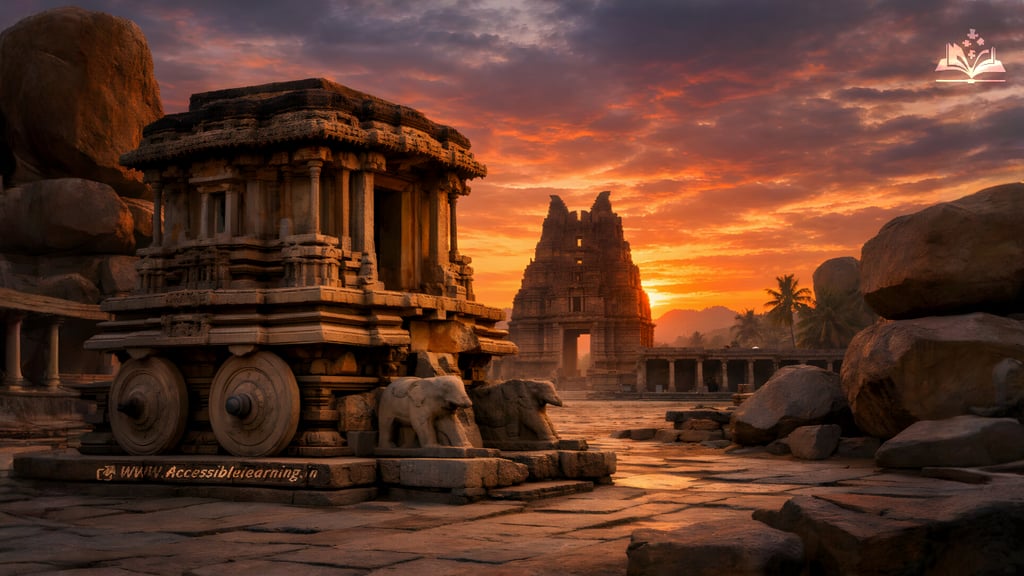
The Chola Empire stands as one of the longest-ruling dynasties in world history, transforming southern India into a maritime superpower between the 9th and 13th centuries CE. From pioneering bronze sculptures to establishing trade networks spanning Southeast Asia, the Cholas left an indelible mark on Indian civilization that resonates even today.
What Was the Chola Empire?
The Chola Empire was a Tamil dynasty that ruled primarily over southern India, with its influence extending across the Bay of Bengal to parts of Southeast Asia. At its zenith during the 10th and 11th centuries, the empire controlled territories covering modern-day Tamil Nadu, Karnataka, Andhra Pradesh, Kerala, Odisha, and even parts of Sri Lanka, the Maldives, and maritime Southeast Asia.
Origins and Early History
The Cholas trace their lineage back to the Sangam period (3rd century BCE to 3rd century CE), mentioned in ancient Tamil literature. However, the imperial Chola dynasty that would dominate South India emerged much later, around 848 CE, when Vijayalaya Chola captured Thanjavur (Tanjore) from the Muthuraiyar chieftains.
The early Chola rulers established Thanjavur as their capital, transforming it into a cultural and administrative hub that would serve as the empire's nerve center for centuries.
The Rise to Power: Medieval Chola Dynasty
Rajaraja Chola I: The Empire Builder (985-1014 CE)
Rajaraja Chola I represents a watershed moment in Chola history. His reign marked the transformation of a regional kingdom into a formidable empire. His military campaigns extended Chola territory significantly:
Conquered the Pandya kingdom in southern Tamil Nadu
Defeated the Chera dynasty in modern Kerala
Invaded and annexed northern Sri Lanka, making it a Chola province
Subjugated the Maldive Islands and coastal Karnataka regions
Launched naval expeditions against kingdoms in Southeast Asia
Beyond military prowess, Rajaraja I revolutionized administration, instituted land surveys for efficient taxation, and commissioned the magnificent Brihadeeswara Temple at Thanjavur—a UNESCO World Heritage site that stands today as testimony to Chola architectural genius.
Rajendra Chola I: The Naval Conqueror (1014-1044 CE)
Building upon his father's legacy, Rajendra Chola I expanded the empire to its greatest territorial extent. His most audacious campaign was the expedition to the Ganges River in northern India around 1023 CE, earning him the title "Gangaikonda" (conqueror of the Ganges).
His naval campaigns were equally impressive:
Defeated the Srivijaya Empire in maritime Southeast Asia (modern Indonesia and Malaysia)
Established Chola dominance over crucial trade routes in the Indian Ocean
Built a new capital called Gangaikondacholapuram to commemorate his victories
Created one of the most powerful naval forces in the medieval world
Chola Administration: A Model of Governance
The Chola administrative system was remarkably sophisticated, featuring decentralized governance that balanced central authority with local autonomy.
Administrative Structure
The empire was divided into:
Mandalams (provinces) - largest administrative units
Valanadus (districts) - subdivisions of mandalams
Nadus (smaller territories) - comprised multiple villages
Kurrams and Taniyurs - village-level administration
Local Self-Governance
What distinguished Chola administration was the emphasis on local governance through village assemblies:
Ur - general village assembly for all residents
Sabha or Mahasabha - assembly in Brahmin villages (agraharams)
Nagaram - assembly in merchant towns
These assemblies managed local affairs, including irrigation, taxation, justice, and public works. Inscriptions from the period detail election procedures, term limits, and qualifications for assembly members—demonstrating a sophisticated understanding of democratic principles.
Revenue and Land Management
The Cholas conducted comprehensive land surveys to assess agricultural productivity and determine taxation. Land was classified based on usage (cultivated, uncultivated, garden land, etc.), and taxes were collected primarily in kind—grains, cloth, and other products—though monetary taxation also existed.
Chola Military: Masters of Land and Sea
Army Organization
The Chola military was highly organized, consisting of:
Infantry units with specialized divisions
Cavalry forces, including both light and heavy cavalry
Elephant corps used in battles and ceremonial functions
Naval forces that dominated the Bay of Bengal
Naval Supremacy
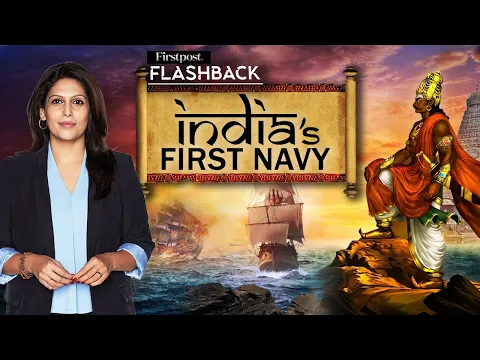
The Chola navy was perhaps the most advanced maritime force in the Indian Ocean during this period. They:
Controlled key ports along the Coromandel Coast
Protected merchant vessels engaged in overseas trade
Launched amphibious operations as far as Southeast Asia
Maintained a network of naval bases across their maritime territories
The conquest of the Srivijaya Empire demonstrated the Cholas' ability to project power across vast oceanic distances—a feat unmatched by other Indian dynasties of the period.
Economic Prosperity: Trade and Commerce
Agricultural Foundation
The Chola economy rested on a strong agricultural base. The rulers invested heavily in irrigation infrastructure:
Construction of large-scale irrigation tanks and reservoirs
Development of canal systems to distribute water
Management of river water through embankments and sluices
These investments dramatically increased agricultural productivity, providing the surplus needed to support urbanization, temple construction, and military campaigns.
Maritime Trade Networks
The Cholas established extensive trade connections spanning:
Southeast Asia: Burma, Thailand, Cambodia, Vietnam, Malaysia, Indonesia
China: Regular diplomatic and commercial exchanges
Middle East: Trade in spices, textiles, and precious stones
East Africa: Commercial contacts along the Swahili Coast
Chola merchants, particularly from guilds like the Ainnurruvar and Manigramam, established settlements in Southeast Asian ports, facilitating not just trade but also cultural exchange.
Trade Goods
Major exports included
Textiles (particularly cotton and silk fabrics)
Spices (pepper, cardamom, cinnamon)
Precious and semi-precious stones
Metalwork and bronze sculptures
Pearls from the Gulf of Mannar
Imports consisted of horses from Arabia, Chinese silk, Southeast Asian camphor and sandalwood, and precious metals.
Cultural Achievements: The Chola Renaissance
Temple Architecture
Chola architecture represents the pinnacle of Dravidian temple design. The defining features include:
Vimana (tower over the sanctum) reaching unprecedented heights
Gopurams (gateway towers) marking temple entrances
Mandapas (pillared halls) for various rituals
Prakara (concentric courtyards) surrounding the main shrine
Three Great Living Chola Temples (UNESCO World Heritage Sites):
Brihadeeswara Temple, Thanjavur (1010 CE) - Built by Rajaraja I, featuring a 66-meter tall vimana
Brihadeeswara Temple, Gangaikondacholapuram (1035 CE) - Rajendra I's architectural masterpiece
Airavatesvara Temple, Darasuram (12th century CE) - Known for intricate stone carvings
These temples served not just as places of worship but as economic centers, educational institutions, and community hubs.
Bronze Sculpture: Chola Metallurgical Genius
Chola bronze casting reached such perfection that these sculptures are considered among the finest metal works in world art history. Using the lost-wax (cire perdue) technique, Chola artisans created:
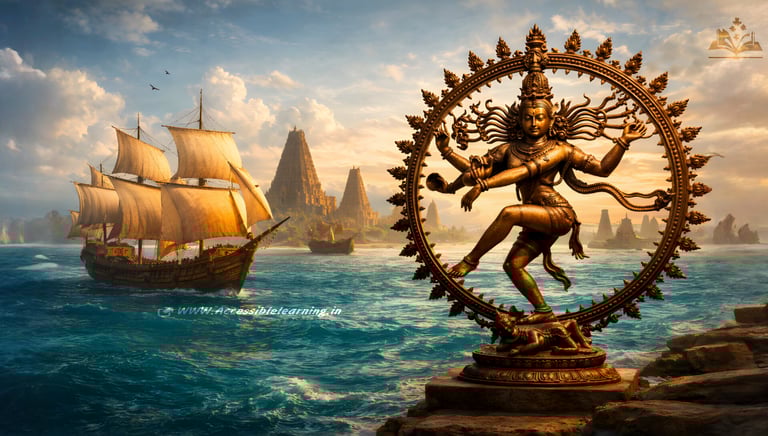
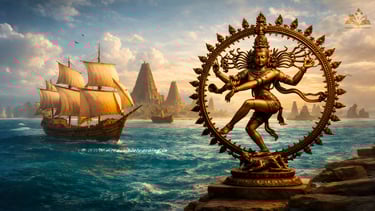
Nataraja (Dancing Shiva) - the iconic representation of cosmic dance
Ardhanarisvara (Shiva-Parvati combined form)
Various forms of Vishnu, Lakshmi, and other deities
Portraits of Chola rulers and saints
The Nataraja bronze, with its perfect balance of movement and stillness, spiritual symbolism and aesthetic beauty, has become a global icon of Indian art. The proportions, posture, and iconographic details follow precise canonical texts (shilpa shastras) while displaying remarkable artistic creativity.
Literature and Language
The Chola period witnessed significant developments in Tamil literature:
Continuation of devotional poetry by Shaiva and Vaishnava saints
Historical chronicles like the Kalingattuparani describing Chola victories
Grammar texts refining Tamil linguistic tradition
Inscriptions that provide detailed historical, administrative, and cultural information
Tamil, already a classical language, received royal patronage and flourished as the language of administration, literature, and commerce.
Dance and Music
The Cholas patronized classical arts:
Bharatanatyam dance tradition evolved in Chola temples
Carnatic music developed with temple patronage
Devadasi system where temple dancers performed ritual dances
Musical instruments and performance traditions documented in temple inscriptions
Religion and Society
Religious Tolerance and Patronage
While the Cholas were primarily Shaivites (devotees of Shiva), they demonstrated remarkable religious pluralism:
Built temples for Vishnu and other deities
Supported Jain institutions
Maintained Buddhist monasteries
Respected local religious traditions in conquered territories
Social Structure
Chola society followed the varna system but with regional variations:
Brahmins - priests, scholars, administrators
Kshatriyas - rulers and warriors
Vaisyas - merchants and traders
Sudras - farmers, artisans, laborers
Beyond the varna framework, occupational guilds (shrenis) wielded considerable economic and social influence. Merchant guilds like the Ainnurruvar had their own armed forces and established trading colonies abroad.
Role of Women
Inscriptional evidence suggests women in Chola society had certain rights:
Property ownership and inheritance rights
Participation in religious endowments
Education for upper-class women
Queens and royal women exercising political influence
However, practices like sati (widow immolation) and restrictions on widow remarriage existed, particularly among upper castes.
The Decline of the Chola Empire
Factors Leading to Decline
The Chola Empire's decline was gradual, resulting from multiple factors:
Rise of the Pandyas: The Pandya kingdom in southern Tamil Nadu regained strength in the 13th century, challenging Chola supremacy
Hoysala invasions: The Hoysala dynasty from Karnataka launched repeated attacks
Internal instability: Succession disputes and weak rulers after the 12th century
Overextension: Maintaining control over vast territories became increasingly difficult
Economic strain: Continuous warfare depleted resources
Loss of naval dominance: Decline in maritime power reduced trade revenues
Final Years
By the mid-13th century, the once-mighty empire had fragmented. The Pandya king Jatavarman Sundara Pandyan I defeated the last significant Chola ruler around 1279 CE. The Chola dynasty continued in name with greatly reduced territory until the 14th century, when they were finally absorbed by the Vijayanagara Empire.
Legacy of the Chola Empire
Architectural Heritage
Chola temples remain active places of worship and major tourist destinations:
Over 100 temples built during the Chola period still stand
UNESCO recognition of Chola temples as World Heritage Sites
Architectural principles influencing Southeast Asian temple design
Cultural Impact on Southeast Asia
The Chola maritime expeditions and trade relationships profoundly influenced Southeast Asian civilization:
Temple architecture in Cambodia, Thailand, and Indonesia shows Chola influence
Hindu-Buddhist synthesis in Southeast Asian kingdoms
Sanskrit and Tamil loanwords in Southeast Asian languages
Cultural practices including dance, music, and religious rituals
The temples of Angkor Wat in Cambodia and Prambanan in Indonesia reflect architectural concepts developed during the Chola period.
Administrative Innovations
The Chola system of local self-governance through village assemblies influenced later South Indian kingdoms and continues to be studied as a model of decentralized administration.
Artistic Legacy
Chola bronzes set standards for metal sculpture that continue to inspire artists globally. Museums worldwide, including the Metropolitan Museum of Art, the British Museum, and the National Museum in Delhi, house Chola bronze masterpieces.
Language and Literature
The Chola period's Tamil literary works remain foundational texts in Tamil culture. The inscriptions provide invaluable historical data about medieval Indian society, economy, and culture.

The Chola Empire represents one of the most remarkable achievements in Indian history. From humble origins in the Kaveri delta, they built an empire that spanned oceans, created artistic masterpieces that endure a millennium later, and developed governance systems that were remarkably progressive for their time.
Their temples stand as UNESCO World Heritage Sites, their bronzes grace museums worldwide, their administrative innovations influence modern governance studies, and their cultural impact resonates across South and Southeast Asia. The Chola legacy reminds us that true power lies not just in military might but in cultural creativity, administrative wisdom, and the ability to inspire across generations.
For anyone interested in medieval Indian history, maritime empires, temple architecture, or classical Indian arts, the Chola Empire offers an endlessly fascinating subject—a golden age when Tamil civilization reached its zenith and left an indelible mark on world history.
Frequently Asked Questions
Q: Who founded the Chola Empire?
The imperial Chola dynasty was founded by Vijayalaya Chola around 848 CE when he captured Thanjavur. However, the Chola lineage dates back to the Sangam period (3rd century BCE-3rd century CE), making it one of the oldest dynasties in Indian history.
Q: What was the capital of the Chola Empire?
The Cholas had two major capitals during their imperial phase: Thanjavur (Tanjore) served as the primary capital from the 9th century, while Gangaikondacholapuram became the second capital after Rajendra Chola I built it in the 11th century to commemorate his northern conquests.
Q: How did the Chola Empire fall?
The Chola Empire declined gradually due to multiple factors, including the rise of rival Pandya and Hoysala kingdoms, internal succession disputes, economic strain from continuous warfare, and loss of naval dominance. The Pandyas defeated the last significant Chola ruler around 1279 CE, though the dynasty continued in name until the 14th century.
Q: What were the major achievements of the Chola dynasty?
The Cholas' major achievements include creating a powerful naval force that dominated the Indian Ocean, constructing magnificent temples including UNESCO World Heritage Sites, perfecting bronze sculpture techniques, establishing efficient local governance systems, developing extensive trade networks with Southeast Asia and China, and advancing Tamil literature and arts.
Q: Which Chola king was the most powerful?
Rajaraja Chola I (985-1014 CE) and his son Rajendra Chola I (1014-1044 CE) are considered the most powerful Chola rulers. Rajaraja expanded the empire significantly and built the Brihadeeswara Temple, while Rajendra extended Chola power to its greatest extent, conquering territories from the Ganges to Southeast Asia.
Q: What religion did the Chola Empire follow?
The Cholas were primarily Hindu, particularly devotees of Shiva (Shaivites). However, they demonstrated religious tolerance, patronizing Vishnu temples, supporting Jain institutions, and maintaining Buddhist monasteries. This pluralistic approach helped maintain stability across their diverse empire.
Q: How far did the Chola Empire extend?
At its peak under Rajendra Chola I, the empire controlled most of southern India, including present-day Tamil Nadu, Karnataka, Andhra Pradesh, Kerala, and Odisha; northern Sri Lanka; the Maldive Islands; and established dominance over parts of maritime Southeast Asia, including portions of modern Malaysia, Indonesia, and southern Thailand.
Q: What is the Chola Empire known for in art and architecture?
The Cholas are renowned for their Dravidian temple architecture, particularly the Great Living Chola Temples (UNESCO sites), and their exquisite bronze sculptures. The Nataraja (Dancing Shiva) bronze is globally recognized as a masterpiece of metal sculpture. Their artistic achievements influenced Southeast Asian temple design and continue to inspire artists worldwide.
Q: How did the Cholas govern their empire?
The Chola administration featured a sophisticated decentralized system with provinces (mandalams), districts (valanadus), and village-level units. Notably, they emphasized local self-governance through village assemblies (ur, sabha, nagaram) that managed taxation, irrigation, justice, and public works—demonstrating early democratic principles.
Q: What was the Chola navy like?
The Chola navy was the most powerful maritime force in the Indian Ocean during the 10th-12th centuries. They controlled key ports, protected trade routes, launched expeditions to Southeast Asia, defeated the Srivijaya Empire, and maintained naval bases across their maritime territories. This naval supremacy was crucial to their economic prosperity and territorial expansion.
Subscribe to Frontier Intelligence
All © Copyright reserved by Accessible-Learning Hub
| Terms & Conditions
Accessible Learning Hub — Actionable clarity for high-agency minds.
Weekly breakdowns on AI breakthroughs, capital flow, and human performance systems. Zero fluff.