

The Carbon Cost of the AI Revolution
Artificial intelligence is transforming industries, powering tools that write, design, code, and analyze data. But behind this technological leap lies a growing environmental concern. Training large AI models and running global data centers requires enormous computing power, electricity, and cooling infrastructure. This article explores the carbon cost of the AI revolution, explaining how AI consumes energy, why its environmental footprint is rising, and how researchers and technology companies are working toward more sustainable and energy-efficient AI systems.
ENVIRONMENTHARSH REALITYAI/FUTURE
Sachin K Chaurasiya
4/7/20267 min read
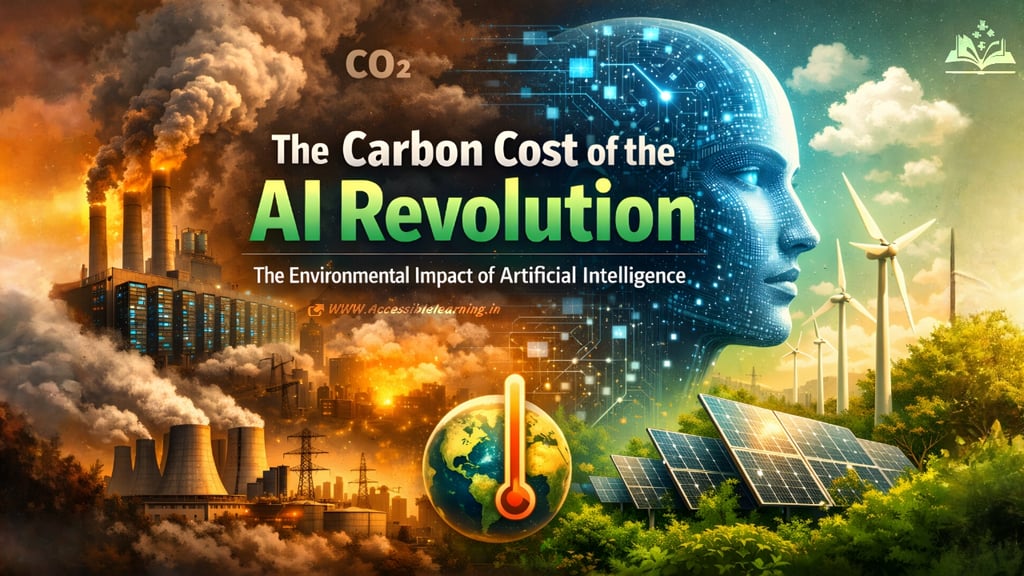

Artificial intelligence is becoming one of the most powerful technologies shaping the modern digital world. AI systems now assist with writing, coding, search, video generation, design, automation, and data analysis. Businesses, researchers, and governments are rapidly integrating AI into everyday tools and services.
But while AI feels invisible to most users, the infrastructure behind it is enormous. Every AI model depends on high-performance computers, large data centers, and continuous electricity. As AI systems grow more powerful and widely used, their environmental footprint is becoming an important global discussion.
The AI revolution is not just a technological shift. It is also an energy challenge.
Why AI Requires So Much Computing Power
Artificial intelligence systems rely on machine learning models that learn patterns from massive datasets. To build these models, companies use powerful processors such as GPUs and specialized AI accelerators. These systems perform extremely large numbers of calculations in order to train and operate AI models. AI workloads usually involve two major phases.
Training
Training is the process where a model learns from data. During this stage, the system processes enormous datasets and adjusts billions of internal parameters. Training advanced models can require:
Thousands of GPUs or AI chips
Weeks or months of continuous computation
Large clusters of high-performance servers
This stage often consumes the largest amount of energy in the lifecycle of an AI model.
Inference
After training, the model is deployed for real-world use. This stage is called inference. Inference happens whenever someone uses an AI system. Examples include:
Asking a chatbot a question
Generating an AI image
Translating a document
Using AI-powered search
Each individual request may require only a small amount of computing power. However, when millions of users interact with AI systems every day, the combined energy demand becomes significant.
The Growing Scale of AI Models
One major reason for the rising energy cost of AI is the rapid increase in model size. Early machine learning models were relatively small and could be trained using modest computing resources. Modern AI systems, however, often contain billions or even trillions of parameters.
Larger models generally perform better because they can capture more complex patterns in data. But this improvement comes with a cost.
Bigger models require:
More computing hardware
Longer training times
Larger datasets
More electricity
As companies compete to build the most capable AI systems, the computational scale continues to increase.
The Infrastructure Behind AI
Most advanced AI systems run in massive data centers operated by large technology companies and cloud providers. A typical AI data center may contain:
Thousands of servers
Large clusters of GPUs or AI accelerators
High-speed networking infrastructure
Backup power systems
Advanced cooling technology
These facilities must operate continuously. Even small interruptions can disrupt services used by millions of people. Because of the enormous computational demand, modern AI data centers can consume megawatts of electricity, similar to the power consumption of small towns.
Cooling: A Hidden Energy Cost
One often overlooked aspect of AI infrastructure is cooling. High-performance processors generate significant heat when running complex computations. Without proper cooling systems, the hardware could quickly overheat.
To maintain safe operating temperatures, data centers use:
Industrial air cooling systems
Liquid cooling technologies
Chilled water systems
Cooling can account for a substantial portion of a data center’s total energy consumption. As AI hardware becomes more powerful, managing heat efficiently becomes increasingly important.


Water Use in Data Centers
Electricity is not the only resource consumed by AI infrastructure. Many data centers also rely on large quantities of water for cooling. Water-based cooling helps remove heat from servers and maintain stable operating temperatures.
In some cases, large facilities may use millions of liters of water annually. This has raised concerns in regions where water resources are already under pressure. To address this issue, companies are experimenting with alternative cooling methods such as:
Closed-loop cooling systems
Immersion cooling
More efficient airflow designs
These approaches aim to reduce water consumption while maintaining efficient temperature control.
The Carbon Footprint of AI
The environmental impact of AI depends largely on how the electricity used by data centers is generated. If data centers run on electricity from fossil fuels such as coal or natural gas, the carbon emissions associated with AI systems can be significant.
The carbon footprint of AI is influenced by several factors:
Size and complexity of the model
Hardware efficiency
Training duration
Number of users running inference
Energy source used by data centers
In regions where renewable energy sources are widely used, the carbon impact of AI infrastructure can be significantly lower.
Hardware and the Rise of AI Chips
The AI boom has driven rapid innovation in computer hardware. Traditional CPUs are not optimized for large-scale machine learning tasks, so companies have developed specialized processors designed specifically for AI workloads.
These include:
GPUs optimized for deep learning
Tensor processing units (TPUs)
Custom AI accelerators
These chips can perform parallel computations far more efficiently than general-purpose processors. While they reduce energy per computation, large clusters of these processors can still consume enormous amounts of power. The global demand for AI chips has increased dramatically as companies expand their AI infrastructure.
Local AI vs Cloud AI
AI systems can operate either in cloud data centers or directly on local devices.
Cloud-Based AI
Most advanced AI models currently run in centralized cloud infrastructure. This allows companies to use specialized hardware and optimized data centers.
Advantages include:
High computational power
Efficient resource management
Centralized updates and maintenance
However, cloud infrastructure concentrates large energy demand in specific locations.
Local AI
Some AI models can run directly on personal devices such as smartphones or personal computers.
Local AI can reduce the need for continuous cloud processing, which may lower network and server demand for certain tasks. However, consumer hardware is usually not powerful enough for large-scale training.
As hardware improves, local AI may help distribute computational demand more efficiently.
The Emergence of Green AI
As awareness of AI’s environmental impact grows, researchers are increasingly focusing on energy-efficient AI development.
This movement is often called Green AI.
Instead of simply building larger models, Green AI focuses on improving efficiency through several strategies.
Efficient model design
Researchers are developing architectures that achieve strong performance without requiring massive computational resources.
Smarter training methods
New training techniques allow models to learn faster using fewer computational cycles.
Energy-efficient hardware
Modern AI chips are designed to perform calculations using less energy per operation.
Renewable-powered infrastructure
Many technology companies are investing heavily in solar, wind, and other renewable energy sources to power their data centers.
These improvements could significantly reduce the environmental footprint of AI systems over time.
AI Can Also Help Solve Environmental Problems
Although AI consumes large amounts of energy, it also has the potential to support environmental solutions.
AI is already being used in areas such as:
Climate modeling and prediction
Renewable energy optimization
Smart electricity grids
Precision agriculture
Wildlife monitoring and conservation
These applications can improve efficiency in industries that traditionally produce large amounts of emissions.
In some cases, the environmental benefits created by AI-driven optimization may outweigh the energy used to run the systems.

AI Can Also Help Solve Environmental Problems
Although AI consumes large amounts of energy, it also has the potential to support environmental solutions. AI is already being used in areas such as:
Climate modeling and prediction
Renewable energy optimization
Smart electricity grids
Precision agriculture
Wildlife monitoring and conservation
These applications can improve efficiency in industries that traditionally produce large amounts of emissions. In some cases, the environmental benefits created by AI-driven optimization may outweigh the energy used to run the systems.
Transparency and Future Regulations
As AI systems become more widespread, policymakers and researchers are calling for greater transparency around their environmental impact.
Future regulations may require companies to report:
Energy consumption during model training
Carbon emissions linked to AI systems
Efficiency metrics for machine learning models
Such transparency could encourage competition not only in performance but also in sustainability.
Companies that build more energy-efficient AI systems may gain a competitive advantage as environmental concerns become more central to technology policy.
The Path Toward Sustainable AI
Artificial intelligence will likely continue expanding into nearly every industry. From healthcare and education to manufacturing and creative work, AI is becoming part of the digital foundation of modern society.
However, this expansion must be balanced with responsible infrastructure development. The future of sustainable AI will depend on several key factors:
More efficient algorithms
Energy-efficient hardware
Renewable-powered data centers
Responsible scaling of AI models
Transparent environmental reporting
If these areas continue improving, the AI industry can continue innovating while reducing its environmental impact.
The AI revolution is transforming how people interact with technology. Yet behind every AI-generated response, image, or automated decision lies a vast computing infrastructure powered by electricity.
Understanding the carbon cost of AI does not mean slowing innovation. Instead, it highlights the importance of building smarter, more efficient systems that balance technological progress with environmental responsibility.
As the world continues adopting artificial intelligence, sustainable development will become just as important as technological advancement.
FAQ's
Q: What is the carbon cost of artificial intelligence?
The carbon cost of artificial intelligence refers to the greenhouse gas emissions generated by the electricity used to train and run AI systems. Large AI models require powerful computing infrastructure and data centers, which consume significant amounts of energy. If that energy comes from fossil fuels, it contributes to carbon emissions.
Q: Why do AI systems consume so much energy?
AI models rely on complex mathematical computations that require high-performance processors such as GPUs and specialized AI chips. Training these models involves processing massive datasets and running trillions of calculations, which leads to high electricity consumption.
Q: How do data centers contribute to AI’s environmental impact?
AI systems are typically hosted in large data centers filled with servers and AI hardware. These facilities operate continuously and require additional energy for cooling systems and networking infrastructure. The environmental impact depends largely on the energy source powering these centers.
Q: Does using AI tools increase global electricity demand?
Yes. As AI adoption grows across industries and millions of users interact with AI systems daily, the demand for computational power increases. This growing demand can contribute to higher global electricity consumption, especially as AI services expand.
Q: Is training AI models more energy-intensive than using them?
Training AI models usually consumes far more energy than everyday usage. Training involves large computing clusters running for extended periods. However, once deployed, the cumulative energy used during inference can also become significant when millions of users interact with the system.
Q: Can artificial intelligence become environmentally sustainable?
Yes, AI can become more sustainable through improvements in hardware efficiency, optimized algorithms, renewable energy-powered data centers, and better model design that reduces unnecessary computational demand.
Q: What is Green AI?
Green AI is an approach to artificial intelligence development that focuses on energy efficiency and environmental sustainability. Instead of simply increasing model size, researchers aim to create models that deliver strong performance while using fewer computational resources.
Q: Are tech companies working to reduce AI emissions?
Many technology companies are investing in renewable energy sources such as solar and wind power to run their data centers. They are also designing energy-efficient chips, improving cooling systems, and developing more efficient AI models.
Q: Can AI help fight climate change?
Yes. AI is being used to improve climate modeling, optimize renewable energy systems, monitor deforestation, manage energy grids, and support environmental research. These applications can help reduce emissions in other industries.
Q: Will AI’s environmental impact grow in the future?
AI usage is expected to increase significantly as more industries adopt intelligent systems. Without improvements in efficiency and energy sources, the environmental footprint of AI could grow. However, advances in hardware, renewable energy, and sustainable AI research may help reduce this impact over time.
Subscribe to Frontier Intelligence
All © Copyright reserved by Accessible-Learning Hub
| Terms & Conditions
Accessible Learning Hub — Actionable clarity for high-agency minds.
Weekly breakdowns on AI breakthroughs, capital flow, and human performance systems. Zero fluff.