

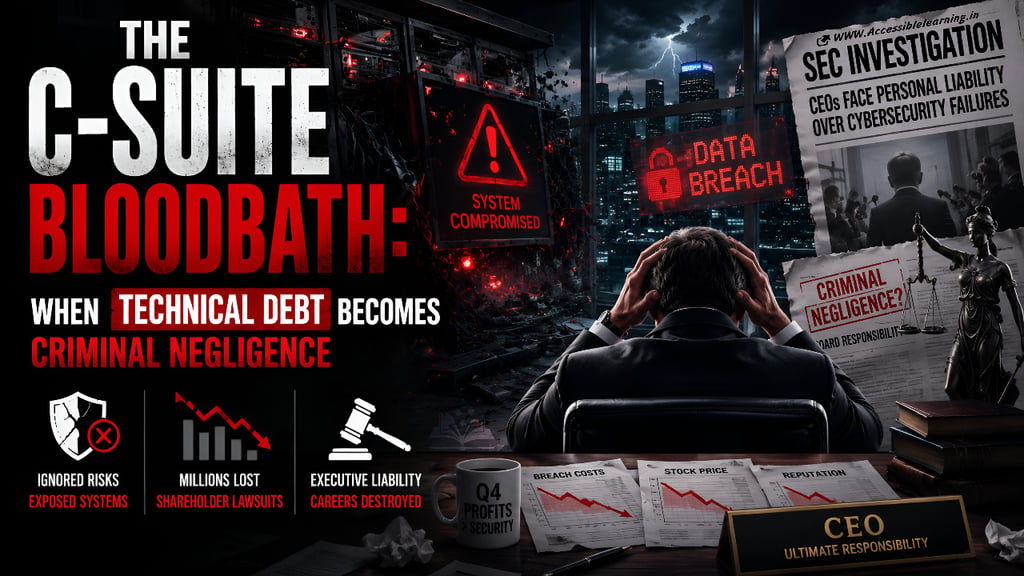
The C-Suite Bloodbath: When "Technical Debt" Becomes Criminal Negligence
Discover how ignored technical debt, legacy systems, and AI-driven cyberattacks could expose CEOs and boards to lawsuits, SEC scrutiny, and personal liability.
HARSH REALITYENTREPRENEUR/BUSINESSMANAI/FUTURE
Sachin K Chaurasiya | Shiv Singh Rajput
7/4/20266 min read
At 2:17 a.m., the hospital's electronic medical records disappeared. Three minutes later, emergency departments diverted ambulances. Surgeries stopped mid-schedule. Pharmacy systems locked. ICU staff reverted to paper charts while attackers demanded millions.
The breach did not begin with an elite hacker discovering an unknown exploit.
It started years earlier when executives approved another stock buyback instead of replacing a 20-year-old authentication system everyone knew had become a liability.
The malware simply finished the job management had already started.
This is no longer a cybersecurity story.
It is a corporate governance story.
Technical Debt Is No Longer an Engineering Problem
For decades, executives hid behind one comfortable phrase: technical debt.
It sounded temporary. Manageable. Even strategic.
In reality, many organizations transformed technical debt into permanent infrastructure decay.
Legacy operating systems remained online long after vendor support ended. Identity platforms accumulated security exceptions. Critical applications depended on undocumented code written by employees who retired a decade ago. Network segmentation never happened because it threatened quarterly deadlines.
Every postponed modernization project quietly expanded the company's attack surface.
Boards often treated cybersecurity as a cost center instead of a business survival function. Finance teams scrutinized infrastructure upgrades while approving acquisitions, executive bonuses, and aggressive shareholder returns.
The balance sheet looked healthier.
The infrastructure became weaker.
AI Has Changed the Timeline Forever
Security teams once believed they had days or weeks to respond to newly disclosed vulnerabilities. That assumption no longer survives.
AI-assisted reconnaissance now allows attackers to identify exposed services, correlate known vulnerabilities, generate exploit chains, and automate intrusion attempts within minutes.
Attackers no longer need months of preparation. They need publicly available vulnerability databases and increasingly capable AI tools.
The uncomfortable reality is brutal. When a known vulnerability remains unpatched, the question no longer becomes if someone will exploit it.
The question becomes how quickly.
In this environment, outdated infrastructure no longer represents slow-moving risk.
It represents an active invitation.
Five Eyes Already Delivered the Warning
The intelligence agencies comprising the Five Eyes alliance have repeatedly warned organizations that legacy systems create strategic risk, not merely operational inconvenience.
That language matters. Strategic liabilities threaten national resilience, economic stability, and public safety.
Hospitals, energy providers, financial institutions, transportation networks, telecommunications companies, and government contractors increasingly depend on software architectures built for threat environments that no longer exist.
Many executives continue treating modernization as optional.
Intelligence agencies do not.
Neither will regulators after the next catastrophic failure.
The Boardroom Has Become the New Attack Surface
Every executive approves risk. Every budget tells a story.
When leadership repeatedly rejects modernization funding despite documented warnings, those decisions become governance records.
Internal audit reports. Security assessments.
Risk committee minutes. Budget requests.
Deferred remediation plans. Those documents create a paper trail.
After a major breach, investigators rarely ask whether attackers existed.
They ask what leadership knew before the attack. That distinction changes everything.
The Coming Wave of Executive Liability
Regulators increasingly view cybersecurity through the lens of governance rather than technology.
The legal landscape continues evolving toward executive accountability.
Shareholders already challenge directors for failing to oversee cyber risk.
Regulators increasingly examine whether companies accurately disclosed material cybersecurity risks.
When organizations knowingly operate unsupported infrastructure while publicly assuring investors that risks remain under control, those statements invite scrutiny.
Future investigations may ask uncomfortable questions.
Did executives knowingly ignore documented risks?
Did leadership prioritize financial engineering over operational resilience?
Did management misrepresent the organization's security posture?
Those questions target decision-makers, not firewall administrators.

When Critical Infrastructure Fails, Nobody Accepts "Technical Debt."
Imagine an AI-assisted attack disabling a regional power grid.
Or shutting down emergency dispatch systems.
Or freezing a nationwide payment processor.
Investigators discover the same pattern.
Unsupported operating systems. Ignored audit findings. Multi-factor authentication has been delayed for years.
Critical patches were postponed because downtime affected revenue.
None of these failures surprise engineers. Most appear in internal reports long before disaster strikes.
The catastrophe begins when leadership decides those reports cost too much to address.
At that point, technical debt stops behaving like deferred maintenance. It begins resembling reckless governance.
The Three Biggest Warning Signs of Lethal Technical Debt
Organizations approaching catastrophic failure usually display the same symptoms long before disaster arrives.
Critical systems depend on unsupported software. If vendors stopped releasing security updates, attackers already know more about your infrastructure than your defenders.
Security exceptions become permanent policy. Temporary workarounds accumulate until they define the architecture. Every exception creates another predictable attack path.
Modernization budgets lose to financial optics. When executives repeatedly fund buybacks, acquisitions, or cosmetic digital projects while delaying infrastructure replacement, risk compounds faster than quarterly earnings improve.
None of these warning signs require advanced threat intelligence. They require leadership willing to confront uncomfortable priorities.
The Myth of the "Too Expensive" Upgrade
Executives frequently reject modernization because replacement projects cost tens or hundreds of millions of dollars.
They rarely calculate the alternative.
Business interruption.
Regulatory penalties.
Class-action litigation.
Cyber insurance disputes.
Customer departures.
Market capitalization losses.
Executive turnover.
Reputational damage lasting years.
One significant breach often exceeds the price of several modernization programs. Technical debt compounds exactly like financial debt. Ignore it long enough, and interest becomes impossible to repay.
Engineers Cannot Fix Executive Decisions
Security professionals often receive blame after major incidents. That narrative ignores organizational reality. Engineers cannot replace infrastructure without funding.
Architects cannot eliminate unsupported platforms without executive approval.
CISOs cannot reduce enterprise risk when leadership consistently accepts greater exposure.
Cybersecurity ultimately reflects governance.
Organizations rarely suffer catastrophic breaches because technical teams fail to identify problems.
They suffer because leadership declines to solve them.
The Next Standard Will Be Reasonableness
Courts rarely demand perfection.
They demand reasonable conduct.
As AI dramatically accelerates cyberattacks, the definition of reasonable leadership will evolve. Continuing to operate obsolete infrastructure despite repeated warnings may soon appear as indefensible as ignoring fire safety inspections in a crowded skyscraper.
Executives who still describe modernization as an IT expense misunderstand the changing legal landscape. It has become a fiduciary responsibility.


The phrase "technical debt" allowed corporate leadership to disguise neglect as strategy for nearly three decades. That era is ending.
Artificial intelligence compresses attack timelines from months into minutes. Critical infrastructure grows more interconnected every year. Regulators increasingly examine board decisions instead of blaming technical staff alone. Shareholders have become far less tolerant of preventable disasters.
The next corporate bloodbath will not begin inside a server room.
It will begin inside a board meeting where someone decides legacy systems can survive one more quarter.
That decision may become the most expensive signature of an executive's career.
FAQ's
Q: What is technical debt, and why is it dangerous?
Technical debt refers to outdated software, legacy systems, or poor architectural decisions that organizations postpone fixing. Over time, it increases security vulnerabilities, operational failures, maintenance costs, and the risk of catastrophic cyberattacks.
Q: Can executives be held personally liable for cybersecurity failures?
Yes. Regulators and shareholders are increasingly holding executives and board members accountable when they knowingly ignore critical cybersecurity risks, misrepresent security readiness, or fail to fund necessary infrastructure upgrades.
Q: Why are legacy systems considered a major cybersecurity risk?
Legacy systems often run unsupported software, miss critical security patches, and lack modern protections like zero-trust architecture and strong identity management. Attackers actively target these known weaknesses.
Q: How does AI make technical debt more dangerous?
AI enables cybercriminals to discover vulnerabilities, automate reconnaissance, generate exploits, and launch sophisticated attacks within minutes. This dramatically reduces the time organizations have to detect and respond to threats.
Q: What are the biggest warning signs of critical technical debt?
Common warning signs include unsupported operating systems, repeated delays in security upgrades, permanent security exceptions, outdated authentication systems, and executives consistently prioritizing short-term financial gains over infrastructure modernization.
Q: What is the connection between technical debt and shareholder lawsuits?
If executives knowingly ignore significant cybersecurity risks that later cause financial losses, shareholders may argue that leadership breached its fiduciary duty by failing to properly oversee cyber risk and protect company value.
Q: How can organizations reduce technical debt before it becomes a crisis?
Organizations should conduct regular architecture reviews, replace unsupported systems, automate patch management, modernize identity and access controls, invest in secure software development, and treat cybersecurity as a board-level governance issue.
Q: Why should boards of directors treat cybersecurity as a business risk instead of an IT expense?
Cybersecurity failures can trigger regulatory investigations, legal liability, operational shutdowns, reputational damage, and billions in financial losses. Modern cyber risk directly affects shareholder value, making it a core business and governance responsibility rather than just a technology issue.
Subscribe To Our Newsletter
All © Copyright reserved by Accessible-Learning Hub
| Terms & Conditions
Knowledge is power. Learn with Us. 📚

