

The Biggest Technology Events That Defined the World in 2025
A clear overview of the most important global technology events of 2025, covering artificial intelligence, cybersecurity, semiconductors, cloud computing, digital privacy, and space technology, without entertainment or hype, focusing only on developments that reshaped the modern tech world.
GLOBAL ISSUESSPACE/TECHAI/FUTUREEDUCATION/KNOWLEDGE
Sachin K Chaurasiya
1/5/20263 min read
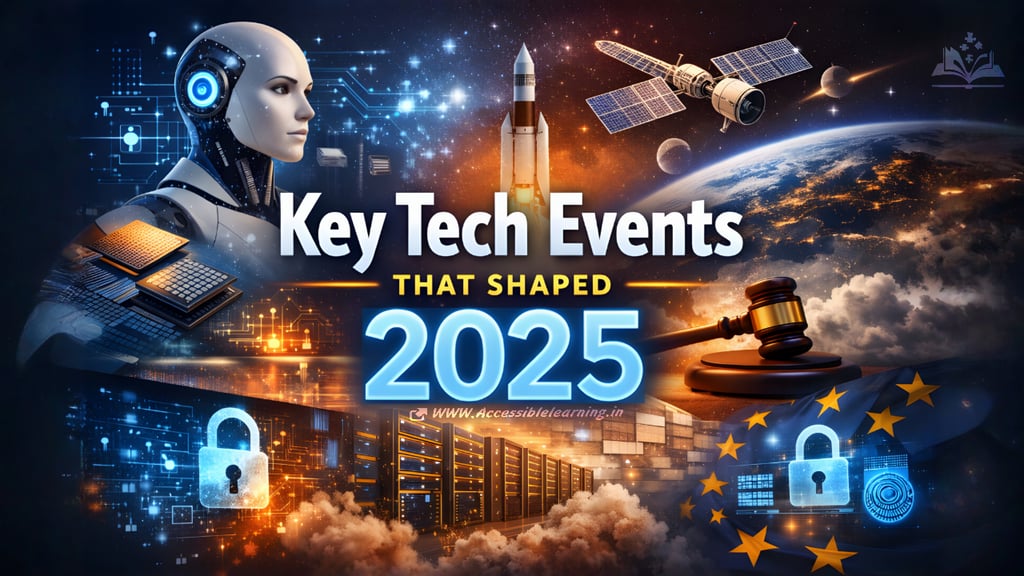
The year 2025 marked a quiet but powerful shift in the global technology landscape. It was not driven by hype or entertainment trends but by deep structural changes in how technology influences governments, businesses, and daily life. Artificial intelligence, cybersecurity, semiconductors, space technology, and digital governance all reached new levels of maturity.
Below is a clear, human-centered overview of the most important technology-only global events of 2025.
Artificial Intelligence Became Core Infrastructure
In 2025, artificial intelligence stopped being treated as an optional productivity tool and became embedded into core systems across industries.
Governments adopted AI for public services such as traffic management, fraud prevention, and healthcare prioritization. Companies integrated AI agents into operations, allowing machines to handle decision-making tasks that once required human judgment. AI models began powering logistics, customer support, financial analysis, and internal planning at scale.
This shift made AI a foundation layer of modern systems rather than an add-on, changing how organizations operate and compete.
Global AI Regulation Moved From Policy to Enforcement
AI regulation entered a serious phase last year, moving beyond discussions into active enforcement.
Multiple regions strengthened laws around AI transparency, data usage, and accountability. Companies were required to disclose when content was generated by AI and explain how models were trained. Violations began carrying financial penalties, forcing organizations to rethink how they build and deploy AI systems.
The result was a slower but more structured pace of AI development, where compliance became just as important as innovation.
Semiconductor Supply Chains Were Strategically Reshaped
Chips became one of the most valuable and contested resources in the tech world during 2025.
Countries invested heavily in domestic semiconductor manufacturing to reduce reliance on foreign suppliers. Restrictions on exporting advanced chips increased, especially those designed for artificial intelligence and defense applications. Chipmakers shifted focus toward AI-optimized processors rather than consumer hardware.
This reorganization of the semiconductor ecosystem changed global tech alliances and long-term innovation strategies.
Cybersecurity Threats Became More Intelligent
Cybersecurity challenges escalated sharply as attackers began using AI-driven techniques.
Phishing campaigns became harder to detect, malware adapted in real time, and ransomware attacks increasingly targeted critical infrastructure such as hospitals, utilities, and transportation systems. Some cyber incidents were officially classified as national security threats rather than criminal activity.
Organizations and governments responded by prioritizing AI-powered security systems and redefining cybersecurity as a strategic necessity.
Big Tech Companies Faced Stronger Antitrust Action
Major technology companies encountered increased legal and regulatory pressure in 2025.
Authorities across multiple regions expanded investigations into data monopolies, platform dominance, and unfair competitive practices. App store policies, advertising control, and data ownership came under closer scrutiny. Some firms were forced to modify business practices to comply with new rules.
This environment reduced unchecked expansion and encouraged the growth of alternative platforms and decentralized solutions.
Quantum Computing Took Measurable Steps Forward
Quantum computing made steady, meaningful progress rather than dramatic headlines.
Improvements in error correction and hardware stability allowed researchers to move closer to practical applications. Governments increased funding, and early enterprise experiments appeared in fields like logistics optimization, chemical modeling, and materials science.
While still not mainstream, quantum computing began transitioning from theoretical research toward early real-world use.
Space Technology Became Commercially and Strategically Central
Space technology in 2025 was driven by function, not exploration alone.
Private companies launched record numbers of satellites to support communication, navigation, and internet access. Satellite-based internet expanded into remote and underserved regions. Governments viewed space infrastructure as critical to national security and global connectivity.
Space was increasingly treated as a vital extension of digital infrastructure on Earth.
Digital Privacy Standards Strengthened Worldwide
Digital privacy gained renewed attention as governments introduced stricter data protection rules.
User consent requirements expanded, tracking practices were limited, and data localization laws forced companies to store information within specific national borders. Businesses had to redesign data collection and monetization strategies to align with these standards.
Privacy began influencing consumer trust and brand reputation more directly than before.
Cloud Computing Shifted Toward Sovereignty
The cloud computing model changed noticeably in 2025.
Governments demanded greater control over where data is stored and processed. Organizations adopted multi-cloud and hybrid strategies to reduce dependency on a single provider. Security, jurisdiction, and data ownership became central concerns rather than secondary considerations.
The idea of fully borderless cloud infrastructure started to fade.
Automation Redefined the Nature of Work
Automation in 2025 altered how work is structured rather than simply replacing jobs.
AI assistants became common in offices, handling scheduling, documentation, and analysis. Hiring focused more on adaptable skills than formal degrees. Continuous learning became essential as roles evolved alongside intelligent systems.
The workforce increasingly shifted toward collaboration between humans and machines.
The technology events of 2025 did not rely on spectacle. Instead, they laid the groundwork for how digital systems will be governed, secured, and integrated into society.
Technology became:
More regulated
More strategic
More deeply embedded in daily life
Rather than accelerating blindly, the tech world began consolidating power, responsibility, and structure. The decisions made last year will shape innovation, policy, and digital freedom for years to come.
Subscribe To Our Newsletter
All © Copyright reserved by Accessible-Learning Hub
| Terms & Conditions
Knowledge is power. Learn with Us. 📚

