

The Biggest Space Technology Breakthroughs That Defined 2025
A comprehensive overview of the most important space technology events of 2025, covering global launches, scientific missions, private space breakthroughs, orbital sustainability, lunar infrastructure, and deep-space innovation that shaped the future of space exploration.
ISRO/NASASPACE/TECHSPACE MISSION
Sachin K Chaurasiya
1/5/20264 min read
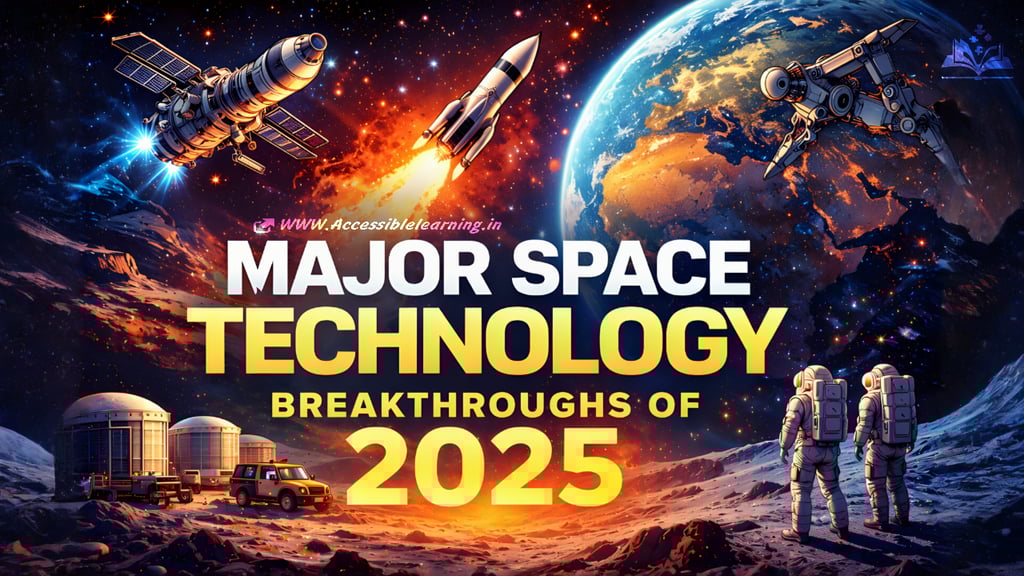
The year 2025 proved that space technology is no longer experimental or distant. Governments and private companies around the world focused on building reliable systems that support long-term exploration, climate monitoring, planetary science, and orbital sustainability. Instead of one-off missions, the space sector emphasized infrastructure, automation, and international cooperation. These developments quietly reshaped how humanity explores space and prepares for a future beyond Earth.
A Historic Surge in Global Space Launches
Spaceflight activity reached record levels in 2025. Governments and private companies together conducted more launches than any previous year. Reusable rockets, streamlined manufacturing, and lower launch costs played a key role.
This surge was not driven by hype but by demand. Earth-observation satellites, communication constellations, scientific probes, and national security payloads all contributed. The high launch frequency showed that space access is becoming routine rather than rare.
NASA Expanded Its Scientific Reach Beyond Earth
NASA focused strongly on science-driven missions in 2025. One major highlight was the deployment of new space observatories designed to study the universe in infrared wavelengths. These missions aim to answer fundamental questions about galaxy formation, cosmic inflation, and the structure of the early universe.
At the same time, NASA continued to strengthen its Mars exploration roadmap. Twin spacecraft missions were launched to study the Martian atmosphere, helping scientists understand how Mars transformed from a potentially habitable planet into a cold desert world.
Private Space Companies Entered a New Phase
Private spaceflight moved beyond basic launch services in 2025.
Heavy-lift rockets developed by commercial players successfully completed complex missions, including deep-space deployments and booster recovery. These achievements signaled that private companies are no longer limited to low-Earth orbit tasks.
Another key development was autonomous spacecraft rendezvous and docking in Earth orbit. This technology is essential for future satellite servicing, orbital refueling, debris removal, and long-duration missions. It also lays the foundation for building infrastructure directly in space.
India Strengthened Its Position as a Space Power
India’s space program had a strong and steady year.
ISRO successfully demonstrated satellite docking technology, an essential capability for crewed missions, space stations, and in-orbit assembly. This placed India among a small group of nations with advanced orbital maneuvering expertise.
Preparations for the Gaganyaan human spaceflight mission continued throughout the year, with major system tests completed. These steps brought India closer to independently sending astronauts into orbit.
India also played a major role in international space cooperation through Earth-observation missions focused on climate monitoring, agriculture, and disaster management.
Earth Observation Became More Critical Than Ever
Space technology in 2025 played a growing role in understanding Earth itself.
New radar and imaging satellites began delivering high-resolution data on climate change, deforestation, glacier movement, and urban expansion. These systems allow scientists and governments to track environmental changes in near real time.
Rather than experimental tools, Earth-observation satellites are now critical infrastructure for climate science, food security, and disaster response.
Plans for Long-Term Human Presence in Space Advanced
Several countries outlined serious plans for long-duration human spaceflight.
Concepts for next-generation space stations, including artificial-gravity designs, gained attention. These designs aim to reduce health risks for astronauts during extended missions.
Lunar infrastructure planning also progressed, with discussions around nuclear power systems, surface habitats, and sustained exploration. These plans reflect a shift from short missions to permanent presence beyond Earth orbit.
The Global Space Economy Reached New Heights
The space economy grew significantly in 2025. Investments flowed into launch services, satellite manufacturing, space data platforms, and orbital services.
Commercial demand now drives much of the industry, while government agencies increasingly act as anchor customers rather than sole operators. This balance is reshaping how space missions are funded, designed, and executed.

Successful Testing of Lunar Surface Communication Networks
In 2025, space agencies tested next-generation communication systems designed specifically for the Moon. Unlike traditional satellite links, these networks are built to support multiple surface assets such as landers, rovers, and future human habitats.
The tests focused on stable data relay, low-latency communication, and resistance to extreme lunar conditions. This marked a critical step toward creating a permanent lunar communication infrastructure, which is essential for long-term exploration and future moon bases.
Breakthrough in Space Debris Tracking and Avoidance Systems
Orbital congestion became a serious concern in 2025, pushing space agencies to deploy advanced space debris monitoring systems. New AI-assisted tracking platforms were introduced to predict collision risks more accurately.
These systems allow satellites to perform automated avoidance maneuvers with minimal human intervention. The development significantly reduced the risk of chain-reaction collisions and marked progress toward sustainable use of Earth orbit.
First Large-Scale In-Orbit Satellite Servicing Demonstration
A major milestone was achieved when robotic spacecraft successfully performed inspection and servicing tasks on aging satellites in orbit. These missions demonstrated fuel transfer, component inspection, and precision maneuvering.
This technology can extend satellite lifespans, reduce space debris, and lower replacement costs. It also opens the door to future orbital construction and maintenance operations.
Advancement in Space-Based Solar Power Experiments
2025 saw meaningful progress in space-based solar power research. Experimental satellites successfully tested wireless energy transmission from orbit to Earth using microwave technology.
While still in early stages, the results showed stable power delivery over long distances. This development renewed interest in space-based energy as a potential clean power source for the future.
Deep Space Navigation Technology Improved Using Pulsars
New autonomous navigation systems were tested in deep space using pulsar signals as natural cosmic beacons. These systems allow spacecraft to determine their position without relying on Earth-based tracking.
The successful demonstrations in 2025 showed that future missions could operate more independently, especially during long-duration journeys to Mars and beyond.
Expansion of Space Weather Monitoring Systems
In response to increased solar activity, multiple space agencies upgraded space weather monitoring satellites in 2025. These systems track solar flares, radiation storms, and magnetic disturbances that can disrupt satellites, power grids, and communication networks.
Improved forecasting accuracy now gives operators more time to protect spacecraft and ground infrastructure, strengthening global technological resilience.
The space technology advances of 2025 reflected a clear shift in priorities. The focus moved from reaching space to operating there efficiently and responsibly. Progress in satellite servicing, debris management, lunar communication systems, and deep-space navigation showed that the global space community is preparing for long-term presence beyond Earth orbit. These efforts laid the groundwork for future human missions, sustainable space operations, and deeper exploration of the solar system.
Subscribe to Frontier Intelligence
All © Copyright reserved by Accessible-Learning Hub
| Terms & Conditions
Accessible Learning Hub — Actionable clarity for high-agency minds.
Weekly breakdowns on AI breakthroughs, capital flow, and human performance systems. Zero fluff.