

The Anatomy of Objectification: Understanding Modern Slang and Its Social Impact
An educational analysis of objectifying language, modern slang, and its psychological, sociological, and real-world impact on respect and boundaries.
HARSH REALITYAWARE/VIGILANTNEPOTISM/SOCIAL ISSUESA LEARNING
Kim Shin | Jagdish Nishad
2/14/20265 min read
Educational Disclaimer
This article examines examples of objectifying language strictly for educational and analytical purposes. The intent is not to promote, normalize, or endorse harmful terminology, but to critically evaluate how such language functions within social, psychological, and cultural contexts. All references are included to support awareness, media literacy, and respectful communication.
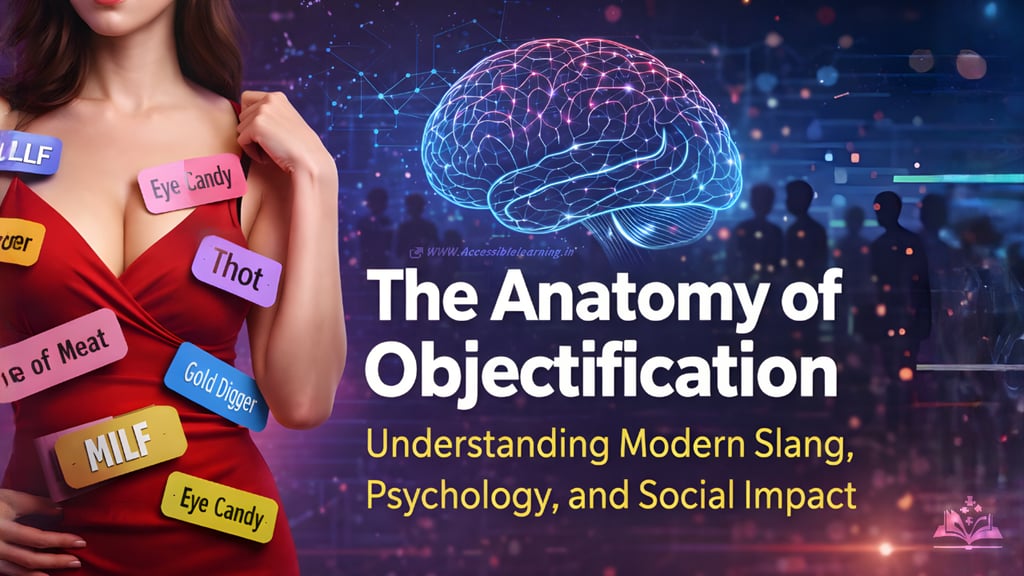
Objectification occurs when a person is reduced to a single trait, body part, stereotype, or function rather than recognized as a full human being. In modern society, slang and informal language often carry objectifying meanings that shape how people are perceived and treated.
While such language may appear casual, humorous, or culturally normalized, its repeated use influences attitudes, reinforces stereotypes, and affects behavior in real-world environments such as schools, workplaces, online spaces, and families.
Understanding objectification is not about being overly sensitive. It is about recognizing how language shapes social reality.
I. Where Objectifying Language Comes From
Digital Culture and Algorithmic Spread
Social media platforms amplify emotionally charged content. Slang that is provocative, sexualized, or degrading often spreads quickly because it generates engagement. Memes, short-form videos, and comment sections normalize these terms through repetition.
Real-world effect:
Teenagers adopt online slang without fully understanding its meaning.
Harmful labels enter classrooms and peer groups as “jokes.”
Online harassment becomes linguistically disguised as humor.
Entertainment and Commercial Incentives
Music, advertising, influencer marketing, and reality television frequently use objectification because it attracts attention. Sexualized or stereotype-driven language becomes monetized.
Real-world effect:
Audiences internalize certain stereotypes as socially acceptable.
Young people learn that attention and validation are linked to appearance.
Public discourse shifts toward image over substance.
Peer Culture and Group Identity
Objectifying slang often functions as a bonding mechanism. Within certain groups, using specific terms signals belonging.
Real-world effect:
Individuals may use degrading language to avoid social exclusion.
Silence becomes complicity in group settings.
Disrespect becomes a performance of loyalty.
II. Psychological Mechanisms Behind Objectification
Power and Control
Reducing someone to a label simplifies them and makes them easier to judge. In situations of insecurity, people may use objectifying language to regain a sense of power.
Real-world example:
After romantic rejection, someone may resort to degrading labels to protect their ego.
Public figures, especially women, are often objectified during criticism to undermine credibility.
Cognitive Efficiency
The human brain categorizes quickly. Labels reduce complexity. Instead of engaging with a person’s individuality, stereotypes provide shortcuts.
Real-world example:
Hiring managers may unconsciously associate certain appearances with competence.
Teachers may treat students differently based on stereotypes reinforced by language.
Desensitization
Repeated exposure reduces emotional response. Words that initially shock eventually feel normal.
Real-world effect:
Workplace banter gradually crosses professional boundaries.
Online comment sections escalate in severity over time.

III. Sociological Dimensions
Gender and Structural Inequality
Objectifying slang disproportionately targets women and often centers on appearance, sexuality, or financial motives. This reflects deeper gender power imbalances.
Real-world impact:
Women in leadership roles face appearance-based commentary more than men.
Professional credibility is undermined by personal or sexualized framing.
Girls may internalize appearance as a primary value.
Commodification of Identity
Modern culture increasingly treats attention as currency. When people are framed as visual or sexual commodities, human value becomes transactional.
Real-world impact:
Influencer culture often rewards hyper-sexualized self-presentation.
People feel pressure to curate identity around desirability.
Relationships are framed around status and image rather than mutual respect.
Normalization Through Humor
Humor often shields objectification from critique. When harmful language is framed as a joke, challenging it can be seen as overreacting.
Real-world impact:
Students may hesitate to report harassment labeled as humor.
Workplace misconduct may be minimized as a casual culture.
Repetition lowers collective sensitivity to disrespect.
IV. Violation of Personal and Social Boundaries
Objectification frequently involves crossing boundaries without consent.
Sexualization of Non-Sexual Roles
Family roles, professional identities, or caregiving positions may be reframed through sexualized slang.
Real-world consequence:
Teachers, parents, or colleagues may feel uncomfortable or unsafe.
Professional environments become hostile or distracting.
Reduction of Professional Identity
When appearance overshadows competence, individuals are not evaluated on skill or achievement.
Real-world consequence:
Career advancement may be influenced by image bias.
Authority may be undermined by gendered commentary.
Digital Boundary Collapse
Online anonymity reduces accountability. People say things digitally that they would not say in person.
Real-world consequence:
Increased cyberbullying.
Permanent digital records of harassment.
Psychological harm amplified by public exposure.
V. Mental Health and Identity Formation
Self-Objectification
Repeated exposure to objectifying language can lead individuals to view themselves primarily in terms of appearance or desirability.
Real-world effects:
Body dissatisfaction.
Eating disorders and appearance anxiety.
Performance pressure on social media.
Social Anxiety and Fear of Judgment
If environments emphasize evaluation based on looks or stereotypes, individuals become hyper-aware of being judged.
Real-world effects:
Reduced classroom participation.
Withdrawal from leadership opportunities.
Avoidance of public expression.
Long-Term Cultural Impact
When objectification becomes normalized, empathy decreases. People become categories rather than individuals.
This affects:
Dating culture
Workplace dynamics
Public debate
Political discourse
VI. Education, Responsibility, and Cultural Change
Addressing objectification requires awareness and skill-building.
Critical Language Reflection
Educators and leaders can encourage analysis of:
What assumptions does this word carry?
Who benefits from this label?
Who is harmed by its repetition?
Policy and Institutional Responsibility
Schools and workplaces must:
Clearly define harassment and boundary violations.
Distinguish between humor and misconduct.
Create reporting systems that are taken seriously.
Media Literacy Education
Students should learn:
How media monetizes attention.
How stereotypes are used to sell products.
How algorithms reward provocative content.
Modeling Respectful Communication
"Respectful communication" means
Addressing people by name and role.
Focusing on achievements and actions.
Avoiding commentary on bodies unless contextually appropriate and consensual.

Objectifying slang is not merely a language issue. It reflects deeper psychological, cultural, and structural patterns. Words shape perception. Perception shapes treatment. Treatment shapes lived experience.
In real-world environments, objectification contributes to:
Gender inequality
Boundary violations
Workplace bias
Cyberbullying
Mental health challenges
Education plays a critical role in breaking this cycle. When individuals understand how language functions socially and psychologically, they gain the ability to choose differently. The goal is not linguistic perfection. The goal is awareness, accountability, and human-centered communication.
FAQ's
Q: What is objectification in modern slang?
Objectification in modern slang refers to language that reduces a person to their appearance, sexuality, stereotype, or social role instead of recognizing them as a complete human being. These labels often simplify identity and ignore individuality.
Q: Why is objectifying language harmful?
Objectifying language can normalize disrespect, reinforce stereotypes, and influence how individuals are treated in schools, workplaces, and online spaces. Over time, repeated exposure shapes perception and behavior.
Q: How does objectification affect mental health?
Objectification can contribute to anxiety, body image concerns, reduced self-esteem, and social pressure. In digital environments, it may also increase vulnerability to cyberbullying and public shaming.
Q: How does modern media contribute to objectification?
Media platforms, entertainment content, and social media trends sometimes use stereotype-based or sexualized language to attract attention. Repetition in popular culture can normalize these patterns.
Q: Is objectifying language always intentional?
Not always. Many people use slang casually without fully understanding its implications. However, even unintentional use can reinforce harmful stereotypes and boundary violations.
Q: How can educators address objectification in classrooms?
Educators can promote critical thinking about language, encourage respectful communication, teach media literacy, and establish clear guidelines around harassment and boundary violations.
Q: How can individuals avoid using objectifying language?
Start by asking:
Does this word reduce someone to one trait?
Would I use this label in a professional setting?
Does it respect the person’s individuality?
Awareness is the first step toward change.
Q: What is the difference between humor and objectification?
Humor becomes objectification when it reduces someone to a stereotype, body, or sexual role in a way that undermines dignity or boundaries. Intent does not always eliminate impact.
Subscribe to Frontier Intelligence
All © Copyright reserved by Accessible-Learning Hub
| Terms & Conditions
Accessible Learning Hub — Actionable clarity for high-agency minds.
Weekly breakdowns on AI breakthroughs, capital flow, and human performance systems. Zero fluff.