

The Algorithmic Divide: Living in the Same House, but Different Realities
We live under the same roof, yet increasingly inhabit different digital worlds. From Facebook and YouTube to TikTok and Instagram Reels, algorithms are shaping what each generation sees, believes, and discusses. Explore how the algorithmic divide is replacing the traditional generation gap, why families struggle to find common ground, and how critical thinking and media literacy can help bridge the growing disconnect.
ACCESSIBLE LEARNING
Sachin K Chaurasiya | Shiv Singh Rajput
6/7/20268 min read
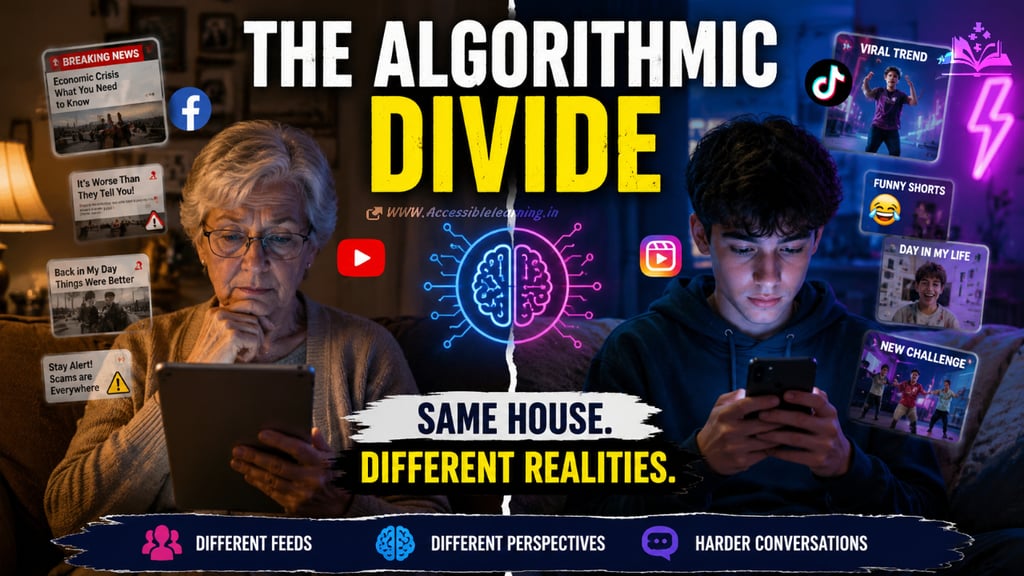
Why You and Your Grandparents Can No Longer Have a Conversation
A strange thing is happening inside modern households. Families sit around the same dinner table, watch events unfold in the same country, and experience the same economy, yet they often seem to live in entirely different worlds.
A teenager talks about a viral trend that shaped online culture overnight. A grandparent discusses a news story that feels urgent and alarming. Parents bring up topics they encountered on social media during their lunch break. Within minutes, the conversation becomes confusing, frustrating, or even confrontational.
For decades, society explained these tensions as a simple generation gap. Young people liked different music, older people preferred different traditions, and everyone eventually found common ground.
Today, the problem runs deeper.
We are witnessing the rise of an algorithmic divide: a reality where different generations consume radically different streams of information, culture, and narratives that rarely overlap. The result is not merely disagreement. It is the gradual disappearance of a shared reality.
What Is the Algorithmic Divide?
The algorithmic divide refers to the growing separation between groups of people who are exposed to different information ecosystems because of recommendation algorithms.
Platforms such as YouTube, Facebook, TikTok, Instagram Reels, and other content-driven networks are designed to maximize engagement. Their algorithms learn what captures attention and then provide more of it.
At first glance, this seems convenient.
If someone likes cooking videos, they receive more cooking content. If another person enjoys sports highlights, their feed becomes filled with sports.
However, over time, these systems do more than personalize entertainment. They personalize reality itself.
Every user begins receiving a unique version of the world based on their viewing habits, emotional reactions, age, interests, fears, and beliefs.
The internet once promised a shared global conversation. Instead, algorithms have fragmented that conversation into millions of separate experiences.
How Older Generations and Younger Generations End Up in Different Worlds
The Information Diet of Older Adults
Many older adults primarily consume content through Facebook, YouTube, messaging groups, and traditional news sources.
Algorithms often recognize patterns such as:
Interest in current events
Political discussions
Community issues
Historical content
Nostalgic media
Health concerns
Financial security topics
As engagement grows, platforms may increasingly recommend:
Fear-based headlines
Crisis-oriented news
Nostalgic stories about "better times"
Polarizing political commentary
Sensational claims
Emotional opinion content
Because negative emotions often drive stronger engagement, content that triggers worry, anger, or outrage can become highly visible. Over months and years, this creates an environment where the world appears increasingly dangerous, unstable, or under threat.
The Information Diet of Younger Generations
Younger users often spend significant time on TikTok, Instagram Reels, YouTube Shorts, and rapidly evolving online communities.
Their algorithms prioritize:
Short-form entertainment
Viral challenges
Meme culture
Creator personalities
Niche interests
Micro-trends
Internet humor
A trend may dominate attention for only a few days before disappearing entirely. Young people become fluent in a fast-moving language of references, jokes, aesthetics, and cultural moments that older generations rarely encounter.
As a result, younger users often perceive the world through:
Rapid cultural shifts
Digital communities
Influencer perspectives
Trend cycles
Online identity formation
The pace of information becomes so fast that even people in their twenties can struggle to keep up.

The Death of Shared Cultural Touchstones
For much of the twentieth century, society experienced culture together. Families watched the same television shows. Communities read the same newspapers.
Millions listened to the same radio stations. While disagreements existed, there were common reference points that connected people. Today, those shared experiences are shrinking.
One family member may spend hours in a Facebook ecosystem discussing politics. Another may be immersed in gaming communities. A third may follow entrepreneurship creators.
A fourth may spend most of their online time consuming beauty, fashion, or lifestyle content. Each person develops a distinct understanding of reality based on what their algorithm considers important.
The consequence is profound:
People no longer disagree about solutions.
They disagree about what is happening in the first place.
Why Family Conversations Feel Harder Than Ever
Many family arguments are no longer driven by personality differences. They are driven by information differences. When two people enter a conversation with completely different assumptions about reality, communication becomes difficult.
One person may view a topic as obvious because their feed has shown it hundreds of times. The other may have never encountered it at all. Both assume they possess common knowledge. Neither realizes their understanding has been shaped by entirely different digital environments.
This often leads to:
Frustration
Misunderstanding
Distrust
Political polarization
Generational resentment
Emotional exhaustion
People leave conversations feeling unheard because they are attempting to discuss issues from incompatible informational foundations.
The Hidden Power of Emotional Algorithms
Algorithms are not necessarily designed to spread misinformation. They are designed to maximize engagement. That distinction matters. The systems reward content that generates reactions.
Human psychology naturally responds strongly to:
Fear
Anger
Shock
Outrage
Validation
Identity reinforcement
As a result, algorithms frequently amplify emotionally charged content regardless of whether it improves understanding. The most engaging content is not always the most accurate. It is often the most emotionally stimulating.
Over time, users can become trapped in cycles where their existing beliefs are continuously reinforced. This process gradually narrows perspective while increasing confidence.
The Rise of Personalized Reality
A generation ago, people argued over opinions. Today, people increasingly argue over facts. This shift stems from personalized reality.
Every user receives:
Different headlines
Different videos
Different recommendations
Different creators
Different narratives
The information environment becomes uniquely tailored. Two people searching for answers may receive entirely different pathways of information, leading them to vastly different conclusions.
The challenge is not simply misinformation. The challenge is fragmentation. When everyone receives a custom-built version of reality, collective understanding becomes difficult to maintain.

Why Critical Thinking Matters More Than Ever
Technology itself is not the enemy. Algorithms are useful tools that help people discover content, learn skills, and find communities. The problem emerges when users stop questioning what they see. Critical thinking acts as a defense against algorithmic manipulation.
It encourages people to ask:
Who created this content?
Why was it created?
What evidence supports this claim?
What information might be missing?
Is this designed to inform me or provoke me?
How would someone with a different viewpoint interpret this?
These questions help transform passive consumers into active thinkers.
Teaching Media Literacy Across Generations
Media literacy can no longer be viewed as a skill only for students. Every generation needs it.
For Older Adults
Effective media literacy education should focus on:
Verifying sources
Recognizing emotionally manipulative headlines
Understanding recommendation algorithms
Identifying misinformation tactics
Cross-checking information from multiple outlets
The goal is not to tell people what to believe. The goal is to help them evaluate information more effectively.
For Younger People
Young users face different challenges. They must learn to:
Slow down information consumption
Distinguish trends from facts
Verify creator credibility
Understand persuasive design
Recognize algorithmic influence
Fast content often creates the illusion of knowledge. Media literacy helps separate familiarity from genuine understanding.
How Families Can Bridge the Algorithmic Divide
Rebuilding communication requires intentional effort.
Start With Curiosity
Instead of immediately challenging someone's viewpoint, ask where they encountered the information.
Understanding the source often reveals the larger context.
Compare Information Sources
Families can benefit from exploring how different platforms present the same topic.
This exercise highlights how algorithms shape perception.
Focus on Questions Instead of Conclusions
Questions encourage discussion.
Conclusions often trigger defensiveness.
Create Shared Experiences
Watching documentaries, reading books, or discussing long-form journalism together can help rebuild common ground.
Shared learning creates shared reference points.
Recognize Algorithmic Influence
Most people underestimate how much their feeds shape their worldview.
Acknowledging this influence makes conversations more productive.
The Future of Human Connection in an Algorithmic Age
The algorithmic divide is one of the defining social challenges of the digital era. Unlike traditional generation gaps, it is not primarily about age, values, or preferences. It is about information architecture.
Families increasingly occupy different digital realities, each reinforced by powerful recommendation systems designed to hold attention. The danger is not simply disagreement.
The danger is losing the ability to understand one another at all. Bridging this divide will require more than better technology. It will require stronger critical thinking, broader media literacy, and a renewed commitment to curiosity.
The families that succeed will not be the ones who always agree. They will be the ones who learn how to question, listen, and explore together despite the algorithms pulling them apart.
In a world where every screen offers a different version of reality, the ability to build shared understanding may become one of the most valuable skills any generation can possess.


FAQ's
Q: What is the algorithmic divide?
The algorithmic divide is the growing separation between groups of people who consume different information online due to personalized recommendation algorithms. Social media platforms, search engines, and video-sharing websites show users content based on their interests and behavior, creating distinct digital realities that often have little overlap.
Q: How do social media algorithms affect different generations?
Social media algorithms often expose different generations to different types of content. Older adults may see more news, political discussions, and nostalgic content, while younger users are more likely to encounter short-form videos, viral trends, memes, and creator-driven content. This can lead to differing perceptions of current events and culture.
Q: Why do family members have different views of reality online?
Family members often use different platforms and engage with different content. Algorithms learn their preferences and continuously recommend similar information, creating personalized information bubbles. Over time, these separate digital experiences can shape different understandings of the same events and issues.
Q: Is the algorithmic divide worse than the traditional generation gap?
In many ways, yes. Traditional generation gaps were often based on differences in values, experiences, and cultural preferences. The algorithmic divide goes further by influencing what information people see, which facts they encounter, and how they interpret the world around them.
Q: What is an algorithmic echo chamber?
An algorithmic echo chamber occurs when digital platforms repeatedly expose users to viewpoints and content that reinforce their existing beliefs. This limits exposure to diverse perspectives and can make people more confident in their views while reducing understanding of alternative viewpoints.
Q: How do recommendation algorithms influence critical thinking?
Recommendation algorithms can reduce critical thinking when users passively consume information without questioning its source or accuracy. However, users who actively verify information, compare sources, and seek diverse viewpoints can minimize this influence and make more informed decisions.
Q: Why do conversations between younger and older generations often become polarized?
Conversations can become polarized because each generation may be drawing information from entirely different digital environments. When people do not share the same facts, references, or media experiences, discussions often become disagreements about reality itself rather than differences in opinion.
Q: What role does media literacy play in reducing the algorithmic divide?
Media literacy helps people understand how content is created, distributed, and recommended online. It teaches users how to evaluate sources, recognize misinformation, identify bias, and think critically about the information they consume.
Q: How can families bridge the algorithmic divide?
Families can bridge the algorithmic divide by discussing information sources openly, practicing active listening, asking questions instead of making assumptions, and exploring different viewpoints together. Shared learning experiences can help rebuild common ground.
Q: What are the signs that algorithms are shaping your worldview?
Common signs include seeing highly repetitive content, rarely encountering opposing viewpoints, feeling strong emotional reactions to online content, and assuming everyone else sees the same information you do. These indicators suggest that algorithms may be influencing your perception of reality.
Q: Can social media algorithms contribute to misinformation?
Yes. While algorithms are designed to maximize engagement rather than spread misinformation, emotionally charged, sensational, or misleading content often receives high engagement. This can increase its visibility and reach, making misinformation more likely to spread.
Q: Why is critical thinking important in the age of algorithms?
Critical thinking helps individuals evaluate information objectively, question assumptions, verify claims, and avoid manipulation. As algorithms increasingly shape what people see online, critical thinking becomes essential for making informed decisions and understanding complex issues.
Q: How does TikTok differ from Facebook in shaping user perspectives?
TikTok primarily focuses on short-form, trend-driven content and rapidly evolving communities, while Facebook often emphasizes news, social discussions, and community-based content. These different environments can create distinct worldviews among users of different age groups.
Q: What is personalized reality?
Personalized reality refers to the unique version of information and content each user receives online through algorithmic recommendations. Because every user's feed is different, people can develop vastly different perceptions of events, trends, and social issues.
Q: Will the algorithmic divide continue to grow in the future?
Unless users become more aware of how algorithms influence information consumption, the algorithmic divide is likely to expand. However, increased media literacy, stronger critical thinking skills, and greater transparency from technology platforms can help reduce its impact.
Subscribe to Frontier Intelligence
All © Copyright reserved by Accessible-Learning Hub
| Terms & Conditions
Accessible Learning Hub — Actionable clarity for high-agency minds.
Weekly breakdowns on AI breakthroughs, capital flow, and human performance systems. Zero fluff.