

The Algorithm vs. The Textbook: Rebuilding Tolerance for "Boring"
Has TikTok-era attention made textbooks feel impossible to read? Explore how algorithms reshape focus, why boredom feels painful, and practical ways to rebuild deep concentration in a world of constant digital stimulation.
ACCESSIBLE LEARNING
Sachin K Chaurasiya | Kim Shin
6/11/20268 min read
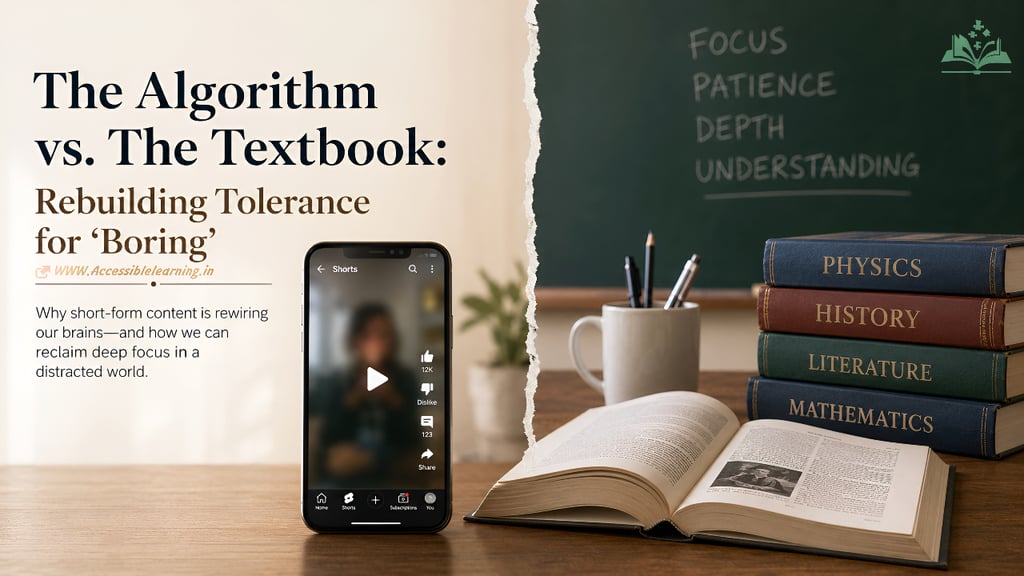

Real Life Doesn't Move at TikTok Speed. How Do We Help the Brain Cope?
A teenager spends hours scrolling through short videos. Every swipe delivers something new: a joke, a shocking fact, a dance trend, a dramatic story, or a perfectly edited clip designed to capture attention within seconds. The next morning, that same teenager sits down with a textbook.
The page doesn't move. Nothing flashes.
No music plays. No rewards arrive every fifteen seconds.
Within minutes, the experience feels unbearable.
Many people assume this reaction is simply laziness, lack of discipline, or a weak work ethic. But modern neuroscience suggests something more complicated is happening. The brain is adapting to a digital environment that operates at extraordinary speed, and traditional learning often cannot compete with that pace.
This creates one of the biggest educational challenges of the digital age: rebuilding tolerance for "boring."
The conflict is no longer just between students and homework. It is increasingly a battle between the algorithm and the textbook.
The Rise of Hyper-Stimulation
Modern social platforms are not simply entertainment tools. They are sophisticated attention-optimization systems. Every recommendation algorithm is designed to maximize engagement. If a user loses interest, the system instantly offers something more exciting.
The result is an endless stream of novelty.
Human brains are naturally attracted to novelty because it often signals potential rewards. Each surprising video, interesting fact, emotional reaction, or entertaining clip can trigger dopamine activity in the brain's reward system.
Importantly, dopamine is not merely the "pleasure chemical." It is heavily involved in motivation, anticipation, learning, and reward prediction.
Short-form content creates a cycle where:
New content appears constantly
Attention shifts rapidly
Rewards arrive frequently
Effort remains minimal
Novelty never stops
Over time, the brain becomes accustomed to high-frequency stimulation. The problem begins when that expectation follows us into environments that operate differently.
Why Textbooks Feel Painfully Slow
Reading a textbook requires a completely different cognitive process. Unlike social media, textbooks demand:
Sustained attention
Delayed gratification
Mental effort
Reflection
Patience
Working memory
The reward structure is fundamentally different. A short video may deliver a payoff within seconds. A chapter in a biology textbook might require twenty minutes before a meaningful insight appears.
To a brain conditioned for rapid stimulation, that delay can feel intolerable. The material itself may not actually be boring. The issue is often that the brain has become calibrated to a much faster reward schedule.
Imagine spending months driving a sports car and then being asked to ride a bicycle uphill. The bicycle is still effective. It simply feels painfully slow compared to what came before. This is increasingly how many learners experience traditional education.
The Neuroscience of Perceived Boredom
Boredom is often misunderstood. Many researchers view boredom not as the absence of stimulation but as a mismatch between what the brain expects and what it receives.
When someone repeatedly experiences fast, highly engaging content, the brain begins anticipating similar levels of stimulation elsewhere. When those expectations are not met, discomfort emerges.
This discomfort can feel like:
Restlessness
Irritation
Mental fatigue
Difficulty concentrating
An urge to switch tasks
Constant distraction
The learner may interpret these feelings as proof that studying is impossible. In reality, the brain is experiencing a temporary adjustment period. The challenge is similar to reducing sugar intake.
After consuming extremely sweet foods for a long time, natural foods can initially seem bland. Eventually, sensitivity returns. The same principle often applies to attention.

The Hidden Cost of Constant Novelty
Novelty is not inherently harmful. Innovation, creativity, and curiosity all depend on it. The problem emerges when novelty becomes the default expectation. Many valuable activities contain long stretches of repetition and gradual progress.
Consider:
Learning mathematics
Reading literature
Practicing music
Writing essays
Conducting research
Developing professional expertise
Building a business
Learning a language
These skills are not mastered through constant excitement. They are built through sustained engagement. Unfortunately, algorithm-driven environments often teach the opposite lesson:
"If something feels difficult or slow, move on immediately."
Real-world achievement rarely works that way. Success usually requires staying with a problem long after the initial excitement disappears.
Why "Boring" Is Actually a Superpower
One of the most underrated abilities in modern society is the capacity to remain engaged when nothing exciting is happening.
Historically, this was normal.
Students read lengthy chapters.
Professionals worked through detailed reports.
Scientists spent years analyzing data.
Artists practiced the same techniques repeatedly.
Athletes performed identical drills thousands of times.
Today, many people experience fewer opportunities to develop this tolerance.
Yet the ability remains incredibly valuable.
People who can persist through boredom often gain advantages because they can:
Learn deeper concepts
Develop expertise
Complete long-term projects
Build stronger focus
Resist distractions
Master complex skills
In many ways, attention endurance has become a competitive advantage. As others become increasingly distracted, focused individuals become increasingly rare.
The Attention Endurance Crisis
Physical fitness requires endurance training. Attention works similarly. A marathon runner does not begin with 42 kilometers. They build capacity gradually. The same principle applies to concentration.
Many learners unknowingly attempt cognitive marathons after years of attention sprinting. They sit down expecting to focus for an hour and become frustrated when their minds wander after five minutes.
This is not necessarily failure. It may simply indicate that attention endurance needs rebuilding. Just as muscles weaken without use, sustained focus can weaken when constantly interrupted. The good news is that it can also be strengthened again.
Rebuilding Tolerance for Slow Learning
The goal is not to eliminate technology. Digital tools provide enormous educational benefits. The objective is balance. Learners must train the brain to function effectively in both fast and slow environments.
1. Practice Delayed Rewards
Choose activities that do not provide immediate gratification. Examples include:
Reading books
Solving puzzles
Writing journals
Learning instruments
Studying difficult subjects
Initially, these tasks may feel uncomfortable. That discomfort is often part of the adaptation process.
2. Increase Focus Time Gradually
Start small. Instead of demanding an hour of concentration, begin with:
10 minutes
Then 15 minutes
Then 20 minutes
Then 30 minutes
Consistency matters more than intensity.
3. Remove Constant Interruptions
Notifications fragment attention.
Every interruption trains the brain to expect novelty.
Creating uninterrupted study sessions helps restore deeper focus.
4. Embrace Productive Boredom
Not every moment needs stimulation.
Waiting in line, riding a bus, or sitting quietly can become opportunities for the brain to reset.
Research increasingly suggests that moments of mental idleness support creativity, reflection, and problem-solving.
5. Make Reading a Daily Habit
Reading remains one of the most effective forms of attention training. Unlike scrolling, reading encourages:
Sequential thinking
Deep comprehension
Memory formation
Imagination
Cognitive endurance
Even fifteen minutes per day can produce meaningful improvements over time.

The Role of Parents and Educators
The solution is not to demonize technology. Short-form content is not inherently evil. The challenge lies in helping young people understand how different environments shape attention.
Parents and educators can:
Explain how algorithms work
Encourage balanced media habits
Create distraction-free study periods
Model-focused behavior
Reward effort rather than constant entertainment
Most importantly, they can normalize the reality that learning often feels difficult before it becomes rewarding. Students should not assume that boredom means failure. Sometimes boredom is simply the doorway to deeper learning.
The Future of Education in an Algorithmic World
Educational systems face a unique challenge. Students are increasingly comparing classrooms to platforms engineered by thousands of designers, psychologists, and data scientists whose sole objective is maximizing engagement.
Schools cannot realistically compete on entertainment alone. Nor should they. The purpose of education is not merely to capture attention. It is to cultivate understanding.
That means helping learners develop skills that algorithms rarely teach:
Patience
Reflection
Critical thinking
Persistence
Deep focus
Intellectual resilience
These abilities become even more valuable in a world saturated with instant gratification.
The Brain Can Adapt Back
The tension between algorithms and textbooks is not a battle that technology must win. The human brain remains remarkably adaptable. Just as it can become accustomed to rapid digital stimulation, it can relearn the value of slower, deeper forms of engagement.
The process may feel uncomfortable at first. Textbooks may seem dull. Lectures may feel slow. Reading may require effort. But these experiences are not signs of failure. They are often signs that the brain is rebuilding an essential skill: the ability to stay present when rewards are delayed.
In a culture increasingly optimized for speed, the capacity to engage with difficult, slow, and seemingly "boring" work may become one of the most powerful cognitive advantages a person can possess.
The future belongs not only to those who can capture attention but also to those who can sustain it.
FAQ's
Q: How does short-form video content affect attention span?
Short-form video platforms expose users to rapid, high-frequency stimulation and constant novelty. Over time, the brain can become accustomed to receiving new information every few seconds, making slower activities such as reading, studying, or attending lectures feel less engaging. However, this does not necessarily mean attention span is permanently damaged. The brain can adapt through intentional focus-building habits.
Q: Why do textbooks feel boring after watching TikTok, Reels, or Shorts?
Textbooks provide delayed rewards, while short-form videos deliver immediate gratification. When the brain becomes used to frequent dopamine-driven stimulation, slower learning formats may feel less rewarding. The issue is often not the textbook itself but the contrast between the speed of digital content and the pace of deep learning.
Q: Can social media actually change the way the brain learns?
Research suggests that digital environments can influence attention patterns, information processing, and reward expectations. While social media does not fundamentally rewire the brain in a harmful or irreversible way, excessive exposure to highly stimulating content can affect how easily a person engages with tasks that require sustained concentration.
Q: Is boredom important for learning and cognitive development?
Yes. Boredom can play a valuable role in learning, creativity, and problem-solving. When the brain is not constantly occupied by external stimulation, it has more opportunities to reflect, process information, form connections, and develop independent thinking skills.
Q: How can students improve focus after spending too much time on short-form content?
Students can rebuild focus by gradually increasing study sessions, reducing distractions, turning off notifications, reading regularly, and practicing activities that require sustained attention. Consistency is more important than attempting dramatic changes overnight.
Q: Does reading books improve attention span?
Reading books encourages deep focus, comprehension, memory retention, and critical thinking. Unlike scrolling through feeds, reading requires continuous engagement with a single topic, which helps strengthen attention endurance over time.
Q: What is attention endurance, and why is it important?
Attention endurance is the ability to maintain focus on a task for an extended period without becoming distracted. It is essential for learning complex subjects, solving difficult problems, developing expertise, and completing long-term projects. In a distraction-rich world, attention endurance is becoming a valuable competitive advantage.
Q: Are TikTok and other short-form platforms harmful to students?
Short-form platforms are not inherently harmful. They can provide entertainment, education, and creativity. Problems arise when excessive use reduces time spent on activities that develop deep focus, critical thinking, and long-term learning. Balance is the key factor.
Q: How long does it take to rebuild concentration and focus?
The timeline varies from person to person. Many individuals notice improvements within a few weeks of consistent practice, while significant changes may take several months. Like physical fitness, cognitive endurance improves gradually through regular training.
Q: Why is deep work becoming more valuable in the digital age?
As algorithms increasingly compete for human attention, the ability to concentrate deeply becomes rarer. People who can focus without constant stimulation are often better equipped to learn complex skills, produce high-quality work, solve challenging problems, and achieve long-term goals.
Q: Can excessive screen time make studying feel harder?
Excessive screen time, particularly when it involves rapid content consumption, can make studying feel more difficult because it trains the brain to expect frequent stimulation. This can increase feelings of restlessness during slower, effort-based learning activities.
Q: What is the best way to balance entertainment and learning?
A healthy balance includes enjoying digital entertainment while also dedicating time to reading, studying, creative projects, exercise, and offline activities. Creating intentional periods for focused work helps ensure that entertainment does not replace deeper forms of learning and personal growth.
Q: Why do educators talk about a growing attention crisis?
Many educators report that students increasingly struggle with sustained focus, reading endurance, and patience for complex tasks. While multiple factors contribute to this trend, the rise of highly engaging digital media is often considered one important influence on modern attention habits.
Q: Can the brain recover from digital overstimulation?
Yes. The brain is highly adaptable. Reducing constant stimulation, practicing focused work, reading regularly, and embracing periods of low stimulation can help restore attention endurance and improve the ability to engage with deeper forms of learning.
Q: What is the main lesson from the debate between algorithms and textbooks?
The key lesson is that fast, entertaining content and deep, meaningful learning serve different purposes. Algorithms are designed to capture attention, while textbooks are designed to build understanding. Long-term success often depends on developing the ability to thrive in both worlds.
Subscribe to Frontier Intelligence
All © Copyright reserved by Accessible-Learning Hub
Accessible Learning Hub — Actionable clarity for high-agency minds.
Weekly breakdowns on AI breakthroughs, capital flow, and human performance systems. Zero fluff.