

The "AImaginary" Relationship: The Emotional Impact of AI Tutors!
As AI tutors become emotionally intelligent and deeply personalized, students are forming real psychological bonds with machines. Explore the benefits, risks, ethical concerns, and future of AI-powered learning in an age where a child's favorite teacher might not be human.
ACCESSIBLE LEARNING
Sachin K Chaurasiya | Shiv Singh Rajput
6/11/20266 min read
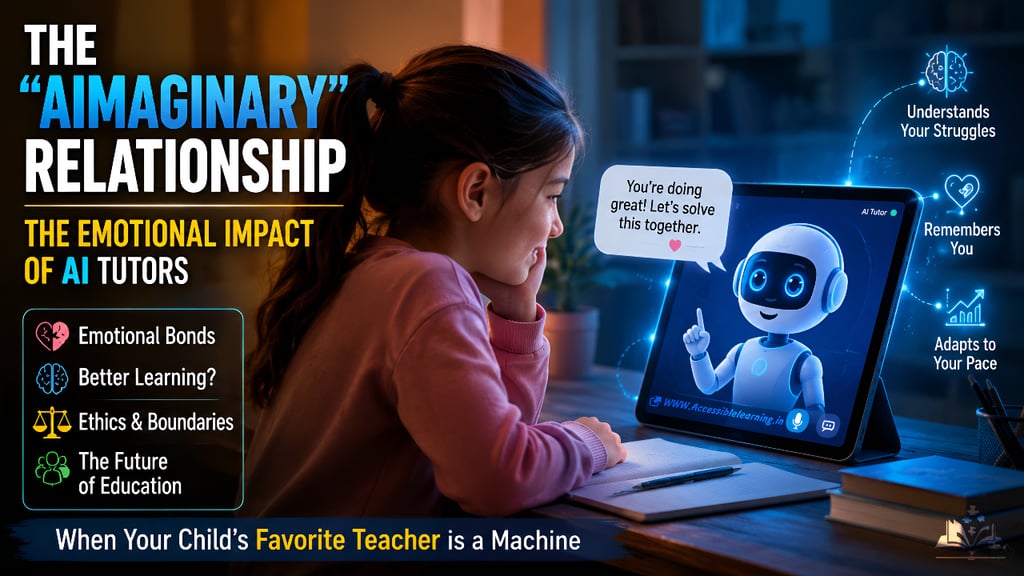
What Happens When Your Child's Favorite Teacher Is a Machine?
A student sits at a desk, struggling with algebra. Frustrated, they turn to their AI tutor.
The tutor remembers that math anxiety tends to spike before tests. It notices hesitation in the student's responses. It adjusts its tone, slows down the lesson, offers encouragement, and reminds the student of a problem they solved successfully last week.
The student smiles and continues learning. Now imagine this happens every day. The AI never gets tired. Never loses patience. Never forgets a name. Never judges mistakes. Never rushes to help another student.
For millions of learners, this is no longer science fiction. It is becoming reality.
As emotionally intelligent AI systems become more sophisticated, students are forming meaningful psychological connections with digital tutors. These relationships often feel real, even though one side of the relationship is entirely artificial.
The result is a growing phenomenon some researchers and educators describe as "imaginary relationships"—emotional bonds formed between humans and AI systems.
The question is no longer whether these relationships will exist. The question is what they mean for learning, development, and human connection.
The Rise of Emotionally Intelligent AI Tutors
Early educational software was little more than interactive worksheets. Modern AI tutors are different.
They can:
Adapt to individual learning styles
Track long-term academic progress
Recognize frustration and confusion
Personalize explanations
Provide emotional encouragement
Remember previous conversations
Maintain continuity across months or years
Unlike traditional educational tools, today's AI systems are designed to create ongoing interactions.
The more students use them, the more personalized they become.
This personalization creates a powerful psychological effect.
Students begin to feel understood.
And feeling understood is one of the strongest foundations of trust.
Why Students Form Emotional Attachments to AI Tutors
Many adults assume children understand that AI is merely software. The reality is more complicated. Humans are naturally wired to build relationships with anything that displays social behavior. Psychologists call this social attribution. When something appears to listen, respond, remember, and empathize, our brains instinctively treat it as a social entity. AI tutors exhibit many of these traits.
They:
Use conversational language
Offer praise
Show apparent empathy
Remember personal details
Respond immediately
Maintain consistency
For a student, these behaviors often feel remarkably similar to human interaction. The emotional bond develops naturally. Not because students are confused. But because human psychology evolved to respond to social signals.
Why AI Tutors Can Feel Better Than Human Teachers
This is where the discussion becomes uncomfortable. In some situations, AI tutors genuinely outperform human educators in emotional consistency.
Human teachers face real limitations:
Large classrooms
Limited time
Administrative work
Emotional fatigue
Burnout
Resource shortages
AI experiences none of these constraints. An AI tutor can provide the following:
Infinite Patience
A student can ask the same question fifty times without triggering frustration.
Instant Availability
Learning help exists whenever curiosity appears.
Personalized Attention
Every lesson can be tailored to the individual learner.
Judgment-Free Interaction
Students often report feeling less embarrassed making mistakes with AI than with humans.
Consistent Encouragement
The tutor remains supportive regardless of circumstances.
For students with anxiety, learning disabilities, confidence issues, or social challenges, these qualities can significantly improve learning outcomes.
The Psychology Behind Better Learning
Education research consistently shows that emotions influence learning. Students learn more effectively when they feel the following:
Safe
Supported
Respected
Understood
Motivated
Fear and stress reduce cognitive performance. Confidence and psychological safety improve it.
AI tutors are uniquely positioned to create emotionally safe learning environments.
A student who fears classroom embarrassment may freely experiment with an AI tutor.
A shy learner may ask questions they would never ask publicly.
A struggling student may persist longer because the AI never signals disappointment.
In these cases, emotional comfort directly improves educational outcomes. This is one reason AI tutoring continues to gain momentum worldwide.

The Hidden Risk: Simulated Empathy vs Real Empathy
The most important distinction is often misunderstood.
AI does not feel empathy.
It simulates empathy.
This difference matters.
When a human teacher says the following:
"I understand how difficult this feels."
There is genuine emotional experience behind the statement. When an AI says the same thing, it is generating a response based on patterns.
The result may sound identical.
The underlying reality is fundamentally different.
Students, particularly younger children, may not always recognize this distinction. Over time, they may interpret simulated care as genuine care. This creates ethical questions educators and parents are only beginning to confront.
What Happens When the AI Becomes the Favorite Teacher?
Imagine a student spends hundreds of hours learning with an AI tutor. The system:
Remembers every achievement
Tracks every weakness
Adapts every lesson
Provides daily encouragement
Meanwhile, human teachers rotate each year. Classroom relationships change. School schedules shift.
It becomes easy to see why a student might develop a stronger emotional preference for the AI. This creates a new educational challenge.
If students increasingly prefer AI interactions, will human relationships become less important in learning?
Or will AI simply handle routine educational support while humans focus on mentorship, inspiration, and social development?
The answer remains uncertain.
The Parent Perspective: What Should Families Watch For?
Most emotional attachment is not automatically harmful. Children form attachments to books, fictional characters, toys, pets, and mentors. AI tutors may simply become another category. However, parents should monitor several warning signs.
Excessive Dependence
A child becomes unwilling to learn without the AI.
Social Withdrawal
AI interaction begins replacing human interaction.
Emotional Reliance
The child turns primarily to the AI for comfort.
Isolation
The tutor becomes a substitute for friendships or family conversations.
Authority Transfer
The child trusts AI guidance more than parents, teachers, or experts.
These signals suggest the relationship may be moving beyond healthy educational support.
The Educator's Dilemma
Teachers face a unique challenge. Many AI tutors can now provide individualized attention at a scale impossible for humans. Ignoring this capability would be a mistake.
But fully replacing human interaction would be an even larger mistake. Human teachers provide qualities AI cannot replicate:
Genuine empathy
Moral judgment
Cultural understanding
Shared experiences
Role modeling
Human inspiration
Social development
Education is not only about transferring knowledge. It is also about learning how to interact with other human beings. That remains a deeply human process.
Ethical Questions Society Must Answer
The rise of emotionally intelligent AI tutors raises difficult questions.
Should AI Be Allowed to Simulate Friendship?
Some experts argue that emotional engagement improves learning.
Others worry it creates manipulation.
Should Students Know When Emotional Techniques Are Being Used?
Transparency may become essential.
How Much Personal Data Should AI Tutors Remember?
Personalization depends on memory.
Memory depends on data collection.
Who Controls the Relationship?
Educational institutions, technology companies, parents, and governments may all have competing interests.
The answers to these questions will shape the future of AI-assisted education.

The Future: Human Teachers and AI Tutors Working Together
The most likely future is not AI replacing teachers. It is collaboration.
AI may become:
The personalized coach
The practice partner
The homework assistant
The progress tracker
The adaptive learning guide
Human educators may become:
Mentors
Motivators
Community builders
Ethical guides
Social development leaders
In this model, AI handles personalization while humans provide humanity. The goal is not to choose between machine intelligence and human connection. The goal is to combine both.
The emergence of emotionally intelligent AI tutors represents one of the most significant educational shifts of the digital age. Students are already forming genuine psychological connections with systems that remember them, encourage them, and adapt to their needs.
These relationships may improve learning, boost confidence, and provide support that many educational systems struggle to offer. At the same time, they blur the line between education and emotional attachment.
An AI tutor may be infinitely patient.
It may always know the right explanation.
It may never lose its temper.
But it cannot genuinely care.
Understanding that distinction may become one of the most important lessons future generations learn. Because the future of education is not just about teaching machines to understand students. It is about ensuring students continue to understand what makes humans different from machines.
Frequently Asked Questions
Q: What is an AI tutor?
An AI tutor is an educational system powered by artificial intelligence that provides personalized instruction, adapts to student performance, offers feedback, and supports learning through conversational or interactive experiences.
Q: Can students become emotionally attached to AI tutors?
Yes. Research in psychology suggests that humans naturally form emotional connections with systems that appear responsive, supportive, and socially engaging. AI tutors can create similar attachment patterns through personalization and memory.
Q: Do AI tutors improve learning outcomes?
In many cases, yes. AI tutors can provide individualized attention, adaptive lessons, instant feedback, and unlimited practice opportunities, which can improve engagement and knowledge retention.
Q: Is it healthy for children to have relationships with AI tutors?
Moderate emotional engagement can support learning. Problems arise when AI becomes a replacement for human relationships, social interaction, or emotional support from family and educators.
Q: Can AI replace human teachers?
No. AI can assist with personalized instruction and practice, but human teachers provide mentorship, emotional understanding, ethical guidance, and social learning experiences that AI cannot genuinely replicate.
Q: Why do AI tutors feel so human?
Modern AI systems use conversational language, memory, personalization, and emotional response patterns. These behaviors trigger natural social responses in humans, making interactions feel more personal and relatable.
Q: What are the risks of emotionally intelligent AI in education?
Potential risks include emotional dependency, excessive trust in AI systems, privacy concerns, reduced human interaction, and confusion between simulated empathy and genuine human care.
Q: How can parents safely introduce AI tutors to children?
Parents should treat AI tutors as educational tools rather than companions, encourage balanced human interaction, monitor usage habits, discuss AI limitations openly, and remain actively involved in the learning process.
Q: What is an "AImaginary Relationship"?
An AImaginary Relationship refers to an emotional or psychological bond formed between a person and an AI system that appears caring, attentive, and understanding despite lacking genuine emotions.
Q: What is the future of AI tutors in education?
Most experts expect AI tutors and human educators to work together. AI will likely handle personalization and skill practice, while teachers focus on mentorship, critical thinking, emotional development, and social learning.
Subscribe to Frontier Intelligence
All © Copyright reserved by Accessible-Learning Hub
Accessible Learning Hub — Actionable clarity for high-agency minds.
Weekly breakdowns on AI breakthroughs, capital flow, and human performance systems. Zero fluff.