

The "AI Workforce" Architect: Scaling a Business Without Hiring
The AI Workforce Architect is redefining business growth by using AI agents, automation, and workflow orchestration to scale operations without hiring. Learn how businesses can increase output, improve efficiency, and create operational leverage through AI-driven systems.
AI ASSISTANTCOMPANY/INDUSTRYAI/FUTUREENTREPRENEUR/BUSINESSMAN
Sachin K Chaurasiya
6/25/20266 min read
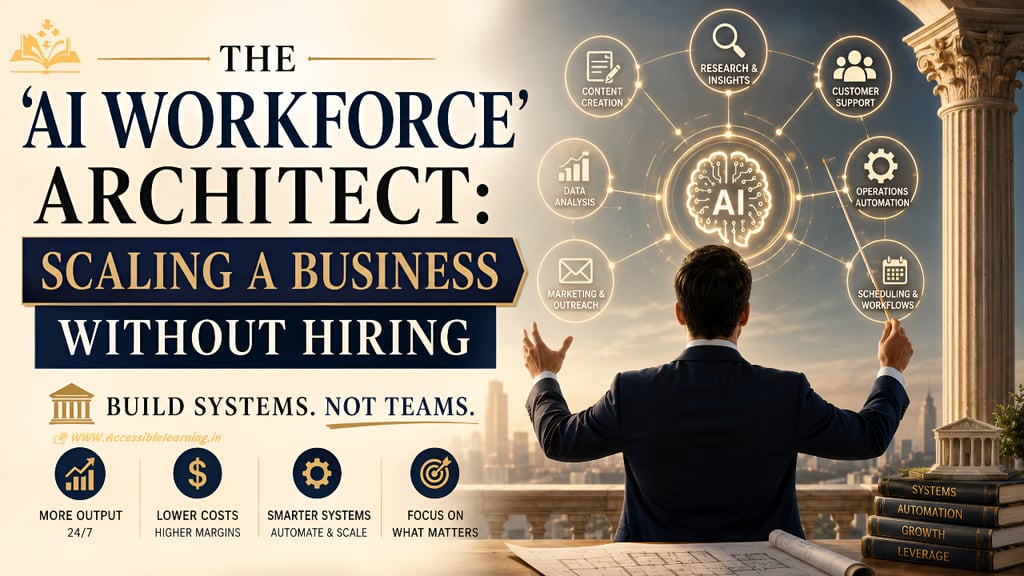
For decades, business growth followed a predictable formula: more customers required more employees. More employees required more managers. More managers required more systems. Eventually, growth became synonymous with increasing payroll, operational complexity, and administrative overhead.
That formula is breaking.
Today, a new business role is emerging: the AI Workforce Architect. Instead of building teams exclusively with human labor, these professionals design, deploy, and manage networks of AI agents that perform tasks traditionally handled by departments, assistants, analysts, marketers, customer support representatives, and operations teams.
The result is not a company with fewer ambitions. It is a company capable of achieving significantly more output without proportional increases in headcount.
This shift is not about replacing every employee with artificial intelligence. It is about redesigning how work gets done and creating systems that scale far beyond the limitations of traditional hiring.
What Is an AI Workforce?
An AI workforce is a collection of specialized AI systems designed to perform business functions with minimal human intervention. Think of it as a digital organization made up of virtual workers.
Instead of hiring:
A content writer
A researcher
A customer support representative
A data analyst
A project coordinator
A social media manager
Businesses can deploy AI agents that handle substantial portions of those responsibilities. Unlike traditional software, modern AI systems can:
Understand context
Make decisions
Generate content
Analyze data
Communicate naturally
Learn from feedback
Coordinate with other AI systems
The AI Workforce Architect creates the structure that allows these systems to operate together efficiently.
Why Traditional Scaling Is Becoming Less Efficient
Most businesses encounter the same growth challenges:
Rising Labor Costs
Hiring creates recurring expenses:
Salaries
Benefits
Training
Equipment
Management costs
Employee turnover
As organizations grow, these costs compound.
Communication Bottlenecks
Larger teams require more meetings, more reporting, and more coordination.
Many organizations eventually spend more time managing work than performing work.
Operational Complexity
Growth often creates the following:
Multiple departments
Layered approval processes
Documentation requirements
Management structures
Complexity increases faster than productivity.
Talent Availability
Finding skilled professionals remains difficult across many industries.
Businesses frequently delay growth because they cannot find qualified people quickly enough.
AI-driven operations directly challenge these limitations.
The Rise of the AI Workforce Architect
The AI Workforce Architect is becoming one of the most valuable strategic roles in modern business.
Their job is not merely to use AI tools.
Their responsibility is to design systems where AI performs meaningful work at scale.
An AI Workforce Architect asks questions such as:
Which processes can be automated?
Which decisions can be delegated to AI?
How should AI agents communicate?
Where should humans remain involved?
How can workflows operate continuously?
Rather than managing employees, they manage workflows. Rather than building departments, they build systems.

Building an AI Workforce: Core Components
1. AI Research Agents
Every business relies on information. Research agents can:
Monitor competitors
Track industry trends
Analyze customer behavior
Gather market intelligence
Summarize reports
Tasks that once required hours can often be completed in minutes.
2. Content Production Agents
Content remains one of the largest growth drivers online. AI content agents can:
Generate blog articles
Create social media content
Draft newsletters
Produce marketing copy
Develop content outlines
Human oversight remains valuable, but production speed increases dramatically.
3. Customer Support Agents
Modern AI support systems can:
Answer common questions
Resolve routine issues
Process requests
Route complex cases
Operate 24/7
Many businesses can automate a significant percentage of customer interactions.
4. Operations Agents
Operations often contain repetitive workflows. AI systems can:
Process documents
Manage internal requests
Schedule tasks
Generate reports
Monitor performance metrics
This reduces administrative burden across the organization.
5. Data Analysis Agents
Data is valuable only when interpreted. AI analysts can:
Identify trends
Detect anomalies
Create dashboards
Generate forecasts
Provide recommendations
Businesses gain insights faster without requiring large analytics teams.
6. Sales and Lead Qualification Agents
Sales teams frequently spend excessive time on low-quality prospects. AI agents can:
Qualify leads
Conduct initial outreach
Score opportunities
Personalize communication
Schedule appointments
This allows human sales professionals to focus on closing deals.
The Multi-Agent Business Model
The real breakthrough is not a single AI tool. It is the coordination of multiple specialized agents. Imagine a workflow:
Step 1
A research agent discovers an emerging industry trend.
Step 2
A content agent creates an article about that trend.
Step 3
A social media agent distributes promotional content.
Step 4
A lead generation agent captures interested prospects.
Step 5
A CRM agent organizes incoming leads.
Step 6
A customer support agent answers initial inquiries.
Step 7
A reporting agent analyzes performance.
No department meetings.
No handoffs between teams.
No delays caused by scheduling conflicts.
Just workflow execution.
This is the foundation of the AI workforce model.
Where Human Workers Remain Essential
Many predictions about AI focus on replacement.
The reality is more nuanced.
Human capabilities remain difficult to replicate.
These include:
Strategic Thinking
AI can generate options.
Humans define direction.
Creativity and Original Insight
AI excels at pattern recognition.
Groundbreaking ideas still emerge primarily from human imagination and experience.
Relationship Building
Trust remains a human advantage.
Clients often prefer meaningful relationships with real people.
Leadership
Organizations require vision, culture, and accountability.
These functions remain deeply human.
High-Stakes Decisions
Major financial, legal, and ethical decisions should continue to involve human judgment.
The strongest organizations combine AI efficiency with human leadership.
The Economics of Scaling Without Hiring
Businesses traditionally face a difficult equation:
More revenue requires more people.
AI changes this equation.
Instead of linear scaling:
Revenue increases
Payroll remains relatively stable
Margins improve
Operational costs grow slowly
This creates what many entrepreneurs seek but rarely achieve:
Operational Leverage
One individual equipped with sophisticated AI systems can often produce output that previously required an entire team.
The result is
Faster growth
Lower overhead
Higher profitability
Greater agility
The companies that master this leverage gain significant competitive advantages.

Common Mistakes Businesses Make
Using AI Without a System
Many companies deploy random AI tools.
Without integration, productivity gains remain limited.
Systems outperform isolated tools.
Automating Broken Processes
AI amplifies existing workflows.
If a process is inefficient, automation often increases inefficiency.
Processes should be optimized before automation.
Ignoring Human Oversight
AI can make mistakes.
Critical outputs require review mechanisms.
Trust without verification creates risk.
Chasing Every New Tool
The AI market evolves rapidly.
Constantly switching platforms creates instability.
Long-term systems matter more than temporary trends.
The Future of the AI Workforce
Over the next decade, organizations will increasingly resemble networks rather than hierarchies. Instead of:
Large departments
Multiple management layers
Extensive administrative structures
Businesses will rely on the following:
Specialized AI agents
Workflow orchestration systems
Human strategic leadership
The competitive advantage will not come from having access to AI. Everyone will have access. The advantage will come from designing better AI workforces.
The companies that learn how to orchestrate digital workers effectively will outperform organizations that continue relying solely on traditional scaling methods.
Becoming an AI Workforce Architect
The future belongs to builders who understand both business operations and artificial intelligence. To become an AI Workforce Architect, focus on the following:
Process design
Workflow automation
AI agent orchestration
Data systems
Business strategy
Operational efficiency
The goal is not simply learning AI tools. The goal is learning how work flows through an organization and then redesigning that flow for an AI-driven world.


The era of scaling through endless hiring is gradually giving way to a new model.
Businesses are discovering that growth no longer requires proportional increases in staff. Instead, it requires intelligent systems, automated workflows, and carefully orchestrated AI agents capable of performing meaningful work around the clock.
The role of the AI Workforce Architect sits at the center of this transformation.
These professionals are not building larger teams. They are building smarter systems.
In the coming years, the most successful businesses may not be those with the most employees. They may be those with the most effective combination of human leadership and AI-powered execution.
The future of scale is not more people. It is better orchestration.
FAQ's
Q: What is an AI Workforce Architect?
An AI Workforce Architect is a professional who designs, manages, and optimizes AI-driven systems and autonomous agents that perform business functions such as marketing, customer support, operations, research, and analytics. Their goal is to create scalable workflows that reduce reliance on traditional hiring.
Q: Can a business really scale without hiring more employees?
Yes, many businesses can significantly increase output without proportional hiring by implementing AI agents, workflow automation, and intelligent systems. However, human oversight remains essential for strategy, leadership, relationship management, and critical decision-making.
Q: What is an AI workforce?
An AI workforce is a network of specialized AI tools and agents that collaborate to perform tasks traditionally handled by employees. These systems can automate content creation, customer service, data analysis, lead generation, and operational processes.
Q: Which business functions can be automated with AI?
Common areas include:
Content creation and marketing
Customer support
Market research
Data analysis and reporting
Lead qualification
Administrative tasks
Workflow management
Email and communication processes
Q: Will AI replace human employees completely?
No. AI is best suited for repetitive, data-driven, and process-oriented tasks. Humans remain crucial for creativity, strategic planning, leadership, innovation, complex problem-solving, and building trust-based relationships with customers and partners.
Q: What are the benefits of building an AI workforce?
Key benefits include the following:
Lower operational costs
Faster execution of tasks
24/7 productivity
Improved scalability
Higher operational efficiency
Better use of human talent for high-value work
Increased profit margins through automation
Q: How do AI agents work together in a business?
AI agents can be connected through automated workflows. For example, a research agent identifies opportunities, a content agent creates marketing assets, a lead-generation agent captures prospects, and a support agent handles inquiries. Together, they form a coordinated digital workforce.
Q: What is the difference between AI automation and an AI workforce?
AI automation typically focuses on automating individual tasks. An AI workforce consists of multiple AI agents working together across departments and processes, creating an interconnected system capable of handling larger business operations.
Q: What skills are needed to become an AI Workforce Architect?
Important skills include:
AI workflow design
Business process optimization
Automation tools and platforms
Data analysis
Prompt engineering
Systems thinking
Operational strategy
AI agent orchestration
Q: Why is the AI Workforce Architect role becoming important?
As AI technology becomes more accessible, competitive advantage shifts from simply using AI to effectively organizing and managing AI systems. Businesses need professionals who can design scalable AI-driven operations that improve productivity and reduce operational complexity.
Subscribe To Our Newsletter
All © Copyright reserved by Accessible-Learning Hub
| Terms & Conditions
Knowledge is power. Learn with Us. 📚

