

The AI Homework War: Why Parents See Cheating and Students See Survival!
Parents call it cheating. Students call it survival. Explore how AI is transforming homework, education, and the future workforce while exposing a growing generational divide over learning, hard work, and digital literacy.
ARTIFICIAL INTELLIGENCE & FUTURE TECHACCESSIBLE LEARNING
Sachin K Chaurasiya
6/6/20268 min read
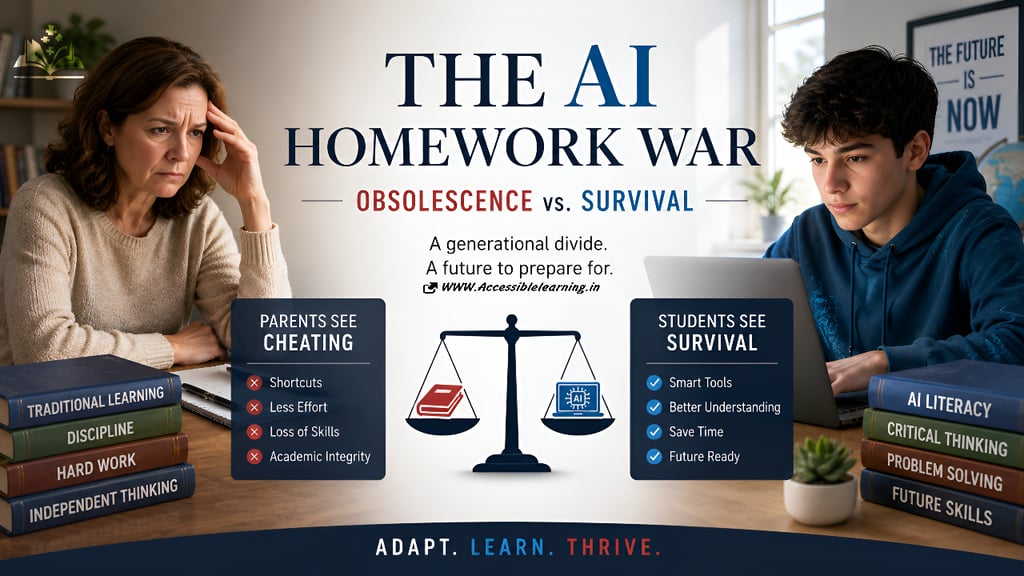
Parents Think It's Cheating. Kids Know It's Survival.
A teenager sits at the kitchen table, staring at a blank document. An essay is due tomorrow. Three other assignments are waiting. Notifications keep appearing on their phone. The pressure is building.
They open an AI chatbot and ask for help organizing their thoughts. A parent walks by, sees the screen, and immediately reacts.
"You're cheating."
The student disagrees.
"I'm just trying to get through my work."
That small disagreement represents one of the biggest educational conflicts of the AI era.
Across homes, schools, and online communities, a new battle is emerging. Parents worry that artificial intelligence is making students dependent, lazy, and incapable of thinking for themselves. Students argue that AI is simply another tool, no different from calculators, search engines, or spell checkers.
Beneath the argument lies a much deeper question:
What does learning actually look like in a world where intelligence is available on demand?
The answer is forcing parents, educators, and students to confront an uncomfortable reality. The educational standards that defined success a decade ago are colliding with a future that values entirely different skills.
This is not just a debate about homework. It is a debate about survival in the age of artificial intelligence.
The Education Model Parents Grew Up With
For most parents, success in school followed a straightforward formula.
You attended class. You listened to the teacher.
You completed assignments independently.
You memorized information. You took exams.
The effort was visible. Learning was often measured by how much work a student could complete without assistance. The process itself became a symbol of character.
If a student spent three hours struggling through math problems, that struggle was viewed as productive. If they wrote an essay entirely on their own, the effort mattered as much as the final grade.
This educational model shaped generations of successful professionals.
The problem is that it was designed for a world where information was scarce.
Today, information is everywhere.
Answers are available instantly. Tutorials exist for nearly every topic. AI can explain concepts, generate examples, and provide personalized assistance within seconds.
When parents see children using these tools, many instinctively interpret it as avoiding work rather than adapting to a new reality. The conflict begins because both generations are operating from different definitions of what meaningful effort looks like.
The Silent Fear Behind the Resistance
Many discussions about AI focus on academic integrity, but another emotional factor often goes unnoticed. For the first time in history, a machine can provide educational support that rivals or exceeds what many adults can offer at home.
A child struggling with algebra can receive detailed explanations at midnight.
A student learning programming can troubleshoot errors instantly.
Someone preparing for an exam can ask unlimited questions without feeling embarrassed or judged.
In many situations, AI becomes the most accessible tutor available.
This creates a subtle discomfort for many parents.
For decades, parents served as educational guides and problem-solvers. Now, children increasingly turn to technology for answers.
The fear is rarely expressed directly. Instead, it often appears as criticism of the tool itself. Parents may worry that AI is replacing effort, but sometimes they are also confronting a more personal realization:
The educational world their children inhabit no longer resembles the one they understand.
That realization can feel unsettling.
Why Students See AI Differently
Students are growing up in an environment that moves faster than any previous generation has experienced.
They are expected to absorb enormous amounts of information, adapt to constant technological change, maintain academic performance, develop digital skills, and prepare for an increasingly uncertain job market.
For many students, AI is not viewed as a shortcut. It is viewed as a necessity.
They use it to:
Understand difficult concepts
Create study plans
Organize research
Review assignments
Improve writing
Debug code
Prepare for exams
From their perspective, AI is helping them manage complexity. The assumption that students use AI simply to avoid work often misses an important reality.
Many are using it because the volume of expectations has become overwhelming. What older generations sometimes interpret as laziness may actually be adaptation.
The student who uses AI to understand a difficult topic still needs to learn that topic. The technology may reduce frustration, but it cannot automatically create understanding.
Learning still requires effort. The difference is that the effort is being directed differently.

The Homework Problem Nobody Wants to Admit
Artificial intelligence has exposed a weakness that has existed within education for years. Many assignments were already focused on repetition rather than genuine learning.
Students have long completed tasks that required them to:
Summarize information
Rewrite existing ideas
Produce predictable essays
Memorize facts
Follow fixed formulas
AI simply revealed how easily these tasks could be automated. This creates an uncomfortable question for educators. If a machine can complete an assignment in thirty seconds, was that assignment measuring meaningful learning in the first place?
The emergence of AI is forcing schools to reconsider what they actually want students to demonstrate. The future of education may depend less on information recall and more on critical thinking, interpretation, creativity, and judgment. These are areas where human intelligence still matters most.
The Workforce Has Already Chosen a Side
While schools continue debating AI policies, the professional world is moving ahead rapidly.
Businesses are integrating AI into daily operations.
Marketing teams use AI for research.
Developers use AI to write and review code.
Designers use AI for ideation.
Analysts use AI to process information faster.
Entrepreneurs use AI to increase productivity.
In many industries, the question is no longer whether employees should use AI.
The question is whether they know how to use it effectively.
This shift has major implications for students.
A graduate entering the workforce in the coming years will likely be expected to collaborate with AI systems rather than avoid them.
Employers increasingly value individuals who can:
Ask effective questions
Evaluate AI-generated content
Verify accuracy
Make strategic decisions
Apply human judgment
Solve complex problems
These skills represent a new form of literacy. The workforce is rewarding orchestration, not just execution.
The New Definition of Hard Work
One reason the AI homework debate feels so intense is because it challenges traditional assumptions about effort.
Historically, effort was measured by time spent.
Longer hours often meant greater dedication.
But technology has repeatedly changed that equation.
A calculator can perform calculations faster than a human.
A spreadsheet can process data faster than manual accounting.
Search engines can retrieve information faster than libraries.
Artificial intelligence is the next step in that progression.
The value is shifting away from producing information and toward directing intelligence.
The student who knows how to ask precise questions, evaluate responses, identify errors, and refine outputs is developing a skill that may become increasingly valuable throughout their career.
Hard work has not disappeared. It has evolved.
When AI Actually Becomes a Problem
None of this means every use of AI is beneficial.
There are legitimate concerns.
Students can become overly dependent on technology.
They can submit AI-generated work without understanding it.
They can avoid difficult learning experiences.
They can lose opportunities to develop independent thinking.
These risks are real.
However, the solution is not blanket prohibition.
Banning AI does not prepare students for a future where AI will be everywhere.
The better approach is teaching responsible usage.
Students should learn how to:
Verify AI outputs
Detect inaccuracies
Challenge assumptions
Cross-check sources
Apply independent reasoning
The goal is not blind trust. The goal is intelligent collaboration.
Bridging the Gap Between Parents and Students
The AI Homework War is often framed as a battle between right and wrong.
In reality, both sides are responding to legitimate concerns.
Parents want their children to develop discipline, resilience, and genuine understanding.
Students want tools that help them navigate an increasingly demanding educational environment.
The conflict becomes productive when both sides recognize that these goals are not mutually exclusive.
AI can support learning without replacing it. Technology can enhance critical thinking when used correctly.
The conversation should move beyond the simple question of whether AI is cheating.
A better question would be:
Is the student learning more effectively because of the technology, or relying on it to avoid learning altogether?
That distinction matters far more than the tool itself.


The Future Belongs to Human-AI Collaboration
Every major technological revolution has triggered fears about declining skills.
Calculators were expected to weaken mathematics. Search engines were expected to weaken memory.
The internet was expected to weaken learning. Instead, society adapted. The skills that mattered evolved.
Artificial intelligence represents another turning point.
Students who refuse to engage with AI may find themselves disadvantaged in a future workplace.
Students who depend on AI for everything may struggle to think independently.
The greatest advantage will belong to those who learn how to combine human judgment with machine capability.
That is the real lesson hidden beneath the AI Homework War.
The debate is not about whether artificial intelligence belongs in education. It already does.
The real challenge is teaching the next generation how to use it wisely.
Because in the years ahead, success may not belong to those who can do everything themselves.
It may belong to those who know how to direct intelligence, human and artificial, toward solving problems that neither could solve alone.
FAQ's
Q: Is using AI for homework considered cheating?
It depends on how the AI is used. Using AI to generate answers and submitting them as original work may violate academic integrity policies. However, using AI to understand concepts, organize ideas, review drafts, or receive explanations is increasingly viewed as a legitimate learning aid. Many educators now focus on whether students understand the material rather than whether AI assisted them during the process.
Q: Does AI help students learn better?
AI can improve learning when used responsibly. It provides instant explanations, personalized tutoring, practice questions, and feedback tailored to a student's needs. However, learning outcomes depend on active engagement. Students who critically evaluate AI-generated responses tend to benefit more than those who simply copy answers.
Q: Will AI replace traditional homework?
AI is unlikely to eliminate homework entirely, but it is changing the purpose of assignments. Schools are increasingly designing tasks that emphasize critical thinking, problem-solving, creativity, discussion, and real-world application rather than simple information recall that AI can easily automate.
Q: What skills should students develop in the age of AI?
Modern students should focus on:
Critical thinking
Problem-solving
Digital literacy
AI literacy
Research and verification skills
Communication
Creativity
Ethical decision-making
These skills help students work effectively alongside AI rather than becoming dependent on it.
Q: Why are many parents concerned about AI in education?
Many parents worry that AI may reduce independent thinking, encourage shortcuts, and weaken foundational learning skills. Some concerns also stem from the rapid pace of technological change and uncertainty about how AI will affect education, careers, and future opportunities.
Q: Can AI replace teachers or tutors?
AI can assist with explanations, practice exercises, and personalized feedback, but it cannot fully replace teachers. Human educators provide mentorship, emotional support, classroom management, real-world experience, and nuanced guidance that current AI systems cannot replicate.
Q: How can students use AI responsibly for schoolwork?
Students can use AI responsibly by:
Asking for explanations instead of direct answers
Verifying information from trusted sources
Using AI to brainstorm ideas
Reviewing and editing their own work
Understanding concepts before submitting assignments
Following school policies regarding AI usage
Q: Is AI literacy becoming an important career skill?
Yes. As AI tools become common across industries, employers increasingly value individuals who can effectively use, evaluate, and manage AI systems. Understanding how to collaborate with AI is quickly becoming as important as computer literacy was in the early digital era.
Q: What is the biggest risk of relying too heavily on AI?
The biggest risk is losing the ability to think independently. Students who depend on AI for every answer may struggle with analysis, creativity, decision-making, and problem-solving. The goal should be to use AI as a tool that enhances learning rather than replaces it.
Q: What is the future of AI in education?
The future of education will likely involve greater integration of AI-powered tutoring, personalized learning paths, automated feedback, and adaptive learning systems. At the same time, schools are expected to place greater emphasis on uniquely human skills such as critical thinking, collaboration, innovation, and ethical judgment.
Subscribe to Frontier Intelligence
All © Copyright reserved by Accessible-Learning Hub
| Terms & Conditions
Accessible Learning Hub — Actionable clarity for high-agency minds.
Weekly breakdowns on AI breakthroughs, capital flow, and human performance systems. Zero fluff.