

The 47-Second Learner: Why Education Must Adapt to the Skimming Generation
Modern students are learning in a world dominated by short-form content and instant information. Discover why traditional education struggles to hold attention, how micro-learning is reshaping classrooms, and what schools must do to engage the skimming generation effectively.
ACCESSIBLE LEARNINGPSYCHOLOGY & COGNITIVE SCIENCE
Shiv Singh Rajput
6/5/20267 min read
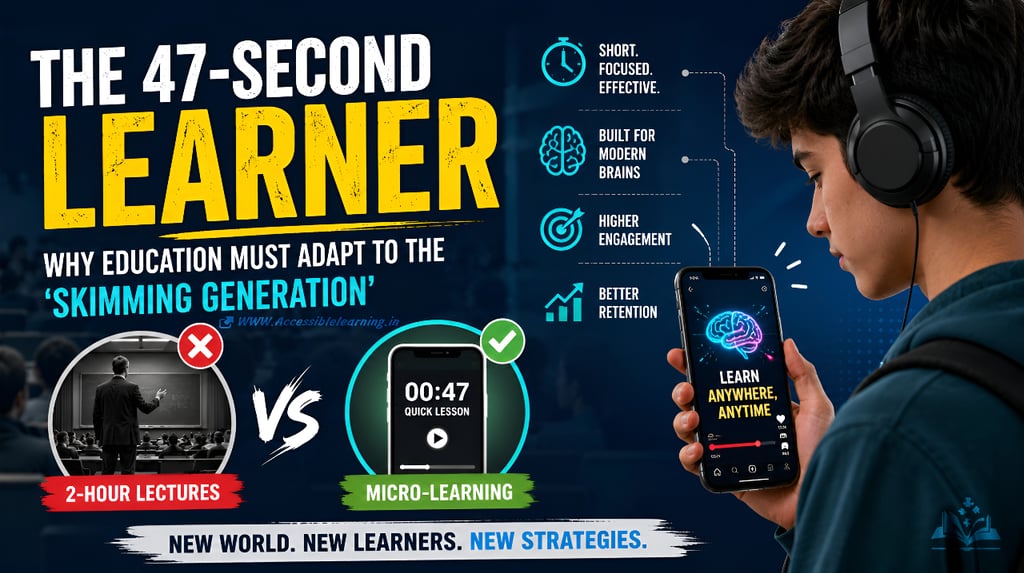
Stop Forcing 2-Hour Lectures on 40-Second Brains
A student opens a lecture video.
Thirty seconds later, they check a notification.
Twenty seconds after that, they switch tabs.
A minute later, they are watching a short video explaining the same concept in less than sixty seconds.
Teachers often interpret this behavior as laziness, lack of discipline, or declining intelligence. But what if the problem is not the learner?
What if the educational system is still designed for a world that no longer exists?
The modern learner grows up surrounded by an endless stream of short-form content. Information arrives in rapid bursts through social media feeds, short videos, interactive apps, podcasts, notifications, and AI-generated summaries. As a result, today's students process information differently than previous generations.
This does not mean they are incapable of deep learning. It means their expectations about how information is delivered have changed.
The challenge facing modern education is clear: stop fighting the reality of shortened attention patterns and start designing learning experiences that work with them. Welcome to the age of the 47-second learner.
The Rise of the Skimming Generation
Never before in human history has information been so abundant.
Students no longer depend solely on textbooks, libraries, or classroom lectures. Answers are available instantly through search engines, AI assistants, educational videos, and online communities.
This abundance has fundamentally altered how people consume knowledge.
Instead of reading every page, learners scan. Instead of watching entire lectures, they search for key moments.
Instead of studying one source deeply, they compare multiple sources quickly.
Researchers often describe this behavior as skimming, but skimming is not necessarily a weakness. It is an adaptation to information overload.
When thousands of pieces of content compete for attention every day, the brain naturally develops filtering mechanisms. The problem arises when educational systems continue expecting students to learn exactly as previous generations did.
Why Traditional Education Is Losing the Attention Battle
Most educational structures were built during an era of information scarcity.
The logic was simple:
Teacher speaks
Students listen
Textbooks provide detailed explanations
Learning happens through extended concentration
For decades, this approach worked because alternative information sources were limited. Today, however, students compare every educational experience against the digital experiences they encounter outside the classroom.
A two-hour lecture competes with:
Interactive learning apps
AI tutors
Educational short videos
Personalized learning platforms
Gamified experiences
Instant search results
The comparison is often unfavorable. Students are not necessarily rejecting learning. They are rejecting inefficient delivery methods.
The Attention Span Debate Misses the Real Issue
A common narrative claims that modern attention spans are shrinking. While attention patterns have certainly changed, the reality is more nuanced.
People routinely spend hours:
Playing video games
Watching streaming content
Following sports events
Participating in online communities
Learning hobbies they enjoy
This suggests that attention itself has not disappeared. Attention has become selective. Modern learners invest attention where they perceive immediate value, relevance, engagement, and reward.
The question is no longer
"How do we force students to focus longer?"
The better question is:
"How do we make learning worthy of their focus?"

Understanding the 47-Second Learning Window
The concept of the 47-second learner represents a broader reality. Many learners now decide within seconds whether content deserves continued attention. This creates a critical educational challenge. The opening moments of a lesson matter more than ever.
Students increasingly expect:
Immediate relevance
Clear outcomes
Fast engagement
Practical applications
Visual stimulation
Interactive participation
If these elements are missing, cognitive disengagement happens quickly. Traditional lectures often spend fifteen minutes introducing a topic before reaching the main point. Modern learners may mentally leave long before then.
What Is Micro-Learning?
Micro-learning is an educational strategy that breaks large subjects into smaller, highly focused learning units. Instead of consuming information in lengthy sessions, learners engage with compact lessons that target specific objectives.
A micro-learning lesson may include:
A three-minute video
A single concept explanation
An interactive quiz
A short infographic
A quick practice exercise
A real-world example
The goal is not to reduce educational quality. The goal is to improve educational accessibility. Micro-learning respects how modern learners naturally consume information while preserving educational depth through structured progression.
Why Micro-Learning Works
1. Reduced Cognitive Overload
The human brain can only process a limited amount of information at one time.
Long lectures often overwhelm learners with excessive details.
Micro-learning reduces mental fatigue by delivering information in manageable portions.
Students focus on understanding one concept before moving to the next.
2. Better Retention
Educational psychology consistently shows that information is remembered more effectively when learning is distributed over time.
This concept, known as spaced learning, aligns naturally with micro-learning models.
Small learning sessions repeated regularly often outperform marathon study sessions.
3. Increased Engagement
Short lessons create frequent moments of achievement.
Each completed lesson provides a sense of progress.
This triggers motivation and encourages continued participation.
The learner feels successful rather than overwhelmed.
4. Greater Flexibility
Modern life is fragmented.
Students balance education with work, family responsibilities, social commitments, and digital distractions.
Micro-learning allows education to fit into available moments.
Learning can occur during:
Commutes
Breaks
Waiting periods
Travel
Short study sessions
Education becomes more accessible because it adapts to real life.
The Myth That Shorter Means Shallower
One criticism of micro-learning is that it encourages superficial understanding. This concern is valid when micro-learning is implemented poorly.
However, effective micro-learning is not about simplifying knowledge.
It is about sequencing knowledge. Consider learning mathematics.
A student does not master calculus through a single two-hour lecture.
They build understanding gradually through interconnected concepts.
Micro-learning follows the same principle.
Complex subjects are divided into logical building blocks that eventually create deep expertise.
The depth remains. The delivery changes.
How AI Is Accelerating the Shift
Artificial intelligence is transforming educational expectations. Students increasingly use AI tools to:
Summarize chapters
Explain difficult concepts
Generate practice questions
Create study guides
Personalize learning pathways
AI delivers information quickly, clearly, and on demand. As these tools become commonplace, educational institutions face increasing pressure to evolve.
Future classrooms may combine:
AI tutoring
Micro-learning modules
Interactive simulations
Personalized lesson paths
Human mentorship
The teacher's role will shift from information delivery toward guidance, critical thinking, and problem-solving.


What Schools and Universities Must Do Next
Educational adaptation requires more than shortening lectures. Institutions should redesign learning experiences around modern cognitive behavior.
Key strategies include:
Modular Curriculum Design
Break large subjects into smaller learning units with clear outcomes.
Interactive Learning
Replace passive listening with participation and engagement.
Frequent Feedback
Provide immediate assessments and progress tracking.
Multimedia Learning
Combine text, visuals, audio, and interaction.
Real-World Relevance
Show learners why concepts matter immediately.
Personalized Learning Paths
Allow students to progress according to their needs and pace.
The Future Learner Will Look Different
The next generation will not learn the same way previous generations did.
That is not a failure. It is an evolution.
Every major communication technology has changed how humans think and learn.
Books changed memory. Television changed information consumption.
The internet changed knowledge access. Short-form digital media is changing attention management.
Educational systems that ignore these shifts risk becoming increasingly disconnected from the learners they serve.
The goal should not be preserving old methods for tradition's sake. The goal should be maximizing learning.
The debate about modern attention spans often focuses on what students have lost. A more productive conversation asks what they have gained.
Today's learners can process information rapidly, navigate multiple sources, adapt quickly, and learn independently in ways previous generations could not.
The challenge is not convincing learners to return to an outdated model.
The challenge is creating educational systems that match the realities of modern cognition.
The 47-second learner is not broken. They are a product of a world overflowing with information.
Education's future depends on recognizing that reality and designing learning experiences that transform short bursts of attention into long-term understanding.
The institutions that embrace micro-learning, personalization, and digital-first education will thrive.
Those that continue forcing two-hour lectures onto forty-second brains may find themselves teaching increasingly empty classrooms.
FAQ's
Q: What is the "47-Second Learner" concept?
The "47-Second Learner" refers to modern learners who make rapid decisions about whether content is worth their attention. Influenced by short-form digital media, they prefer information that is clear, engaging, and immediately relevant. The term highlights changing learning behaviors rather than a decline in intelligence or capability.
Q: Why are traditional lectures becoming less effective for modern students?
Traditional lectures often rely on long periods of passive listening. Today's learners are accustomed to interactive, fast-paced, and personalized content. When educational experiences fail to capture attention quickly, engagement and information retention can decrease significantly.
Q: What is micro-learning in education?
Micro-learning is an educational approach that delivers content in small, focused learning units. These lessons typically target a single concept and can include short videos, quizzes, infographics, interactive exercises, or quick explanations that learners can complete in minutes.
Q: Does micro-learning improve knowledge retention?
Yes. Research in learning science suggests that breaking information into smaller chunks and revisiting concepts over time can improve retention. Micro-learning often aligns with spaced repetition techniques, which help learners remember information more effectively.
Q: Is micro-learning suitable for complex subjects?
Absolutely. Effective micro-learning does not oversimplify complex topics. Instead, it breaks large subjects into structured learning modules that build upon one another. Subjects such as mathematics, science, programming, and medicine can all benefit from a well-designed micro-learning framework.
Q: How has social media influenced modern learning habits?
Social media platforms have trained users to consume information in short, engaging formats. As a result, many learners now expect quick access to valuable information, visual explanations, interactive content, and immediate feedback during the learning process.
Q: What are the benefits of micro-learning for students?
Key benefits include:
Higher engagement levels
Better information retention
Reduced cognitive overload
Flexible learning schedules
Faster skill acquisition
Improved motivation through measurable progress
Q: How can schools adapt to the skimming generation?
Schools can adapt by:
Creating shorter, modular lessons
Using multimedia learning materials
Incorporating interactive activities
Offering personalized learning paths
Providing frequent assessments and feedback
Integrating AI-powered learning tools
Q: What role will artificial intelligence play in future education?
AI is expected to support personalized learning, instant feedback, automated tutoring, adaptive lesson plans, and customized study materials. Rather than replacing teachers, AI will likely enhance learning experiences and allow educators to focus more on mentorship and critical thinking development.
Q: Is the decline in attention span a myth?
The issue is more complex than a simple decline in attention span. Many people can focus for extended periods on activities they find engaging, such as gaming, sports, or hobbies. The real challenge is capturing and maintaining attention in educational environments that compete with highly optimized digital content.
Q: Can micro-learning replace traditional education completely?
No. Micro-learning works best as part of a broader educational strategy. Deep learning, discussion, collaboration, research, and critical thinking still require longer periods of engagement. The most effective educational models often combine micro-learning with more comprehensive learning experiences.
Q: What is the future of education for Generation Alpha and future generations?
The future of education will likely focus on personalized learning, AI-assisted instruction, micro-learning modules, interactive technologies, project-based learning, and flexible educational pathways. Institutions that adapt to modern learning behaviors will be better positioned to prepare students for a rapidly changing world.
Subscribe to Frontier Intelligence
All © Copyright reserved by Accessible-Learning Hub
| Terms & Conditions
Accessible Learning Hub — Actionable clarity for high-agency minds.
Weekly breakdowns on AI breakthroughs, capital flow, and human performance systems. Zero fluff.